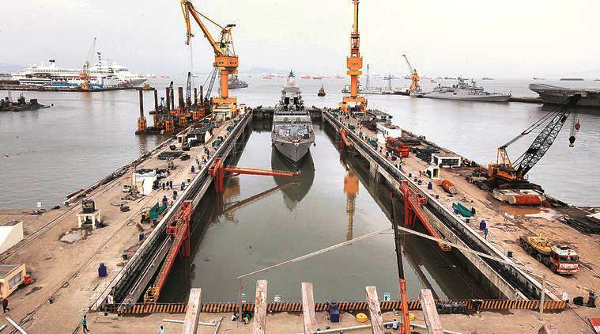
India is moving towards one of the largest naval expansions in its history, with the Indian Navy aiming to operate more than 200 warships and submarines by 2035 while shifting the centre of future naval construction decisively towards Indian shipyards.
Chief of Naval Staff Admiral Dinesh K. Tripathi has said that the Navy is adding an indigenous warship or submarine at an average rate of approximately one every 40 days. He has also stated that all 52 ships presently on order are being constructed in Indian shipyards, underlining how deeply naval modernisation is now tied to India’s Aatmanirbhar Bharat programme.
The long-term objective represents far more than simply increasing the number of hulls at sea. India is attempting simultaneously to expand its combat fleet, replace ageing platforms and build a domestic industrial ecosystem capable of designing, constructing and maintaining increasingly sophisticated naval vessels.
From Around 145 Ships to More Than 200
The Indian Navy currently operates around 145 ships and submarines, according to recent statements cited from the Navy chief. Its 2035 objective would therefore require a substantial net expansion even as older vessels are retired during the coming decade.
Earlier planning figures placed the Navy on a trajectory towards approximately 155–160 vessels by 2030 and 175–200 by 2035. The Navy’s more recent statements increasingly refer to becoming a 200-plus ship force by 2035.
The expansion will encompass a broad range of platforms rather than one particular type of warship.
Future fleet strength will depend on new:
- destroyers and frigates,
- corvettes and anti-submarine vessels,
- conventional and nuclear-powered submarines,
- survey and support ships,
- amphibious platforms,
- mine-warfare vessels,
- unmanned systems and specialised auxiliary craft.
Aircraft carriers and their associated air wings will remain another important element of India’s blue-water naval capability.
Indigenous Shipbuilding Becomes the Foundation
Perhaps the most significant aspect of the 2035 plan is where the ships are being built.
All 52 naval vessels currently on order are being constructed domestically, according to Admiral Tripathi. The Navy ultimately wants self-reliance to move beyond hull construction into propulsion, sensors, weapons, electronics and individual components.
That represents a major change from earlier decades when many of India’s frontline warships were purchased directly from foreign shipyards or depended heavily upon imported designs and equipment.
The transition has already become visible.
In June 2026, Prime Minister Narendra Modi commissioned INS Dunagiri, INS Sanshodhak and INS Agray together in Kolkata. All three were indigenously built, while their construction involved more than 200 Indian MSMEs. The government said the platforms contained over 75% indigenous content.
A few weeks later, the Navy commissioned INS Mahendragiri, the sixth Project 17A Nilgiri-class stealth frigate.
Designed by the Indian Navy’s own Warship Design Bureau and constructed by Mazagon Dock Shipbuilders Limited, Mahendragiri represents the growing maturity of Indian warship design and construction.
Project 17A Shows the Direction
The seven-ship Project 17A Nilgiri-class programme provides a useful example of the type of naval industrial capability India is attempting to establish.
These advanced frigates incorporate improvements in stealth, automation, survivability and firepower compared with earlier Indian designs.
More importantly, they were designed by the Navy’s Warship Design Bureau and constructed at Mazagon Dock Shipbuilders Limited and Garden Reach Shipbuilders & Engineers.
Mahendragiri was delivered only around 17 months after the lead ship of the class, illustrating how serial construction can increasingly reduce delivery intervals once production lines mature.
A continuous order pipeline is therefore critical.
Modern warship construction requires specialised welders, designers, naval architects, electrical engineers, weapon-system integrators and hundreds of component suppliers. Allowing production lines to remain idle between major programmes can cause expertise to disappear.
Reaching the 2035 fleet target will consequently require not only money but continuity in shipbuilding orders.
Smaller Warships Are Arriving in Numbers
The Navy’s expansion is not limited to high-end frigates and destroyers.
India is simultaneously building a substantial force of Anti-Submarine Warfare Shallow Water Craft, designed for detecting and attacking submarines in coastal and relatively shallow waters.
The 77-metre vessels employ waterjet propulsion and are equipped with lightweight torpedoes, indigenous rocket launchers and shallow-water sonar systems.
The recently delivered Agray was built with more than 80% indigenous content, according to the Defence Ministry.
Ships of this category free larger destroyers and frigates from routine coastal anti-submarine duties while creating a denser defensive network around ports, naval bases and maritime approaches.
India is similarly inducting new survey ships and specialised support vessels that form the less visible but essential backbone of a large navy.
Submarines Will Be Critical to the 2035 Fleet
The headline figure of 200 should not be interpreted as referring only to surface warships.
The Navy’s stated objective covers ships and submarines, and expanding India’s underwater force will be one of the most important elements of the programme.
India has already completed the six-boat Kalvari-class programme and is moving towards additional conventional submarine construction.
The proposed Project 75(I) programme envisages six advanced conventional submarines equipped with Air Independent Propulsion, while India is also developing longer-term indigenous submarine programmes.
At the strategic level, nuclear-powered ballistic missile submarines provide the maritime component of India’s nuclear deterrent.
India is also pursuing nuclear-powered attack submarines, which would dramatically extend the Navy’s ability to conduct sustained underwater operations across the wider Indo-Pacific.
A 200-platform Navy without sufficient submarine strength would therefore remain incomplete.
The Indian Ocean Is Driving Expansion
India’s naval build-up also reflects changing strategic geography.
The Navy is responsible for protecting a coastline of approximately 11,098 kilometres, an Exclusive Economic Zone of nearly 2.4 million square kilometres, and sea lanes through which close to 90% of India’s trade by volume moves.
At the same time, the Indian Ocean is becoming increasingly contested.
China possesses the world’s largest navy by number of major platforms and has steadily increased its maritime presence beyond the western Pacific.
Chinese warships, submarines, surveillance vessels and research ships increasingly operate across the Indian Ocean.
Pakistan is meanwhile modernising its own underwater fleet, including new Chinese-designed submarines.
India therefore needs sufficient ships not simply for wartime combat but to maintain continuous presence across an enormous maritime space.
A ship deployed near the Persian Gulf cannot simultaneously monitor the Malacca approaches. A destroyer escorting a carrier cannot also undertake anti-piracy patrols off Africa.
Fleet size therefore matters.
India Wants a Blue-Water Navy
The 200-warship target reflects India’s ambition to sustain a true blue-water navy — a force capable of operating for extended periods far from its home coastline.
Such a Navy requires much more than combat ships.
It requires fleet tankers for replenishment at sea, surveillance aircraft, helicopters, carrier aviation, satellites, secure communications, logistics bases and maintenance infrastructure.
India has already developed a network of maritime partnerships and logistics arrangements that allows its warships to operate over an increasingly large geographical area.
The fleet must be capable of protecting India’s interests from the western Indian Ocean and Persian Gulf to the Bay of Bengal, Andaman Sea and approaches towards the western Pacific.
The 40-Day Shipbuilding Rhythm
One of the most striking indicators of this transformation is the Navy chief’s statement that an indigenous warship or submarine is now being added approximately every 40 days.
The figure does not mean an individual ship can be constructed in 40 days. Major warships still require years from keel laying to commissioning.
Rather, multiple programmes operating simultaneously across Indian shipyards are reaching completion at staggered intervals.
Mazagon Dock in Mumbai, GRSE in Kolkata, Cochin Shipyard, Goa Shipyard and several private-sector companies collectively form an increasingly large naval manufacturing network.
Behind them sits an even larger supplier ecosystem manufacturing pumps, electrical equipment, communications systems, valves, radars, weapons components and specialised machinery.
The 200-warship plan is consequently also an industrial programme.
Indigenous Content Is Moving Deeper
India has already achieved substantial localisation of hull construction and many onboard systems.
The next objective is more difficult: reducing dependence on imported critical components.
Admiral Tripathi has said that self-reliance must move from the platform level towards the component level, with the Navy ultimately seeking a fully Aatmanirbhar force by 2047.
Future indigenous development will therefore increasingly focus on:
marine gas turbines and diesel engines, advanced sonars, AESA radars, electronic warfare systems, missiles, torpedoes, underwater sensors and naval aviation systems.
Building an Indian hull while importing the propulsion system and much of its electronics still leaves strategic dependencies.
The next phase of naval indigenisation is intended to address precisely those gaps.
2035 Will Require Both Expansion and Replacement
Reaching 200 vessels will not simply require adding around 55 ships to today’s fleet.
Several older ships and submarines will retire before 2035.
India must therefore build enough vessels to replace retiring platforms and create additional fleet strength simultaneously.
That makes sustained construction particularly important.
Recent reporting around INS Mahendragiri noted that the Navy is aiming for a record 19 inductions during 2026, following more than a dozen inductions the previous year. It also reiterated the Navy’s intention to reach the 200-warship target principally through Indian shipyards.
Maintaining such momentum across multiple years will determine whether the 2035 target is achieved.
From Imported Ships to an Indian-Built Fleet
The transformation becomes particularly visible when viewed historically.
India has operated warships originating from Britain, Russia, Germany and other overseas suppliers.
Foreign technology will continue to play an important role, especially in propulsion systems and specialised equipment.
But the direction of travel has changed.
The Indian Navy is increasingly becoming a fleet designed, built, integrated and maintained in India.
Projects such as the indigenous aircraft carrier INS Vikrant, Visakhapatnam-class destroyers, Nilgiri-class frigates, Kalvari-class submarines, Arnala-class ASW vessels and Sandhayak-class survey ships have created a much broader domestic shipbuilding foundation.
The 2035 target is essentially an attempt to scale that foundation.
Building Maritime Power at Home
India’s plan for a 200-plus warship and submarine force is therefore much larger than a fleet-expansion programme.
It represents the convergence of naval strategy, defence manufacturing and technological self-reliance.
The Indian Ocean is becoming more strategically important. China’s naval reach is expanding. Pakistan’s submarine fleet is modernising. India’s dependence on maritime trade continues to grow.
Against that background, New Delhi has concluded that maritime power cannot depend indefinitely on imported warships.
The significance of the 2035 objective consequently lies in two numbers:
more than 200 ships and submarines — and an increasingly overwhelming proportion built in India.
If the current shipbuilding tempo can be sustained, the Indian Navy of the mid-2030s could therefore be very different from the force of today: larger, more heavily networked, stronger below the surface and supported by one of the world’s largest indigenous naval shipbuilding ecosystems.
References
Chief of Naval Staff Admiral Dinesh K. Tripathi, November 2025: Navy aims to become a 200-plus ship force by 2035; all 52 ships then on order were being constructed in Indian yards.
Press Information Bureau, June 21, 2026: Commissioning of indigenous INS Dunagiri, INS Sanshodhak and INS Agray; more than 200 MSMEs involved and over 75% indigenous content.
Press Information Bureau, July 2026: INS Mahendragiri commissioning and details of India’s indigenous Project 17A programme.
PIB Backgrounder, July 13, 2026: India’s indigenous Nilgiri, Sandhayak and Arnala classes and the Navy’s role in protecting India’s coastline, EEZ and maritime trade.
India Today, July 11, 2026: Naval induction tempo and the Navy’s objective of reaching around 200 warships by 2035 through domestic shipbuildi
You may also like
-
Bengaluru Startup Astrome Wins Indian Army iDEX Challenge to Develop Indigenous Portable Electronic Intelligence System
-
DRDO’s Shakti Electronic Warfare System: India’s Indigenous Shield Against Radar and Missile Threats at Sea
-
DRDO Develops Generative AI Framework to Improve Military Object Recognition with Limited Training Data
-
Indian Startup Decouvertes Unveils Vision Nano 250g Drone with 25-Minute Flight Endurance
-
Exercise Tarang Shakti 2026 Concludes in Jodhpur, Showcasing India’s Air Power, Indigenous Defence Technology
