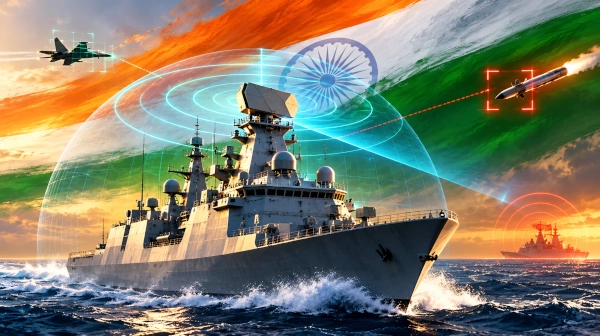
India’s naval modernisation programme has placed increasing emphasis on electronic warfare, an essential capability that enables warships to detect hostile radar activity, identify potential threats and employ electronic countermeasures against enemy surveillance and weapon systems. At the centre of this technological development is Shakti, an indigenous electronic warfare suite designed and developed by the Defence Research and Development Organisation (DRDO) for the Indian Navy’s major surface combatants.
Developed by the Defence Electronics Research Laboratory (DLRL), Hyderabad, Shakti combines advanced Electronic Support Measures (ESM) and Electronic Countermeasures (ECM) to provide naval vessels with an additional layer of protection against radar-guided threats. The system can intercept, detect, classify and identify radar emissions while supporting electronic countermeasures against hostile systems operating in complex electromagnetic environments.
Shakti represents a significant achievement in India’s efforts to develop sophisticated naval electronic warfare technologies domestically. The system has been associated with frontline platforms including INS Visakhapatnam and India’s indigenous aircraft carrier INS Vikrant, while additional installations are planned across major warship programmes.
On February 13, 2024, the Ministry of Defence signed a ₹2,269.54 crore contract with Bharat Electronics Limited (BEL) for 11 Shakti electronic warfare systems, together with associated equipment and accessories. This followed an earlier production programme announced in November 2021, when DRDO confirmed that 12 Shakti systems were under production at BEL with support from more than 50 micro, small and medium enterprises.
The programme reflects India’s increasing ability to develop complex electronic systems involving radar signal interception, threat identification, electronic jamming and electromagnetic intelligence. It also demonstrates the growing partnership between DRDO laboratories, defence public-sector manufacturers, the Indian Navy and domestic industrial suppliers.
Recent defence media reports in October 2026 have suggested that the Navy is considering an additional Shakti installation to replace an older electronic warfare suite aboard an existing warship. Although the reported proposal has not been independently confirmed through an official procurement announcement, it has renewed attention on the strategic importance of Shakti and the Indian Navy’s continuing transition towards indigenous electronic defence capabilities.
What Is the Shakti Electronic Warfare System?
Shakti is an integrated shipborne electronic warfare suite developed to help Indian Navy warships detect and respond to electromagnetic threats. Its primary function is to monitor relevant radar emissions in the surrounding environment, analyse their characteristics and provide capabilities for electronic countermeasures.
Modern naval operations take place in an electromagnetic environment containing signals from shipborne radars, aircraft, coastal surveillance systems and other electronic equipment. Some emissions originate from friendly or neutral platforms, while others may indicate surveillance, target tracking or hostile activity.
A warship must distinguish potentially threatening signals from this background activity to maintain situational awareness. Shakti supports this requirement through electronic surveillance and signal-processing capabilities designed to detect and identify radar emissions.
The Ministry of Defence has described the system as providing an electronic layer of defence against modern radars and anti-ship missile threats. Its capabilities complement other shipboard systems, including surveillance radars, combat management equipment, defensive weapons and countermeasure arrangements.
Shakti does not replace a warship’s physical air-defence weapons. Instead, it contributes to the broader defensive architecture by detecting electromagnetic activity and supporting electronic responses against relevant threats.
DRDO’s Defence Electronics Research Laboratory Developed Shakti in Hyderabad
The Defence Electronics Research Laboratory, located in Hyderabad, is the DRDO establishment responsible for developing Shakti.
DLRL specialises in electronic warfare technologies and systems intended for different military platforms. Its work includes the development of capabilities associated with electronic surveillance, signal interception, electronic countermeasures and specialised equipment for the Armed Forces.
Shakti emerged from India’s efforts to build an indigenous family of electronic warfare systems capable of meeting the operational requirements of modern naval platforms.
Developing such equipment requires expertise across several technological disciplines, including radio-frequency engineering, digital signal processing, antennas, microwave electronics, electronic hardware, software and systems integration.
Radar signals can differ considerably in frequency, pulse characteristics, modulation and operating behaviour. Electronic warfare systems must process these signals accurately while functioning in environments containing multiple simultaneous emitters.
The development of Shakti therefore represents more than the manufacture of a single electronic device. It involves integrating several sophisticated subsystems into an operational suite capable of supporting electronic surveillance and countermeasure functions aboard warships.
DLRL’s work forms part of India’s broader indigenous defence research effort, which seeks to strengthen domestic capabilities in advanced electronic technologies rather than depend entirely on imported systems.
How Electronic Warfare Protects Modern Naval Warships
Electronic warfare involves the military use of electromagnetic energy to obtain information, protect friendly systems and interfere with an adversary’s use of the electromagnetic spectrum.
For a naval vessel, the ability to understand electromagnetic activity in its surroundings can be critical. Modern warships face potential threats from aircraft, missiles, surface vessels and other platforms equipped with sophisticated radar and electronic systems.
Radar emissions can provide information about the presence and activities of such platforms. An electronic warfare receiver may detect these signals without requiring the ship to transmit radar energy of its own, making passive electromagnetic surveillance an important contributor to situational awareness.
Once a signal has been detected, the system can analyse its characteristics to help determine the nature of the emitter. Depending on the available information and the system’s capabilities, this analysis may support classification of the radar and identification of its likely function.
Electronic countermeasures provide a different capability. They seek to interfere with selected hostile electronic systems, potentially reducing the effectiveness of radar surveillance, tracking or guidance under suitable conditions.
These functions are complementary. Electronic surveillance helps a warship understand the electromagnetic environment, while electronic countermeasures provide options for responding to relevant threats.
Shakti combines both elements within an integrated naval electronic warfare suite.
Shakti’s Electronic Support Measures Detect and Identify Radar Emissions
Electronic Support Measures constitute an important component of the Shakti system.
ESM equipment uses receiving systems to detect electromagnetic signals emitted by external sources. Unlike an active radar, which transmits energy and measures reflections, passive electronic surveillance can collect information from emissions produced by other radar systems.
The Ministry of Defence states that Shakti’s ESM component supports the accurate interception and determination of direction of modern radar emissions.
Direction finding is important because it helps identify the bearing from which a signal originates. When combined with other available information, this can assist operators in understanding the distribution of radar emitters around a warship.
The system also performs signal classification and identification. These functions involve analysing characteristics of detected emissions and comparing them with available technical information to help determine the type or function of a radar.
The ability to distinguish radar emissions is particularly valuable in busy maritime environments where many civilian and military electronic systems may be operating simultaneously.
Effective electronic surveillance can contribute to a warship’s broader understanding of its surroundings and support timely assessments when potentially threatening radar activity is detected.
Electronic Countermeasures Provide an Additional Defensive Layer
Shakti incorporates Electronic Countermeasures designed to support the defence of Indian Navy ships against radar-related threats.
Electronic countermeasures involve the controlled use of electromagnetic techniques intended to interfere with an adversary’s electronic systems. Depending on the equipment and circumstances, these techniques may affect radar detection, tracking or other functions.
The Ministry of Defence has specifically identified Shakti’s role in providing protection against modern radars and anti-ship missile threats.
Radar-guided anti-ship missiles present a serious challenge to naval vessels because they can use radar-based sensing or guidance during portions of their flight. Electronic warfare systems can contribute to the ship’s defensive response by supporting the detection and disruption of relevant electromagnetic threats.
However, successful electronic countermeasures depend on several factors, including the characteristics of the opposing radar, environmental conditions and the defensive system’s technical capabilities.
Electronic jamming should therefore not be understood as an absolute guarantee of protection against every radar-guided missile.
For modern warships, electronic countermeasures work alongside other defensive capabilities, including missile systems, guns, surveillance sensors and combat management arrangements. Shakti adds an important electronic component to this layered approach.
Wideband Electronic Warfare Enables Operations in Complex Electromagnetic Environments
The Ministry of Defence has confirmed that Shakti integrates wideband Electronic Support Measures and Electronic Countermeasures.
Wideband capability is important because military radars operate across different portions of the electromagnetic spectrum. An electronic warfare system must be capable of detecting relevant signals across its designed operating range while processing emissions with different characteristics.
The electromagnetic environment surrounding a modern naval vessel can be extremely complex. Military and civilian radars, communication systems and other electronic equipment may operate simultaneously, producing numerous signals that vary in power, frequency and transmission pattern.
Shakti is designed to intercept electronic emissions and implement countermeasures in such dense environments.
The system’s ability to operate under these conditions is an important feature because actual maritime operations rarely involve a single isolated radar emitter.
Reliable electronic surveillance requires signal-processing capabilities that can distinguish relevant emissions from surrounding electromagnetic activity. Countermeasure systems must also operate within the technical limitations and operational requirements of the ship.
Although the Government has confirmed Shakti’s wideband capabilities, detailed operational parameters such as frequency coverage, sensitivity, jammer output and classified threat-response techniques have not been publicly disclosed.
Radar Fingerprinting Helps Identify Electronic Threats
One of the advanced functions officially identified for Shakti is radar fingerprinting.
Radar fingerprinting involves analysing distinctive characteristics of electromagnetic emissions to support the identification of radar systems. Different radars may exhibit particular combinations of frequency, pulse structure, timing, modulation and other signal properties.
By examining these characteristics, electronic surveillance systems can help distinguish between different types of emitters.
Such identification can contribute to situational awareness by providing information about the nature of radar activity detected around a warship.
Modern signal-processing technologies have made it possible to analyse increasingly complex electromagnetic emissions. However, the reliability of identification depends on signal quality, the available reference information and the operating conditions encountered.
The Ministry of Defence has confirmed that Shakti incorporates radar fingerprinting, but it has not publicly disclosed the technical methods or identification libraries used by the system.
The capability represents an important aspect of indigenous electronic warfare development because effective emitter identification requires substantial expertise in radar technology and signal analysis.
Data Recording and Replay Support Post-Mission Analysis
Shakti also incorporates data recording and replay functions, which the Ministry of Defence has identified as part of the system’s capabilities.
These features allow relevant electromagnetic information collected during operations to be recorded and examined subsequently. Post-mission analysis can help specialists review detected radar emissions, evaluate system performance and study the characteristics of the electromagnetic environment encountered.
Recording functions can also support technical assessments and the continued refinement of electronic warfare knowledge.
Such capabilities are valuable because electromagnetic activity may change over time as different radar technologies, operating methods and signal characteristics emerge.
By allowing information to be examined after an operational activity, recording and replay functions contribute to the analytical dimension of electronic warfare.
They also illustrate that a modern EW system is not simply a device for detecting or transmitting electromagnetic signals. It is part of a wider technical process involving observation, analysis and the development of institutional knowledge.
Shakti’s recording and replay capabilities support this broader role within the Indian Navy’s electronic warfare architecture.
Shakti’s First Installation Aboard INS Visakhapatnam
The first Shakti electronic warfare system was installed aboard INS Visakhapatnam, the lead ship of the Indian Navy’s Project 15B guided-missile destroyers.
The Ministry of Defence confirmed this installation on November 18, 2021, shortly before the destroyer’s commissioning on November 21. The announcement marked a major milestone in bringing an advanced indigenous electronic warfare capability into service aboard a frontline Indian warship.
INS Visakhapatnam represents an important development in India’s indigenous warship construction programme. Built by Mazagon Dock Shipbuilders Limited, the destroyer incorporates advanced sensors, missile systems, naval guns, communication equipment and automated ship-management technologies.
The integration of Shakti adds an electronic surveillance and countermeasure capability to the ship’s defensive equipment. While the destroyer’s radar systems provide active surveillance and target-related information, its electronic warfare equipment supports the passive detection of radar emissions and responses to relevant electromagnetic threats.
Modern destroyers must operate in environments where they may encounter aircraft, missiles, hostile surface vessels and other sources of electromagnetic activity. Shakti contributes to the ship’s ability to monitor this environment and supports the broader defensive functions performed by its combat systems.
The installation aboard INS Visakhapatnam established an important operational foundation for the programme and demonstrated India’s ability to integrate an indigenous electronic warfare suite into a sophisticated naval combat platform.
INS Vikrant Selected for Shakti Electronic Warfare Protection
India’s indigenous aircraft carrier INS Vikrant is another major naval platform associated with the Shakti programme.
In its November 18, 2021 announcement, the Ministry of Defence confirmed that Shakti was being installed aboard the carrier. The official statement identified the system as an important component of the Navy’s efforts to equip major warships with indigenous electronic warfare capabilities.
An aircraft carrier performs a different operational role from a destroyer. Its primary function involves operating embarked aircraft while serving as a major component of a naval task group. Protecting such a vessel requires coordination among surveillance systems, defensive weapons, accompanying warships and electronic warfare equipment.
Electronic surveillance can help identify potentially threatening radar activity in the surrounding maritime environment. Electronic countermeasures provide additional defensive options against certain radar-dependent threats.
The inclusion of Shakti in the carrier’s equipment plan therefore reflects the importance of electronic warfare within the protective arrangements of large naval platforms.
INS Vikrant was designed and built in India, with Cochin Shipyard Limited serving as its principal construction yard. The development of indigenous systems for the carrier contributes to the wider objective of strengthening domestic capabilities across shipbuilding, naval electronics and combat-system integration.
The 2021 Ministry of Defence statement confirms Shakti’s installation programme aboard Vikrant. However, it does not provide a detailed public account of the system’s subsequent trials, final configuration or operational performance aboard the carrier.
Shakti Planned for Project 15B, Project 17A and Talwar-Class Follow-On Warships
The Ministry of Defence’s November 2021 announcement identified several major Indian Navy shipbuilding programmes intended to receive Shakti systems.
These included Project 15B destroyers, Project 17A frigates and Talwar-class follow-on ships. The inclusion of different warship classes demonstrates the Navy’s intention to deploy indigenous electronic warfare capabilities across multiple categories of major surface combatants.
Project 15B comprises modern guided-missile destroyers developed as part of India’s indigenous naval construction programme. Their responsibilities include fleet protection, maritime operations and the employment of advanced sensors and weapons against different categories of threats.
Project 17A represents a new generation of Indian-built stealth frigates incorporating modern combat systems and improved ship design. Electronic warfare forms an important part of the defensive equipment required for such vessels.
The Talwar-class follow-on programme involves frigates based on an established naval design. The planned integration of Shakti reflects the Navy’s efforts to incorporate indigenous electronic equipment into different warship platforms, including vessels associated with foreign-origin designs.
Adapting an electronic warfare system to different ships requires engineering work involving equipment installation, power supply, electromagnetic compatibility, antenna placement, cabling and operational interfaces.
Although the Ministry identified these shipbuilding programmes as intended recipients, publicly available information does not establish the completed installation status of Shakti aboard every vessel in these classes.
November 2021: DRDO Hands Over Shakti to the Indian Navy
A major public milestone occurred on November 19, 2021, when Prime Minister Narendra Modi formally handed over the Shakti electronic warfare system to the Indian Navy during the Rashtra Raksha Samarpan Parv programme in Jhansi.
The handover followed the Ministry of Defence’s announcement on November 18, which described Shakti’s capabilities and identified its role in strengthening the electronic defence of major Indian warships.
Defence Minister Rajnath Singh congratulated DRDO, the Indian Navy and industry partners involved in developing the system. He described the achievement as an important step towards greater self-reliance in advanced defence technologies.
The then DRDO Chairman, Dr. G. Satheesh Reddy, also acknowledged the development teams and highlighted Shakti’s contribution to the Navy’s electronic intelligence capabilities.
At the time of the announcement, 12 Shakti systems were under production at Bharat Electronics Limited, supported by more than 50 MSMEs. The Ministry reported the value of that production programme as ₹1,805 crore.
The handover represented the culmination of indigenous research, development and industrial cooperation. It also established Shakti as an important component of India’s naval electronic warfare modernisation effort.
February 2024: Ministry of Defence Signs ₹2,269.54 Crore Shakti Contract
The Shakti programme received another major boost on February 13, 2024, when the Ministry of Defence signed a contract with Bharat Electronics Limited, Hyderabad, for 11 additional Shakti electronic warfare systems and associated equipment.
The contract was valued at ₹2,269.54 crore and placed under the Buy (Indian–Indigenously Designed, Developed and Manufactured), or Indian-IDDM, procurement category.
The Ministry stated that these systems would equip major Indian Navy warships and contribute to strengthening their electronic defence capabilities.
The Indian-IDDM classification is particularly significant because it supports the domestic development and manufacturing of defence equipment rather than relying exclusively on imported finished systems.
The Ministry confirmed that Shakti was capable of intercepting electronic emissions and implementing countermeasures in dense electromagnetic environments. This reinforced its importance as an integrated electronic surveillance and defensive system.
The contract also demonstrated sustained government investment in indigenous naval electronics and provided additional manufacturing opportunities for BEL and its industrial partners.
Officially Confirmed Shakti Programme Milestones
| Date | Development | Officially confirmed details |
|---|---|---|
| November 18, 2021 | Shakti development announced | DRDO confirmed indigenous development by DLRL, Hyderabad |
| November 18, 2021 | First shipboard installation | Shakti installed aboard INS Visakhapatnam |
| November 18, 2021 | Aircraft carrier integration | Installation underway aboard INS Vikrant |
| November 18, 2021 | Production programme | 12 systems under production at BEL, valued at ₹1,805 crore |
| November 19, 2021 | Formal handover | Prime Minister handed over Shakti to the Indian Navy |
| February 13, 2024 | Major procurement contract | 11 Shakti systems ordered from BEL for ₹2,269.54 crore |
| January 30, 2025 | Manufacturing progress disclosed | BEL identified Shakti EW among major projects contributing to execution during the first nine months of FY 2024–25 |
| July 31, 2025 | DRDO programme information updated | DRDO’s SAMUDRIKA records continued to identify Shakti as an indigenous naval EW system |
| October 2026 | Reported new upgrade proposal | Media reported a possible replacement of an older EW suite; official confirmation remains unavailable |
The 2021 and 2024 announcements concern separate procurement disclosures. Their quantities should not automatically be added together to establish the number of delivered or operational systems because public records do not provide a complete reconciliation of contract phases, installations and deliveries.
Bharat Electronics Limited Manufactures Shakti for the Indian Navy
Bharat Electronics Limited is the principal production partner for Shakti, translating DRDO’s electronic warfare research into equipment manufactured for Indian naval platforms.
BEL is a Navratna defence public-sector enterprise with extensive experience developing and manufacturing radar systems, communications equipment, electronic warfare technologies and other advanced electronic systems for the Armed Forces.
Manufacturing an integrated electronic warfare suite requires expertise in precision electronics, radio-frequency components, specialised hardware, software integration, testing and system-level validation.
The relationship between DRDO and BEL allows research and industrial manufacturing capabilities to support the same programme. DRDO contributes technology development and system expertise, while BEL provides production engineering, manufacturing infrastructure and industrial integration.
BEL’s official investor communication dated October 28, 2024, also addressed the Shakti programme. During the company’s conference call, management identified Shakti naval electronic warfare equipment as a programme associated with BEL and DRDO, clarifying its role in the development and production arrangement.
In a subsequent conference call on January 30, 2025, BEL identified Shakti EW among the major projects contributing to execution during the first nine months of the financial year. This provided a further official indication of continuing industrial activity associated with the programme.
The long-term importance of this arrangement extends beyond initial manufacturing. Domestic production capabilities can support future equipment integration, upgrades, maintenance and technical improvements within the Indian defence industrial ecosystem.
More Than 155 Indian Industrial Partners Support the Shakti Programme
The February 2024 Shakti contract highlighted the growing participation of Indian industrial suppliers in advanced defence electronics.
According to the Ministry of Defence, the procurement programme involved more than 155 industry partners, including MSMEs, and was expected to generate approximately 2.5 lakh person-days of employment over four years.
The scale of this industrial participation reflects the complexity of manufacturing modern electronic warfare systems. Such equipment depends on numerous specialised components, electronic assemblies, mechanical structures, connectors, power systems and supporting technologies.
Smaller enterprises contribute to defence manufacturing by supplying specialised components, undertaking precision production and supporting testing or integration activities within larger industrial programmes.
The participation of domestic suppliers can help strengthen manufacturing capabilities and create experience in demanding defence-quality requirements.
For India’s defence industry, the Shakti programme provides an example of how government-funded research can support wider industrial development when technologies move into production.
It also demonstrates that self-reliance in sophisticated military systems requires more than the capabilities of a single laboratory or manufacturer. Sustained progress depends on an integrated network of research institutions, major producers and specialised industrial suppliers.
Programme SAMUDRIKA: DRDO’s Family of Indigenous Naval Electronic Warfare Systems
Shakti forms part of Programme SAMUDRIKA, a DRDO initiative intended to develop a family of seven electronic warfare and electronic support systems for different Indian Navy platforms.
According to DRDO’s official Defence Electronics Research Laboratory records, the programme covers shipborne and airborne electronic warfare applications.
The three shipborne systems identified under SAMUDRIKA are Shakti, Nayan and Tushar. The four airborne systems are Sarang, Sarakshi, Sarvadhari and Nikash.
These systems reflect the different electronic surveillance and warfare requirements of surface vessels, helicopters and aircraft.
Shipborne electronic warfare equipment must operate within the electrical, mechanical and electromagnetic environment of naval vessels. Airborne systems face different restrictions involving aircraft weight, available space, power consumption and integration with aviation equipment.
By developing a family of specialised electronic warfare technologies, DRDO seeks to address multiple operational requirements through indigenous research and engineering capabilities.
The official SAMUDRIKA programme entry, updated on July 31, 2025, records Indian Navy orders for 12 Shakti systems and seven Nayan systems.
This information confirms the programme’s continuing relevance, although it does not establish the final delivery status of all previously announced Shakti procurements.
Shakti and India’s Transition from Earlier Naval Electronic Warfare Systems
The Ministry of Defence stated in November 2021 that Shakti would replace earlier-generation electronic warfare systems used by the Indian Navy.
Modernisation of electronic warfare equipment is important because radar technology continues to evolve. Contemporary radar systems may incorporate advanced signal-processing techniques, electronically scanned antennas, different emission patterns and improved resistance to interference.
Electronic surveillance systems must consequently remain capable of detecting and analysing increasingly complex electromagnetic signals.
Replacing older equipment with newer systems can improve a warship’s access to modern processing capabilities, updated electronic hardware and improved operator interfaces, depending on the equipment involved.
The Indian Navy’s transition towards Shakti reflects the importance of maintaining electronic warfare capabilities suited to contemporary maritime operations.
The programme also supports greater standardisation of indigenous equipment across different warship classes, potentially improving the availability of domestic technical support and future upgrade options.
However, public information does not establish the exact performance differences between Shakti and every earlier naval electronic warfare system. Such comparisons would require detailed technical information that the Ministry of Defence has not publicly released.
October 2026 Reports Suggest Additional Shakti Upgrade for Existing Warship
Recent defence media reports have suggested that the Indian Navy is considering the procurement of another Shakti electronic warfare suite to replace an older Ellora Mk-II system aboard an existing warship.
Reports published between October 9 and October 12, 2026, describe a proposed single-tender procurement involving Bharat Electronics Limited.
According to these accounts, the proposed equipment would reportedly be delivered to the Weapon Equipment Depot at Visakhapatnam within an indicated period of 18 months.
Some reports have suggested that the intended recipient could be a Shivalik-class frigate associated with the Eastern Fleet.
However, no corresponding official Ministry of Defence, DRDO or BEL announcement was identified confirming the reported October 2026 proposal, the specific recipient ship or the award of a new contract.
The reported development must therefore be distinguished from the officially confirmed Shakti programme and its established procurement history.
A Request for Proposal, even when formally issued, represents a stage in the procurement process rather than proof that a contract has been signed or equipment delivered.
The confirmed programme already establishes the Indian Navy’s commitment to Shakti through the 2021 production arrangements and the ₹2,269.54 crore contract signed in February 2024.
Electronic Warfare Strengthens the Survivability of Naval Task Groups
The importance of shipborne electronic warfare extends beyond the protection of an individual vessel.
Major naval warships frequently operate alongside other platforms as part of coordinated maritime formations. These formations may include destroyers, frigates, aircraft carriers, helicopters and supporting vessels, each contributing different surveillance and defensive capabilities.
An electronic warfare-equipped ship can collect information about relevant radar emissions in its surrounding environment. That information may contribute to the broader tactical picture when integrated through the ship’s approved operational systems and procedures.
Electronic countermeasures can also support the defence of a ship against selected radar-related threats, complementing the protective capabilities provided by accompanying vessels and other defensive systems.
For aircraft carrier groups, electronic surveillance and countermeasure capabilities are particularly important because carriers represent valuable maritime assets whose protection depends on multiple defensive layers.
The development of indigenous shipborne EW systems therefore contributes to the Indian Navy’s wider objective of strengthening maritime situational awareness and fleet survivability.
Shakti’s confirmed installation and planned deployment aboard major naval platforms reflect this broader operational requirement.
Shakti Complements Naval Air-Defence Missiles and Combat Management Systems
Modern naval defence depends on several different systems working together to detect, assess and respond to threats.
Shipborne surveillance radars provide active detection capabilities, while combat management systems organise information and support the employment of available defensive equipment.
Surface-to-air missile systems and naval guns provide physical interception capabilities against applicable threats. Electronic warfare systems contribute a different layer by monitoring electromagnetic activity and supporting electronic countermeasures.
These functions address different aspects of the same defensive challenge.
For example, a ship’s electronic surveillance equipment may detect radar emissions relevant to its threat assessment. Its other sensors and combat systems provide additional information that can support the overall operational picture.
Where technically and operationally appropriate, electronic countermeasures may complement physical defensive systems by attempting to interfere with radar-dependent functions.
The Ministry of Defence has confirmed Shakti’s integration of ESM and ECM capabilities, but it has not publicly detailed its classified interfaces with every shipboard combat system.
Nevertheless, its role as an additional electronic layer is consistent with the broader architecture of modern naval defence.
Indigenous Electronic Warfare Reduces Dependence on Foreign Technology
Electronic warfare is among the more technologically demanding areas of defence research because it involves specialised knowledge of electromagnetic signals, radar behaviour, advanced electronics and signal-processing techniques.
Dependence on imported electronic warfare equipment can create challenges involving maintenance, upgrades, technical documentation and access to certain sensitive technologies.
Indigenous development provides greater opportunities for domestic institutions to acquire the scientific and engineering expertise required to design and improve such systems.
Shakti demonstrates this approach through the participation of DRDO’s Defence Electronics Research Laboratory, Bharat Electronics Limited and a network of Indian industrial suppliers.
The programme contributes to domestic capabilities in electronic surveillance, radar signal analysis, electronic countermeasures and complex naval systems integration.
It also provides an established industrial foundation from which future generations of naval electronic warfare technologies can be developed.
Although indigenous design and manufacturing do not automatically establish complete domestic sourcing of every component, they represent important steps towards strengthening control over critical technological capabilities.
Electronic Warfare Will Remain Central to the Future of Naval Combat
The electromagnetic environment has become increasingly important in modern maritime operations as aircraft, missiles, ships and surveillance systems incorporate more sophisticated electronic technologies.
Radar systems continue to evolve through improvements in antennas, digital processing, signal generation and electronically controlled scanning. These developments create corresponding requirements for electronic surveillance and countermeasure technologies.
Future naval electronic warfare systems will need to process complex signal environments while maintaining reliability under demanding operational conditions.
Advances in computing, digital signal processing and software-defined technologies may provide opportunities for improving electronic surveillance and analysis. Artificial intelligence and machine learning are also being investigated internationally for certain signal-processing and classification applications.
However, publicly available official information does not establish that Shakti currently incorporates artificial intelligence-based autonomous threat assessment or other specific technologies beyond those confirmed by DRDO and the Ministry of Defence.
The established programme demonstrates India’s ability to develop integrated naval electronic warfare equipment, providing an important foundation for continued research and future improvements.
Shakti Demonstrates India’s Growing Strength in Advanced Naval Defence Electronics
The Shakti electronic warfare system represents a significant achievement in India’s efforts to develop sophisticated naval technologies through indigenous research and manufacturing.
Designed by DRDO’s Defence Electronics Research Laboratory and manufactured through Bharat Electronics Limited, the system provides capabilities involving radar emission interception, detection, classification, identification and electronic countermeasures.
Its radar fingerprinting, wideband electronic support and data recording functions contribute to the Indian Navy’s ability to understand and respond to complex electromagnetic environments.
The installation aboard INS Visakhapatnam, the confirmed integration programme for INS Vikrant and planned deployment across major warship classes demonstrate the importance attached to Shakti within India’s naval modernisation efforts.
The ₹2,269.54 crore procurement contract signed in February 2024 further reinforces the programme’s industrial significance, while participation by more than 155 companies and MSMEs highlights its contribution to India’s defence manufacturing ecosystem.
Shakti also occupies an important place within DRDO’s broader Programme SAMUDRIKA, which seeks to provide indigenous electronic warfare capabilities for different naval platforms.
As modern maritime operations place increasing demands on electromagnetic surveillance, electronic protection and sophisticated combat systems, India’s investment in these technologies strengthens an essential area of defence preparedness.
Shakti is more than an indigenous electronic warfare suite. It represents the integration of Indian scientific expertise, naval operational requirements and domestic manufacturing capabilities into a sophisticated defence technology programme.
The continued development, production and integration of such systems will strengthen India’s technological self-reliance while supporting the Indian Navy’s long-term modernisation and maritime security objectives.
References
1. Press Information Bureau, Ministry of Defence, Government of India
Prime Minister to Formally Handover DRDO Designed and Developed Advanced Electronic Warfare Suite ‘Shakti’ for Indian Naval Ships to Chief of Naval Staff
Published: November 18, 2021
Release ID: 1773020
https://www.pib.gov.in/Pressreleaseshare.aspx?PRID=1773020
2. Press Information Bureau, Ministry of Defence, Government of India
MoD Inks Contract Worth Rs. 2269.54 Cr with BEL to Procure 11 Shakti Electronic Warfare Systems for Indian Navy
Published: February 13, 2024
Release ID: 2005641
https://www.pib.gov.in/PressReleasePage.aspx?PRID=2005641
3. Defence Research and Development Organisation
Defence Electronics Research Laboratory, Hyderabad
Programme SAMUDRIKA — Indigenous Naval Electronic Warfare Systems
Last updated: July 31, 2025PressReleasePage
https://drdo.gov.in/drdo/technology-cluster-links/labs-products-detail/2134/188
4. Bharat Electronics Limited
EW Suite for Large Warship — Integrated Electronic Warfare Systems
Official product information.
https://bel-india.in/product/ew-suite-for-large-warship/
5. Bharat Electronics Limited
Transcript of Conference Call Held on October 28, 2024
Official investor communication discussing naval electronic warfare programmes.
https://bel-india.in/wp-content/uploads/2024/10/Transcript-of-the-conference-call-held-on-28.10.2024.pdf
6. Bharat Electronics Limited
Conference Call Transcript — January 30, 2025
Official investor communication identifying Shakti EW among major projects under execution.
https://bel-india.in
7. Press Information Bureau, Ministry of Defence
INS Visakhapatnam and Indigenous Naval Modernisation
Official information on Project 15B destroyers and associated combat capabilities.
https://www.pib.gov.in/PressReleasePage.aspx?PRID=1772352
8. Press Information Bureau, Ministry of Defence
DRDO’s Indigenous Defence Technologies and Shakti Electronic Warfare System
Official review of DRDO achievements, December 2021.
https://www.pib.gov.in/PressReleasePage.aspx?PRID=1786640
You may also like
-
GHCL Begins Production at 2,800-Tonne Bromine Manufacturing Facility in Gujarat
-
Bengaluru Startup Astrome Wins Indian Army iDEX Challenge to Develop Indigenous Portable Electronic Intelligence System
-
DRDO Develops Generative AI Framework to Improve Military Object Recognition with Limited Training Data
-
BHEL Awards ₹52.68 Crore Indigenous Gas Turbine Component Contract to Azad Engineering
-
Indian Startup Decouvertes Unveils Vision Nano 250g Drone with 25-Minute Flight Endurance
