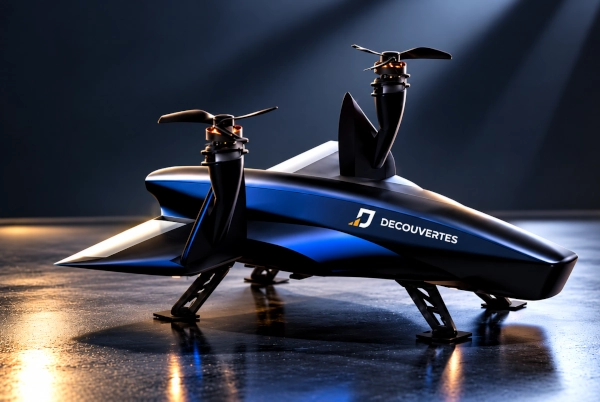
Indian drone technology startup Decouvertes Future Tech Private Limited, based in Pune, Maharashtra, has unveiled its upcoming Vision Nano unmanned aerial vehicle (UAV), a compact drone weighing approximately 250 grams and designed for lightweight aerial applications. The indigenous platform features a 20-megapixel camera, a claimed flight endurance of 25 minutes and an operational range of 5 kilometres.
The company introduced Vision Nano through its official communication channels in October 2026, highlighting its lightweight construction, portability and indigenous engineering. The development adds another platform to India’s expanding private-sector drone ecosystem, where domestic companies are designing unmanned aircraft for commercial, industrial, surveillance and training applications.
Decouvertes has positioned Vision Nano as a compact aerial system suited to video recording, recreational flying and pilot training. Although its small dimensions could make it relevant to certain observation applications, the company has not officially confirmed its deployment or selection for Indian military or Special Forces operations.
The announcement reflects the increasing participation of Indian startups in developing specialised unmanned aerial systems under the country’s broader emphasis on indigenous technological innovation and defence manufacturing.
Vision Nano Combines Lightweight Design with Aerial Imaging Capabilities
The Vision Nano has been developed as a compact UAV intended to provide aerial imaging capabilities without requiring a large aircraft or extensive support equipment. Its lightweight design makes portability an important feature, allowing the system to be carried and handled more easily than larger multirotor platforms.
According to specifications published by Decouvertes, the aircraft weighs 250 grams and incorporates a 20-megapixel camera. The manufacturer claims that the drone can remain airborne for up to 25 minutes and operate over a range of 5 kilometres, providing a combination of mobility, endurance and imaging capability.
The aircraft’s compact configuration could make it useful for applications where operators require a small aerial platform that can be transported conveniently and deployed for short-duration observation or recording tasks. However, actual flight performance will depend on operational conditions, including wind, temperature, battery characteristics and mission requirements.
Decouvertes has presented Vision Nano as an upcoming product. Its published specifications describe the proposed standard configuration, but independent flight-test results and detailed performance validation have not yet been made publicly available.
Vision Nano Technical Specifications and Features
The manufacturer’s official product information identifies the following specifications for the Vision Nano UAV.
| Parameter | Company-published specification |
|---|---|
| Product | Vision Nano |
| Manufacturer | Decouvertes Future Tech Private Limited |
| Country of development | India |
| Drone category | Nano-class UAV |
| Weight | 250 grams |
| Flight endurance | Up to 25 minutes |
| Operational range | 5 kilometres |
| Camera | 20 megapixels |
| Primary applications | Video recording, recreational flying and pilot training |
| Development status | Upcoming product |
| Commercial launch date | Not announced |
The combination of a 250-gram weight, 25-minute endurance and 20-megapixel camera represents the principal features highlighted by the company. These specifications indicate the design objectives of the platform rather than independently demonstrated operational performance.
The manufacturer has not yet published complete information concerning maximum flight altitude, flight speed, battery capacity, communication frequencies, environmental protection or wind resistance. Details about the aircraft’s navigation architecture, autonomous functions and data-link security have also not been specified in its official Vision Nano product description.
20-Megapixel Camera Designed for Aerial Observation and Recording
The Vision Nano incorporates a 20-megapixel imaging system intended for capturing aerial photographs and video. High-resolution cameras enable small UAVs to collect visual information from elevated positions, making them useful for documenting locations, examining objects and recording activities that are difficult to observe from ground level.
In a compact drone, the camera must operate within strict limits on weight, power consumption and available space. Integrating an imaging system into a lightweight airframe therefore requires careful consideration of the aircraft’s overall design and energy requirements.
Decouvertes identifies video recording as one of the drone’s primary applications. The camera could also support general visual inspection and observation tasks, depending on the capabilities of the final production configuration.
However, the company has not disclosed whether Vision Nano includes mechanical camera stabilisation, optical zoom, thermal imaging or specialised image-processing capabilities. The published 20-megapixel specification describes image resolution and should not be interpreted as confirmation of these additional features.
Claimed 25-Minute Flight Endurance Supports Short-Duration Aerial Missions
Flight endurance is an important performance characteristic for small unmanned aerial vehicles because their limited dimensions restrict the capacity of onboard batteries.
Decouvertes claims that Vision Nano can achieve a flight duration of up to 25 minutes. If demonstrated under practical operating conditions, this endurance would allow the aircraft to undertake short-duration recording, observation and training activities without frequent battery replacement.
Achieving useful endurance in a compact drone requires a balance between airframe weight, propulsion efficiency, battery capacity and electrical power consumption. Additional equipment and demanding weather conditions can reduce the time available for flight.
The company’s stated operational range of 5 kilometres also suggests an emphasis on providing greater operating flexibility than would be available from a drone restricted to very short distances. Nevertheless, the published material does not specify the conditions under which this range was determined or whether it represents a communication limit or another operational measurement.
Both endurance and range figures remain manufacturer-stated specifications until supported by publicly available independent testing.
Compact Drone Design Offers Potential for Surveillance and Inspection
Small unmanned aerial systems are increasingly used for activities requiring rapid access to aerial imagery. Their portability makes them particularly useful where larger aircraft would be unnecessary or difficult to transport.
A lightweight drone can support visual inspection of buildings, industrial equipment, agricultural areas and other locations where aerial observation offers practical advantages. Compact aircraft can also serve as training platforms for operators developing experience in flight control and aerial imaging.
The Vision Nano’s combination of small size and onboard camera could make it relevant to some of these applications. However, its suitability for specific tasks would depend on flight stability, camera performance, environmental tolerance and the capabilities of its control system.
While media reports have described the aircraft as suitable for Special Forces, the company’s official product documentation presently lists video recording, recreation and pilot training as its intended applications. No official Indian defence procurement, military evaluation or operational deployment of Vision Nano has been confirmed.
Decouvertes Future Tech Develops Indigenous UAV Platforms in Pune
Decouvertes Future Tech Private Limited is an Indian engineering and drone technology company headquartered in Pune, Maharashtra. Founded in 2023, the company works in unmanned aerial systems, product engineering, prototyping and advanced manufacturing.
The startup focuses on developing UAV platforms for applications ranging from training and industrial inspection to defence-related requirements. Its official website identifies indigenous engineering as an important part of its development approach, with work covering airframes, flight-control systems, communications and ground-control software.
Decouvertes states that its engineering, prototyping and validation activities are conducted in India. The company also identifies itself as a startup recognised under the Government of India’s Startup India initiative.
Vision Nano forms part of the company’s wider efforts to develop unmanned systems with different operational characteristics. By offering platforms ranging from small quadcopters to larger specialised aircraft, the startup seeks to address varied requirements within India’s developing drone technology market.
Vision Nano Joins Company’s Expanding Indigenous Drone Portfolio
The Vision Nano is one of several unmanned platforms developed or presented by Decouvertes. Its existing Vision series includes aircraft designed for different applications, payload requirements and operating environments.
The company’s Vision 1.0 is a quadcopter associated with drone pilot training and related applications. Vision 2.0 is a heavier multirotor platform intended for more demanding operational requirements, while Vision 3.0 combines vertical take-off and landing capabilities with fixed-wing flight.
Decouvertes has also developed Vision 4.0, a coaxial multirotor platform designed to carry larger payloads. The different configurations demonstrate the company’s interest in developing aircraft tailored to distinct mission profiles rather than relying on a single UAV design.
Vision Nano occupies the lightweight end of this product range. Its proposed characteristics emphasise compact dimensions, portability and aerial imaging rather than the heavier payloads and specialised capabilities associated with the company’s larger systems.
The expansion of such product portfolios illustrates how Indian UAV developers are exploring different segments of the unmanned aviation market, from introductory training platforms to more advanced industrial and defence-oriented aircraft.
Lightweight UAV Development Supports India’s Indigenous Drone Ecosystem
India’s unmanned aerial systems industry has expanded through growing participation by startups, engineering enterprises, research institutions and established defence manufacturers. Companies are developing technologies covering aircraft structures, propulsion, flight-control systems, sensors, software and communications equipment.
Small drones represent an important segment of this ecosystem because they provide opportunities for companies to refine aircraft design, manufacturing techniques and electronic integration. Their development also supports practical experience in aerodynamics, energy management, flight stability and embedded systems.
Indigenous engineering capabilities can contribute to the availability of domestically developed products and improve the ability of companies to adapt aircraft to local requirements. However, the extent of domestic content must be evaluated separately for individual components and systems.
Decouvertes describes Vision Nano as an India-made UAV developed through indigenous engineering and equipment. The company has not published a detailed component-level breakdown establishing the origin of every subsystem used in the aircraft.
The development nevertheless reflects the broader contribution of Indian startups to the country’s growing technological capabilities in unmanned aviation.
Drone Pilot Training Offers an Important Application for Vision Nano
Pilot training is among the applications specifically identified by Decouvertes for Vision Nano. Compact multirotor aircraft can provide a practical introduction to UAV operation, helping trainees understand aircraft orientation, flight control, manoeuvring and safe operating procedures.
Training with small drones allows new operators to develop familiarity with the relationship between pilot commands and aircraft movement. Such experience provides a foundation for progressing towards more complex unmanned aerial systems.
The availability of domestically developed training platforms can also support organisations seeking equipment suited to their instructional requirements. Engineering institutions, drone training centres and other educational organisations may benefit from access to small aircraft that allow practical instruction alongside classroom learning.
For Vision Nano, its value as a training system will depend on the final configuration, including flight-control features, safety provisions, maintenance requirements and available support equipment. The company’s stated focus on training indicates one of the intended markets for the aircraft.
Potential Defence Applications Require Further Testing and Validation
Compact UAVs have attracted interest internationally because of their ability to provide aerial observation with relatively limited logistical requirements. Their small dimensions can make them useful in situations where portability and rapid deployment are important.
However, a commercial or general-purpose miniature drone does not automatically meet the requirements of military operations. Defence applications may demand specialised capabilities involving secure communications, resistance to electronic interference, environmental durability, reliable navigation and integration with operational procedures.
Such requirements can be particularly demanding for lightweight platforms because additional equipment increases power consumption and aircraft weight. Engineering trade-offs therefore become important when adapting small drones for specialised tasks.
Decouvertes has experience developing other UAV platforms for defence-related applications, but this does not establish that Vision Nano has completed military qualification or been selected by a defence organisation.
Any future military application would require appropriate technical evaluation and validation against the requirements of the intended user.
Vision Nano Remains an Upcoming Product
Although Decouvertes has publicly introduced Vision Nano and published its principal specifications, the company has not announced a confirmed commercial release date.
The official product page identifies the aircraft through a concept rendering, while the company’s public announcement describes it as an upcoming product. These materials establish the manufacturer’s development plans but do not independently confirm completed production or operational trials.
Further information about flight testing, production readiness, commercial pricing and availability will be important for assessing the platform’s progress towards market introduction.
The company has also not published detailed information concerning manufacturing capacity, production quantities or confirmed customer orders for Vision Nano.
As development progresses, demonstrated endurance, camera performance, flight stability and reliability will provide a clearer indication of the aircraft’s suitability for its intended applications.
Vision Nano Highlights Growing Role of Indian Startups in UAV Innovation
The unveiling of Vision Nano adds another indigenous platform to India’s expanding unmanned aerial technology landscape. With its claimed 250-gram weight, 25-minute flight endurance, 5-kilometre range and 20-megapixel camera, the aircraft represents Decouvertes Future Tech’s entry into the compact UAV segment.
The development highlights the opportunities available to Indian engineering startups in creating specialised drones for aerial imaging, pilot training and other lightweight applications. It also reflects the increasing importance of domestic research, product development and technological expertise within India’s UAV industry.
While the manufacturer’s announced specifications are promising, further testing and technical disclosures will be necessary to establish the aircraft’s operational performance and commercial readiness.
By developing compact unmanned platforms alongside larger specialised aircraft, Indian startups such as Decouvertes are contributing to the country’s growing UAV engineering capabilities and strengthening the foundation for indigenous innovation in aerospace technology.
The continued development of such platforms can expand domestic expertise in aircraft design, electronics, software integration and unmanned aviation, supporting India’s long-term ambition to build a competitive and technologically capable drone manufacturing ecosystem.
References
1. Decouvertes Future Tech Private Limited
Vision Nano — Official Product Specifications
Manufacturer’s product information, 2026.
https://www.decouvertes.in/products/vision-nano.html
2. Decouvertes Future Tech Private Limited
Official Product Portfolio — Vision Series UAV Platforms
https://www.decouvertes.in/products/index.html
3. Decouvertes Future Tech Private Limited
Official Company Announcement — Introducing Vision Nano
Company LinkedIn page, October 2026.
https://www.linkedin.com/company/decouvertes-future-tech-private-limited/
4. Decouvertes Future Tech Private Limited
Company Overview and Indigenous UAV Development
https://www.decouvertes.in/
5. IDRW
Indian Startup Unveils Vision Nano 250g UAV for Special Forces
Published: October 11, 2026.
https://idrw.org/vision-nano-uav-250g-india-decouvertes/
6. Convergence Now
Indian Startup Unveils Vision Nano 250g UAV for Special Forces, Claims 25-Minute Flight Time
Published: October 12, 2026.
https://www.convergence-now.com/startup/indian-startup-unveils-vision-nano-250g-uav-for-special-forces-claims-25-minute-flight-time/
You may also like
-
DRDO Develops Generative AI Framework to Improve Military Object Recognition with Limited Training Data
-
BHEL Awards ₹52.68 Crore Indigenous Gas Turbine Component Contract to Azad Engineering
-
Exercise Tarang Shakti 2026 Concludes in Jodhpur, Showcasing India’s Air Power, Indigenous Defence Technology
-
Indian Navy Vice Chief Inspects Japan’s Mogami-Class Stealth Frigate as India-Japan Shipbuilding Cooperation Expands
-
India and Russia Explore Joint Icebreaker Construction as Maritime Industrial Cooperation Expands
