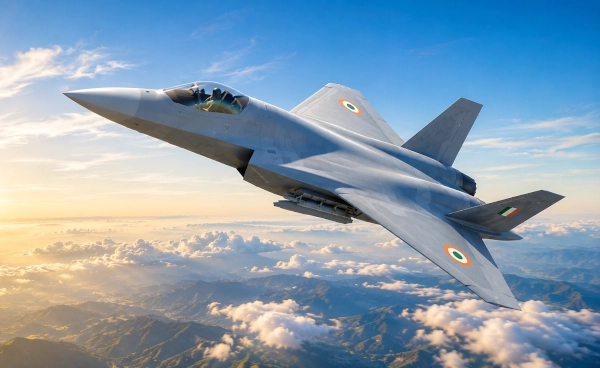
India has formally intensified efforts to participate in the Future Combat Air System (FCAS) programme, signalling its intention to gain access to technologies that will define the next generation of aerial warfare.
The Ministry of Defence has informed the Parliamentary Standing Committee on Defence that it has initiated “concerted” efforts to co-join the sixth-generation fighter development programme. The latest disclosure marks a progression from India’s earlier consideration of both Europe’s FCAS and the UK-Italy-Japan Global Combat Air Programme (GCAP).
What Is FCAS?
FCAS is being developed by France, Germany and Spain as a future networked air-combat ecosystem. At its centre is the Next Generation Fighter (NGF), but the programme goes considerably beyond building a single aircraft.
The future fighter is intended to operate alongside unmanned Remote Carriers, advanced sensors, electronic-warfare systems and other assets connected through a digital Combat Cloud. The concept reflects the direction of sixth-generation warfare, where aircraft, drones and sensors operate as an integrated network rather than as isolated platforms.
Beyond AMCA
India’s interest in FCAS does not replace the indigenous Advanced Medium Combat Aircraft (AMCA) programme. AMCA is being developed as India’s fifth-generation stealth fighter, while participation in a sixth-generation programme would provide a pathway towards technologies required for the generation beyond it.
Chief of Defence Staff General Anil Chauhan had earlier told the parliamentary committee that India needed to engage with one of the international sixth-generation programmes to ensure that it did not fall behind as advanced combat-air technologies evolved.
Potential areas of interest could include next-generation stealth, artificial intelligence, advanced electronic warfare, manned-unmanned teaming, high-performance propulsion, networked sensors and collaborative combat aircraft.
A Major India-France Defence Opportunity
India had already explored possible participation in FCAS during discussions with France earlier in 2026, including possibilities for co-development and co-manufacturing.
The latest parliamentary disclosure indicates that those discussions are developing into a more focused government effort.
If India ultimately joins FCAS with a substantial technology and development role, it could become one of the most ambitious Indo-European aerospace collaborations undertaken so far.
For the Indian Air Force, the strategy would effectively create a two-stage technological progression: develop AMCA as an indigenous fifth-generation fighter while simultaneously building access to sixth-generation technologies for the decades beyond 2040.
The Standing Committee has consequently urged the government to establish a clear roadmap for the development and acquisition of sixth-generation combat-air capabilities.
India is therefore looking beyond simply purchasing the next fighter aircraft. The larger objective is to secure a place in the development ecosystem that will shape air combat after the fifth-generation era.
You may also like
-
Indian Navy Vice Chief Inspects Japan’s Mogami-Class Stealth Frigate as India-Japan Shipbuilding Cooperation Expands
-
Philippine Marine Wargames Reportedly Show BrahMos Can Penetrate Chinese Destroyer Air Defences
-
Safran Signs 18 Agreements with Indian Aerospace Suppliers, Expanding Make in India Manufacturing Partnerships
-
Indian Army’s Vajra Corps Certifies First Batch of Drone Operators, Strengthens Battlefield Surveillance
-
India to Seek 35% Increase in Defence Modernisation Budget for FY 2027–28
