Artificial intelligence is beArtificial intelligence is beginning to move out of police control rooms and CCTV monitoring centres and directly onto the faces of officers in the field.
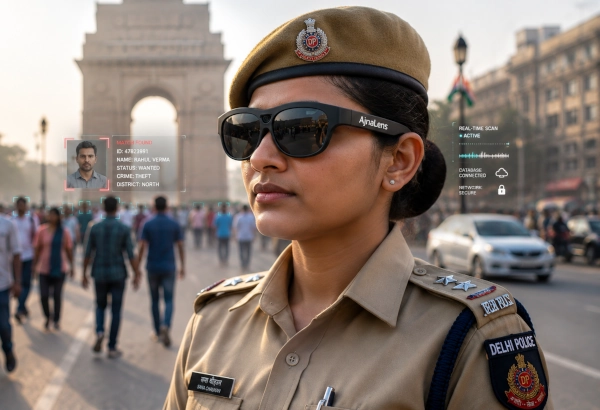
Delhi Police has begun using AI-enabled smart glasses developed by Indian deep-tech company AjnaLens, giving personnel the ability to use facial-recognition technology while moving through crowds and sensitive locations.
The technology received widespread attention when Delhi Police deployed the smart spectacles as part of the security arrangements for the 77th Republic Day celebrations in January 2026. Officers wearing the glasses were positioned around important entry points, intersections and areas adjoining the Republic Day parade route.
More recently, AjnaLens devices were also reported among the surveillance technologies deployed by police personnel around Jantar Mantar in New Delhi in July 2026, bringing the technology back into public attention — this time accompaginning to move out of police control rooms and CCTV monitoring centres and directly onto the faces of officers in the field.
Delhi Police has begun using AI-enabled smart glasses developed by Indian deep-tech company AjnaLens, giving personnel the ability to use facial-recognition technology while moving through crowds and sensitive locations.
The technology received widespread attention when Delhi Police deployed the smart spectacles as part of the security arrangements for the 77th Republic Day celebrations in January 2026. Officers wearing the glasses were positioned around important entry points, intersections and areas adjoining the Republic Day parade route.
More recently, AjnaLens devices were also reported among the surveillance technologies deployed by police personnel around Jantar Mantar in New Delhi in July 2026, bringing the technology back into public attention — this time accompanied by a wider debate over the limits of facial recognition and biometric surveillance.
What Is AjnaLens?
AjnaLens is an Indian deep-tech company specialising in Extended Reality, artificial intelligence, mixed-reality headsets and AI-powered smart glasses.
The company describes itself as an Indian OEM developing both hardware and software for XR and AI applications, with products aimed at government, defence, enterprise, industrial and training applications.
Its current portfolio includes the AjnaXR Enterprise mixed-reality platform and AjnaAI smart glasses, which are designed to combine computer vision and artificial intelligence with information gathered from a person’s immediate surroundings.
For policing, the important development is that cameras and AI processing which would traditionally be associated with a fixed CCTV system can now effectively accompany an officer.
In simple terms, the policeman wearing the device becomes a mobile sensor.
How Delhi Police Uses the Smart Glasses
The AjnaLens system used by Delhi Police incorporates a camera capable of observing people in front of the officer.
Images captured by the glasses can be processed by facial-recognition software and compared with photographs contained in a police database.
Instead of an officer manually examining photographs of wanted individuals and attempting to recognise them among thousands of people, the computer performs the initial comparison.
Delhi Police officials said during the Republic Day deployment that the technology could identify persons even when their appearance had changed substantially over time.
Additional Commissioner of Police (New Delhi) Devesh Kumar Mahla told Hindustan Times that facial characteristics could still be compared even where a person had grown a beard, acquired marks on the face or where the reference photograph was many years old.
This is one of the most important potential advantages of AI-assisted facial recognition.
A human policeman may struggle to recognise a person from a decade-old photograph. A facial-recognition algorithm instead analyses multiple facial characteristics and calculates whether the observed face is sufficiently similar to the stored record.
From Face to Digital Signature
Modern facial recognition generally works in several stages.
First, the camera detects the presence of a face.
Software then analyses characteristic facial features and converts them into a mathematical representation — often called a facial template or embedding.
That representation is compared with stored templates derived from photographs in the database.
The software then calculates a similarity score.
If the similarity exceeds a predetermined threshold, the system can flag the individual as a possible match.
Importantly, a facial-recognition result should therefore be understood as an algorithmic match rather than, by itself, proof of identity. Police still need appropriate procedures for confirming a person’s identity after an alert is generated.
Red Means a Possible Match
One particularly interesting feature reported in the Delhi deployment is a simple colour-coded interface.
Police officers said people being scanned could be marked using green and red indicators.
A green indication represents a person for whom the system has not detected a corresponding criminal-database match, while a red indication alerts the officer to a potential match requiring further examination.
The objective is straightforward: the policeman should not have to study complicated data while simultaneously controlling a crowd.
AI performs the comparison while the officer receives a simplified operational alert.
That turns what would otherwise be an intelligence-room function into a capability available directly to personnel on patrol.
Connected to a Smartphone
The system is not simply a pair of conventional spectacles containing a camera.
During the Republic Day deployment, the AjnaLens smart glasses were reported to be connected to a mobile phone used by the police officer.
The smartphone and associated application provide the computing and database interface needed to process information and display alerts.
Another significant feature reported by Delhi Police was that the system could function without permanent Internet connectivity, allowing facial-recognition data to be handled through locally available systems rather than requiring every query to travel continuously through an external network.
For law-enforcement deployments, such an architecture can be important.
A major security event cannot depend entirely upon uninterrupted mobile Internet connectivity. Local processing can also potentially reduce latency and provide greater control over sensitive police information, depending upon how the system is configured.
How Large Is the Database?
Published figures concerning the exact size of the database have varied.
Initial reporting ahead of the Republic Day deployment quoted police officials describing a database containing more than 10,000 suspects. AjnaLens subsequently stated that the security system could cross-reference faces against more than 65,000 criminal records.
The difference may reflect different databases, subsequent expansion, or different ways of counting records and individuals.
Delhi Police has not publicly released enough technical documentation to independently establish the precise database configuration used across each deployment.
The larger point, however, remains important: the officer is no longer expected to remember individuals from a watchlist. The wearable system can potentially compare a passing face against thousands of stored records in a short period.
A Force Multiplier at Large Events
The Republic Day parade provides a useful example of why police forces are interested in this technology.
Tens of thousands of spectators, security personnel, officials and invited guests can be concentrated in a relatively small geographical area.
Traditional security requires layers of police personnel, checkpoints, intelligence teams and CCTV operators.
Wearable facial recognition adds another layer.
An officer patrolling an entry route could theoretically identify a database match without having to first photograph the individual and send the image to a remote control room.
That can dramatically shorten the intelligence cycle:
Camera sees face → AI analyses face → database is searched → possible match is generated → officer receives alert.
What previously required coordination between several people can potentially occur within seconds.
Thermal Imaging Adds Another Sensor
Reports on the police deployment also say the AjnaLens spectacles incorporate thermal-imaging capability.
Thermal imaging detects differences in infrared radiation associated with temperature rather than identifying a person’s face in the same manner as an ordinary visible-light camera.
Police officials have described thermal capability as useful for security screening and detecting suspicious anomalies.
However, claims that thermal imaging itself can directly identify every concealed metal object or weapon should be treated cautiously. The precise capabilities depend on the sensors, algorithms, distance, clothing, environmental conditions and the way the system is configured.
Detailed independent performance specifications for the particular Delhi Police configuration have not been publicly released.
From Republic Day to Jantar Mantar
The Republic Day deployment demonstrated the system primarily as a counter-crime and high-security-event technology.
The debate changed when facial-recognition surveillance appeared around protests at Jantar Mantar in July.
Delhi Police confirmed using facial-recognition systems around the protest location to identify wanted criminals, absconders and history-sheeters, with police sources saying the technology was intended to prevent people with criminal antecedents from exploiting demonstrations to disturb public order.
ThePrint separately reported officers at Jantar Mantar wearing AjnaLens smart spectacles linked to police databases.
The Indian Express also reported extensive AI-assisted facial recognition around the site, although it noted that Delhi Police had not publicly provided detailed information about the database composition, accuracy levels or procedures followed when the system generated a possible match.
That distinction is important.
The existence and police use of facial-recognition surveillance at Jantar Mantar has been reported and acknowledged in various forms, while the precise technical configuration and operating procedures remain incompletely disclosed publicly.
An Important Indian Deep-Tech Development
The company says it designs and manufactures XR headsets and AI smart glasses in India and has built intellectual property covering immersive computing technologies. It says its technology has applications across defence, industrial training, government programmes and enterprise operations.
Police deployment demonstrates another potential market: wearable intelligence for law enforcement and public security.
The underlying technology could eventually support far more than facial recognition.
AI glasses could potentially provide officers with navigation information, vehicle-registration alerts, translated text, missing-person information, incident instructions, maps, hazardous-material warnings or live feeds from command centres — depending on the software ecosystem and legal authorisation.
In that sense, AjnaLens points towards a larger transformation in policing.
From CCTV Surveillance to Wearable Intelligence
The conventional smart-city surveillance model places thousands of cameras across roads, railway stations, airports and public spaces and sends those feeds to central control rooms.
Wearable AI changes that model.
Instead of only bringing the scene to the computer, it brings the computer to the policeman.
The officer sees the real world.
The camera observes it simultaneously.
Artificial intelligence interprets part of what the camera sees.
The database provides context.
And the policeman makes the operational decision.
That combination of human judgement, computer vision, artificial intelligence and wearable hardware could become an increasingly important part of future policing.
Delhi Police’s use of AjnaLens therefore represents more than an experiment with futuristic spectacles. It is an early example of AI moving directly into frontline law enforcement in India.
The technological potential is considerable: faster identification of wanted persons, mobile access to police databases and greater situational awareness for officers.
At the same time, its power makes safeguards equally important. Facial recognition capable of helping locate a dangerous fugitive is the same technological capability that can scan an ordinary citizen walking through a public gathering.
The next stage of India’s smart-policing journey will therefore involve two developments occurring together — better technology and clearer rules governing how that technology may be used.
AjnaLens has demonstrated that Indian companies can build sophisticated wearable AI systems capable of finding applications in frontline policing. The challenge now is ensuring that this new generation of digital policing becomes both an effective security tool and a technology deployed within transparent, accountable boundaries.
You may also like
-
Indian Navy Vice Chief Inspects Japan’s Mogami-Class Stealth Frigate as India-Japan Shipbuilding Cooperation Expands
-
India and Russia Explore Joint Icebreaker Construction as Maritime Industrial Cooperation Expands
-
Philippine Marine Wargames Reportedly Show BrahMos Can Penetrate Chinese Destroyer Air Defences
-
Safran Signs 18 Agreements with Indian Aerospace Suppliers, Expanding Make in India Manufacturing Partnerships
-
Indian Army’s Vajra Corps Certifies First Batch of Drone Operators, Strengthens Battlefield Surveillance
