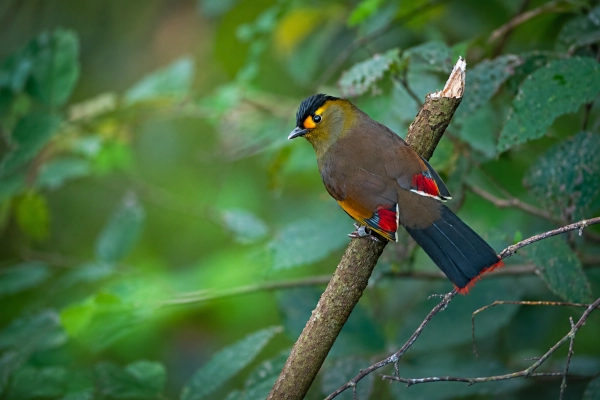
The Bugun Liocichla (Liocichla bugunorum) is one of India’s rarest and most remarkable birds. Known from a tiny area of West Kameng district in Arunachal Pradesh, this colourful forest songbird has become an international symbol of community-led wildlife conservation in the Eastern Himalayas.
The species was first noticed in Eaglenest Wildlife Sanctuary in January 1995, but its identity remained uncertain for more than a decade. It was formally described as a new species in 2006 by astronomer and naturalist Ramana Athreya, after detailed observations showed that its plumage, size and vocalisations differed from other known liocichlas.
Today, the Bugun Liocichla is classified as Critically Endangered and is listed under Schedule I of India’s Wild Life (Protection) Act, giving it the highest level of legal protection.
Bird at a Glance
Common name: Bugun Liocichla
Scientific name: Liocichla bugunorum
Order: Passeriformes
Family: Leiothrichidae
Distribution: West Kameng district, Arunachal Pradesh
Important habitat: Singchung Bugun Village Community Reserve and adjoining Eaglenest landscape
Conservation status: Critically Endangered
Indian legal protection: Schedule I
Lifestyle: Resident forest bird
Diet: Berries and probably insects and other small invertebrates
Approximate length: About 22 cm
Special significance: One of the most geographically restricted birds known from India
A Bird Found Almost Nowhere Else
The Bugun Liocichla has an extraordinarily restricted known distribution.
Its core population occurs in the forests around Lama Camp and Singchung, adjoining Eaglenest Wildlife Sanctuary in western Arunachal Pradesh.
The landscape lies within the Eastern Himalaya Biodiversity Hotspot, one of the richest centres of biological diversity in Asia.
Eaglenest Wildlife Sanctuary itself covers about 217 sq km in West Kameng district and contains an exceptional range of tropical, subtropical and temperate Himalayan habitats.
Yet the Bugun Liocichla occupies only a tiny portion of this enormous mountain landscape.
Wildlife Conservation Society–India has described its known global range as being around 2 sq km, with the known population believed to comprise no more than about 20 birds.
That makes it one of the most range-restricted birds in the world.
The Discovery Began in 1995
The story of the Bugun Liocichla is unusual even by ornithological standards.
On January 12, 1995, Ramana Athreya was birdwatching inside Eaglenest Wildlife Sanctuary when he briefly observed a pair of unfamiliar liocichlas.
The birds did not match any species described in the standard Indian bird literature available to him.
Athreya did not encounter them again until January 2005, when a small flock appeared in the same region.
Initially the birds were suspected to be related to the Emei Shan Liocichla (Liocichla omeiensis), a Chinese species whose nearest known population was more than 1,000 km away.
Further observations, however, revealed substantial differences.
Formally Described as a New Species in 2006
After years of searching, Athreya finally captured one individual on May 25, 2006 at Lama Camp.
The bird was photographed, measured and released alive.
Only a few naturally loosened feathers were retained as type material and deposited with the Bombay Natural History Society.
Comparison of its appearance and song with related species demonstrated that it represented a species previously unknown to science.
Athreya formally named it:
Bugun Liocichla — Liocichla bugunorum.
The scientific description was published in Indian Birds in September 2006.
Why No Bird Was Killed for the Type Specimen
The description of the Bugun Liocichla also became noteworthy for the way the scientific type was handled.
Traditionally, newly described bird species were represented by a preserved specimen.
Athreya decided against sacrificing an individual because the known population was so small.
At the time, only three possible breeding pairs had been located.
He therefore photographed, measured and released the captured bird and retained only feathers that had naturally become detached.
Athreya explicitly explained that killing one member of such an extraordinarily small population would have been inappropriate.
The decision became an important example of adapting taxonomic practice to the conservation needs of an exceptionally rare species.
What Does the Bugun Liocichla Look Like?
Despite its rarity, the Bugun Liocichla is an exceptionally colourful bird.
Its overall body is olive to greyish-olive, but several brilliant patches transform its appearance.
The original scientific description identified:
- a black cap;
- conspicuous orange-yellow lores between the eye and bill;
- a bright yellow patch behind the eye;
- golden-yellow areas on the wings;
- crimson markings on the wing feathers;
- white wing tips;
- yellowish-olive breast; and
- striking orange-red colouring on the tail.
The combination is unlike that of any other Indian bird.
Spectacled Appearance
The facial markings are particularly distinctive.
A triangular orange-yellow patch occurs in front of the eye, while another yellow streak lies immediately behind it.
Separated by a dark region around the eye, these markings can give the bird an almost spectacled appearance.
Above them is a black cap composed of feathers that can be raised slightly.
The cheeks and sides of the head are various shades of olive and grey.
A Brilliantly Coloured Wing
At rest, the wings reveal an intricate pattern of olive, black, golden yellow, crimson and white.
The bases of the flight feathers are broadly yellow.
Small crimson patches occur close to the ends of the secondary feathers, while white tips provide further contrast.
Although the body coloration helps the bird merge into mountain vegetation, these flashes of red and yellow become much more conspicuous when it moves through foliage.
The Extraordinary Tail
The tail is one of the Bugun Liocichla’s most spectacular features.
From above it appears largely blackish with olive tones.
The underside, however, can show vivid flame-orange and red colouring, particularly on the outer tail feathers.
The feather tips end in orange-red barbs, creating flashes of brilliant colour when the bird spreads or flicks its tail.
About 22 Centimetres Long
The holotype measured approximately 220 mm, or about 22 centimetres, in total length.
It is therefore considerably larger than a typical sparrow but much smaller than most pigeons.
Its compact body, rounded wings and relatively strong legs are typical of birds adapted to moving through dense mountain vegetation.
A High-Altitude Forest Specialist
The Bugun Liocichla is associated with montane forest at elevations above roughly 2,000 metres.
The birds studied during the original description occurred around 2,300 metres, where pairs were observed during the breeding season.
Eaglenest is unusual because its forests extend across an enormous altitudinal gradient.
The sanctuary and surrounding Kameng forests include habitats ranging from low-elevation tropical forest to temperate mountain vegetation above 3,000 metres.
The Bugun Liocichla occupies a very narrow portion of this broader ecological spectrum.
Dense Secondary Vegetation Can Be Important
Interestingly, the species is not restricted exclusively to pristine old-growth forest.
Many early sightings occurred around Lama Camp in areas that had historically experienced logging and contained thick regenerating vegetation.
The bird appears to favour a complex mixture of shrubs, vines, small trees and forest edge.
This highlights an important conservation lesson: recovering secondary forests can sometimes be critically important habitat, especially when they occur alongside intact natural forest.
A Bird Usually Found in Pairs
During May 2006, the known Bugun Liocichlas were observed primarily in pairs.
The original surveys indicated that different pairs appeared to occupy defined territories, with neighbouring pairs separated by several hundred metres.
During winter, however, small groups have sometimes been observed.
The species is generally secretive and frequently remains within dense vegetation, making vocalisations particularly important for locating individuals.
Song: The Voice That Helped Confirm a New Species
The bird’s vocalisations played a major role in proving that the Eaglenest population represented a distinct species.
Its song differed markedly from that of the closely related Emei Shan Liocichla.
Researchers recorded several different calls and compared them through sonograms.
The combination of distinctive vocalisations, plumage differences and body measurements formed the evidence supporting recognition of Liocichla bugunorum as a separate species.
Its song remains one of the most useful means of detecting the bird in dense forest.
What Does It Eat?
Little is known about the diet because so few individuals have ever been observed for long periods.
The original field observations documented a pair feeding on small berries.
On another occasion, birds were seen searching tangled vines and apparently taking either insects or plant material.
The Bugun Liocichla is therefore believed to be an opportunistic forest feeder consuming a mixture of fruits and small invertebrates.
This kind of diet is common among related laughingthrushes and liocichlas.
One of the World’s Rarest Birds
The greatest concern surrounding the Bugun Liocichla is its tiny population.
When the species was described in 2006, Athreya recorded ten individuals near Lama Camp and four near Bompu, although he cautioned that the population was probably somewhat larger than those observed birds.
Subsequent conservation assessments have continued to regard the species as exceptionally scarce.
WCS-India has reported a known population of not more than around 20 birds within an extremely restricted core range.
For a bird population this small, the disappearance of even a few adults could have serious consequences.
Critically Endangered
The Bugun Liocichla is globally classified as Critically Endangered.
The State of India’s Birds also designates it as a High Priority species and records it as an Eastern Himalayan forest endemic protected under Schedule I of the Wild Life (Protection) Act.
Its vulnerability arises from the combination of:
extremely small population, extremely restricted range, dependence on a small mountain-forest landscape and the risk of habitat alteration.
The Bugun Community Changed the Bird’s Future
The most remarkable part of the Bugun Liocichla story may not be its discovery.
It is what happened afterward.
The bird was named bugunorum in honour of the Bugun people, whose traditional lands surround the species’ known habitat.
Rather than regarding conservation as something imposed from outside, members of the community became directly involved in protecting the forests.
This eventually led to one of India’s most celebrated community conservation initiatives.
Singchung Bugun Village Community Reserve
In 2017, the Bugun community and Arunachal Pradesh Forest Department established the Singchung Bugun Village Community Reserve (SBVCR) in West Kameng.
The reserve initially covered about 17 sq km of community-owned forest, adjoining Eaglenest Wildlife Sanctuary.
One of its principal purposes was protecting the habitat of the Bugun Liocichla.
Local residents participate directly in management, monitoring and protection.
Community members have also worked as forest guards, nature guides and ecotourism personnel.
Conservation Through Ecotourism
The discovery of the Bugun Liocichla brought birdwatchers from around the world to West Kameng.
Instead of allowing tourism to become an uncontrolled pressure, the community increasingly developed low-impact birdwatching and nature tourism.
Local guides, camps and associated services generate income while giving residents an economic stake in protecting forests.
The conservation model demonstrates an important principle:
a rare species can become more valuable alive in its natural habitat than through exploitation of the forest surrounding it.
The Arunachal Pradesh Forest Department itself highlights the Bugun community’s conservation initiatives and Eaglenest’s international reputation for bird diversity.
Community Patrols
Bugun youth have been employed to patrol the reserve and prevent activities such as illegal hunting and forest degradation.
They also monitor wildlife, maintain infrastructure and help visiting researchers and birdwatchers.
This gives local residents a direct management role rather than treating them merely as people living next to a protected area.
India Biodiversity Award
The success of the initiative gained national recognition.
The Singchung Bugun Village Community Reserve received the India Biodiversity Award in 2018 for its community-based conservation achievements.
The reserve has since become an important Indian example of how indigenous communities and government wildlife agencies can work together to protect threatened biodiversity.
Threats to the Bugun Liocichla
Because the entire known population occupies such a small geographical area, almost any major change to that habitat could become significant.
Potential threats include:
road development, forest clearing, infrastructure expansion, uncontrolled tourism, fire, climate change and degradation of montane vegetation.
The original species description already identified proposed road construction through the Lama Camp landscape as a major concern.
Even relatively small habitat disturbances could matter when virtually an entire global population is concentrated within a few mountain slopes.
Climate Change Is a Particular Concern
High-elevation species can be especially vulnerable to climate change.
As temperatures increase, vegetation zones may gradually shift uphill.
Species that occupy narrow altitudinal bands can therefore lose suitable habitat because mountains provide only limited space for further upward movement.
For the Bugun Liocichla, maintaining a broad belt of connected forest across different elevations is therefore important for long-term resilience.
This is one reason conservation of the wider Eaglenest–Singchung landscape matters in addition to protecting known territories.
Eaglenest: A Global Birding Treasure
The discovery of the Bugun Liocichla transformed Eaglenest into one of the most famous birdwatching destinations in Asia.
The sanctuary lies in the Eastern Himalaya Biodiversity Hotspot and protects exceptionally diverse forest habitats.
Its steep mountain slopes support hornbills, laughingthrushes, wren-babblers, pheasants, eagles and numerous other Himalayan birds. The Arunachal Pradesh Forest Department describes Eaglenest as globally renowned for its biodiversity and a major destination for birdwatching and wildlife photography.
Yet among this extraordinary variety, one small olive-coloured bird has become the sanctuary’s most celebrated resident.
An Indian Bird Known From One Tiny Corner of the Himalayas
The Bugun Liocichla is exceptional even among India’s endemic wildlife.
India contains many species whose ranges extend across parts of a State or mountain chain.
Liocichla bugunorum, by contrast, is associated with an extraordinarily small area surrounding the forests of Singchung and Eaglenest in West Kameng.
Its survival therefore depends heavily upon the decisions made within one local landscape.
Few wildlife conservation stories demonstrate the importance of individual communities so clearly.
Why the Bugun Liocichla Matters
Scientifically, the bird demonstrates that even in the twenty-first century, vertebrate species unknown to science can still survive in India’s remote forests.
Ecologically, it highlights the exceptional biodiversity of the Eastern Himalayas.
Culturally, its name permanently links the bird with the Bugun community.
And from a conservation perspective, it demonstrates that protection need not always begin with the creation of a large government-controlled reserve.
Sometimes it can begin with a village deciding that a forest — and the tiny bird living inside it — is worth protecting.
A Rare Bird and an Extraordinary Conservation Story
The Bugun Liocichla entered scientific history quietly.
A pair of unfamiliar birds appeared briefly before a birdwatcher in a remote Arunachal forest in 1995.
Eleven years later, science recognised them as a species found nowhere else.
The discovery could easily have become a story of a bird already on the path towards extinction.
Instead, it helped inspire the creation of a community reserve.
Today, the forests around Singchung are protected not only through wildlife law, but through the direct involvement of the Bugun people whose name the bird carries.
With possibly only a few dozen individuals surviving, the Bugun Liocichla remains dangerously close to extinction.
But its existence also demonstrates what focused conservation can achieve.
A bird occupying one tiny corner of Arunachal Pradesh has brought together science, indigenous stewardship, ecotourism and government conservation, turning West Kameng into one of the most important examples of community-led biodiversity protection in India.
References
Athreya, Ramana (2006), Indian Birds — “A new species of Liocichla from Eaglenest Wildlife Sanctuary, Arunachal Pradesh, India.” Original scientific description of Liocichla bugunorum.
Department of Environment, Forest & Climate Change, Government of Arunachal Pradesh — Eaglenest Wildlife Sanctuary. Official information on the sanctuary and the Bugun conservation landscape.
State of India’s Birds — Bugun Liocichla. Current conservation priority, Critically Endangered status and Schedule I protection.
Wildlife Conservation Society–India — Singchung Bugun Village Community Reserve. Information on the reserve, population and extremely restricted range of the species.
Government of Arunachal Pradesh — Singchung Bugun Village Community Reserve conservation works. Official forest-management support for the community reserve.
You may also like
-
Tiny 3.3-mm Parasitic Wasp Discovered in Assam Marks First Record of Its Genus in India
-
How India Brought the Greater One-Horned Rhinoceros Back From the Brink
-
From Periyar to Thuruthi, New Surveys Reveal the Remarkable Diversity of Kerala’s Dragonflies, Birds and Butterflies
-
Delhi Biodiversity Survey Records Two Dragonfly and Damselfly Species for the First Time
-
Rare Leafless Orchid Gastrodia keyiensis Discovered in Arunachal Pradesh’s Keyi Valley
