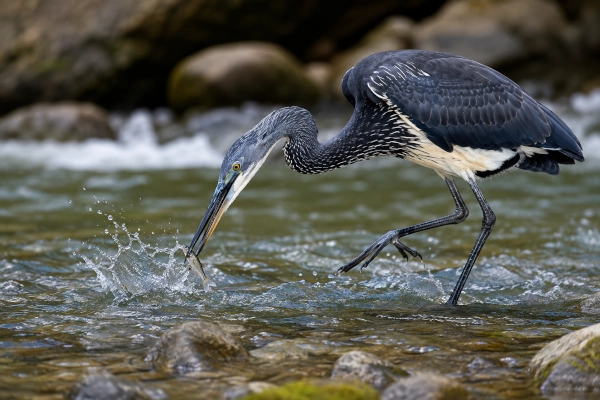
The White-bellied Heron (Ardea insignis) is one of the rarest birds found in India and among the most threatened herons in the world. A large, imposing river bird of the eastern Himalayas, it survives mainly along remote, fast-flowing rivers bordered by mature forests.
In India, the species is now principally associated with eastern Arunachal Pradesh, particularly the river systems around Namdapha Tiger Reserve, Kamlang Tiger Reserve and the Lohit Valley. Its dependence on relatively undisturbed, free-flowing rivers makes the White-bellied Heron especially vulnerable to changes in river habitats.
The Wildlife Institute of India describes it as a Critically Endangered species and is studying its habitat, prey and human pressures in eastern Arunachal Pradesh.
Bird at a Glance
Common name: White-bellied Heron
Scientific name: Ardea insignis
Family: Ardeidae
Order: Pelecaniformes
Conservation status: Critically Endangered
Indian stronghold: Arunachal Pradesh
Important habitats: Namdapha Tiger Reserve, Kamlang Tiger Reserve and the Lohit–Noa-Dihing river systems
Preferred habitat: Clear, fast-flowing Himalayan rivers and streams bordered by mature forest
Diet: Predominantly fish
Major threats: River modification, habitat disturbance, hunting, intensive fishing, sand and gravel extraction and other human pressures
A Giant Among Herons
The White-bellied Heron is a very large, long-legged and long-necked waterbird.
Its overall plumage is predominantly dark slate-grey, giving the bird a sombre appearance when standing against rocks beside a mountain river.
The feature responsible for its name is the contrasting white belly and vent. It also possesses a paler throat, while white streaking can occur along the neck and scapular region.
In flight, the contrast becomes even more striking. The dark wings and paler areas of the underparts produce a conspicuous black-and-white pattern beneath the bird.
Its bill is long, sharply pointed and predominantly dark, perfectly adapted for capturing fish.
The long legs allow it to stand in shallow sections of rivers while scanning the water.
How to Identify the White-bellied Heron
A combination of characteristics separates the species from more familiar herons:
- exceptionally large body;
- dark grey plumage;
- distinctly white belly and vent;
- pale throat;
- very long neck;
- long, powerful legs;
- heavy, pointed dark bill; and
- strong contrasting pattern visible when flying.
Males and females are broadly similar in appearance.
Adults possess delicate pale plumes around the nape, while juveniles are generally darker and more heavily streaked. The breeding plumage can become somewhat paler, especially around the neck.
A Bird of Wild Himalayan Rivers
Unlike many herons that readily occupy village ponds, reservoirs, marshes or agricultural wetlands, the White-bellied Heron has much more specialised habitat requirements.
It is strongly associated with undisturbed or relatively undisturbed rivers flowing through forested Himalayan landscapes.
The bird favours stretches containing combinations of:
rapid-flowing water,
shallow riffles,
gravel bars,
exposed rocks,
quiet pools, and
mature riverine forest.
These river systems provide feeding areas as well as trees suitable for roosting and nesting.
Researchers studying the species in Arunachal Pradesh have found a strong association with free-flowing rivers experiencing comparatively little human disturbance.
Arunachal Pradesh: India’s Most Important Refuge
Within India, Arunachal Pradesh is crucial to the survival of the White-bellied Heron.
The bird has been recorded in the eastern part of the State, particularly across Changlang, Lohit and Anjaw districts.
Important landscapes include:
Namdapha Tiger Reserve
Kamlang Tiger Reserve
Noa-Dihing River basin
Lohit River basin
Walong and adjoining areas
Researchers from the Nature Conservation Foundation conducted systematic surveys across seven major river basins of Arunachal Pradesh during 2017-18, followed by work in Assam.
Despite searching 81 sites, they encountered White-bellied Herons only six times at three sites — an indication of just how scarce the bird has become.
Namdapha Tiger Reserve: A Critical Stronghold
The enormous Namdapha Tiger Reserve in eastern Arunachal Pradesh is particularly important.
Namdapha protects vast tracts of tropical and subtropical forest together with the Noa-Dihing river system, providing one of India’s most significant remaining White-bellied Heron habitats.
The Wildlife Institute of India has undertaken research examining the bird’s habitat quality and prey resources in Namdapha, including comparisons between protected and more disturbed river sections.
The reserve is also especially significant because breeding by the species has been confirmed there.
Given the tiny surviving population, protection of even individual feeding and nesting territories can have global conservation significance.
The Lohit Valley
Another important landscape lies farther north and east along the Lohit River.
White-bellied Herons have been recorded across parts of the Lohit basin, including stretches in Anjaw district.
Researchers have documented the species both upstream and downstream along portions of the river, emphasizing that conservation must consider entire river systems rather than isolated protected areas.
The Wildlife Institute of India has more recently been involved in work specifically directed towards developing a conservation plan for the White-bellied Heron and its habitats in the Lohit and Noa-Dihing river basins.
Walong: A Rare Nesting Discovery
An especially important discovery occurred in Walong in Arunachal Pradesh’s Anjaw district.
In April 2021, researchers recorded a pair of White-bellied Herons and a nest beside the Lohit River.
The nest was located in a tree about 11 metres above the ground.
At the time, it represented only the second documented nesting locality in India, after Namdapha Tiger Reserve.
For such an exceptionally rare species, discovering a breeding site is enormously important because successful nesting determines whether the tiny population can persist.
Feeding: A Specialist Fish Hunter
The White-bellied Heron is primarily a piscivore — a fish-eating bird.
Research in Arunachal Pradesh indicates that fish account for the overwhelming majority of its diet. Wildlife Institute of India research notes that fish constitute more than 95% of its diet.
This explains the bird’s close relationship with healthy mountain rivers.
White-bellied Herons commonly search for prey in shallow water, riffles and river margins where fish can be intercepted.
A hunting bird may remain remarkably still, watching the current for movement.
When an opportunity appears, the long neck is thrust forward and the spear-like bill is used to seize the prey.
Why River Rapids Matter
Not all parts of a river are equally useful to the White-bellied Heron.
Researchers have observed that it particularly depends on fish associated with river rapids and naturally flowing sections.
A Himalayan river contains numerous microhabitats — rapids, pools, boulder fields, gravel bars and quieter side channels.
Together these support diverse fish populations.
Altering the flow regime can therefore change not simply the amount of water present but also the physical structure of the habitat and availability of prey.
This makes the species an unusually sensitive indicator of the health of eastern Himalayan river ecosystems.
A Solitary and Elusive Bird
White-bellied Herons are generally difficult to observe.
They occur at extremely low densities and frequently use remote valleys with difficult terrain.
Adults are often encountered singly or as pairs rather than in the large colonies associated with some other herons.
Their wariness is advantageous in wild landscapes but also makes scientific monitoring challenging.
Absence of observations does not always prove that a bird is absent, while repeated detection of only a handful of individuals makes estimating the total population exceptionally difficult.
Breeding
Knowledge of White-bellied Heron reproduction remains limited because so few nests have ever been documented.
Known nests are generally constructed high in large trees near suitable river habitat.
Studies from Bhutan, where considerably more nesting information has been accumulated, show that nesting trees and surrounding forest conditions are important components of breeding habitat.
A study covering nests recorded between 2003 and 2018 documented only a small number of breeding attempts, illustrating the rarity of opportunities to study the species.
Successful reproduction is particularly important for a species with such a tiny global population because the loss of even one breeding pair can have disproportionate consequences.
One of the Rarest Birds on Earth
The White-bellied Heron is classified as Critically Endangered.
The formal IUCN/BirdLife estimate has placed the population within the broad range of 50–249 individuals, although field researchers and conservation organisations have suggested that the number of confirmed surviving birds may be fewer than 60.
Because the species is elusive and inhabits difficult terrain, precise numbers remain uncertain.
The important point is that the surviving population is extraordinarily small.
Even if the higher estimate were ultimately correct, this would still make the White-bellied Heron one of the rarest large waterbirds in the world.
Global Distribution
Historically, the species had a wider Himalayan and South-East Asian distribution.
Its surviving populations are now concentrated primarily in:
India — particularly Arunachal Pradesh
Bhutan
Myanmar
Studies indicate that it has disappeared from large portions of its former range, producing small and fragmented surviving populations.
Bhutan remains especially important for the species, while eastern Arunachal Pradesh represents its principal Indian refuge.
Why Has the White-bellied Heron Become So Rare?
There is no single cause.
The bird combines several characteristics that make it vulnerable: a naturally small population, specialised habitat requirements, dependence on fish-rich rivers, low density and sensitivity to disturbance.
These vulnerabilities are compounded by changes affecting its river systems.
River Modification
Changes to natural river flow can alter rapids, pools, gravel bars and fish communities.
Because the White-bellied Heron is closely associated with particular free-flowing river conditions, large changes to river hydrology may affect feeding and breeding habitat.
Researchers have repeatedly identified Himalayan hydropower development as an issue requiring careful consideration in areas occupied by the species.
Fishing Pressure
Fishing can affect the bird in several ways.
Heavy extraction may reduce prey availability, while some fishing methods can disturb feeding stretches.
The large-scale Arunachal surveys identified certain fishing practices among the potential pressures affecting White-bellied Heron occurrence.
Sand and Gravel Extraction
Riverbeds provide construction materials such as sand and gravel.
Extraction can alter shallow feeding areas, disturb riverbanks and increase human activity within otherwise quiet river stretches.
Researchers identified sand and gravel mining as another potential threat in north-east India.
Hunting
Hunting remains particularly dangerous for a species existing in such tiny numbers.
When a population contains only a handful of individuals, the loss of even one adult — especially a breeding adult — can substantially affect local survival prospects.
Field research in north-east India has identified hunting among the threats requiring conservation attention.
Human Disturbance
Roads, settlements, construction, fishing camps and other activities can increase disturbance around feeding, roosting and nesting sites.
White-bellied Herons appear to favour relatively quiet river sections, making protection of low-disturbance habitat particularly important.
More Than a Bird: A Symbol of Healthy Himalayan Rivers
Saving the White-bellied Heron has significance far beyond conserving one extremely rare bird.
Its survival depends on functioning river ecosystems containing:
clean flowing water,
healthy fish populations,
natural rapids and pools,
stable riverbanks, and
mature surrounding forests.
Protecting those habitats also benefits fish, reptiles, amphibians, mammals, other river birds and communities dependent on healthy watersheds.
The White-bellied Heron can therefore serve as an umbrella species for conservation of eastern Himalayan rivers.
Protecting sufficient habitat for this demanding bird inevitably protects a much larger ecological community.
Conservation Priorities in Arunachal Pradesh
The immediate conservation challenge is to ensure that the remaining birds survive long enough to reproduce successfully.
Important measures include protecting known nesting trees and feeding stretches, reducing disturbance near breeding sites, maintaining connectivity between river habitats, controlling hunting and destructive fishing practices, monitoring fish populations and evaluating development projects in relation to the bird’s ecological requirements.
Regular population monitoring is equally important.
Because so few birds remain, conservationists need to know whether particular individuals disappear, new juveniles appear or previously unknown breeding territories are discovered.
Scientific Research Is Crucial
There is still much that scientists do not know about Ardea insignis.
Researchers continue to investigate questions such as:
Where do individuals move during different seasons?
How large is each bird’s territory?
Which fish species are most important?
What river characteristics determine feeding-site selection?
How frequently do breeding pairs reproduce successfully?
Do birds move between Bhutan, India and Myanmar?
How genetically connected are the remaining populations?
Answering these questions will allow conservation efforts to move from general habitat protection towards highly targeted management.
The fact that the Wildlife Institute of India and other research organisations continue to study the Lohit and Noa-Dihing landscapes is therefore particularly significant.
Arunachal Pradesh Holds a Global Responsibility
For most people, seeing a White-bellied Heron in the wild will remain extraordinarily unlikely.
Along an isolated Arunachal river, however, a tall grey bird may occasionally emerge from the forest, stand motionless on a boulder above the rushing water, and wait for a fish to enter striking range.
That solitary figure represents one of the last survivors of an ancient Himalayan river ecosystem.
The continued presence of the White-bellied Heron in Namdapha, Kamlang and the Lohit Valley gives Arunachal Pradesh an exceptional conservation responsibility.
Protecting the bird means protecting some of India’s wildest remaining mountain rivers.
And if those rivers continue to support Ardea insignis, they will also continue supporting countless other species that depend upon the forests, clean water and free-flowing river systems of the eastern Himalayas.
References
Wildlife Institute of India (WII) — Research on the habitat, prey and anthropogenic pressures affecting the Critically Endangered White-bellied Heron in eastern Arunachal Pradesh.
Nature Conservation Foundation — Assessing the Status of the Critically Endangered White-bellied Heron Ardea insignis in North-east India.
BirdLife International DataZone — Species profile for Ardea insignis.
Royal Society for Protection of Nature, Bhutan — White-bellied Heron species biology, identification and conservation information.
eBird / Cornell Lab of Ornithology — Identification and habitat information for the White-bellied Heron.
Bird Conservation International — Research on the species’ status and threats in north-east India.
You may also like
-
Satpura Tiger Reserve’s Barasingha Population Crosses 300 as Madhya Pradesh Plans New Wildlife Corridors
-
Karnataka’s Tiger Population Could Cross 700 as New Census Builds on Official Count of 563
-
Project Cheetah Expands as Veerangana Durgavati Tiger Reserve Becomes Madhya Pradesh’s Third Cheetah Habitat
-
Kashmir Markhor Population Rises to 227 as Kazinag Conservation Efforts Show Results
-
ICAR-CIFRI Pushes Conservation of Indigenous Himalayan Fish for Biodiversity and Livelihood Security
