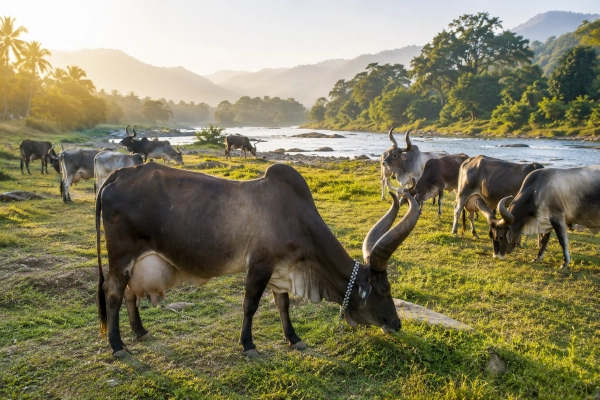
Kankrej is one of India’s great indigenous Bos indicus cattle breeds, renowned for its imposing frame, characteristic lyre-shaped horns, strong legs and remarkable ability to travel long distances over difficult terrain. Native to the dry and semi-arid regions of Gujarat and Rajasthan, the breed has traditionally served farmers as both a dependable draught animal and a useful milk producer.
The National Dairy Development Board classifies Kankrej as a dual-purpose breed used for both milk and draught work. Its native tract extends across parts of northern Gujarat and western Rajasthan, particularly the region surrounding the Rann of Kutch.
Beyond India, Kankrej acquired unusual historical importance. Cattle of this genetic background were exported overseas, particularly to Brazil, where they became known as Guzerat or Guzerá. Guzerat subsequently became one of the important Indian-derived genetic groups involved in the formation of the American Brahman, giving Kankrej a place in the history of cattle breeding far beyond the Indian subcontinent.
Breed at a Glance
Breed: Kankrej
Species: Bos indicus
Type: Dual-purpose — milk and draught
Native region: Gujarat and Rajasthan
Important breeding tract: Northern Gujarat and adjoining western Rajasthan
Typical colour: Silver-grey to iron-grey; males may become considerably darker
Horns: Large, strong and characteristically lyre-shaped
Build: Large, powerful and well proportioned
Traditional strengths: Draught work, long-distance walking and moderate milk production
International descendants/influence: Guzerat/Guzerá cattle and an important contribution to American Brahman development
Origin and Native Tract
Kankrej takes its name from the historic Kankrej region of northern Gujarat.
The traditional breeding tract lies southeast of the Rann of Kutch and includes areas associated with the Banas and Saraswati river systems. NDDB identifies the native tract as including parts of Banaskantha, Mehsana, Kutch, Ahmedabad, Kheda and Sabarkantha in Gujarat, along with Barmer and Jodhpur districts of Rajasthan.
Older regional names reflect the geographical spread of the cattle. In different areas, Kankrej-type animals have historically been called Wadhiar, Wagad, Wagadia and related local names.
The breed developed under conditions characterised by high summer temperatures, seasonal scarcity of fodder, long journeys between grazing areas and the demands of traditional agriculture. These environmental and working conditions favoured cattle possessing endurance, sound feet and powerful limbs.
One of India’s Large Indigenous Cattle Breeds
Kankrej cattle are among the larger and heavier traditional Indian zebu breeds.
A mature animal typically possesses a deep, substantial body carried on strong and relatively well-balanced legs. The overall impression is of strength without excessive heaviness.
The head is broad, while the face tends to be comparatively short. The forehead may show a slight depression in the centre, and the muzzle is generally dark.
One of the breed’s most recognisable characteristics is its combination of a powerful body with an alert and energetic appearance.
The Distinctive Lyre-Shaped Horns
Perhaps nothing identifies a Kankrej animal more readily than its magnificent horns.
The horns emerge strongly from the head, extend outward and upward and often develop the graceful curved profile commonly described as lyre-shaped.
On mature bulls they can become particularly impressive.
The horns are not merely ornamental breed characteristics. Historically, they formed part of the distinctive appearance by which pastoralists and cattle breeders recognised and selected Kankrej animals over generations.
Together with the broad forehead, large ears and grey coat, they give the breed an unmistakable profile.
Coat Colour
Kankrej cattle occur in shades ranging from silver-grey and light grey to iron-grey and very dark grey.
Males commonly become darker with maturity, particularly around the head, neck, hump, shoulders and hindquarters.
The central portion of the body may remain lighter, producing a striking contrast in mature bulls.
Calves may initially exhibit different shades that change as they grow.
Dark pigmentation of the skin is another useful feature in cattle adapted to regions exposed to intense sunlight.
Strong Legs and Durable Feet
The legs and feet are among the most functionally important characteristics of the Kankrej breed.
Traditional Kankrej cattle were required to travel substantial distances between villages, grazing areas, water sources and agricultural fields. Their development therefore strongly favoured animals possessing sound legs, balanced movement and durable hooves.
Historical breed descriptions particularly praise their small, round and hard feet along with their active gait.
This capability helped make Kankrej bullocks highly valued in western India, where livestock often had to work under dry conditions and travel across hard or uneven ground.
Excellent Walking Ability
Kankrej cattle acquired a reputation not simply for strength but for the ability to maintain movement over considerable distances.
This made the bullocks particularly useful for:
- ploughing agricultural land;
- pulling carts;
- transporting produce;
- travelling between distant grazing grounds; and
- undertaking sustained draught work.
They were traditionally regarded as fast and powerful draught cattle, an important combination in an era when bullock transport was central to rural trade and agriculture.
Their walking ability remains one of the defining functional traits of the breed.
Draught Power
The substantial body, strong shoulders and well-developed musculature of Kankrej males made them particularly suitable for agricultural work.
Bullocks could be employed for both field cultivation and road transport.
Unlike breeds developed almost exclusively for heavy pulling, however, Kankrej animals retain comparatively active movement. This allowed them to perform agricultural tasks while also covering distance efficiently.
It is this combination of power, stamina and mobility that historically made them especially valuable to farmers and pastoral communities.
Milk Production
Kankrej is not exclusively a draught breed. Its cows possess useful dairy capacity, leading to its classification as a dual-purpose indigenous cattle breed.
NDDB reports an average milk yield of approximately 1,738 kg per lactation, with a reported range of roughly 800–1,800 kg under the data presented in its breed profile.
Production naturally varies substantially according to genetics, nutrition, management, age, lactation number and environmental conditions.
For traditional farming households, the advantage of Kankrej lay precisely in this combination: cows could provide milk while males supplied valuable draught power.
Adapted to the Dry West of India
Kankrej evolved in a region where livestock face considerable climatic challenges.
Northern Gujarat and western Rajasthan can experience intense heat, variable rainfall, dry grazing conditions and seasonal fodder shortages.
As an indigenous zebu breed, Kankrej possesses many characteristics associated with tropical adaptation, including loose skin, a prominent hump and physiological traits that assist Bos indicus cattle in coping with hot environments.
Its ability to remain useful under conditions that may challenge less adapted cattle has helped preserve the breed across generations.
The Hump and Other Zebu Characteristics
Like other Indian zebu breeds, Kankrej possesses a prominent hump over the shoulders.
This becomes particularly well developed in adult males.
Other characteristic features include:
Dewlap: Moderately loose and pendulous.
Ears: Relatively large, open and somewhat pendulous.
Skin: Pigmented and moderately loose.
Tail: Usually ending in a dark switch.
Male appearance: Mature bulls often develop a powerful neck, prominent hump and darker coat.
These characteristics collectively give mature Kankrej bulls a particularly imposing appearance.
Temperament and Working Behaviour
Kankrej cattle were historically selected in close association with people.
Bullocks needed to respond to commands while working in pairs, pulling carts and ploughing fields. Animals displaying manageable behaviour combined with strength and stamina naturally had greater practical value.
Well-managed Kankrej animals are generally regarded as active and workable cattle, although individual temperament varies with genetics, handling and husbandry.
Their alertness is particularly evident when they move, contributing to the breed’s reputation as energetic draught cattle.
Kankrej Becomes Guzerat in Brazil
One of the most fascinating chapters in the history of Kankrej cattle unfolded thousands of kilometres away from India.
Indian cattle of Kankrej origin were exported to Brazil, where the breed became established under the name Guzerá, internationally also written as Guzerat.
Oklahoma State University’s cattle-breed history records that the Guzerat population was developed from Kankrej cattle imported from India between the late nineteenth and twentieth centuries.
Brazilian breeders subsequently developed large populations of Guzerá adapted to tropical livestock production.
As a result, an Indian cattle breed associated with Gujarat and Rajasthan became an important component of South American zebu breeding.
From Kankrej to Guzerat to American Brahman
The international influence went even further.
The American Brahman was created in the United States using several Indian Bos indicus genetic groups.
Among the major strains involved were:
Guzerat, derived from Kankrej;
Gir;
Nellore/Ongole; and
to a lesser extent, Krishna Valley cattle.
Oklahoma State University’s breed history describes Guzerat as one of the principal Indian-derived groups used in developing the American Brahman and notes its particularly important influence on the breed.
Thus, the genetic journey can broadly be represented as:
Kankrej of India → Guzerat/Guzerá overseas → major contribution to American Brahman
It represents a remarkable example of Indian livestock genetics influencing cattle populations on another continent.
Influence on Tropical Cattle Breeding
The significance of Kankrej-derived genetics abroad was closely related to environmental adaptation.
European Bos taurus cattle introduced into tropical and subtropical areas frequently faced challenges associated with heat and insects.
Indian zebu cattle had evolved under tropical and subtropical conditions over generations.
Breeders therefore incorporated Indian genetics into cattle populations designed for warmer environments.
The descendants of these programmes subsequently became important across parts of the Americas and other tropical cattle-producing regions.
The familiar hump, loose skin, large frame and heat-adapted appearance of many modern Brahman cattle ultimately reflect this Indian zebu inheritance.
Importance in Traditional Gujarat
Within India, however, the importance of Kankrej has always been much more immediate.
For generations, these cattle represented several forms of household wealth simultaneously.
A Kankrej cow could provide milk. A bullock could cultivate land and transport goods. Breeding animals represented valuable genetic stock, while cattle could accompany pastoral families across substantial distances.
The breed consequently became woven into the agricultural landscape of northern Gujarat.
The cattle economy of Banaskantha and adjoining regions continues to provide an important geographical setting for conservation and genetic improvement of the breed.
Role in Rajasthan
The Kankrej breeding tract extends beyond Gujarat into western Rajasthan.
NDDB specifically records its presence in Barmer and Jodhpur, while broader distribution occurs across western Rajasthan.
The transition between northern Gujarat and western Rajasthan forms a broad dryland livestock zone rather than a rigid biological boundary.
Pastoral movements historically carried cattle between these regions, helping maintain the breed across the landscape.
Genetic Improvement and Conservation
Modern livestock development has created a new challenge for indigenous breeds.
Mechanisation has reduced demand for draught bullocks in many farming regions, while dairy systems increasingly favour specialised high-yielding animals.
Yet breeds such as Kankrej possess traits that may remain strategically important, particularly climatic adaptation, mobility, robustness and locally adapted genetics.
Consequently, organised breeding programmes have been undertaken to improve and conserve Kankrej populations.
Under India’s National Dairy Plan-I, a pedigree-selection programme for Kankrej cattle was implemented through the Banaskantha Milk Union in Gujarat. NDDB records the production and distribution of genetically evaluated breeding bulls as part of this programme.
Such programmes attempt to improve productive performance without losing the distinctive genetic identity of the breed.
Why Indigenous Kankrej Genetics Matter
The importance of Kankrej is increasingly relevant in an era of climate variability.
Livestock breeding is not simply about maximising production under ideal conditions. Animals must also remain productive under real farm environments involving heat, fluctuating fodder supply and disease pressure.
Indigenous breeds represent reservoirs of genetic diversity accumulated through generations of natural and farmer-led selection.
Once a distinctive population disappears through indiscriminate crossbreeding or declining breeder numbers, recreating that genetic combination is extremely difficult.
Kankrej therefore represents more than a traditional cattle breed. It forms part of India’s animal genetic heritage.
A Breed That Travelled From Gujarat to the World
Few Indian cattle breeds illustrate the international importance of indigenous livestock genetics as clearly as Kankrej.
Born from the dry landscapes surrounding the Rann of Kutch and neighbouring Rajasthan, these large grey cattle became famous for their tremendous horns, strong legs and powerful working ability.
They served Indian agriculture as draught animals and milk cattle for generations.
Then their genetics travelled overseas.
In Brazil, Kankrej became the foundation of Guzerá/Guzerat cattle. Through Guzerat and related importations, Kankrej genetics contributed significantly to the creation of the American Brahman, a breed that subsequently became enormously influential throughout tropical cattle production.
The journey of Kankrej therefore stretches from the villages and grazing lands of Gujarat and Rajasthan to cattle ranches across the Americas.
Its story is a reminder that India’s indigenous breeds are not relics of an agricultural past. They are living genetic resources whose qualities — strength, endurance, climatic adaptation, milk production and resilience — have influenced cattle breeding far beyond the land where they first evolved.
Quick Identification Guide
When identifying a typical Kankrej animal, look for the combination of a large frame, grey coat, darker colouring in mature males, broad forehead, large ears, prominent hump, strong legs and spectacular lyre-shaped horns.
The animal’s powerful but comparatively agile build is equally characteristic.
References
National Dairy Development Board (NDDB)
Kankrej – Indigenous Cattle Breed Profile
Native tract, utility and milk-production information.
National Dairy Development Board – Dairying in Gujarat: A Statistical Profile
Distribution and dual-purpose classification of Kankrej cattle.
National Dairy Development Board – National Dairy Plan-I
Kankrej pedigree-selection and genetic-improvement programme in Gujarat.
Oklahoma State University – Kankrej Cattle
Historical breed description, physical characteristics and traditional draught qualities.
Oklahoma State University – Guzerat Cattle
History of Kankrej-derived Guzerat cattle and their international influence.
Oklahoma State University – Brahman Cattle
Historical account of Indian cattle strains, including Guzerat, involved in development of the American Brahman.
You may also like
-
Satpura Tiger Reserve’s Barasingha Population Crosses 300 as Madhya Pradesh Plans New Wildlife Corridors
-
Karnataka’s Tiger Population Could Cross 700 as New Census Builds on Official Count of 563
-
Project Cheetah Expands as Veerangana Durgavati Tiger Reserve Becomes Madhya Pradesh’s Third Cheetah Habitat
-
Kashmir Markhor Population Rises to 227 as Kazinag Conservation Efforts Show Results
-
ICAR-CIFRI Pushes Conservation of Indigenous Himalayan Fish for Biodiversity and Livelihood Security
