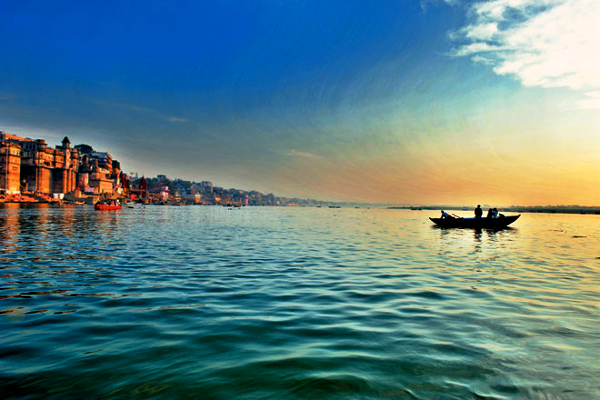
Among the kingdoms repeatedly mentioned in the Mahabharata, Kashi occupies a distinctive place. Centred on the ancient city of Varanasi, the kingdom stood in the fertile middle Gangetic plain and was already portrayed in the epic as a wealthy, prestigious and militarily important realm. The Mahabharata itself explicitly connects the two names: in the Udyoga Parva, Sanjaya describes the “lord of Kashi” as the ruler of Varanasi and as a powerful ally of the Pandavas.
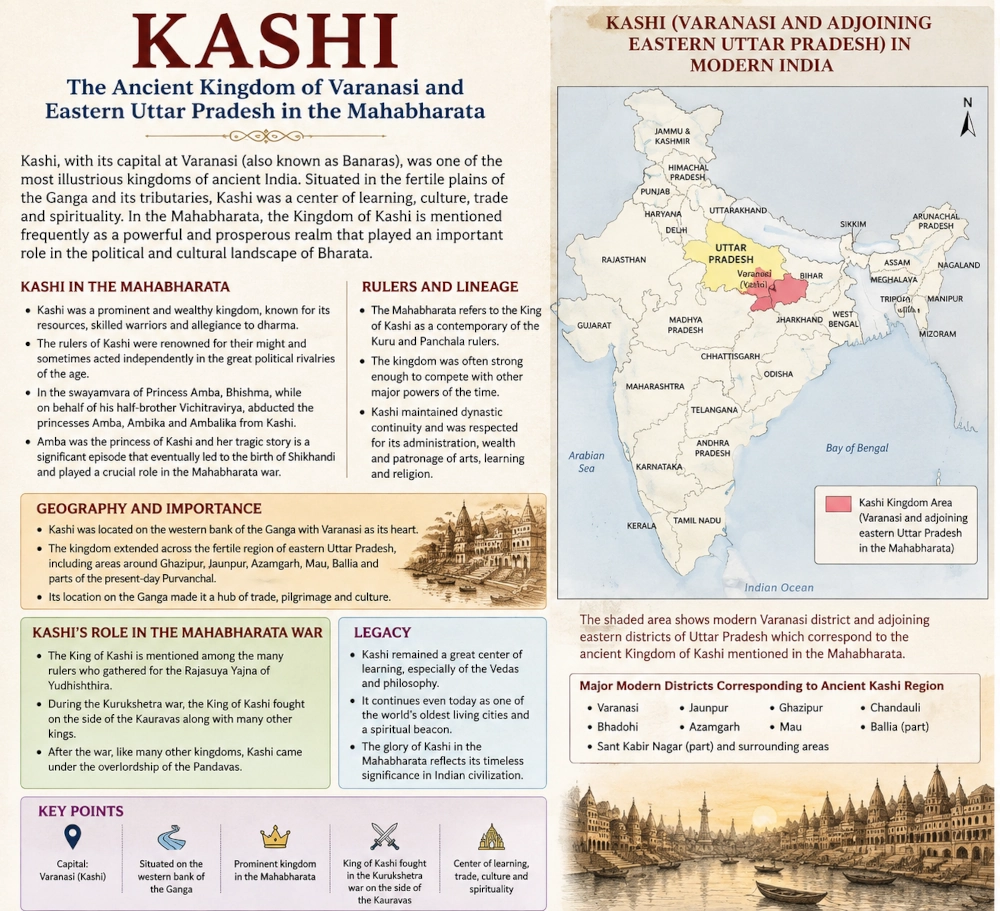
In modern geographical terms, the heartland of Kashi corresponds most closely to Varanasi and adjoining parts of eastern Uttar Pradesh. The exact political boundaries of a Mahabharata-era kingdom cannot be reconstructed with modern district-level precision, so any modern map should be treated as an approximate geographical representation rather than a fixed ancient frontier. The Government of Uttar Pradesh likewise identifies Varanasi with the ancient name Kashi.
Kashi at a Glance
| Feature | Description |
|---|---|
| Ancient Kingdom | Kashi |
| Capital | Varanasi |
| Modern Location | Varanasi and adjoining eastern Uttar Pradesh, India |
| Principal River | Ganga |
| Political Character in the Mahabharata | Important independent monarchy |
| Kurukshetra Alignment | Predominantly with the Pandavas |
| Famous Royal Connection | Amba, Ambika and Ambalika |
| Important Pandava Ally | The King of Kashi |
| Other Kashi Warrior Mentioned | Vibhu, son of the ruler of Kashi |
Kashi and Varanasi in the Mahabharata
The association between Kashi and Varanasi is unusually clear in the epic.
Kashi refers to the kingdom and its people, while Varanasi is presented as its royal city. When Sanjaya describes the forces gathering around the Pandavas before the Kurukshetra War, he states that the powerful ruler of Kashi, who ruled in Varanasi, had joined them.
This makes Kashi one of the ancient kingdoms for which an identification with a surviving modern city is particularly strong.
Modern Varanasi stands on the Ganga in southeastern Uttar Pradesh and continues to be known widely as Kashi. The extraordinary longevity of the name demonstrates the cultural continuity of the region, even though the political boundaries surrounding the city changed many times over subsequent centuries.
The Royal House of Kashi Enters the Kuru Story
Kashi becomes deeply connected with the central dynastic story of the Mahabharata through three princesses:
Amba, Ambika and Ambalika.
After the death of Chitrangada, the young Vichitravirya became king of the Kurus. Bhishma, acting as guardian of the Kuru dynasty, learned that the king of Kashi was arranging a svayamvara for his three daughters.
The Adi Parva describes Bhishma travelling to the marriage ceremony of the three princesses and carrying them away after challenging the assembled rulers.
This single episode would have enormous consequences for the history of the Kuru dynasty.
Amba and the Fall of Bhishma
The eldest princess, Amba, informed Bhishma that she had already chosen King Salva in her heart.
Bhishma therefore allowed her to go to Salva. Salva, however, refused to accept her after having been defeated by Bhishma. Amba eventually came to regard Bhishma as the cause of her misfortune and dedicated herself to bringing about his destruction.
Her story eventually becomes intertwined with Shikhandi, whose presence on the battlefield makes possible one of the decisive moments of the Kurukshetra War.
Thus, the royal house of Kashi is indirectly connected with the fall of the greatest warrior of the Kuru dynasty.
The significance is remarkable: an incident that began at the court of Kashi ultimately helped determine the fate of Bhishma generations later at Kurukshetra.
Ambika and Ambalika Become Queens of the Kurus
The other two Kashi princesses, Ambika and Ambalika, married Vichitravirya.
Vichitravirya subsequently died without leaving an heir. To preserve the Kuru line, Satyavati called upon Vyasa under the ancient practice of niyoga.
Ambika became the mother of Dhritarashtra, while Ambalika became the mother of Pandu.
This means that the bloodline of the royal house of Kashi entered directly into the central Kuru genealogy.
Through Ambika came Dhritarashtra and eventually the Kauravas.
Through Ambalika came Pandu and therefore the royal line represented by the Pandavas.
Kashi was consequently not a distant kingdom appearing only on the geographical margins of the epic. Its royal family became woven into the very ancestry of the two houses whose rivalry forms the central political drama of the Mahabharata.
Kashi as a Wealthy Kingdom
The epic also gives indications of the wealth and resources associated with Kashi.
During the aftermath of Yudhishthira’s disastrous dice game, Bhima refers to the wealth, gems, animals, armour and weapons that had been given by the king of Kashi, alongside possessions accumulated from other rulers.
Such references fit the geographical position of Kashi.
The kingdom occupied part of the highly productive Gangetic plain. Varanasi’s position on the Ganga gave the region access to riverine movement and the network of settlements stretching across northern India.
The epic’s references therefore portray Kashi as more than a ceremonial kingdom. It possessed wealth, royal prestige and the military equipment expected of a substantial Kshatriya state.
Kashi Joins the Pandavas
By the time preparations began for the great war, the political alignment of Kashi was clear.
Sanjaya informed Dhritarashtra that:
“The lord of Kasi, that mighty car-warrior who rules in Varanasi has become an ally of theirs…”
This is one of the most explicit geographical-political statements regarding Kashi in the epic.
The ruler of Kashi therefore stood among the kings who supported Yudhishthira and the Pandavas against Duryodhana.
His presence was sufficiently important for Sanjaya to name him while describing the formidable coalition gathering behind the sons of Pandu.
The King of Kashi in the Bhagavad Gita
Kashi receives an even more famous mention at the very opening of the Bhagavad Gita.
Surveying the Pandava army, Duryodhana points out its great warriors to Drona. Among them he names the:
“valiant king of Kashi.”
He appears in the same enumeration as Yuyudhana, Virata, Drupada, Dhrishtaketu, Chekitana, Purujit, Kuntibhoja and other prominent warriors of the Pandava coalition.
The reference is important because it establishes Kashi’s ruler among the recognised maharathas and leading warriors assembled on the Pandava side at Kurukshetra.
Kashi was therefore represented not merely by auxiliary troops but at the highest level of the allied royal command.
The Warriors of Kashi at Kurukshetra
The kingdom appears repeatedly in descriptions of the Pandava forces.
One important warrior was Vibhu, described in the Udyoga Parva as the son of the ruler of the Kasis. He is listed among the warriors accompanying the Pandava army. The text associates him with a substantial military force consisting of chariots, cavalry and elephants.
Elsewhere the Kasis are described among important fighting contingents, and warriors belonging to Kashi continued to appear in the battle narrative. One Kashi warrior, Abhibhu, is later recorded among the Pandava-side combatants killed during the war.
The repeated references show that Kashi’s participation was more extensive than the presence of a single king.
A broader Kashi military contingent fought alongside the Pandava coalition.
Why Would Kashi Support the Pandavas?
The Mahabharata does not provide a single diplomatic explanation for every alliance at Kurukshetra, but Kashi’s position can be understood within the network of relationships surrounding the Pandavas.
The royal families of Kashi and Kuru had long-standing dynastic connections through Ambika and Ambalika.
The Pandavas also possessed an enormous coalition extending across Panchala, Matsya, Chedi, Kekaya and other kingdoms.
Kashi’s participation placed one of the leading Gangetic kingdoms within this eastern and central Indian network supporting Yudhishthira.
Its alliance also reinforced the Pandavas’ access to troops drawn from the Ganga plain.
Kashi After the Kurukshetra War
The political identity of Kashi did not disappear with the war.
During the Ashvamedha undertaken after Yudhishthira’s victory, Arjuna followed the sacrificial horse through a succession of kingdoms. The Ashvamedhika Parva records the horse entering the realms of the Kasis, Angas and Kosalas, among others.
This reference is valuable because it shows Kashi continuing to be recognised as a distinct territorial realm in the post-war narrative of the epic.
The kingdom therefore appears across several chronological layers of the Mahabharata: before the generation of Dhritarashtra and Pandu, during the rise of the Pandavas, in the preparations for Kurukshetra, during the war itself and in the political settlement following the conflict.
Kashi’s Strategic Geography
The location of Kashi helps explain its importance.
Its heartland lay along the Ganga, one of the principal natural arteries of northern India.
The river connected the region westward towards the territories of the Kurus and Panchalas and eastward towards the lands associated with Magadha, Anga and other Gangetic kingdoms.
The surrounding alluvial plain was capable of supporting intensive agriculture and comparatively dense settlement.
A kingdom controlling the Varanasi region therefore occupied a valuable position within the political geography of the Gangetic world.
Kashi stood at a meeting point between the western Gangetic kingdoms and the increasingly important political centres farther east.
Kashi Was Both Sacred City and Political State
Modern memory often thinks of Kashi primarily as a sacred city associated with Shiva, the Ganga, pilgrimage and moksha.
The Mahabharata, however, preserves another important dimension of Kashi.
It presents Kashi as a kingdom.
It had:
- a king and royal dynasty;
- a capital at Varanasi;
- princesses whose marriages affected interstate politics;
- wealth and valuable resources;
- chariot warriors and organised military forces;
- diplomatic relations with other kingdoms;
- and an independent place within the political geography of ancient Bharatavarsha.
The sacred and political identities of Kashi therefore existed alongside one another.
Kashi and the Formation of the Mahabharata World
Few kingdoms outside Kuru and Panchala are connected with the central family story as intimately as Kashi.
The three princesses of Kashi alter the course of the Kuru succession.
Ambika becomes the mother of Dhritarashtra.
Ambalika becomes the mother of Pandu.
Amba’s long struggle ultimately contributes to Bhishma’s downfall.
Generations later, the king of Kashi and the warriors of his kingdom enter the battlefield on the side of the Pandavas.
Kashi therefore appears at both the beginning and culmination of the Kuru dynastic crisis.
Kashi on the Modern Map of India
For a modern geographical comparison, ancient Kashi should be placed in eastern Uttar Pradesh, centred on present-day Varanasi along the Ganga.
A cautious modern representation can show the broader Varanasi region rather than pretending that the ancient frontier followed today’s district boundaries.
Ancient Kashi → Varanasi and adjoining eastern Uttar Pradesh → India
The identification of the capital is especially strong because the Mahabharata itself refers to the lord of Kashi as the ruler of Varanasi.
The map below therefore uses modern India for orientation while treating the shaded eastern Uttar Pradesh zone as an approximate historical location, not a claim about exact Mahabharata-era borders.
Kashi’s Place in the Mahabharata
Kashi emerges from the Mahabharata as one of the major kingdoms of the Gangetic heartland—a realm whose political importance went far beyond the fame of its capital.
Its royal daughters became ancestors of the two branches of the Kuru dynasty. Its wealth entered the great assemblies of kings. Its ruler joined the Pandavas. Its warriors fought at Kurukshetra. And even after the destruction of the great war, Kashi continued to appear as a recognised kingdom during Yudhishthira’s imperial Ashvamedha.
The ancient kingdom survives today in an extraordinary way.
The political state disappeared, its frontiers changed and dynasties passed into history, yet Kashi remains Kashi.
At the centre of that ancient landscape still stands Varanasi beside the Ganga—the same city that the Mahabharata explicitly identifies as the seat of the ruler of Kashi.
Reference
Mahabharata, Adi Parva, Sambhava Parva, Section CII — Bhishma and the three daughters of the King of Kashi.
Mahabharata, Udyoga Parva, Section L — The ruler of Kashi in Varanasi joins the Pandavas.
Bhagavad Gita, Chapter 1 — The valiant King of Kashi is named among the Pandava warriors.
Mahabharata, Udyoga Parva, Section CXCIX — Vibhu, son of the ruler of Kashi, appears with the Pandava forces.
District Varanasi, Government of Uttar Pradesh — Historical identification of Varanasi with Kashi.
You may also like
-
Sindhu: The Indus Kingdom of Jayadratha in the Mahabharata
-
Kuninda or Kulinda: The Himalayan Realm of the Mahabharata in Uttarakhand and Himachal Pradesh
-
Durga versus Mahishasura: Weapons, Battlefield Tactics and the Triumph of Shakti
-
Kuluta: The Kullu Valley Kingdom of the Mahabharata
-
Trigarta: The Kangra–Jalandhar Kingdom of the Mahabharata
