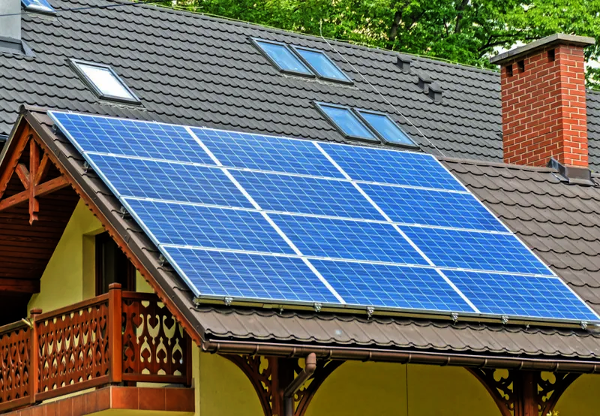
India’s flagship residential rooftop-solar programme has crossed a major national milestone, with more than 50 lakh households now covered under the Pradhan Mantri Surya Ghar: Muft Bijli Yojana.
Union Minister for New and Renewable Energy Pralhad Joshi announced the achievement at the CII International Energy Conference and Exhibition in New Delhi on August 6, 2026.
The minister said around 19 lakh participating households are receiving zero electricity bills, while more than 12 lakh households have collectively earned ₹421 crore by supplying surplus solar electricity to the grid.
The figures demonstrate that the programme is developing beyond a conventional subsidy scheme. Rooftop systems are allowing households to generate electricity for their own use, reduce purchases from distribution companies and, where state regulations permit, receive financial credit or payment for surplus energy exported through the grid.
The scheme has now reached half of its ultimate target of covering one crore residential households by the financial year 2026–27.
From Electricity Consumers to Energy Producers
PM Surya Ghar is changing the traditional relationship between households and the electricity system.
Under the conventional model, electricity flows in one direction—from a generating station through transmission and distribution networks to the consumer. A grid-connected rooftop-solar system allows power to flow in both directions.
Solar panels generate electricity during daylight hours. A household first consumes the electricity required to operate appliances, lighting, fans, pumps and other equipment. When generation exceeds immediate consumption, the surplus can be transferred to the local electricity network through a bidirectional meter.
Depending on the regulations adopted by the state electricity regulator and distribution company, the exported electricity may be adjusted against the household’s future consumption or purchased under an approved settlement mechanism.
This makes the rooftop owner a small, decentralised electricity producer.
The ₹421 crore reportedly earned by more than 12 lakh households shows that surplus-power exports are becoming a measurable source of value rather than merely a theoretical benefit of the programme.
Installation Pace More Than Triples
The speed of rooftop-solar deployment has increased sharply.
According to Joshi, the installation rate rose from approximately 5,000 systems per day in October 2025 to more than 16,000 per day in July 2026. This represents an increase of more than 3.2 times within nine months.
The acceleration is significant because residential rooftop solar involves thousands of individual projects rather than a few large solar parks.
Every installation requires a household application, technical assessment, vendor selection, equipment procurement, installation, inspection, net-metering approval and subsidy processing. Scaling this process nationally requires coordination among the Union government, state agencies, electricity distribution companies, banks, vendors and local authorities.
Official data showed that 39,72,447 rooftop-solar systems covering 48,02,717 households had been installed by July 22, 2026. The crossing of the 50-lakh beneficiary mark shortly afterwards indicates that deployment continued at a high rate into August.
The number of beneficiary households can differ from the number of rooftop systems because the government records installations and households covered as separate measures.
Nineteen Lakh Households Record Zero Bills
The scheme’s most immediate attraction is the possibility of sharply reducing monthly electricity expenditure.
Approximately 19 lakh households have now recorded zero electricity bills, according to the latest ministerial announcement.
A zero bill does not mean that every participating household automatically receives 300 units of electricity without charge. The result depends on the capacity of the rooftop system, local sunlight, equipment performance, household consumption and the applicable net-metering arrangement.
A properly sized system may generate enough electricity during a billing period to offset the household’s grid consumption. When the value of electricity produced and exported equals or exceeds the electricity drawn from the network, the energy component of the bill can fall to zero.
Some fixed charges, meter charges, duties or other state-specific levies may still apply.
Earlier government data indicated that more than 18.93 lakh beneficiaries had recorded a zero electricity bill during at least one monthly billing cycle by July 20, 2026. The figure was based on information reported by electricity distribution companies.
The latest announcement rounds this figure to approximately 19 lakh households.
How Households Earn from Surplus Electricity
The ability to earn from surplus electricity depends on the interaction between rooftop generation and household demand.
A solar system normally produces its highest output between late morning and early afternoon. Many residential households consume less electricity during these hours, particularly when occupants are away at work or school.
The unused electricity can be exported to the grid.
A bidirectional meter separately records electricity imported from the distribution system and electricity exported by the rooftop plant. The distribution company then calculates the consumer’s bill according to the applicable net-metering, net-billing or gross-metering regulations.
Under net metering, exported units are generally offset against imported units. Under net billing, exported electricity may be credited at a separately determined tariff. The exact arrangement varies among states.
A three-kilowatt rooftop system can generate more than 300 units in a favourable month, although actual output will vary according to location, season, panel orientation, shade, temperature and equipment condition.
Households with moderate daytime consumption may therefore produce enough electricity to cover their requirements and retain an exportable surplus.
The reported ₹421 crore earned by 12 lakh households averages approximately ₹3,500 per participating household. The actual amount received by individual beneficiaries will vary considerably according to generation, consumption and state settlement rules.
A ₹75,021-Crore National Programme
PM Surya Ghar: Muft Bijli Yojana was launched in February 2024 with an approved financial outlay of ₹75,021 crore.
Its central objective is to support rooftop-solar installations covering one crore residential households by the financial year 2026–27.
The programme is demand-driven. Residential consumers with a grid-connected electricity connection can apply through the national PM Surya Ghar portal, select a registered vendor and complete the installation according to prescribed technical standards.
The government provides Central Financial Assistance to reduce the upfront cost.
The subsidy is generally structured as:
- ₹30,000 for a one-kilowatt system;
- ₹60,000 for a two-kilowatt system; and
- ₹78,000 for a three-kilowatt or larger eligible residential system.
For capacities above three kilowatts, the central subsidy is ordinarily capped at ₹78,000.
Some states and Union Territories provide additional assistance, which can further reduce the cost borne by households.
Affordable Loans Expand Access
The initial cost of purchasing and installing solar panels remains one of the largest barriers to residential adoption.
To make rooftop systems accessible to middle-income and economically weaker households, nationalised banks provide collateral-free loans at concessional rates for eligible installations.
As of July 2026, the applicable interest rate was stated as the Reserve Bank of India’s repo rate plus 50 basis points—equivalent at that time to approximately 5.75 per cent annually—with a repayment period of up to ten years.
The loan structure allows a household to spread its expenditure over several years while beginning to save on electricity bills immediately after commissioning.
Whether a household achieves positive monthly savings after paying the loan instalment depends on the system price, subsidy, loan terms, electricity tariff and solar generation.
The scheme’s economics generally become more attractive for homes with higher electricity consumption and access to unshaded rooftop space.
Subsidy Spending Accelerates
Government expenditure under PM Surya Ghar has risen rapidly as installations have expanded.
The scheme recorded expenditure of:
- ₹7,822.92 crore during 2024–25;
- ₹16,166.23 crore during 2025–26; and
- ₹10,392.48 crore during 2026–27 as of July 22, 2026.
The budget allocation for the current financial year stands at ₹22,000 crore.
The rising expenditure reflects the growing volume of subsidy claims, installations and financing support.
By June 2026, the government had stated that more than ₹22,750 crore in subsidies had been disbursed, including ₹2,743 crore during May alone.
Direct transfer of the approved subsidy into the beneficiary’s bank account is intended to reduce intermediaries and make the payment process more transparent.
Utility-Led Models for Households Without Suitable Roofs
Individual rooftop ownership remains difficult for families living in rented homes, apartment complexes, densely built settlements or houses with weak or shaded roofs.
The government has therefore introduced Renewable Energy Service Company and Utility-Led Aggregation models under the scheme.
Under these arrangements, a utility or specialised company can aggregate a large number of consumers, arrange financing, install systems and recover its investment through an agreed commercial structure.
The model could enable participation by households that lack sufficient capital or suitable individual rooftop space.
It may also reduce costs through bulk procurement, standardised installations and professional maintenance.
The expansion of aggregation models will be important if PM Surya Ghar is to progress beyond relatively affluent homeowners and reach a wider cross-section of urban and rural consumers.
Rooftop Solar Strengthens the Electricity Grid
India’s electricity demand is rising rapidly due to economic growth, urbanisation, industrialisation, air-conditioning, electric mobility and improved household access.
Rooftop solar adds generation close to the point at which electricity is consumed.
This can reduce the quantity of power that distribution companies must transport over long distances during sunny daytime hours. It can also lower technical losses and ease pressure on local transformers and distribution feeders in areas where solar output coincides with peak demand.
However, very high rooftop-solar penetration also creates new technical requirements.
Distribution companies need smart meters, improved forecasting, modern protection systems and better management of two-way power flows. Voltage fluctuations can occur on local feeders when solar generation is high and consumption is low.
Future growth will therefore require investment in distribution-network modernisation, battery storage and digital energy-management systems.
Reducing Dependence on Centralised Generation
Large power plants will remain essential to India’s electricity system, but decentralised rooftop generation can reduce the need for some additional daytime electricity from coal, gas and utility-scale renewable projects.
Millions of small systems distributed across the country also create a more diversified generation network.
A problem at one rooftop plant has negligible impact on the national grid, whereas the sudden failure of a large generating unit can remove hundreds or thousands of megawatts from the system.
Distributed solar can improve resilience when combined with batteries, smart inverters and systems capable of operating safely during local outages.
Most grid-connected rooftop plants currently shut down automatically when the electricity network fails. This anti-islanding protection prevents solar electricity from entering lines on which technicians may be working.
Households seeking backup electricity during outages require an appropriately designed hybrid inverter and battery system.
Supporting Domestic Solar Manufacturing
The rapid expansion of residential rooftop solar is creating a large domestic market for modules, inverters, mounting structures, cables, meters and electrical protection equipment.
PM Surya Ghar requires eligible installations to comply with domestic-content and approved-manufacturer requirements prescribed by the government.
The objective is to ensure that public subsidy supports Indian manufacturing and reduces dependence on imported solar equipment.
A stable residential market can encourage manufacturers to invest in new capacity because demand is distributed across millions of installations rather than being dependent only on occasional utility-scale tenders.
The scheme is also creating opportunities for small and medium enterprises involved in installation, engineering, financing, logistics, maintenance and digital monitoring.
Employment Across the Solar Value Chain
The government estimates that the one-crore-household target could create approximately 17 lakh employment opportunities across manufacturing, logistics, supply chains, sales, installation, operation, maintenance and financial services.
Rooftop solar is relatively labour-intensive because every system must be individually surveyed, designed, transported, installed, connected and inspected.
The workforce required includes electricians, solar-panel installers, civil technicians, engineers, sales personnel, loan officers, meter technicians and maintenance workers.
Training and certification will be essential to ensure that rapid expansion does not compromise electrical safety or installation quality.
Poorly installed systems can create risks involving loose structures, exposed wiring, water leakage, electrical fires and reduced energy production.
The long-term reputation of the programme will depend on systems continuing to operate safely and efficiently for 20 to 25 years.
Environmental Benefits
The government estimates that rooftop-solar installations covering one crore households could add approximately 30 gigawatts of distributed solar capacity.
Over an assumed operating life of 25 years, the systems are projected to generate around 1,000 billion units of renewable electricity and avoid approximately 720 million tonnes of carbon-dioxide-equivalent emissions.
The environmental benefit depends on the amount of solar electricity that replaces power generated from fossil fuels.
Rooftop installations also use existing built space, reducing the requirement to acquire large tracts of land for energy projects.
Their environmental footprint must nevertheless be managed across the full equipment lifecycle, including responsible manufacturing, replacement of inverters and recycling of solar modules at the end of their operating life.
Halfway to the One-Crore Target
Crossing 50 lakh beneficiary households places PM Surya Ghar halfway towards its national goal.
The next 50 lakh may be more difficult to reach.
Many early adopters had sufficient rooftop space, access to finance and relatively high electricity bills, making the economic case straightforward. Future expansion will need to cover lower-income households, apartment residents, tenants and consumers in states where rooftop deployment has progressed more slowly.
Distribution companies will also need to process a rising volume of inspections, meter replacements and grid-connectivity applications without creating delays.
The government has set an intermediate objective of reaching 75 lakh households by December 2026, before moving towards one crore by the end of the financial year.
Maintaining an installation rate above 16,000 systems per day would provide strong momentum, although achieving the final target will require sustained participation from states, banks, vendors and electricity utilities.
A Decentralised Clean-Energy Transformation
The importance of PM Surya Ghar lies in the scale at which it is bringing electricity generation into ordinary homes.
More than 50 lakh beneficiary households, 19 lakh zero-bill consumers and ₹421 crore earned by families exporting surplus electricity represent three distinct outcomes: wider clean-energy access, direct household savings and the emergence of citizens as small power producers.
The programme is simultaneously building a residential solar market, supporting domestic manufacturing, creating skilled employment and adding decentralised renewable capacity.
Its long-term success will depend on the quality of installations, timely subsidy payments, reliable net metering, fair treatment of exported electricity and effective maintenance throughout the life of each system.
The 50-lakh milestone shows that rooftop solar has moved beyond a niche technology in India. It is becoming part of the country’s mainstream electricity system and an increasingly important instrument for household savings, clean-energy generation and national energy security.
References
News on AIR. “PM Surya Ghar Muft Bijli Yojana Crosses 50 Lakh Beneficiary Households: Energy Minister Pralhad Joshi.” August 6, 2026.
Press Information Bureau, Ministry of New and Renewable Energy. Parliamentary replies and progress reports on PM Surya Ghar: Muft Bijli Yojana, July 2026.
Press Information Bureau, Ministry of New and Renewable Energy. “75 Lakh Households Targeted for Rooftop Solar Installations by December 2026.” June 4, 2026.
Press Information Bureau. “PM Surya Ghar: India’s Solar Revolution.” March 13, 2025.
You may also like
-
India’s Economic Warfare Challenge: Strategic Autonomy, Energy Security and the Rise of a Global Power
-
India-US Trade Deal Stalemate: Why Washington’s Tariff Pressure Has Failed to Secure an Agreement
-
US Double Standards in Foreign Policy: 16 Recent Cases Involving India, Russia, China and Global Trade
-
India’s Arctic Energy Ambitions: Russian Oil, LNG and a New Sea Route to Indian Ports
-
India and Russia Explore Joint Icebreaker Construction as Maritime Industrial Cooperation Expands
