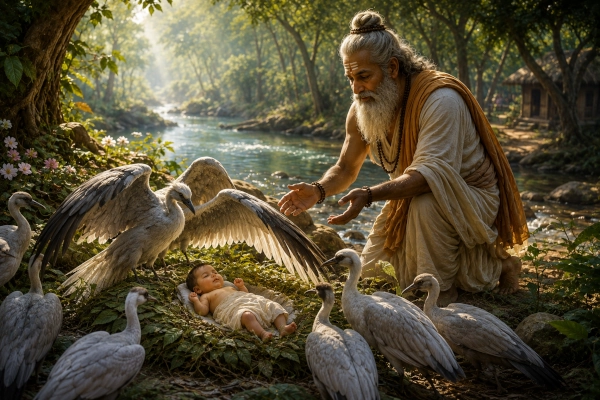
Long before the Kuru princes were born, before Hastinapura became the centre of a great struggle for power, a newborn child lay alone beside the river Malini.
No cradle held her.
No palace guards watched over her.
Her mother had vanished into the heavens, and her father sat far away in meditation, unaware that a daughter had entered the world.
Around the helpless infant stretched an ancient forest filled with prowling beasts, twisting roots and the dark movements of unseen creatures. Yet destiny had not abandoned her.
From the branches above descended a flock of birds.
They gathered around the child, spread their wings over her fragile body and became her first guardians.
The infant whom human beings had left behind was saved by the compassion of the forest.
She would be named Shakuntala—the girl protected by the shakunta birds.
Vishvamitra’s Terrible Penance
The story began with the great sage Vishvamitra.
He had once been a powerful king, proud of his armies, wealth and royal authority. But an encounter with the sage Vasistha revealed that spiritual power could surpass the strength of kingdoms.
From that day, Vishvamitra renounced his throne and entered the wilderness. He sought through austerity to rise beyond the limits of kingship and attain the status of a Brahmarshi.
His penance became severe.
He stood beneath the burning sun with his arms raised above his head. During the rains, he remained exposed to storms. In winter, he entered freezing water and meditated while cold winds swept across the forest.
He controlled his breath, silenced hunger and withdrew his mind from every worldly desire.
Years passed.
Ants built mounds around his motionless feet. Creepers climbed over his body. Birds nested in his matted hair, mistaking the unmoving sage for part of the forest.
The heat generated by his austerities began to spread through the worlds.
Rivers seemed to tremble. Celestial beings felt the growing force of his penance. Even Indra, king of the gods, became uneasy.
Indra feared that Vishvamitra might acquire power great enough to challenge the celestial order. He therefore decided to interrupt the sage’s meditation before his austerities reached their full strength.
For this task, he summoned the apsara Menaka.
Menaka Descends to Earth
Menaka was one of the most beautiful dancers in the court of the gods.
Her movements were graceful enough to still the winds. Her anklets produced music that could soften the anger of warriors, and her face possessed the calm radiance of the full moon.
But when Indra ordered her to approach Vishvamitra, fear entered her heart.
“Lord of heaven,” she said, “Vishvamitra’s anger is as fierce as fire. If he discovers that I have disturbed his penance, his curse may destroy me.”
Indra reassured her.
“The wind shall assist you,” he said. “Kama, the god of desire, shall enter the forest. The season itself will become your ally.”
Bound by the command of the celestial king, Menaka descended from heaven.
The wilderness changed as she entered it.
Trees suddenly blossomed out of season. Bees emerged from hidden hollows and hummed among the flowers. A mild breeze carried the fragrance of jasmine and sandalwood through the forest.
Cuckoos began to call from the branches. Deer moved gently through the grass. The harsh wilderness became as soft and inviting as a celestial garden.
Menaka approached a clear pool near the place where Vishvamitra meditated.
She stepped into the water.
Her anklets chimed.
The sound was delicate, yet in the deep silence surrounding the sage, it seemed to travel through every tree.
The wind rose at Indra’s command. It caught Menaka’s garments and carried them lightly away. She cried out and moved after them with apparent embarrassment.
Vishvamitra opened his eyes.
The Sage and the Apsara
For years, the sage had turned his mind away from the world. But when his eyes fell upon Menaka, the power of desire entered the stillness he had built within himself.
He saw her standing beside the water, surrounded by blossoms shaken loose by the wind.
For a moment, the forest, the austerities and his great ambition disappeared from his mind.
Menaka lowered her eyes.
Vishvamitra invited her to remain in his hermitage, and she agreed.
Days became months. Months became years.
The severe ascetic who had once ignored hunger and cold now walked with Menaka through flowering groves. They listened to the river at twilight and watched moonlight descend through the branches.
Although Menaka had approached him under Indra’s command, her feelings grew complicated. She had been sent to deceive the sage, yet she could not remain untouched by the life they shared.
In time, she conceived a child.
But Vishvamitra eventually awakened from the enchantment that surrounded him.
He understood that his penance had been broken. He recognised the design of Indra and the part Menaka had played in it.
Anger rose within him, but it was joined by shame. He knew that the failure was not hers alone. Desire had existed within his own heart, and it was that hidden weakness which had defeated him.
Without cursing Menaka, Vishvamitra turned away from worldly life once more and departed to resume his austerities in a distant wilderness.
Menaka remained behind, carrying their unborn child.
The Birth Beside the Malini
When her time came, Menaka travelled to the banks of the river Malini.
The river flowed gently through the forest, its clear waters passing beneath leaning trees and flowering vines. White cranes stood among the reeds, while deer approached the banks to drink.
There, in the solitude of the wilderness, Menaka gave birth to a daughter.
The infant had dark, luminous eyes and skin that seemed touched by the soft glow of dawn. Her tiny fingers curled around Menaka’s hand.
For a moment, the apsara looked upon her child with tenderness.
But Menaka belonged to the celestial realm. Her task on earth had ended, and she feared both Vishvamitra’s anger and the consequences of returning to heaven with the infant.
Caught between celestial duty and maternal love, she made a painful choice.
She placed the newborn upon a bed of soft leaves near the river.
The child stirred and began to cry.
Menaka hesitated.
The sound followed her through the trees as she walked away. For a moment, she nearly turned back. But then her celestial form rose from the earth, and she disappeared towards the heavens.
The infant was left alone.
The Forest Draws Near
The child’s cries travelled through the wilderness.
A jackal paused among the bushes and lifted its head. A snake moved through the grass. Farther away, the low growl of a hunting beast rolled between the trees.
The afternoon sun descended. Shadows lengthened across the riverbank.
The newborn had no strength to move and no voice beyond her small, desperate cries.
Then the birds came.
They were shakuntas—forest birds that had heard the infant from the surrounding trees.
One descended and landed near her head.
Another settled beside her feet.
Soon many birds gathered around the abandoned child. Some called loudly into the forest. Others pecked at insects crawling near her body.
As the sun grew fierce, the birds spread their wings above her, forming a living canopy.
Their feathers shielded her face from the heat.
When cold wind rose from the river, they pressed close around her. Some brought drops of water in their beaks. Others remained alert, crying out whenever a creature approached.
A snake glided towards the child through the fallen leaves.
The birds shrieked and descended upon it. They struck at its head and wings beat against its eyes until the serpent withdrew into the grass.
Later, a jackal emerged from the shadows.
The flock rose as one.
Their cries filled the forest. They flew at the animal’s face, pecking and beating their wings until it turned away.
All through the night, the birds remained around the infant.
Moonlight silvered the river. The forest echoed with the calls of owls and distant beasts, but the small child slept beneath a shelter made of feathers.
She had been abandoned by the celestial world and left unprotected by humankind.
Yet the creatures of the forest refused to let her die.
Sage Kanva Hears the Birds
At dawn, the sage Kanva left his hermitage to bathe in the Malini.
Kanva was a revered ascetic whose ashrama stood within the forest. His life was devoted to sacred study, sacrifice, compassion and the instruction of disciples.
As he approached the river, he heard an unusual sound.
The birds were calling loudly from one place along the bank.
Their voices did not resemble the peaceful songs of morning. They were sharp and urgent, as though warning him or asking him to follow.
Kanva turned from the path.
He moved through the reeds and came upon a remarkable sight.
A newborn girl lay upon a bed of leaves. Around her stood dozens of birds. Their wings were spread over her, and their eyes watched the sage cautiously.
Kanva stopped.
The birds did not flee.
One remained beside the infant’s head. Another touched the cloth around her with its beak. The entire flock seemed determined to protect her even from the approaching hermit.
Kanva’s heart filled with compassion.
He knelt slowly and extended his hands.
“I shall not harm her,” he said gently. “You have guarded this child well.”
The birds watched him.
Perhaps they recognised the peace in his voice. Perhaps the forest itself revealed that the sage could be trusted.
One by one, they folded their wings and moved aside.
Kanva lifted the infant.
The child opened her eyes and looked at him. Her crying ceased.
Through his spiritual vision, the sage perceived something of the mystery surrounding her. He understood that this was no ordinary forest child, though he did not yet know the full destiny she carried.
He looked towards the birds gathered around them.
“Because the shakuntas protected you when all others had left you,” he said, “you shall be called Shakuntala.”
At the sound of the name, the birds filled the air with gentle calls.
Then they rose from the ground and flew into the morning sky.
Childhood in Kanva’s Hermitage
Kanva carried Shakuntala back to his ashrama and raised her as his own daughter.
The hermitage became her first true home.
She grew among sacred fires, quiet cottages and trees heavy with fruit. Disciples taught her to gather flowers for worship, feed the deer and carry water from the river.
The animals loved her.
Fawns followed her through the forest. Peacocks opened their brilliant tails when she approached. Birds descended onto her shoulders and ate grains from her hands.
She spoke gently to every creature and seemed to understand the moods of the wilderness. When a young deer was injured, she cleaned its wound. When summer dried the forest pools, she carried water for birds and smaller animals.
Her beauty grew with her.
Her hair was dark as a rain cloud. Her eyes were deep and calm, and the simplicity of the hermitage gave her a grace no palace ornament could imitate.
Kanva loved her completely.
Though he had not fathered her body, he had given her protection, education and affection. To Shakuntala, he was her true father.
The sage once explained:
“The one who gives life, the one who protects life and the one who provides food may all be called a father. Love and duty create bonds as sacred as birth.”
Shakuntala therefore never felt that she lacked a family.
The forest had guarded her.
The birds had sheltered her.
Kanva had chosen her.
King Dushyanta Enters the Forest
Years passed, and Shakuntala became a young woman.
One day, King Dushyanta entered the forest while hunting.
The sound of chariot wheels and hunting horns disturbed the quiet woods. Deer fled between trees, and birds rose in frightened clouds.
But when Dushyanta neared Kanva’s hermitage, he ordered his soldiers to remain behind. He understood that weapons, noise and bloodshed had no place in an ascetic sanctuary.
The king entered the ashrama alone.
There he saw Shakuntala watering young plants.
She wore simple bark garments, yet she seemed more radiant than women dressed in royal silk. A fawn stood beside her, drinking from the water that spilled from her vessel.
Dushyanta stopped.
Shakuntala looked up.
For a moment, neither spoke.
The king asked who she was, wondering how a woman of such noble appearance had come to live in a forest hermitage.
Shakuntala welcomed him according to the customs of the ashrama. She offered water and a seat, then explained that she was the daughter of Sage Kanva.
Dushyanta was puzzled.
“Kanva is known for his lifelong celibacy,” he said. “How can you be his daughter?”
Shakuntala then told him the story of her birth—how she had been born to Vishvamitra and Menaka, abandoned beside the Malini, protected by birds and found by Kanva.
Dushyanta listened in amazement.
He recognised in her both royal and celestial lineage.
But it was not merely her ancestry that drew him. He saw her compassion, intelligence and dignity.
Affection grew rapidly between them, and the king asked her to become his wife.
The Promise of a Son
Shakuntala did not answer lightly.
She understood that a woman raised in a forest hermitage could easily be forgotten once a king returned to his palace. She therefore sought a promise concerning the future.
“The son born from our union must be acknowledged as your heir,” she said.
Dushyanta agreed.
They entered into a gandharva marriage, a union based upon mutual consent.
For a time, the king remained in the hermitage. But royal duties eventually called him back to his capital.
He promised to send an escort for Shakuntala and bring her to the palace with honour.
Then he departed.
Shakuntala watched his chariot disappear between the trees.
The forest became quiet once more.
In time, she realised that she was carrying his child.
The Birth of Sarvadamana
Shakuntala gave birth to a powerful son.
From infancy, the boy displayed extraordinary strength and fearlessness. While other children played with wooden toys, he wandered among wild animals.
He opened the mouths of lion cubs and counted their teeth.
He wrestled with young tigers.
He tied powerful forest beasts to trees as though they were harmless calves.
The sages named him Sarvadamana—the subduer of all.
Yet Shakuntala remembered Dushyanta’s promise. The child belonged not only to the hermitage but also to a royal dynasty.
When the boy had grown, Kanva decided that mother and son should go to the king’s court.
Shakuntala left the forest where she had spent her life.
Birds called from the branches as she departed. Deer followed her for some distance before stopping at the edge of the trees.
The forest child now travelled towards a palace.
Dushyanta’s Denial
Shakuntala entered the royal court with her son beside her.
Dushyanta sat upon the throne surrounded by ministers, priests and warriors.
She reminded him of their meeting in Kanva’s hermitage, their marriage and his promise that their son would become heir.
But before the assembled court, the king denied knowing her.
In some traditions, this denial arose from a curse that clouded his memory. In the Mahabharata’s account, Dushyanta’s hesitation is presented as concern over public acceptance and the legitimacy of the heir.
Whatever the cause, his words struck Shakuntala with terrible force.
The woman who had been abandoned as an infant now faced abandonment again.
Yet she did not collapse.
She stood before the throne with dignity.
“Truth is greater than a thousand sacrifices,” she declared. “A king may deceive others, but he cannot deceive the witness within his own heart.”
She reminded Dushyanta that a son is the continuation of his father and that rejecting one’s own child is a rejection of dharma.
Sarvadamana stood beside her, fearless even before the royal court.
Then a divine voice sounded from the heavens.
It confirmed that the boy was indeed Dushyanta’s son and commanded the king to accept him.
Dushyanta rose from his throne.
He embraced the child and acknowledged Shakuntala as his queen. He explained that he had feared the court might otherwise question the legitimacy of a son brought from the forest.
Sarvadamana was declared heir.
He later became known as Bharata.
The Child Who Gave India Its Ancient Name
Bharata grew into a mighty emperor.
His authority extended across vast lands, and his fame spread among kings, sages and distant peoples. Through his strength and governance, the realm became associated with his name.
The land came to be celebrated as Bharatavarsha—the realm of Bharata.
Thus the abandoned infant protected by birds became the mother of one of the most renowned rulers of ancient tradition.
Shakuntala’s journey began without human protection.
Her celestial mother left her.
Her great father did not know she existed.
A king later hesitated to acknowledge her.
Yet each abandonment revealed the strength within her.
She survived because birds guarded her.
She grew because Kanva loved her.
She prevailed because she refused to surrender truth.
The shakuntas that sheltered her upon the riverbank could not have known the destiny of the child beneath their wings. They saw only a helpless life and chose to protect it.
But through that simple act of compassion, they preserved the woman who would give birth to Bharata and become an ancestress of the great dynasties of the Mahabharata.
Shakuntala carried the memory of those first guardians in her very name.
She was the child of a kingly sage and a celestial apsara, the daughter of Kanva by love, the wife of Dushyanta and the mother of Bharata.
Yet before she was any of these, she was a newborn beneath a canopy of wings.
And the forest, kinder than the world that had abandoned her, kept her alive.
You may also like
-
Durga versus Mahishasura: Weapons, Battlefield Tactics and the Triumph of Shakti
-
National Institute of Naturopathy Opens Admissions for BNYS Programme at Pune for 2026–27
-
Yudhishthira’s Counter-Diplomacy With Shalya: Working With an Ally Who Has Joined the Other Side
-
Gnani AI Launches Nationwide Challenge Offering Up to 100 Paid AI Internships
-
NMMSS Scholarship Application Deadline Extended to October 31, 2026
