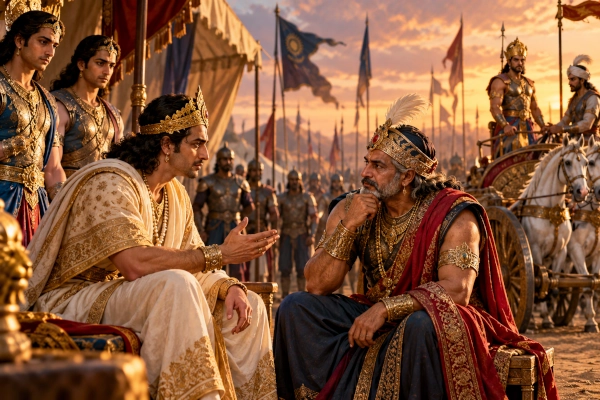
The Mahabharata repeatedly shows that diplomacy does not end simply because alliances have hardened. One of its most subtle examples appears in Yudhishthira’s handling of King Shalya, ruler of Madra and maternal uncle of Nakula and Sahadeva. Shalya begins his journey intending to support the Pandavas, but Duryodhana intercepts him with extraordinary hospitality and secures a promise before revealing who has provided it. Bound by his word, Shalya agrees to fight for the Kauravas.
For Yudhishthira, this creates a difficult diplomatic problem. A king who is personally connected to the Pandavas and initially sympathetic to them has now formally entered the opposing camp. Yet Yudhishthira does not react by condemning Shalya, questioning his honour or severing relations. Instead, he accepts the political reality of Shalya’s commitment and looks for the remaining space in which cooperation is still possible.
The episode becomes a remarkable example of counter-diplomacy: rather than trying to reverse an alliance that Shalya believes he is honour-bound to maintain, Yudhishthira asks how that relationship can still be used strategically.
Shalya Sets Out to Support the Pandavas
Shalya is not initially presented as a natural Kaurava ally. As the brother of Madri, he is closely related to Nakula and Sahadeva and intends to join the Pandavas as the conflict moves towards war.
Duryodhana learns of Shalya’s approach and acts before the Pandavas can receive him. Along Shalya’s route, elaborate arrangements are made for his army’s rest, food and hospitality. Shalya is deeply impressed and assumes that Yudhishthira has organised the reception.
Believing himself indebted to his host, Shalya declares that he wishes to reward the person responsible and offers a boon. Only then does Duryodhana reveal himself.
Shalya has been manoeuvred into a difficult position. Having already offered a favour, he considers himself bound by his word. Duryodhana asks him to support the Kaurava cause, and Shalya agrees.
The episode demonstrates that Duryodhana understands diplomacy as preparation, timing and leverage. He does not persuade Shalya through ideology. Instead, he creates a situation in which Shalya’s own sense of honour becomes the mechanism that secures his cooperation.
Shalya Does Not Hide What Happened
After giving his promise to Duryodhana, Shalya continues on to meet Yudhishthira.
This moment is important because Shalya does not conceal his new commitment. He explains how Duryodhana gained his promise and makes clear that he now considers himself obliged to honour it.
Yudhishthira could have interpreted this as betrayal. From a purely emotional perspective, he had reason to feel aggrieved. Shalya was a close relative of two Pandava brothers and had originally intended to support them.
Yet Yudhishthira recognises that Shalya has not voluntarily abandoned the relationship in the ordinary sense. He has become trapped by an obligation created through Duryodhana’s calculated hospitality.
Rather than spending political capital attacking Shalya over an irreversible commitment, Yudhishthira turns immediately towards what can still be achieved.
Yudhishthira Accepts the Existing Commitment
Yudhishthira does not ask Shalya to break the promise he has already given Duryodhana.
That restraint is central to the episode. If Yudhishthira demanded that Shalya violate his word, he would place him in a conflict between family loyalty and royal honour. It might also weaken Yudhishthira’s own moral position by asking another ruler to disregard a pledged commitment.
Instead, he effectively accepts the situation as it now stands.
Shalya will fight for the Kaurava army. That cannot easily be changed. Yudhishthira therefore identifies another question: can Shalya still assist the Pandavas without formally abandoning the obligation he has undertaken?
This is where the encounter moves from disappointment to strategy.
Yudhishthira Anticipates Karna’s Need for a Charioteer
Yudhishthira understands that Karna will eventually become one of Arjuna’s most dangerous opponents.
A battlefield confrontation between Karna and Arjuna is not merely possible; it has become central to the strategic structure of the coming war. Karna sees Arjuna as his great rival, while Duryodhana depends heavily on Karna as one of the warriors capable of threatening the Pandavas’ strongest military asset.
Yudhishthira therefore asks Shalya for a very particular favour.
If circumstances lead to Shalya becoming Karna’s charioteer during the confrontation with Arjuna, Yudhishthira asks him to act in a manner that reduces Karna’s confidence and fighting spirit.
The request is unusually precise. Yudhishthira is not seeking intelligence about Kaurava deployments, a battlefield defection or deliberate sabotage of Shalya’s own army. He is targeting the psychological relationship between warrior and charioteer.
Why the Charioteer Matters in the Mahabharata
In the warfare portrayed in the Mahabharata, a charioteer is far more than a driver.
The charioteer controls movement, observes battlefield conditions, positions the warrior, judges terrain, manages horses and communicates continuously with the fighter. A skilled charioteer can help preserve a warrior’s concentration and confidence under extreme pressure.
The most famous example is Krishna’s role as Arjuna’s charioteer. Krishna’s contribution is strategic, psychological and moral as much as physical.
Yudhishthira understands the same principle from the opposite direction.
If Karna enters his decisive confrontation with Arjuna accompanied by a charioteer who constantly questions his judgement, compares him unfavourably with his opponent and undermines his confidence, the effect may be disproportionate to the apparently limited intervention.
Yudhishthira therefore converts Shalya’s unavoidable presence within the Kaurava camp into a possible source of strategic pressure.
Shalya Agrees to the Request
Shalya accepts Yudhishthira’s request.
This preserves the peculiar duality of his position. He remains committed to fighting on Duryodhana’s side because of the promise he has given, yet he also retains sympathy for the Pandavas and agrees to assist Yudhishthira in the particular circumstances he has described.
The arrangement becomes important later in the war when Shalya indeed becomes Karna’s charioteer.
During Karna’s final campaign against Arjuna, Shalya repeatedly criticises and provokes him. Their exchanges become increasingly bitter, with Shalya praising Arjuna and questioning Karna’s claims of superiority.
The tension between warrior and charioteer becomes one of the defining features of Karna’s final battlefield appearance.
Yudhishthira Uses Influence Without Demanding Defection
The diplomatic significance of the episode lies in what Yudhishthira does not demand.
He does not insist that Shalya publicly switch sides. He does not demand that Shalya violate his oath. He does not treat continued communication as weakness or compromise.
Instead, he separates formal alignment from residual influence.
Shalya may now belong militarily to the Kaurava coalition, but his personal relationships, sympathies and judgement have not been erased. Yudhishthira understands that political alignment is not always identical to complete psychological or strategic loyalty.
That distinction creates room for diplomacy even after the formal alliance structure appears settled.
The Difference Between Position and Relationship
Shalya’s position has changed, but his relationship with the Pandavas has not disappeared.
This distinction is essential to understanding Yudhishthira’s response. States, rulers and political actors can occupy opposing positions while retaining channels of communication, personal trust or shared interests.
Yudhishthira does not confuse Shalya’s obligation to Duryodhana with permanent hostility towards the Pandavas.
Because he preserves that distinction, he can continue negotiating with someone who is technically part of the opposing coalition.
Had Yudhishthira responded with humiliation or accusation, Shalya might have become emotionally committed to Duryodhana as well as formally committed to him. By treating him with dignity, Yudhishthira leaves the older relationship intact.
Duryodhana Wins the Alliance, Yudhishthira Preserves the Relationship
The episode also provides an interesting contrast between two different forms of diplomacy.
Duryodhana acts first and successfully captures Shalya’s formal military support. His strategy is tactically effective. He exploits hospitality, timing and Shalya’s commitment to honour.
Yudhishthira arrives too late to prevent that success.
But Yudhishthira does something Duryodhana has not secured: he preserves Shalya’s underlying goodwill.
Duryodhana possesses Shalya’s pledge. Yudhishthira retains Shalya’s confidence.
The distinction becomes strategically meaningful when Shalya later occupies a position close to Karna.
The episode therefore shows that diplomatic success cannot always be measured solely by formal declarations of allegiance. Informal relationships may continue to influence events even after official commitments have changed.
Yudhishthira Does Not Waste Energy on an Irreversible Loss
Another notable feature of Yudhishthira’s conduct is his refusal to spend time lamenting a diplomatic setback that can no longer be easily reversed.
Shalya has already given his word. Repeatedly arguing over how Duryodhana obtained that promise would not recover the lost alliance.
Yudhishthira therefore turns from the question of how the setback happened to the qumkae an image for thisestion of what remains possible.
This ability to distinguish between reversible and irreversible developments is one of the most practical elements of the episode.
Effective diplomacy often requires accepting that a particular outcome has already occurred and redirecting effort towards whatever leverage remains.
Modern Meaning: Diplomacy Can Continue Across Opposing Camps
The modern lesson from Yudhishthira’s handling of Shalya is that formal alignment does not necessarily require the destruction of every relationship across the divide.
Countries frequently maintain diplomatic missions, military hotlines, trade channels, intelligence contacts or political dialogue even when they support opposing sides in a regional dispute.
A partner may enter another coalition because of treaty obligations, economic pressure, security requirements or changes in national interest. Responding by immediately destroying every remaining relationship can eliminate opportunities that may later prove valuable.
Yudhishthira demonstrates another approach: recognise the new alignment, preserve communication and identify the areas where interests still overlap.
Do Not Force an Ally to Choose Again When the Choice Is Already Made
Yudhishthira also avoids forcing Shalya into a second public choice.
Once Shalya has pledged himself to Duryodhana, demanding an immediate reversal would probably deepen the conflict. Shalya would have to defend his honour publicly, making it harder for him to maintain any useful relationship with the Pandavas.
Modern diplomacy often encounters similar situations.
A country may vote differently in an international organisation, purchase weapons from a rival power or join an economic initiative led by another bloc. Treating every disagreement as a loyalty test can push a flexible partner into a permanently hostile position.
Strategic relationships are often better preserved by recognising that states can disagree strongly in one sphere while cooperating in another.
Preserve Access Before Seeking Influence
Yudhishthira’s first achievement is not Shalya’s later behaviour towards Karna. It is the preservation of access.
Without communication, no later request would have been possible.
This is one of the fundamental realities of diplomacy. Influence requires access, and access often survives only when both sides avoid unnecessary humiliation.
Maintaining dialogue with an opposing actor does not imply approval of every decision that actor has made. It simply preserves the ability to communicate when circumstances change.
Yudhishthira retains that ability because he treats Shalya as a ruler constrained by circumstances rather than as an enemy who must be permanently rejected.
Limited Cooperation Can Be More Valuable Than Total Realignment
Yudhishthira does not attempt to recover everything he has lost.
He seeks one strategically significant act.
This is another important diplomatic principle. When complete alignment is impossible, limited cooperation may still produce meaningful results.
States frequently cooperate selectively on maritime security, intelligence, counter-terrorism, energy, disaster relief or trade even when they disagree over major geopolitical questions.
The objective does not always need to be converting the other side completely. Sometimes the realistic goal is securing cooperation in the narrow area where it matters most.
Yudhishthira applies precisely this logic to Shalya.
Personal Relationships Can Survive Coalition Politics
The Mahabharata also recognises something modern diplomacy repeatedly demonstrates: coalition structures do not erase personal relationships.
Shalya remains the maternal uncle of Nakula and Sahadeva despite entering Duryodhana’s army. His affection, obligations and memories do not disappear simply because his military position has changed.
Modern international relations operate differently from the dynastic politics of the epic, but interpersonal and institutional relationships still matter. Leaders, diplomats, military officers and officials often maintain channels across political divides that later become useful during crises.
Diplomatic relationships built over years can therefore retain strategic value even when immediate policy positions diverge.
Counter-Diplomacy Begins After the Opponent Has Already Succeeded
Yudhishthira’s response is particularly instructive because Duryodhana has already achieved his objective.
This is not diplomacy conducted from a position of complete control. It is diplomacy conducted after an adversary has made the first successful move.
Counter-diplomacy begins by asking what remains available.
Yudhishthira cannot undo Duryodhana’s hospitality, erase Shalya’s promise or prevent him from joining the Kaurava army. What he can do is recognise that Duryodhana’s success is incomplete.
Shalya’s military service has been secured. His inner loyalty has not.
That remaining difference becomes Yudhishthira’s diplomatic space.
Strategic Patience Turns a Setback Into Leverage
The Shalya episode reveals a characteristic strength in Yudhishthira’s diplomacy: patience under unfavourable circumstances.
Rather than reacting emotionally to losing an ally, he studies the altered situation and identifies the point at which Shalya may still become strategically useful.
His approach does not erase the setback. Shalya still fights for the Kauravas and eventually becomes commander of their army.
Yet Yudhishthira extracts value from a relationship that appeared lost.
This is the central lesson of the encounter. Diplomacy is not always the art of keeping every ally permanently on one’s own side. Sometimes it is the art of preserving enough trust that even an ally who has crossed into the opposing camp does not become completely inaccessible.
Yudhishthira’s counter-diplomacy with Shalya shows how restraint, personal respect and carefully targeted negotiation can preserve strategic options after formal alignment has already changed. In the Mahabharata’s diplomatic world, as in statecraft more broadly, maintaining a relationship can sometimes achieve what confrontation would permanently destroy.
References
Mahabharata, Udyoga Parva — Shalya’s journey, Duryodhana’s hospitality and Shalya’s meeting with Yudhishthira.
Mahabharata, Karna Parva — Shalya as Karna’s charioteer and their exchanges during Karna’s final campaign.
Bibek Debroy, trans. — The Mahabharata, based on the Bhandarkar Oriental Research Institute Critical Edition.
Kisari Mohan Ganguli, trans. — The Mahabharata of Krishna-Dwaipayana Vyasa, Udyoga Parva and Karna Parva.
You may also like
-
India Strengthens Trade Ties with Netherlands as Piyush Goyal Visits Port of Rotterdam
-
India to Train 600 Nigerian Army Soldiers in Specialised Jungle and Mountain Warfare
-
India and Russia Strengthen Parliamentary Diplomacy as Om Birla Meets State Duma Chairman Vyacheslav Volodin
-
India Seeks South Korean Shipbuilding Partnerships as Sarbananda Sonowal Begins Four-Day Visit to Busan
-
India and Italy Hold First Maritime Security Dialogue in Rome, Strengthen Strategic Maritime Cooperation
