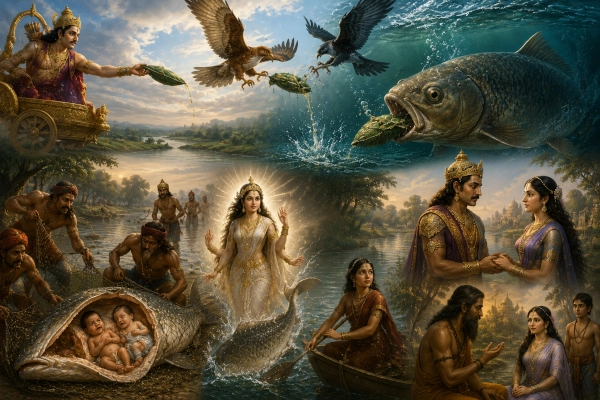
Long before Satyavati became queen of Hastinapura, long before she became the mother of kings and the grandmother of two rival branches of the Kuru dynasty, her destiny began far from any palace.
It began in the heavens, with an apsara named Adrika.
Adrika belonged to the radiant company of celestial maidens who danced in the courts of the gods. Her beauty was like moonlight upon moving water, and her laughter was said to resemble the music of silver bells.
Yet through an offence committed in the celestial realm, she was cursed to abandon her divine form and live upon earth as a fish.
The light of heaven vanished from around her. Graceful arms became fins, her shining garments became cold scales and the apsara who had once moved through golden halls fell into the dark waters of the river Yamuna.
There she remained, swimming beneath the surface, waiting for the mysterious condition that would one day release her from the curse.
She did not know that her freedom would become linked to the birth of one of the most influential women in the Mahabharata.
King Uparichara Vasu
At that time, the kingdom of Chedi was ruled by Uparichara Vasu, a powerful and righteous monarch favoured by Indra.
He was called Uparichara because he possessed a celestial chariot through which he could travel above the earth. When the king crossed the sky, his chariot gleamed like a second sun, and the people below raised their hands in wonder.
Uparichara Vasu governed his kingdom according to dharma. He protected farmers, honoured sages, performed sacrifices and punished injustice without cruelty.
His wife was Queen Girika, graceful, virtuous and deeply beloved by him.
One spring morning, when the forests were bright with new leaves and the air was heavy with the fragrance of blossoms, Girika approached the king. The time was auspicious for conception, and she wished that they might be blessed with a son.
Uparichara Vasu gladly agreed.
But before they could be together, a sacred obligation arose.
The king’s ancestors required him to enter the forest and hunt an animal for an ancestral rite. The command of the Pitris could not be ignored. Torn between affection for his queen and duty towards his ancestors, Uparichara chose dharma.
He entered the forest with his bow.
The King in the Forest
The forest was alive beneath the morning sun.
Deer moved between shafts of golden light. Monkeys leapt among the branches, and peacocks cried from distant ridges. Flowering trees bent beneath clusters of red and yellow blossoms.
Yet as the king travelled through the wilderness, his thoughts remained with Girika.
He remembered her face, her voice and the hope with which she had awaited him. Desire rose powerfully within him, and despite his effort to control his mind, his seed was released.
The king was distressed.
The moment chosen for conception was sacred, and he did not wish the seed to be wasted. He believed it carried the possibility of a son destined for greatness.
He gathered it carefully upon a broad leaf and wrapped the leaf securely.
Looking upward, he saw a trained hawk flying above the trees.
The king called the bird down.
“Carry this swiftly to Queen Girika,” he commanded. “Guard it as you would guard your own life. Do not rest until it reaches her hands.”
The hawk grasped the leaf packet in its beak and rose into the air.
Its wings beat powerfully as it flew towards the royal palace.
Below, rivers wound through forests like silver serpents. Above, clouds drifted across the blue expanse. The bird carried within its beak a secret upon which generations would depend.
But fate had chosen a different destination.
The Battle in the Sky
As the messenger hawk crossed the Yamuna, another hawk saw the packet in its beak.
The second bird believed it to be a piece of flesh.
It swooped down and attacked.
The messenger twisted away, but the attacker struck again. Their wings collided in the air. Feathers scattered across the sky as the two birds fought above the river.
The first hawk refused to release its burden.
The second clawed at its body and snapped at the leaf with its beak.
The struggle grew violent. The birds spiralled downward, screeching as they struck one another.
Then the packet slipped free.
For a moment, the folded leaf turned slowly in the sunlight.
It fell through the air and disappeared into the waters of the Yamuna.
The messenger hawk cried out and circled helplessly above the river, but the current had already carried the packet below the surface.
There, in the dark water, Adrika saw it descending.
The cursed apsara, still living in the body of a great fish, opened her mouth and swallowed it.
Thus the king’s seed, intended for Queen Girika, entered the womb of a celestial woman imprisoned within the form of a fish.
The Fish of the Yamuna
Months passed.
Adrika swam through the deep waters, feeling a strange life grow within her. The river that had been her prison now carried her towards release.
Her body became heavy. She withdrew into the quieter reaches of the Yamuna, hiding among reeds and submerged roots.
The fish knew that the curse was approaching its end.
One morning, fishermen spread their nets across the river.
The Yamuna flowed quietly beneath a pale dawn. Mist drifted over its surface, and the fishermen called to one another as they drew their boats through the water.
Suddenly, one of the nets tightened.
Something enormous struggled beneath it.
The rope pulled violently against the hands of the fishermen. Water burst upward as the fish struck with its tail. The boat rocked, and several men nearly fell into the river.
“Pull together!” cried their leader.
The fishermen strained against the net. Slowly, the great fish was dragged towards the boat.
It was unlike any creature they had caught before. Its scales shone strangely in the morning light, and its body was so large that several men were required to lift it.
They carried it to the riverbank.
When they opened its body, expecting an extraordinary catch, they stepped back in astonishment.
Within the fish were two living human children—a boy and a girl.
At that very moment, the celestial form of Adrika rose from the body that had imprisoned her.
The curse was broken.
For an instant, the fishermen beheld a radiant woman clothed in heavenly light. Her eyes shone with gratitude, and her beauty illuminated the riverbank.
Then the apsara rose towards the heavens and vanished.
The fishermen remained frozen beside the two crying infants.
They had entered the river seeking fish.
Instead, they had drawn the beginning of a dynasty from its depths.
The Twins Are Taken to the King
The astonishing news soon reached King Uparichara Vasu.
The fishermen brought the twins before him and explained how they had been discovered inside the great fish.
Through insight granted by divine favour, the king understood what had happened. These were his children, conceived through the strange arrangement of fate after the hawk had lost the leaf above the Yamuna.
The male child bore auspicious marks and appeared destined for rulership.
Uparichara accepted the boy and arranged for him to be raised as a prince. He later became associated with the land of the Matsyas and continued a royal line.
But the girl carried the strong odour of fish upon her body.
Because of this, she became known as Matsyagandha—the maiden who smelled of fish.
The king entrusted her to the chief of the fishing community who had found her. In many retellings, this fisherman is known as Dasharaja.
Though born of a celestial apsara and a mighty king, the girl grew up in a humble settlement beside the river.
Destiny concealed her royal blood beneath the scent of fish and the clothing of a fisherman’s daughter.
The Childhood of Matsyagandha
Matsyagandha grew into a strong and beautiful young woman.
She learned the movements of the river—the shifting currents, the dangerous whirlpools and the moods of the monsoon. She knew how to secure a boat against a storm, how to read the colour of the water and how to guide travellers safely from one bank to another.
Her foster father trusted her deeply.
She helped him ferry sages, merchants and villagers across the Yamuna. Her hands became firm upon the oars, and her dark hair streamed behind her when the river winds rose.
People noticed her beauty, but the fish-like odour surrounding her kept them at a distance.
Some mocked her.
Others covered their faces when she passed.
Matsyagandha endured their words silently. She carried within her a dignity that neither poverty nor ridicule could destroy.
She did not know that royal blood flowed through her.
She did not know that her mother had once danced in heaven.
She did not know that one day kings would seek her hand and that the future of Hastinapura would be reshaped because of her.
The Meeting with Parashara
One day, the great sage Parashara came to the banks of the Yamuna.
He wished to cross the river, and Matsyagandha was assigned to ferry him.
The sage entered the boat, and she pushed away from the shore. The oars dipped into the water, sending circles across the quiet surface.
As they travelled, Parashara perceived through his spiritual vision that the young boatwoman was no ordinary fisherman’s daughter. He saw the hidden line of her destiny and knew that a son of immense wisdom was meant to be born through her.
The sage told her that she would become the mother of an extraordinary child.
Matsyagandha was frightened.
She feared disgrace, the anger of her foster father and the loss of her future. She also spoke of the odour that had followed her since birth.
Parashara reassured her.
Through his ascetic power, he surrounded the boat with a dense mist so that no one upon either bank could see them. He promised that her maidenhood and honour would remain intact in the eyes of the world.
Then he granted her a remarkable boon.
The odour of fish vanished from her body.
In its place arose a fragrance so exquisite that it travelled for miles. It resembled the mingled scent of lotus, sandalwood and rain upon dry earth.
From that moment she became known as Yojanagandha, the woman whose fragrance could be perceived across a yojana.
Upon an island in the river, she gave birth to a dark-complexioned child.
The infant grew immediately through divine power and stood before his mother as a young ascetic. Because he was born upon an island, he was called Dvaipayana. Because of his dark complexion, he was called Krishna.
The world would later know him as Krishna Dvaipayana Vyasa—the sage who arranged the Vedas and composed the Mahabharata.
Before departing, Vyasa told his mother:
“Whenever you remember me in a time of need, I shall come.”
Then he walked into the forest to begin his life of austerity and wisdom.
Matsyagandha returned to her father transformed.
The fish odour was gone. A divine fragrance surrounded her, and the hidden power of her destiny had begun to reveal itself.
She would thereafter be known as Satyavati.
King Shantanu Finds Satyavati
Years later, King Shantanu of Hastinapura came near the river.
A wonderful fragrance travelled through the air. It was so pure and captivating that the king followed it through the reeds, wondering whether some celestial garden had appeared upon earth.
There he saw Satyavati standing beside a boat.
Her beauty and dignity seized his heart.
Shantanu approached her foster father and asked for her hand in marriage.
The fisherman agreed only on one condition: the sons born to Satyavati must inherit the throne of Hastinapura.
The condition appeared impossible because Shantanu already had a son and heir—Devavrata, the mighty prince who would later become Bhishma.
Unable to disinherit his beloved son, Shantanu returned to the palace in sorrow.
Devavrata soon discovered the reason for his father’s grief.
For Shantanu’s happiness, he surrendered his right to the throne. When the fisherman feared that Devavrata’s future children might later claim the kingdom, the prince took an even more terrible oath.
He vowed never to marry and never to father children.
The gods themselves cried out at the severity of the promise and named him Bhishma.
Thus Satyavati became queen of Hastinapura.
The Mother of the Kuru Line
Satyavati bore Shantanu two sons, Chitrangada and Vichitravirya.
Both became kings, but both died without leaving heirs capable of securing the dynasty.
The Kuru line stood on the edge of extinction.
Then Satyavati remembered the promise made to her long ago upon the river island.
She called for Vyasa.
The sage appeared before her and, through the ancient practice of niyoga, fathered three sons who would determine the future of the kingdom: Dhritarashtra, Pandu and Vidura.
Dhritarashtra became the father of the Kauravas.
Pandu became the father of the Pandavas.
Vidura became the wise counsellor who repeatedly defended dharma within the troubled royal court.
Thus the woman once found inside a fish became the central mother of the Mahabharata’s royal lineage.
The River Beneath the Throne
Satyavati’s life stretched across worlds that rarely touched one another.
She was born from a king’s seed and a cursed apsara.
She was discovered by fishermen and raised beside a river.
She became the mother of Vyasa, the author within the Mahabharata itself.
She became queen of the Kuru dynasty.
Through her decisions, the line of Hastinapura survived. Yet the same line eventually divided into Kauravas and Pandavas and moved towards the terrible war of Kurukshetra.
Behind the crowns, vows and battles of the epic stood the quiet current of the Yamuna.
A hawk’s struggle in the sky had caused a leaf to fall.
A cursed fish had swallowed it.
A fisherman’s net had drawn two children from the water.
From that unlikely chain of events came Satyavati—the woman through whom the central families of the Mahabharata entered history.
Her story reveals one of the epic’s deepest truths: destiny often enters the world through humble and unexpected doors.
The future queen did not begin her life in a palace.
She came from the darkness of a river, carried within a fish, surrounded by mystery.
Yet from that river-born child flowed the entire human drama of the Mahabharata.
You may also like
-
Indian Railways Announces 3,548 NTPC Graduate Vacancies, Applications Open Until November 6, 2026
-
Durga versus Mahishasura: Weapons, Battlefield Tactics and the Triumph of Shakti
-
National Institute of Naturopathy Opens Admissions for BNYS Programme at Pune for 2026–27
-
Yudhishthira’s Counter-Diplomacy With Shalya: Working With an Ally Who Has Joined the Other Side
-
Gnani AI Launches Nationwide Challenge Offering Up to 100 Paid AI Internships
