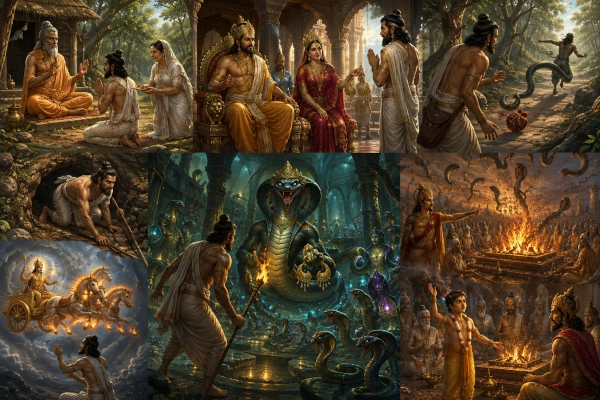
Long before the fires of Janamejaya’s snake sacrifice rose against the sky, the name of Takshaka had already become bound to another man’s anger.
That man was Uttanka, a devoted student whose loyalty to his teacher carried him beyond royal palaces, across lonely forests and into the hidden kingdom of the Nagas.
His journey began not with revenge, but with a promise.
The Student Who Never Neglected His Duty
Uttanka had spent many years in the hermitage of his preceptor, serving him with patience and discipline.
He gathered firewood before dawn, brought water from distant streams and tended the sacred fires. He cared for the cattle, prepared the altar and attended to every instruction without complaint.
So complete was his devotion that the passing of years seemed to matter little to him.
At last, when his education was complete, his teacher gave him permission to return home.
Uttanka bowed and said, “Master, allow me to offer you a fitting guru dakshina. No student should leave the house of his teacher without expressing gratitude.”
The sage answered gently, “Your service has already pleased me. Ask my wife whether she desires anything.”
Uttanka approached the teacher’s wife and bowed.
“Mother, tell me what gift I may bring you.”
She considered his words and then replied, “In four days, I shall observe a sacred ceremony. I wish to wear the earrings belonging to the queen of King Paushya. Bring them to me before the appointed time.”
Uttanka accepted the task without hesitation.
He knew that the queen’s earrings were no ordinary ornaments. They were renowned for their beauty and were believed to possess a divine lustre. Yet he had given his word.
He set out at once.
The Court of King Paushya
After travelling through forests and open plains, Uttanka reached the palace of King Paushya.
The royal court glittered with polished pillars, golden lamps and silken banners. Warriors stood beside the throne, while priests and ministers filled the hall.
Uttanka entered dressed as an ascetic, carrying the dust of the road upon his body.
King Paushya rose to honour him.
“Welcome, revered Brahmana. Tell me what you desire.”
Uttanka explained his purpose.
“I seek the earrings worn by your queen. My teacher’s wife has asked for them as guru dakshina.”
The king replied, “Go to the inner apartments and ask her yourself. If she is willing, she will give them.”
Uttanka entered the palace chambers, but he could not see the queen.
He returned and said, “O King, you have deceived me. There is no queen within.”
Paushya looked at him carefully.
“The queen is there, but she cannot be seen by one whose ritual purity is incomplete.”
Uttanka reflected upon his journey and realised that he had performed his purification carelessly. He washed himself properly, controlled his mind and entered again.
This time, the queen appeared before him.
She sat radiant beneath jewelled lamps, wearing the earrings he had come to obtain. They glowed beside her face like two drops of captured sunlight.
Uttanka bowed and repeated his request.
The queen removed the ornaments and placed them in his hands.
“You may take them,” she said, “but guard them carefully. Takshaka, king of the Nagas, greatly desires these earrings. He will try to steal them from you.”
Uttanka wrapped the earrings securely in a piece of cloth.
“I shall protect them.”
The queen looked at him gravely.
“Do not underestimate Takshaka. He is skilled in disguise, swift in movement and powerful in deception.”
Uttanka thanked her and began the return journey.
The Mysterious Mendicant
The sun was high when Uttanka entered a lonely stretch of wilderness.
The path wound between thorny shrubs and great trees. No village smoke rose in the distance, and no travellers passed him.
As he walked, he noticed a strange ascetic moving nearby.
The man wore no clothing and appeared only at intervals. One moment he walked ahead of Uttanka; the next he vanished behind the trees. Then he appeared again beside the path.
Uttanka immediately remembered the queen’s warning.
He held the bundle containing the earrings close to his body.
After many hours, he reached a pool and decided to perform his cleansing rites. He placed the wrapped earrings upon the ground beside him and entered the water.
The mysterious mendicant appeared.
Before Uttanka could reach the shore, the stranger seized the bundle and ran.
“Stop!” Uttanka shouted.
The thief looked back.
For an instant, his human form trembled like a reflection disturbed upon water. His limbs shortened, his skin darkened and his body lengthened into coils.
The mendicant had been Takshaka.
The serpent king grasped the earrings in his mouth, slipped into a narrow opening in the earth and vanished.
Uttanka reached the hole and struck the ground with his staff.
“Takshaka! Return what you have stolen!”
No answer came.
He began digging furiously, tearing at the soil with his hands and staff. But the passage was too small, and the earth beneath it seemed immeasurably deep.
Uttanka’s deadline was approaching.
Failure would mean breaking his promise to his teacher’s wife.
He continued digging until his hands bled.
The Road into the Naga Realm
The gods had watched Uttanka’s struggle.
Indra, lord of heaven, saw that the student’s determination arose from duty rather than greed. He sent his thunderbolt to enter Uttanka’s staff.
When Uttanka struck the ground again, the earth split open.
Before him appeared a passage descending into darkness.
Cold air rose from below, carrying the scent of damp stone, flowers and serpent musk.
Uttanka entered.
The tunnel twisted deep beneath the earth. Its walls gradually changed from rough soil to shining stone. Soon the darkness gave way to a strange radiance produced by jewels embedded in pillars and ceilings.
He had entered Nagaloka, the realm of the serpents.
It was more magnificent than any human kingdom.
Golden palaces stood beside underground rivers. Crystal stairways descended into pools of blue light. Trees with silver leaves grew in gardens where no sun had ever shone. Jewels upon the hoods of the Nagas illuminated avenues, gateways and assembly halls.
Yet Uttanka had no eyes for their splendour.
He sought Takshaka.
He called upon the Nagas to return the earrings, but none came forward. Serpents watched him from carved balconies and shadowed doorways. Their eyes gleamed red, green and gold.
Uttanka understood that words alone would not compel them.
The Horse of Fire
As he searched the serpent realm, Uttanka encountered two mysterious women weaving cloth upon a loom. The threads they worked were black and white, crossing one another without end.
Nearby stood six youths turning a great wheel with twelve spokes.
He also saw a majestic man beside an extraordinary horse.
The horse’s body shone with unnatural brilliance. Its eyes glowed like embers, and heat rolled from its breath.
The man said to Uttanka, “Blow into the body of this horse.”
The command seemed strange, but Uttanka sensed divine power before him. He obeyed.
The moment he breathed into the horse, flames burst from its body.
Fire poured from its mouth, nostrils and every hair upon its skin. Smoke rolled through the palaces of Nagaloka. Heat filled the tunnels and halls.
The serpent kingdom erupted into panic.
Nagas fled from their chambers. Young serpents cried out. Great cobras raised their hoods but could not withstand the smoke.
The horse was no mortal creature. It was connected with Agni, the god of fire, and the divine power released through it threatened to consume the entire serpent realm.
Takshaka realised that his kingdom would burn unless he yielded.
He emerged from his palace carrying the earrings.
“Take them,” he hissed. “Leave our realm.”
Uttanka received the ornaments, but another problem remained.
The ceremony was almost upon them, and the journey back to the hermitage would take too long.
The divine horseman instructed Uttanka to mount the horse.
The creature rose with the speed of thought.
The glowing caverns vanished beneath them. They passed upward through the earth, crossed forests and rivers and reached the hermitage before the appointed hour.
The Promise Fulfilled
The teacher’s wife had prepared for her ceremony and was waiting.
The auspicious time drew near.
She had begun to fear that Uttanka would not return.
Then he appeared at the entrance of the hermitage, exhausted and covered with dust, but carrying the earrings safely.
He placed them before her.
“Mother, I have brought what you requested.”
She accepted them with delight and blessed him.
“Your devotion has overcome danger, distance and even the power of the Nagas. May your learning bear fruit, and may righteousness guide your path.”
Uttanka had fulfilled his duty.
Yet his heart was not at peace.
He remembered Takshaka’s deception. He remembered the stolen earrings, the desperate digging and the danger he had faced in Nagaloka.
Resentment took root within him.
In time, that resentment would find a much greater cause.
The Death of Parikshit
Years passed.
Takshaka’s name again spread through the lands of the Kurus, this time in connection with the death of King Parikshit.
Parikshit had once insulted a meditating sage by placing a dead snake around his neck. The sage’s young son, enraged by the humiliation of his father, cursed the king to die from the bite of Takshaka within seven days.
When the appointed day came, Parikshit surrounded himself with guards, physicians and protective rituals.
Takshaka nevertheless found a way inside.
Disguised and concealed within fruit brought to the king, he entered the protected chamber. There he revealed his true form, bit Parikshit and consumed the royal residence in the fire of his venom.
The king died.
His young son Janamejaya later inherited the Kuru throne.
For a time, Takshaka remained beyond punishment.
Then Uttanka came to Janamejaya’s court.
Uttanka Before Janamejaya
The sage stood before the young king and spoke without fear.
“Why do you sit peacefully upon the throne while the murderer of your father lives?”
Janamejaya’s expression changed.
Uttanka continued.
“Takshaka slew Parikshit. He overcame the protection of the court and struck him down through deception. Shall such a crime remain unanswered?”
The king replied, “My father’s death arose from a Brahmana’s curse. What can I do against destiny?”
Uttanka’s voice hardened.
“Destiny may have pronounced the hour, but Takshaka carried out the deed. He is arrogant, treacherous and cruel. I know his nature well, for he once stole the earrings I had been entrusted to protect.”
He told Janamejaya of his descent into Nagaloka and of Takshaka’s refusal to surrender the jewels until divine fire threatened the serpent realm.
The old wound in Uttanka’s heart joined the king’s grief.
“Perform the Sarpa Satra,” he urged. “Conduct a sacrifice whose power will draw Takshaka and the serpent race into the flames. Avenge your father and punish the Naga king.”
Janamejaya listened.
His grief became anger, and his anger became a royal command.
Priests were summoned. An enormous sacrificial altar was built. Mantras were prepared that could seize serpents wherever they hid and drag them through the air into the fire.
Thus Uttanka’s pursuit of a stolen pair of earrings became connected to one of the most terrible events in the early history of the Mahabharata.
The Fire That Grew Beyond Justice
When the snake sacrifice began, countless Nagas were pulled helplessly into the flames.
Many had never harmed Parikshit.
Many had never seen Takshaka.
Yet the ritual did not distinguish between the guilty and the innocent. The entire serpent race stood in danger of destruction.
Uttanka had sought justice against one powerful Naga. Janamejaya sought revenge for his father. But their anger grew into something far larger than either grievance.
Takshaka fled to Indra for protection. The priests then intensified their chants, intending to drag even Indra and Takshaka together into the sacrificial fire.
Only the arrival of the young sage Astika prevented the extermination of the Nagas.
Astika persuaded Janamejaya to stop the ritual, teaching the king that punishment without limit becomes injustice.
The Lesson of Uttanka’s Journey
Uttanka’s adventure contains several layers.
His pursuit of Takshaka began with a noble motive: he had promised to bring the queen’s earrings to his teacher’s wife. He endured hardship, entered an unknown world and confronted a powerful enemy to keep his word.
His devotion was admirable.
Yet the same determination later became entangled with resentment.
Takshaka’s theft was wrong. The killing of Parikshit demanded judgment. But the desire to punish one offender expanded into an effort to destroy an entire race.
The story therefore stands at the threshold between duty and vengeance.
Uttanka entered Nagaloka because he would not abandon his responsibility. He returned victorious because divine powers aided his sincerity.
But when he later stood before Janamejaya, the memory of injustice still burned within him.
That fire eventually became the flames of the Sarpa Satra.
And so the Mahabharata reminds us that even righteous anger must be governed by wisdom. A grievance may be real, a wrong may demand an answer and courage may be necessary—but justice is lost when hatred refuses to distinguish the guilty from the innocent.
You may also like
-
Durga versus Mahishasura: Weapons, Battlefield Tactics and the Triumph of Shakti
-
National Institute of Naturopathy Opens Admissions for BNYS Programme at Pune for 2026–27
-
Yudhishthira’s Counter-Diplomacy With Shalya: Working With an Ally Who Has Joined the Other Side
-
Gnani AI Launches Nationwide Challenge Offering Up to 100 Paid AI Internships
-
NMMSS Scholarship Application Deadline Extended to October 31, 2026
