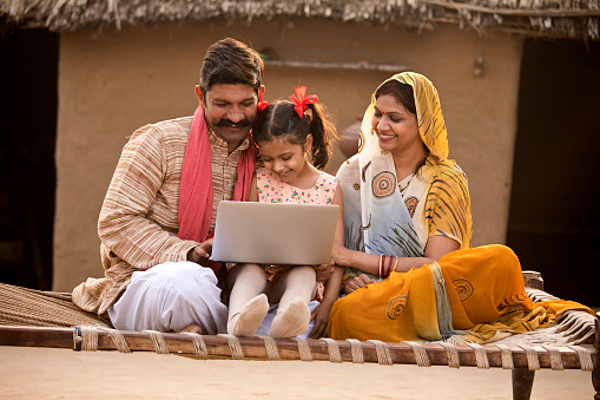
India’s digital transformation is extending rapidly into villages and remote regions, with more than 2.21 lakh Gram Panchayats now service-ready under the BharatNet programme. The country has also established 5.01 lakh functional Common Service Centres, creating an extensive last-mile network for delivering government, financial, educational and commercial services.
The latest figures were presented by Minister of State for Electronics and Information Technology Jitin Prasada in a written reply in the Lok Sabha on August 5, 2026.
The data indicate that Digital India has evolved from a programme focused mainly on internet connectivity into a broad national ecosystem linking digital identity, payments, welfare delivery, healthcare, public services, documents and skills.
Digital India enters its second decade
Launched in July 2015, Digital India was designed to improve digital infrastructure, deliver government services electronically and equip citizens with the skills needed to participate in a technology-driven economy.
Over the past decade, the programme has expanded to include rural broadband, mobile connectivity, digital payments, online documentation, telemedicine, direct benefit transfers, language technology and emerging-technology training.
Its implementation involves central ministries, state governments, public institutions and private-sector partners. This whole-of-government approach has enabled different platforms to work together as part of a connected public digital infrastructure.
BharatNet strengthens rural broadband connectivity
BharatNet remains one of the most important components of India’s rural digital expansion.
As of June 2026, approximately 2.21 lakh Gram Panchayats had been made service-ready under the project. A service-ready Gram Panchayat has the necessary broadband infrastructure to support internet connectivity and digital-service delivery.
The network can help schools, Panchayat offices, health centres, Common Service Centres and local enterprises access high-speed internet. It can also support online education, telemedicine, digital banking, agricultural information, e-commerce and government services.
Tamil Nadu had 9,280 service-ready Gram Panchayats under BharatNet, including 210 in Dharmapuri district.
The expansion of the network is significant because the next phase of India’s digital growth will depend heavily on improving connectivity in villages, small towns and difficult geographical regions.
Internet subscriber base crosses 109 crore
India has witnessed a sharp increase in telephone and internet penetration over the past twelve years.
The total number of telephone connections increased from 93.3 crore in March 2014 to more than 133 crore in March 2026.
During the same period, internet subscribers rose more than fourfold—from 25.15 crore to 109.27 crore.
This growth has been supported by the expansion of mobile networks, increasing smartphone adoption and a steep decline in the cost of internet access.
The average price of mobile data fell from approximately ₹269 per gigabyte in 2014 to around ₹8–10 per gigabyte during 2025–26.
Affordable data has enabled millions of citizens to access digital payments, video communication, entertainment, education, healthcare and government services through mobile phones.
Mobile towers connect underserved villages
The government is also expanding mobile connectivity in areas where commercial telecom coverage remains inadequate.
As of June 30, 2026, a total of 24,784 mobile towers had been commissioned across India under schemes supported by the Digital Bharat Nidhi.
These towers are intended to provide coverage in remote, hilly, forested, border and previously uncovered regions.
In Tamil Nadu, 356 towers were planned to provide mobile connectivity to 445 villages. Of these, 257 towers had become operational, covering 308 villages.
Dharmapuri district had 14 towers planned for 22 villages. Eleven towers had been commissioned, providing coverage to 19 villages.
The Union government has disbursed ₹1,886 crore under ongoing Digital Bharat Nidhi projects in Tamil Nadu.
Improved mobile connectivity can support emergency communication, banking, telemedicine, online education, welfare delivery and local economic activity.
Aadhaar supports direct welfare delivery
Aadhaar has become a key component of India’s digital public infrastructure.
More than 1.44 billion Aadhaar numbers have been generated across the country, including over 8.18 crore in Tamil Nadu.
The Aadhaar-enabled Direct Benefit Transfer ecosystem now covers 318 schemes administered by 56 ministries.
According to the government, more than ₹52 lakh crore has been transferred directly into beneficiaries’ bank accounts through the DBT system.
The system is used for delivering pensions, scholarships, subsidies and other welfare benefits. Direct transfers are intended to reduce delays, duplication and leakage while improving transparency in public expenditure.
UPI transforms everyday payments
The Unified Payments Interface has emerged as the backbone of India’s digital payment system.
UPI now serves more than 55.49 crore users and 6.5 crore merchants, with 731 banks connected to the platform.
The government stated that UPI accounts for nearly 85% of India’s digital payment transactions and almost half of global real-time digital payments.
UPI allows money to be transferred directly between bank accounts through mobile applications. Its interoperability and ease of use have encouraged adoption among large businesses, neighbourhood stores, street vendors and individual consumers.
The platform has also helped small merchants participate in the digital economy without requiring expensive card-processing systems. Payments can be accepted through simple QR codes linked to bank accounts.
DigiLocker crosses 71 crore users
DigiLocker has become an important platform for storing and accessing authenticated digital documents.
The service has more than 71.66 crore registered users and contains over 936.03 crore digital documents issued by 2,822 organisations.
Citizens can use DigiLocker to access documents such as driving licences, academic certificates and identity records. These documents can be shared electronically with government departments, educational institutions and service providers.
Tamil Nadu has recorded more than 2.18 crore Aadhaar-enabled DigiLocker registrations.
The platform reduces dependence on physical certificates, simplifies verification and lowers the risk of documents being lost or damaged.
UMANG integrates government services
The UMANG mobile platform provides access to 2,575 government services through a common interface.
It brings together services offered by central and state government departments, reducing the need for citizens to use numerous separate websites and mobile applications.
Tamil Nadu has integrated 17 services with the UMANG platform.
A unified platform can make government services easier to locate and use, particularly for citizens unfamiliar with the administrative structure of different departments.
e-Sanjeevani delivers more than 48 crore consultations
Digital healthcare has become another major component of India’s public digital infrastructure.
The e-Sanjeevani telemedicine platform has delivered healthcare consultations to more than 48 crore patients across the country. Tamil Nadu accounted for over four crore consultations.
The platform enables patients to consult doctors remotely and supports communication between healthcare institutions.
Telemedicine is particularly valuable in rural and underserved areas where specialist doctors may not be locally available. It can reduce travel expenses, improve follow-up treatment and expand access to preliminary medical advice.
BHASHINI addresses digital language barriers
The government also highlighted BHASHINI, the National Language Translation Mission, as an important platform for improving linguistic inclusion.
BHASHINI uses technologies such as speech recognition, machine translation and text-to-speech systems to make digital services accessible in Indian languages.
Language remains a significant barrier to digital participation. Many citizens may have access to smartphones and the internet but find it difficult to use services available primarily in English.
By supporting Indian-language interfaces and translation tools, BHASHINI can help public platforms reach a much wider population.
Common Service Centres provide last-mile assistance
Common Service Centres remain essential for citizens who require assistance in accessing online services.
As of May 2026, India had 5.01 lakh functional CSCs, including 3.91 lakh operating at the Gram Panchayat level.
More than 800 government and commercial services are available through the CSC network. These include banking, insurance, pension services, utility payments, telemedicine, educational facilities, certificates and online applications.
Tamil Nadu had 18,240 functional CSCs, of which 12,112 were operating at the Gram Panchayat level.
Dharmapuri district had 498 CSCs, including 412 located in rural Gram Panchayats.
The centres are operated by Village Level Entrepreneurs and serve as assisted digital-access points. They are particularly useful for senior citizens, first-time internet users and people who do not own digital devices or possess the skills needed to complete online procedures independently.
The CSC network also creates employment and entrepreneurship opportunities within rural communities.
Digital literacy target surpassed
The Pradhan Mantri Gramin Digital Saksharta Abhiyan was launched to provide basic digital literacy training to rural citizens.
More than 6.39 crore people were trained under the programme, exceeding its target of six crore beneficiaries. PMGDISHA concluded on March 31, 2024.
Tamil Nadu accounted for more than 14 lakh trained participants, including 64,813 people from Dharmapuri district.
Participants were introduced to basic computer and smartphone use, internet access, digital payments, email and online government services.
The programme addressed an important gap between the availability of digital infrastructure and the ability of citizens to use it effectively.
Emerging-technology training expands
Digital India is also supporting skills in areas such as artificial intelligence, cloud computing, data analytics and cybersecurity.
FutureSkills Prime, a joint initiative of the government and NASSCOM, has registered more than 34 lakh candidates. Over 23 lakh people have enrolled in or completed emerging-technology courses.
More than 5.81 lakh candidates from Tamil Nadu have participated in the programme.
The National Institute of Electronics and Information Technology trained more than 31.92 lakh candidates during the previous three financial years through 56 centres and over 9,000 partner institutions.
NIELIT operates a centre in Chennai and works with more than 35 partner institutes across Tamil Nadu. More than 37,500 candidates were trained in the state during the last three years.
The NIELIT Digital University platform has registered over 2.75 lakh candidates for online and blended courses, including programmes in artificial intelligence and cybersecurity.
Tamil Nadu’s e-Sevai supports online governance
Tamil Nadu’s e-Sevai portal was also highlighted as an example of state-level digital-service delivery.
Developed by the Tamil Nadu e-Governance Agency, the portal provides end-to-end online access to a range of citizen-centric government services.
Such platforms can reduce the need for repeated visits to government offices, improve application tracking and make administrative procedures more transparent.
The integration of national digital infrastructure with state-level portals is important because many essential public services are administered by state governments and local bodies.
From digital access to digital empowerment
The expansion of Digital India demonstrates that the country’s digital transformation is no longer limited to increasing internet connections.
BharatNet and mobile towers provide connectivity. Aadhaar supports identity verification. UPI enables payments. DigiLocker provides authenticated documents. UMANG brings government services together, while Common Service Centres offer assisted access.
Platforms such as e-Sanjeevani, BHASHINI and FutureSkills Prime extend the same infrastructure into healthcare, language inclusion and employment-oriented training.
Challenges remain in areas such as service quality, cybersecurity, online fraud, digital literacy, data protection and regional-language accessibility. Reliable connectivity must also translate into affordable household-level access and meaningful use.
Nevertheless, the presence of 2.21 lakh service-ready Gram Panchayats, more than five lakh functional CSCs and over 109 crore internet subscribers shows that India’s digital transformation is steadily moving deeper into rural society.
The success of the next phase will be measured not only by the number of citizens connected to the internet, but also by how effectively digital infrastructure improves access to healthcare, education, welfare, employment, markets and public administration.
Reference
DD India
“Govt expands Digital India footprint; 2.21 lakh gram panchayats now service-ready under BharatNet”
Published on August 6, 2026
The figures were provided by Minister of State for Electronics and Information Technology Jitin Prasada in a written reply in the Lok Sabha on August 5, 2026.
You may also like
-
India’s Economic Warfare Challenge: Strategic Autonomy, Energy Security and the Rise of a Global Power
-
India-US Trade Deal Stalemate: Why Washington’s Tariff Pressure Has Failed to Secure an Agreement
-
US Double Standards in Foreign Policy: 16 Recent Cases Involving India, Russia, China and Global Trade
-
India’s Arctic Energy Ambitions: Russian Oil, LNG and a New Sea Route to Indian Ports
-
India and Russia Explore Joint Icebreaker Construction as Maritime Industrial Cooperation Expands
