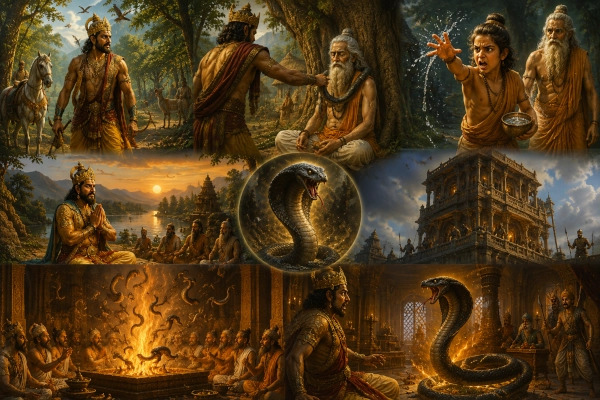
Long after the great war of Kurukshetra had ended, the throne of the Kuru kingdom passed to Parikshit, the grandson of Arjuna and the son of Abhimanyu and Uttara.
Parikshit had entered the world under extraordinary circumstances. While he was still in his mother’s womb, Ashwatthama had released a terrible celestial weapon to destroy the last heir of the Pandavas. Lord Krishna protected the unborn child and restored him to life. Because the infant had beheld that divine presence before birth, he later searched for it in every face he saw. Thus he came to be called Parikshit—the examiner, the one who observed and sought.
He grew into a courageous and capable king. Under his rule, the kingdom prospered, justice was maintained and the teachings of Dharma remained respected. Yet even a righteous ruler could be overcome by a single moment of hunger, exhaustion and wounded pride.
That moment would alter the destiny of the Kuru line.
The King Enters the Forest
One day, King Parikshit rode into a vast forest to hunt.
The morning had begun with the blare of horns, the stamping of horses and the swift movement of royal attendants through the woodland. Deer fled through the undergrowth, birds rose from the trees and the king pursued his quarry deep into the wilderness.
As the hours passed, Parikshit became separated from his companions. The sun climbed high above the forest. Heat pressed down through the branches, and the king’s throat grew painfully dry.
His horse was tired. His bow felt heavy in his hand. The animal he had been pursuing had disappeared among the trees.
Parikshit searched for water, but the forest seemed endless. At last, he saw smoke rising faintly beyond a grove. Thinking that a hermitage must be nearby, he followed it.
There, beneath the shade of ancient trees, stood the peaceful ashrama of the sage Shamika.
Birds moved fearlessly among the huts. Deer grazed nearby. Sacred fires burned gently in their enclosures. The place seemed untouched by the urgency and violence of the outer world.
At the centre of the hermitage sat Sage Shamika.
He was motionless.
His eyes were closed, his breath scarcely visible. His senses had withdrawn from the world as a tortoise draws its limbs into its shell. He was absorbed in deep meditation, unaware of sound, heat, hunger or the arrival of the king.
Parikshit approached him.
“Revered one,” he said, “I am exhausted and consumed by thirst. Have you seen the deer that passed this way? Is there water nearby?”
The sage did not answer.
Parikshit waited.
Again he spoke, more loudly.
“Holy one, I am Parikshit, king of the Kurus. I ask only for water and guidance.”
Still, Shamika remained silent.
The king’s reason told him that the sage was meditating. Yet fatigue clouded his judgement. Hunger sharpened his irritation, and royal pride entered where patience should have remained.
“Does he ignore me deliberately?” Parikshit thought. “Does he consider a king unworthy even of a word?”
Nearby, lying upon the ground, was the lifeless body of a snake.
In a sudden act of mockery, Parikshit lifted the dead serpent with the tip of his bow and placed it across the sage’s shoulders like a garland.
For a moment, the dead snake hung around Shamika’s neck, its body cold and limp against the sage’s matted hair.
Parikshit looked at what he had done.
The anger that had driven him faded almost immediately, leaving behind discomfort and shame. Yet pride prevented him from removing the serpent or asking forgiveness.
He turned away and rode back towards his capital.
Behind him, Sage Shamika remained deep in meditation, unaware of the insult.
The Anger of Shringin
Not far from the hermitage lived Shamika’s young son, Shringin.
Though still a boy, Shringin had been raised in austerity. He had studied sacred teachings, practised discipline and acquired spiritual power through penance. But his wisdom had not yet matured enough to restrain his anger.
While Shringin was away, another boy from the hermitage saw the dead snake around Shamika’s neck. Disturbed by the sight, he hurried to Shringin and told him what had happened.
“Your father sat in meditation,” the boy said, “and King Parikshit came to the hermitage. When the sage did not reply, the king placed a dead serpent around his neck and left.”
Shringin’s face darkened.
His eyes blazed with fury.
“A king who should protect righteousness has insulted a Brahmarshi!” he cried. “He has mocked my father while he was defenceless in meditation. Such arrogance cannot go unpunished.”
The other boy tried to calm him.
“Your father may have forgiven the act. Let us wait until he awakens.”
But Shringin’s anger had already swept away caution.
He took water into his palm and invoked the power of his austerities. His voice rang through the forest as he pronounced the curse:
“Because King Parikshit placed a dead serpent upon the shoulders of my innocent father, on the seventh day from today he shall die from the burning bite of Takshaka, king of the Nagas!”
The words carried the force of accumulated penance.
Once spoken, they could not easily be withdrawn.
The curse passed into the unseen fabric of destiny.
Shamika’s Sorrow
After some time, Sage Shamika emerged from meditation.
He opened his eyes and felt the dead snake around his neck. Without anger, he removed it and laid it upon the ground.
Shringin approached, still breathing heavily from rage.
“Father,” he said, “King Parikshit insulted you. I have cursed him. Seven days from now Takshaka shall bite him, and the king will die.”
Shamika stared at his son in dismay.
“You have done a terrible thing,” he said.
Shringin was astonished. “But Father, the king dishonoured you!”
“Yes,” Shamika replied, “his action was wrong. He acted under the influence of hunger, thirst and anger. But he is a protector of the realm, a guardian of order and a descendant of the Pandavas. A ruler should not be destroyed for one moment of foolishness.”
The sage’s voice became heavy with sorrow.
“True austerity is not shown by the power to curse. It is shown by the strength to forgive. Anger has consumed the merit you should have guarded.”
Shringin lowered his head.
The fire of his rage had cooled, and fear entered his heart.
“Can the curse be recalled?” he asked.
Shamika closed his eyes for a moment.
“No. The words were spoken with the force of penance. But the king must be warned. Perhaps he may prepare himself, make peace with Dharma and face what is to come with wisdom.”
The sage summoned a disciple named Gauramukha and sent him to Hastinapura.
“Go quickly,” Shamika instructed him. “Tell King Parikshit everything. Tell him that I bear him no hatred. Tell him that my son spoke in anger, and that Takshaka will come for him on the seventh day.”
Parikshit Accepts the Curse
When Gauramukha reached the royal court, he was brought before the king.
Parikshit listened silently as the messenger described the curse.
The court fell into stunned silence.
Ministers demanded punishment for the sage’s son. Warriors offered to surround the forest and destroy every serpent they could find. Physicians were summoned. Priests began discussing protective rites.
But Parikshit raised his hand.
“No blame shall fall upon Sage Shamika,” he said. “The fault began with me.”
He remembered the peaceful figure of the sage, the dead snake lifted upon his bow and the shame he had felt while leaving the hermitage.
“I was a king,” Parikshit continued, “yet I failed to govern my own anger. I insulted one who had done me no harm. The curse is severe, but my act gave birth to it.”
He placed the affairs of the kingdom in order and entrusted the succession to his young son, Janamejaya.
Then the king withdrew from ordinary pleasures and prepared for death.
Some traditions describe him sitting beside the sacred Ganga, surrounded by sages, asking the highest questions concerning duty, mortality and liberation. Others describe elaborate defensive measures arranged by his ministers. These traditions agree on one essential point: Parikshit knew that the seventh day would bring Takshaka.
The Tower Beyond the Reach of Serpents
The royal ministers refused to surrender their king without resistance.
They constructed a great palace upon a tall pillar, far above the ground. Its walls were carefully sealed. Guards surrounded every entrance. Physicians skilled in the treatment of poison stood ready. Brahmins recited protective hymns day and night.
No snake was permitted near the building.
Every piece of food, every vessel and every visitor was examined.
The ministers believed that no serpent, however powerful, could enter such a place.
But Takshaka was no ordinary snake.
He was a mighty Naga king, feared for his venom and his mastery of illusion. He had heard the curse of Shringin and knew that destiny had summoned him.
As he travelled towards Hastinapura, Takshaka encountered a learned Brahmin physician named Kashyapa.
Kashyapa was renowned for his knowledge of antidotes. He was hurrying towards the palace, confident that he could save Parikshit from any serpent bite.
Takshaka appeared before him in the form of a Brahmin.
“Where are you going with such urgency?” he asked.
“I am going to King Parikshit,” Kashyapa replied. “Takshaka is destined to bite him, but I possess the knowledge to neutralise even the strongest poison.”
Takshaka smiled.
“Can you truly overcome my venom?”
To test him, Takshaka turned towards a great banyan tree and struck it with his fangs.
Flames of poison raced through the trunk. The leaves shrivelled. The branches cracked. In moments, the immense tree was reduced to ashes.
Kashyapa sat beside the ashes, chanted his mantras and applied his knowledge.
A small shoot appeared.
The trunk reformed, branches spread and green leaves once again covered the living tree.
Takshaka understood that Kashyapa could indeed counteract his poison.
He then offered the physician wealth greater than anything the king might give him.
“Take this treasure and return home,” Takshaka said. “The king’s death has been determined by a Brahmin’s curse. Even if you revive his body, destiny will find another path.”
Kashyapa reflected deeply. Through spiritual insight, he perceived that Parikshit’s appointed time had arrived. He accepted the wealth and turned back.
Takshaka continued towards the palace.
The Serpent Hidden in the Fruit
The seventh day approached its end.
The king’s guards remained alert. The palace was still secure, and no serpent had been seen.
Some began to believe that the curse had failed.
Takshaka, however, assumed a new disguise.
With the help of other Nagas, he entered a piece of fruit in the form of a tiny worm. The fruit was carried by ascetics or attendants who appeared harmless and was presented to the king.
The guards inspected the visitors but discovered nothing dangerous.
The fruit was brought into Parikshit’s chamber.
As evening approached, the king looked at it. When the fruit was opened, a small dark insect emerged.
Parikshit understood at once.
“So this is how Takshaka has come,” he said.
Some accounts describe the king placing the tiny creature upon his neck with calm resignation. Others say that the insect grew before anyone could react.
The creature expanded.
Its small body lengthened into enormous coils. Its eyes blazed like embers. Its hood rose above the king, and its scales shone with the dark fire of storm clouds.
Takshaka had revealed his true form.
The guards cried out. Priests began chanting. Physicians rushed forward.
But the Naga king struck.
His fangs entered Parikshit’s body, and his venom erupted like fire.
Flames engulfed the palace. The king’s body burned in the blaze of Takshaka’s poison, and the appointed destiny was fulfilled.
Thus died Parikshit, grandson of Arjuna and guardian of the Kuru throne.
Janamejaya’s Vow of Vengeance
News of the king’s death spread throughout the kingdom.
When Parikshit’s son Janamejaya learned that his father had been killed by Takshaka, grief soon became fury.
“The serpent king has destroyed my father,” he declared. “Then the entire race of serpents shall pay the price.”
Janamejaya ordered the performance of the terrible Sarpa Satra, the great snake sacrifice.
Powerful priests lit the sacrificial fire and began chanting mantras that dragged serpents from every corner of the world. Nagas were pulled helplessly through the sky and cast into the flames. Countless serpents perished.
Even Takshaka, who had sought refuge with Indra, began to be drawn towards the sacrificial fire.
The destruction would have continued until the entire serpent race had vanished, but the young sage Astika, born of both human and Naga ancestry, entered the sacrificial hall. Through wisdom, humility and eloquence, he persuaded Janamejaya to end the sacrifice.
The cycle of vengeance was finally broken.
The Lesson of Parikshit and Takshaka
The story of Parikshit does not portray a wicked king destroyed by a righteous curse. It presents something more tragic and more human.
Parikshit was a respected ruler who committed one thoughtless act. Shringin was a gifted young ascetic who allowed anger to direct his spiritual power. Takshaka became the instrument of a curse, and Janamejaya nearly destroyed an entire race in retaliation for one death.
At every stage, anger multiplied the consequences of the anger that came before it.
A thirsty king insulted a sage.
An enraged boy cursed a king.
A serpent fulfilled the curse.
A grieving son sought revenge upon every serpent.
Only Astika’s wisdom prevented the chain from continuing.
The tale therefore stands as one of the Mahabharata’s clearest warnings: power without restraint is dangerous, whether it belongs to a king, an ascetic, a serpent or a grieving son. A moment of wounded pride can become a curse, and a curse can grow into a war against the innocent.
Dharma is preserved not merely by strength, but by patience, forgiveness and mastery over anger.
You may also like
-
Semicon 2.0 Targets 200 Chip-Design Companies and One Lakh Semiconductor Technicians
-
Centre to Lower NEET-SS 2025 Cut-Off to 30th Percentile as 1,857 Super-Speciality Seats Remain Vacant
-
Krishna’s Last Peace Mission: The Five Villages That Could Have Prevented Kurukshetra
-
The Frog King and the Serpent: The Enemy Invited Into the Well
-
The Serpent and the Meaning of Violence: When Grief Turned Ruru Against Every Snake
