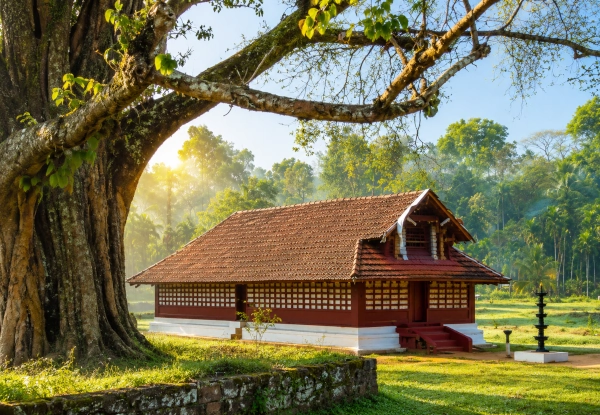
Valliyoorkavu Bhagavathy Temple, situated near Mananthavady in Wayanad, is one of northern Kerala’s most important centres of Goddess worship. Surrounded by trees, fields and the highland landscape of Wayanad, the shrine occupies a distinctive place in the religious life of the district, particularly among its indigenous communities.
The presiding Mother Goddess, popularly called Valliyooramma, is worshipped through three complementary manifestations—Vana Durga, the protectress of the forest; Bhadrakali, the fierce power that destroys evil; and Jala Durga, the divine presence associated with water. This threefold conception connects the Goddess with the natural foundations of Wayanad itself: forest, protective energy and life-sustaining water.
Located only a few kilometres from Mananthavady, Valliyoorkavu is both a neighbourhood temple and a major regional pilgrimage destination. Its annual festival is regarded by the temple administration as the largest temple celebration in Wayanad and brings together devotees from different communities across the district.
Origins and Sacred Tradition
The precise date of the temple’s foundation remains uncertain. The District Tourism Promotion Council of Wayanad associates the shrine with the 14th century, while another official Kerala Tourism account states that its exact year of construction is unknown and that traditions surrounding it suggest an old Dravidian origin. The available evidence therefore supports its antiquity without allowing a firmly established foundation date.
A widely repeated temple legend links the origin of Valliyoorkavu with a sacred sword carried through Wayanad. In one version of the tradition, oracles travelling from Kodungallur towards Thirunelli rested near the region and later discovered that the divine sword had disappeared. It was eventually seen hanging from a forest creeper. Their appeal to the Mother to release it—remembered through the expression associated with “Valliyooramma”—became connected with the Goddess and the place where her power was recognised. The legend varies in its details across oral accounts, but the sword remains central to the temple’s ritual memory.
The shrine is also regarded as one of the guardian temples associated with the sacred landscape of Thirunelli. This position connects Valliyoorkavu with the wider network of pilgrimage routes, forest shrines and sacred settlements of northern Wayanad.
Valliyooramma in Three Divine Forms
The worship of the Goddess as Vana Durga, Bhadrakali and Jala Durga gives the temple a layered theological identity.
Vana Durga embodies the Mother as the guardian of forests, wildlife and those who live close to nature. This form carries particular meaning in Wayanad, where human settlements, farms and forest ecosystems have remained closely connected for centuries.
Bhadrakali represents the Goddess as a force of protection, justice and the destruction of hostile powers. Devotees seek her intervention against fear, illness, adversity and forces believed to disturb personal or social well-being.
Jala Durga expresses the sacred character of water as a source of fertility, purification and continuity. Her presence completes the temple’s symbolic union of the forested earth, divine power and water.
Rather than functioning as three separate goddesses, these forms are understood as different expressions of the same supreme Mother.
A Temple Closely Linked with Wayanad’s Tribal Communities
Valliyoorkavu holds exceptional importance for the indigenous communities of Wayanad. Government sources identify the shrine as a major place of worship for the district’s tribal population, and the annual festival includes ceremonial roles performed by tribal chieftains.
Communities including the Adiya, Paniya and others have historically participated in the worship of Valliyooramma. The Kerala Forest Department specifically records Valliyoorkavu among the prominent temples visited by members of the Adiyan community.
This relationship distinguishes Valliyoorkavu from temples where festival rituals are controlled exclusively by a conventional priestly hierarchy. Here, indigenous participation forms part of the shrine’s public identity. The ceremonial hoisting of the festival flag by tribal leaders symbolises their enduring connection with the Goddess and the sacred land around the temple.
The temple administration also states that the shrine admits visitors without distinctions based on caste or religion, reflecting its character as a broad community centre within Wayanad.
The Valliyoorkavu Festival
The annual festival is held during the Malayalam month of Meenam, generally falling in March or April. The temple’s official website and the District Tourism Promotion Council describe it as a 14-day celebration, although some other government tourism pages use durations of ten or fifteen days. The temple administration’s 14-day account is therefore the most appropriate practical guide, while current dates should always be confirmed before travel.
The festival begins with the ceremonial arrival of the sacred sword of Valliyooramma from the Palliyara Bhagavathy Temple at Pandikkadavu. The chief priest carries the sword to Valliyoorkavu, marking the opening of the ritual season and recalling the shrine’s foundational legend.
The festival flag is traditionally raised later in the observance, with tribal chieftains taking an important ceremonial role. Rituals, processions, community gatherings and folk performances then transform the temple grounds into one of Wayanad’s largest centres of public celebration.
Among the characteristic observances are Kalamezhuthu, Eedum Koorum, Oppana Varavu, Rudhirakkolam, ritual ablutions and forms of devotional song and dance. These ceremonies preserve visual, musical and performative traditions that extend beyond ordinary daily worship.
Kalamezhuthu involves creating a large ritual image of the deity on the floor using naturally coloured powders. The image is not merely decorative; it becomes the focus of song, invocation and ceremonial worship before being erased at the conclusion of the rite.
Eedum Koorum is associated with oracular performance and embodied devotion. Through movement, costume, rhythm and divine invocation, the performer becomes part of the ceremonial communication between the Goddess and the assembled community.
The closing phase includes the Arattu, or ceremonial bathing of the deity, bringing the annual sequence to completion.
A Festival Ground with a Complex Social History
The Valliyoorkavu festival also carries a difficult history connected with Wayanad’s former system of bonded agricultural labour.
Oral histories and scholarly studies describe a practice known as kundalpani, vallipani or nippupani, under which members of marginalised tribal communities—particularly Paniya and Adiya labourers—were bound to work for landlords for a fixed period. Agreements were often renewed around the season of the Valliyoorkavu festival, and payment known as nippupanam marked the arrangement.
Researchers differ over the precise institutional role played by the temple. Some accounts describe the festival grounds as a centre where labourers were selected and contracted, while other scholars argue that the arrangements occurred elsewhere and that the temple itself was not directly responsible. The available oral testimony nevertheless indicates that landlords exploited the religious devotion of tribal workers by linking labour obligations with promises made in the name of Valliyooramma.
This history must be treated separately from the spiritual meaning the temple holds for the same communities. Valliyooramma remained their deity and protector even when oppressive social structures operated around the annual gathering. Remembering both dimensions—the devotion of the people and their exploitation under feudal labour relations—provides a fuller understanding of Wayanad’s social past.
The formal abolition of bonded labour changed the legal environment, and the festival today functions as a major religious and cultural gathering rather than a labour-contracting centre.
Architecture and Natural Setting
Valliyoorkavu follows the restrained architectural character associated with traditional Kerala shrines. Sloping tiled roofs protect its structures from Wayanad’s heavy monsoon rain, while timberwork, shaded verandas and open ritual spaces create a close relationship between the buildings and surrounding vegetation.
The temple is modest in scale compared with the monumental complexes of the Tamil country. Its spiritual presence arises from proportion, ritual activity, mature trees and the open landscape rather than from towering gateways or extensive stone enclosures.
Government accounts describe its architecture as reflecting a Dravidian style, while Kerala Tourism places the temple within the traditional sacred landscape of Mananthavady and the Pazhassi heritage circuit.
The name kavu itself suggests a sacred grove. Such spaces historically combined worship with the protection of trees, water and particular areas of land believed to belong to a deity. At Valliyoorkavu, the natural surroundings remain essential to the experience of the shrine and reinforce the worship of the Goddess as Vana Durga.
Daily Worship and Offerings
Devotees visit Valliyoorkavu seeking protection, family welfare, relief from illness, success in important undertakings and the removal of personal obstacles. The official temple portal lists offerings including Pushpanjali, Rakthapushpanjali and Lalitha Sahasranama Pushpanjali.
Rakthapushpanjali, performed with red flowers, is particularly associated with powerful forms of the Goddess. Lalitha Sahasranama Pushpanjali accompanies the recitation of the thousand names of the Divine Mother and expresses a more contemplative form of Shakti worship.
The temple is generally open in the morning and evening. Its current official schedule is approximately 5:30 a.m. to 12:30 p.m. and 5:30 p.m. to 8:00 p.m., although visitors should confirm timings during festivals and special observances.
How to Reach Valliyoorkavu Bhagavathy Temple
The temple is situated at Arattuthara near Mananthavady in Wayanad district. Mananthavady is the nearest major town, with the shrine lying roughly four to five kilometres away depending on the route used.
Regular road connections link Mananthavady with Kalpetta, Sulthan Bathery, Kozhikode, Kannur, Thalassery and Mysuru. Buses, taxis and autorickshaws are available from Mananthavady for the final stretch.
Kozhikode Railway Station is approximately 98 kilometres away, while Calicut International Airport is around 109 kilometres from the temple, according to the District Tourism Promotion Council. Travel times can vary considerably because the route crosses the Western Ghats.
Visitors arriving during the annual festival should expect large crowds and traffic restrictions near the temple. Early arrival is advisable, particularly on the days associated with the sacred sword procession, flag hoisting and Arattu.
The Mother Shrine of Wayanad
Valliyoorkavu Bhagavathy Temple is more than a regional Durga shrine. It is a sacred grove, a tribal pilgrimage centre, a guardian temple within Wayanad’s religious geography and the setting of the district’s largest annual temple celebration.
Its identity has been shaped by the worship of Valliyooramma as forest, warrior and water Goddess; by the ceremonial participation of indigenous communities; and by rituals that preserve Wayanad’s folk traditions. Its history also carries the memory of a former feudal order that exploited tribal labour around the festival season.
These layers make Valliyoorkavu an essential site for understanding Wayanad. The temple belongs simultaneously to religion, ecology, cultural performance and social history. For devotees, Valliyooramma remains the protective Mother of the land; for the visitor, the shrine offers one of the clearest encounters with the living spiritual heritage of Kerala’s northern highlands.
References
Kerala Tourism, Government of Kerala. “Valliyoorkkavu Bhagavathy Temple, Wayanad.”
District Tourism Promotion Council, Wayanad. “Valliyoorkavu Bhagavathy Temple.”
Wayanad District Administration, Government of Kerala. “Culture and Heritage: Valliyoorkavu Temple.”
Sree Valliyoorkavu Bhagavathi Devaswom. “About Sree Valliyoorkavu Bhagavathi Kshethram.”
Kerala Forest Department. “Indigenous Communities of Kerala.”
Shibina A. S. and Anjitha Ajayan. “Memories of Slavery: The Bonded Labour System in Valliyoorkaav Temple.” Ala, 31 July 2023.
You may also like
-
Samatata — The Low-Lying Deltaic Realm of Southeastern Bengal
-
Tamralipta — The Maritime Gateway of the Lower Ganga
-
Suhma — The River-and-Forest Country of Southwestern Bengal
-
Gauda — The Western Bengal Country of the Bhagirathi and the Rise of Karnasuvarna
-
Pundra — The Northern Bengal Kingdom of the Karatoya and the Ancient City of Pundranagara
