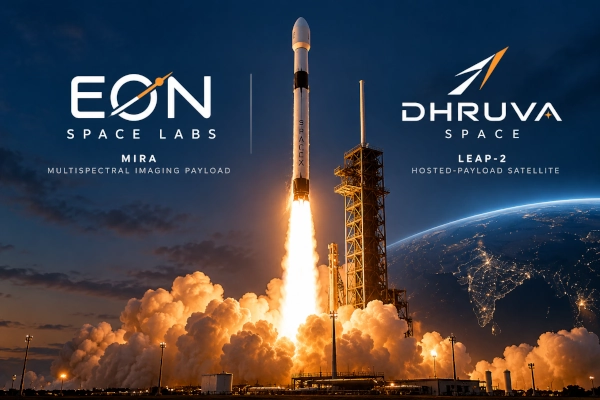
Indian space companies EON Space Labs and Dhruva Space have advanced two different indigenous capabilities aboard SpaceX’s Transporter-18 mission, highlighting the growing depth of India’s private space ecosystem.
EON Space Labs flew its MIRA miniaturised multispectral imaging payload integrated with TakeMe2Space’s MOI-1A spacecraft, while Hyderabad-based Dhruva Space deployed its LEAP-2 hosted-payload satellite. The two systems serve different roles: EON is developing compact optical payloads, while Dhruva is building the satellite platforms and mission infrastructure needed to carry such technologies into orbit.
EON Space Labs Takes MIRA Back to Space
EON Space Labs confirmed that its MIRA imaging system flew aboard Transporter-18 as part of TakeMe2Space’s MOI-1A spacecraft.
MIRA is a 502-gram indigenous multispectral Earth-observation payload developed for small-satellite missions. According to the company, it combines compact optical design, imaging electronics and mechanical architecture developed by its engineering team in India.
The payload uses a miniaturised telescope-based system intended to reduce the mass and volume normally associated with Earth-observation optics. EON has also received an Indian patent covering the underlying imaging architecture.
MIRA Returns After the PSLV-C62 Setback
MIRA had previously been carried aboard ISRO’s PSLV-C62 mission in January 2026, which was lost following a launch-vehicle anomaly.
EON subsequently integrated the payload with MOI-1A for another flight opportunity. The Transporter-18 mission gives the company a renewed chance to validate its compact imaging system in orbit.
For EON, the significance lies less in the launch itself than in proving that a highly miniaturised Indian optical payload can support future Earth-observation missions requiring lower mass and smaller spacecraft.
Compact Optics Could Support Smaller Earth-Observation Satellites
Miniaturisation is increasingly important for commercial satellite missions because payload mass directly affects spacecraft size, launch cost and available power.
MIRA’s 502-gram architecture is intended to offer multispectral imaging without the larger telescope assemblies used on conventional remote-sensing spacecraft.
Such systems could support applications including agriculture, environmental monitoring, infrastructure analysis and other forms of Earth observation while allowing operators to use smaller satellite platforms.
Dhruva Space Deploys LEAP-2
Dhruva Space used Transporter-18 to deploy LEAP-2, the second commercial mission based on its P-30 satellite platform.
LEAP, or Launching Expeditions for Aspiring Payloads, is designed to host technologies from multiple customers on a common spacecraft. This allows companies to demonstrate sensors and other hardware in orbit without building a complete satellite of their own.
LEAP-2 carries SatLeo Labs’ TAPAS-1 thermal-imaging payload and a star tracker developed by France-based Sodern ArianeGroup.
Dhruva Expands Beyond Satellite Manufacturing
LEAP-2 also demonstrates Dhruva Space’s broader role in mission integration.
The company handled the satellite platform, hosted-payload integration and launch preparation for Falcon 9. It is also supporting operations through its ground infrastructure, including its station in Luleå, Sweden.
This gives Dhruva a presence across several parts of the satellite mission chain rather than limiting its role to spacecraft hardware.
The company’s model is aimed at customers that need access to orbit but do not want to independently manage satellite development, launch integration and ground operations.
Hosted Payloads Lower the Barrier to Orbital Testing
Hosted-payload platforms such as LEAP can reduce the cost and complexity of testing new technologies in space.
Instead of financing a dedicated satellite, a payload developer can share spacecraft infrastructure while concentrating on its own sensor, electronics or experimental hardware.
This approach is particularly useful for startups and research teams seeking early orbital validation before committing to larger constellations or standalone missions.
Two Different Layers of India’s Private Space Industry
EON Space Labs and Dhruva Space represent complementary parts of the emerging Indian space value chain.
EON is developing compact optical systems that can make smaller Earth-observation spacecraft more capable. Dhruva is creating the platforms, integration services and ground infrastructure that allow such payloads to reach and operate in orbit.
Their participation in Transporter-18 shows how India’s private space sector is becoming more specialised. MIRA adds to domestic capability in miniaturised imaging, while LEAP-2 strengthens India’s commercial infrastructure for hosted payloads and in-orbit technology demonstration.
Together, the two programmes reflect an industry moving beyond individual satellite launches towards a broader ecosystem of indigenous sensors, spacecraft platforms and mission services.
References
- EON Space Labs — Official Company Updates, October 2026
https://www.linkedin.com/company/eonspacelabs/ - Dhruva Space — Official LEAP-2 Mission Page
https://www.dhruvaspace.com/leap-2-mission - Dhruva Space — Official Company Updates, October 2026
https://www.linkedin.com/company/dhruvaspace/ - TakeMe2Space — Official MOI-1A Mission Information
https://www.tm2.space/ - SpaceX — Official Transporter-18 Launch Record
https://www.spacex.com/launches/
You may also like
-
ICAR Scientists Develop Indigenous Protective Gloves for Cotton Farmers, Sign Commercial Manufacturing Agreement
-
India Moves Towards Five-Year Assured Orders for Defence Startups Under New Procurement Reforms
-
BHEL–Coal India Joint Venture Begins Construction of ₹25,016 Crore Indigenous Coal Gasification Project in Odisha
-
Zen Technologies Introduces Indigenous Hyper-Strike Falcon AI-Guided Counter-Drone Interceptor
-
L&T and Germany’s SCHOTTEL Expand Partnership for Controllable Pitch Propeller Systems in Indian Shipbuilding
