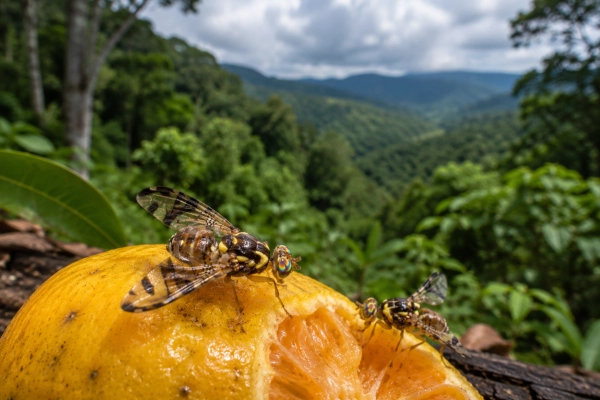
A three-year scientific survey in Meghalaya has uncovered two fruit fly species previously unknown to science and documented three others from the Indian subcontinent for the first time, reinforcing Northeast India’s importance as one of the country’s richest yet least comprehensively studied centres of insect diversity.
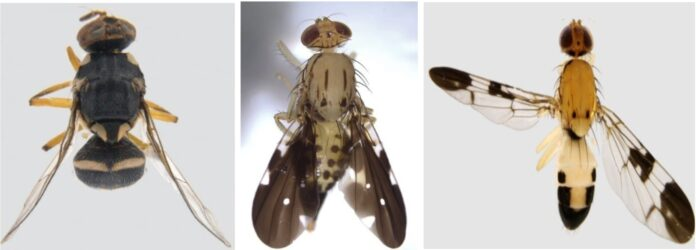
Researchers recorded 37 fruit fly species belonging to several genera and 16 subgenera across forest, orchard and vegetable habitats in Ri-Bhoi district. The two species described as new to science were named Zeugodacus umiam, after the Umiam region where the research was conducted, and Zeugodacus nasivittatus, whose name refers to its distinctive physical markings.
The study was carried out from October 2020 to September 2023 in the Bhoirymbong, Kyrdemkulai and Umiam areas. Scientists examined fruit fly communities in relatively undisturbed forests, mixed fruit-growing areas and seasonal vegetable fields. The locations represent a varied ecological zone where tropical conditions near Assam gradually transition towards the cooler uplands of the Khasi Hills.
The research was led by Kennedy Ningthoujam of the College of Post Graduate Studies in Agricultural Sciences at Central Agricultural University, Umiam. The multidisciplinary team included scientists from the ICAR–National Bureau of Agricultural Insect Resources in Bengaluru, other Central Agricultural University institutions, Tamil Nadu Agricultural University and the Krishi Vigyan Kendra in East Garo Hills.
Zeugodacus umiam was recovered from Khasi mandarin, Meghalaya’s economically important GI-tagged citrus fruit. Adult flies responded to cue-lure, a synthetic attractant commonly used to detect particular groups of male fruit flies. Zeugodacus nasivittatus was associated with sweet orange and responded to protein- and yeast-based food baits, which can attract both male and female insects. These differing responses are important because no single trap or lure can reliably reveal the complete fruit fly community present in a landscape.
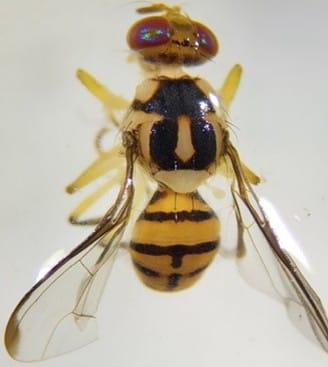
The survey also recorded Bactrocera abbreviata, Erectovena desperata and Phorelliosoma hilaratum as first reports from the Indian subcontinent. The discovery does not necessarily mean that these insects have recently entered the region. They may have remained undocumented because Meghalaya’s forest-dwelling fruit fly fauna has received far less systematic attention than pests found in commercial orchards.
Two other species, Acroceratitis bimacula and Acrotaeniostola spiralis, were collected exclusively from bamboo using yeast-based baits. Phorelliosoma hilaratum was associated with forest trees and responded to yeast and protein attractants. These records demonstrate that fruit fly diversity extends well beyond species attacking cultivated mangoes, citrus fruits or vegetables. Many occupy specialised ecological niches involving wild plants, bamboo and forest vegetation.
Researchers collected specimens through several complementary methods. Infested fruits were brought to the laboratory so that larvae could pupate and adults could emerge for identification. Field sampling also used McPhail traps, eco-traps, bottle traps, net traps and occasional sweep-net collection. The traps were baited with methyl eugenol, cue-lure, zingerone and food mixtures containing yeast or protein.
Male-targeted chemical lures are effective for detecting particular pest groups, while food baits provide broader sampling by attracting both sexes and species that do not respond to conventional para-pheromones. The study found that trap design, bait type, host availability, season and habitat all influenced the composition and number of flies captured. Net traps and zingerone performed particularly well in parts of the diversity analysis.
The genus Bactrocera was dominant in the Meghalaya collections. This group includes several of the world’s most economically damaging fruit pests, including Bactrocera dorsalis, commonly known as the oriental fruit fly. Females puncture ripening fruits to deposit eggs, after which the larvae feed within the flesh. Infestation can cause premature fruit fall, rotting and substantial loss of marketable produce.
Fruit flies also create challenges beyond damage in orchards. Countries frequently impose quarantine restrictions on produce originating from areas where serious pest species occur. A region seeking to expand exports of citrus, mangoes or other horticultural products must therefore demonstrate effective surveillance, pest control and post-harvest treatment.
The Meghalaya findings provide a scientific baseline for such work. Accurate identification allows agricultural authorities to distinguish widespread crop pests from rare native species and forest specialists. This is essential because an undifferentiated control programme could waste resources, overlook newly emerging threats or harm insects that play little role in agricultural losses.
The research has particular relevance for Khasi mandarin, one of Meghalaya’s signature horticultural products. Understanding which fruit flies use the crop, when their populations increase and which lures attract them can support more precisely timed management. Farmers could deploy monitoring traps before population peaks, remove infested and fallen fruits, maintain orchard sanitation and use targeted baiting instead of relying entirely on repeated broad-spectrum pesticide applications.
Long-term surveillance is also important because Meghalaya lies close to international borders and contains numerous cultivated and wild host plants. Trade, passenger movement and the natural dispersal of insects can alter pest distributions. A species that currently remains uncommon could become agriculturally important if changing climate, cropping patterns or host availability allow it to expand.
One of the study’s most important ecological findings was the distinctive role of forests. Forest sites showed stronger initial species sharing and supported rare or specialised taxa that were absent or less common in cultivated systems. Orchards and vegetable fields, by contrast, were more strongly influenced by available crops and the pest species adapted to them.
This distinction gives the discovery a dual significance. Agricultural landscapes require monitoring because they can support destructive fruit fly populations, while natural forests require conservation because they preserve a much wider and less understood insect community. Clearing or fragmenting forests could eliminate specialised species before science has documented their ecological roles.
The survey also illustrates why insect biodiversity is often underestimated. Large mammals and birds can sometimes be recorded through visual surveys or camera traps, while tiny insects may require multiple trap types, seasonal sampling, microscopic examination and specialist taxonomic knowledge. Several years of continuous fieldwork may be needed to separate common species from rare ones and recognise organisms that have never been formally described.
Taxonomy—the science of identifying, naming and classifying organisms—is therefore directly connected with agriculture and biosecurity. A new species description creates a reference that scientists and quarantine authorities can use in future surveys. Without a recognised name and diagnostic features, officials may confuse an unfamiliar insect with a known pest or fail to track changes in its distribution.
The study establishes Ri-Bhoi as an important fruit fly diversity zone within South Asia and provides the first broad assessment linking species composition with habitats, host plants, seasonal occurrence and bait preference in Meghalaya. It also shows that the region’s citrus orchards, vegetable fields, bamboo stands and natural forests form interconnected biological systems rather than isolated environments.
Further surveys across other districts of Meghalaya and neighbouring northeastern states could reveal additional species and clarify whether the newly documented flies are locally restricted or more widely distributed. Molecular studies, detailed host records and repeated monitoring would also help determine which species pose a genuine crop risk and which primarily belong to natural forest communities.
The research has been published as an article-in-press in Scientific Reports. The journal notes that the available manuscript is an early, unedited version that may receive corrections before final publication.
Reference
Ningthoujam, Kennedy, K. J. David, Sunita Chetry, et al. “Diversity, Richness, and Species Composition of Fruit Flies with New and First Records from Meghalaya, India.” Scientific Reports, published 8 June 2026. DOI: 10.1038/s41598-026-56503-8.
You may also like
-
Self-assembly of Organic Molecules Opens a New Path to Green Hydrogen Production
-
Bi-layered Single-piece Dental Implant Reduces the Need for Surgical Unterventions
-
NASA Invites ISRO Into Moon Base Programme as US Opens Door Wider to Indian Space Startups
-
ISRO Successfully Completes Final EOS-05 Orbit-Raising Manoeuvre
-
Scientists Uncover A Way to Outsmart Quantum Entanglement Loss with A Single Move
