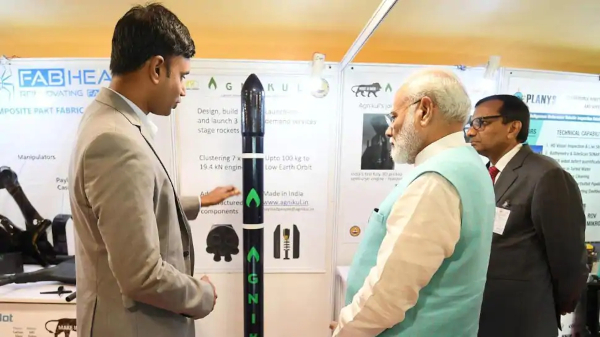
Agnikul Cosmos is building an indigenous small-satellite launch system around single-piece, additively manufactured semi-cryogenic engines and modular ground infrastructure. The Chennai-based company operates from the IIT Madras ecosystem and is developing Agnibaan, a configurable orbital launch vehicle intended to place small satellites into low Earth orbit through dedicated missions.
A Rocket Engine Printed as One Integrated Structure
Conventional liquid rocket engines contain injectors, combustion chambers, cooling passages and associated interfaces manufactured separately and joined through welding, brazing and precision assembly. Each joint adds manufacturing operations, inspection requirements and potential geometric variation.
Agnikul uses metal additive manufacturing to consolidate the principal combustion hardware into a single Inconel structure. Its Agnilet and Agnite semi-cryogenic engines integrate the injector, combustion chamber and regenerative cooling channels within the printed assembly. After printing, the hardware undergoes computed-tomography inspection, heat treatment, grinding and cleaning before testing or flight integration.
The approach allows internal passages and injector geometries to be produced directly from a digital design. It also shortens the route from an engine design revision to physical hardware, supporting rapid iteration and mission-specific manufacturing.
Semi-Cryogenic Propulsion
Agnikul’s propulsion system uses liquid oxygen as the oxidiser and aviation turbine fuel as the hydrocarbon fuel. Liquid oxygen is stored at cryogenic temperature, while ATF remains comparatively convenient to transport and handle using established fuel infrastructure.
The combination offers relatively high propellant density and avoids the storage complexity associated with liquid hydrogen. Regenerative cooling circulates fuel through channels surrounding the combustion chamber, absorbing heat before the fuel reaches the injector.
ISRO conducted a 15-second hot test of an Agnilet development engine at the Vertical Test Facility of the Thumba Equatorial Rocket Launching Station in November 2022. The tested engine operated at a chamber pressure of 10.8 bar using liquid oxygen and ATF and was manufactured from Inconel 718 through 3D printing.
Agnilet and Agnite
Agnilet formed the propulsion core of Agnibaan SOrTeD, Agnikul’s suborbital technology demonstrator. The flight configuration used a pressure-fed semi-cryogenic engine, allowing the company to validate ignition, combustion, vehicle control and launch operations with a relatively compact propulsion architecture.
Agnite is designed for the orbital Agnibaan vehicle and uses electric-pump-fed propellant delivery. Electrically driven pumps provide finer control over propellant flow while avoiding the gas generators and turbine machinery used in conventional turbopump-fed engines. Agnikul’s modular architecture allows engines to be clustered according to the payload and mission profile.
The vehicle’s control system is designed to accommodate different engine configurations while maintaining acceptable thrust-to-weight ratio, stability and controllability. This gives Agnibaan a scalable architecture for payloads requiring different launch capacities.
Agnibaan Orbital Launch Vehicle
Agnibaan is a two-stage, orbital-class launch vehicle designed for dedicated small-satellite missions. Its propulsion, avionics, flight software and structural configuration are being developed around mission customisation rather than a single fixed rocket arrangement.
The first stage can use a selected cluster of engines based on the required performance. The upper stage uses a vacuum-optimised Agnite engine for orbital insertion, with an optional additional stage available for missions requiring more precise deployment.
A dedicated launcher gives satellite operators greater control over launch date, orbital altitude and inclination than a conventional rideshare mission. This is especially useful for Earth-observation, communications and technology-demonstration satellites that need deployment into a specific orbital plane.
Agnibaan SOrTeD Flight
Agnikul launched the Agnibaan Sub-Orbital Technology Demonstrator from Sriharikota on May 30, 2024. The vehicle lifted off at 7:15 a.m. from Agnikul Launchpad-01 and completed 66 seconds of powered flight under autonomous control.
The mission demonstrated clean lift-off, a programmed pitch-over manoeuvre, wind-bias correction and integration between Agnikul’s mission-control hardware and ISRO’s range systems. Its flight computer used a Linux-based operating environment and an Ethernet-based architecture to connect onboard computing systems.
The flight established several milestones. It was the first launch of a rocket powered by a single-piece 3D-printed semi-cryogenic engine, India’s first flight using semi-cryogenic rocket propulsion and the first mission launched from a privately established launchpad within Sriharikota.
SOrTeD supplied flight data for the larger orbital vehicle while validating the company’s engine, autopilot, avionics, structures and launch procedures in an operational environment.
India’s First Private Launchpad
Agnikul Launchpad-01, also called Dhanush, was established within the Satish Dhawan Space Centre at Sriharikota and inaugurated in November 2022. It became India’s first launchpad designed and operated by a private company.
The facility consists of a launch pedestal and a mission-control centre located approximately four kilometres away. It is connected with ISRO’s range-safety and mission-control infrastructure, allowing flight parameters to be monitored during launch operations.
Dhanush is designed around modular and transportable components. The launch pedestal, propellant systems and mission-control equipment can be adapted to different sites, supporting Agnikul’s longer-term concept of selecting a launch location according to the orbital inclination required by the customer.
Launch latitude has a direct effect on achievable orbital inclination and vehicle performance. A mobile ground system could therefore give operators more freedom to choose the launch geometry appropriate for a satellite constellation.
Rocket Factory-01
Agnikul manufactures its engines at Rocket Factory-01 in the IIT Madras Research Park. The facility brings engine design, printing, post-processing, inspection and production within one integrated environment.
Keeping these stages together allows design data to move directly from engineering teams to the additive-manufacturing system. Inspection results and hot-test data can then be returned to the design process for subsequent production cycles.
The company later expanded its manufacturing capability through a Large Format Additive Metal Manufacturing facility containing a large-format printer and an indigenously developed depowdering system. Agnikul has also obtained AS9100D certification for its aerospace quality-management framework.
Support from ISRO and IN-SPACe
Agnikul signed a framework agreement with the Department of Space in 2021, enabling access to ISRO facilities, technical expertise and qualification support through IN-SPACe. The arrangement covered testing of the company’s single-piece semi-cryogenic engine and other launch-vehicle systems.
ISRO subsequently supported Agnilet hot testing, range coordination and flight-safety integration. It also supplied a Flight Termination System package for the controlled suborbital vehicle—the first transfer of such an ISRO flight package to a private Indian launch company.
This model allows a private company to retain control over its vehicle technology while using established national facilities for testing, range safety and launch execution.
Significance for Indian Manufacturing
Agnikul’s technology places advanced propulsion manufacturing at the centre of India’s private space sector. Producing complex engine hardware as integrated printed structures can reduce assembly operations, simplify inventory and support faster design changes.
The company has also developed its launchpad, mission-control systems, autopilot, motor controllers and major vehicle subsystems in India. This creates domestic expertise across additive manufacturing, combustion engineering, high-speed electronics, flight software and launch operations.
Agnibaan SOrTeD proved that a single-piece printed semi-cryogenic engine could progress from digital design and ground testing to controlled flight. Agnikul’s next technical objective is to apply the same manufacturing philosophy to orbital missions, establishing an Indian launch service designed specifically around the requirements of small satellites.
REFERENCES
Agnikul Cosmos. “Official Website: Single-Piece 3D-Printed Semi-Cryogenic Engines and Mobile Launch Systems.”
https://www.agnikul.in/
Agnikul Cosmos. “Technology: Agnilet, Agnite, Additive Manufacturing and Mobile Launchpad.”
https://agnikul.in/technology-2/
Agnikul Cosmos. “Products: Agnibaan, SOrTeD and Dhanush.”
https://agnikul.in/product/
Agnikul Cosmos. “Mission-01: Agnibaan SOrTeD.”
https://www.agnikul.in/missions/
Agnikul Cosmos. “Company History and Manufacturing Facilities.”
https://www.agnikul.in/who-we-are/
Indian Space Research Organisation. “ISRO Facilitates Hot Testing of Agnilet Engine.” November 8, 2022.
https://www.isro.gov.in/ISRO_Agnilet_Engine.html
Indian Space Research Organisation. “First Private Launchpad and Mission Control Centre Established at SDSC SHAR.” November 28, 2022.
https://www.isro.gov.in/first_private_launch_mission_control.html
Indian Space Research Organisation. “Framework MoU Signed with Agnikul Cosmos.” September 17, 2021.
https://www.isro.gov.in/Framework%20MoUAgnikul.html
Indian Space Research Organisation. “Flight Termination System Packages Delivered to Agnikul.” November 11, 2022.
https://www.isro.gov.in/flight_termination_system.html
Indian Space Research Organisation. “Launch Missions Facilitated by ISRO.”
https://www.isro.gov.in/Indian_private_players.html
Press Information Bureau. “Agnikul Launches World’s First Rocket with Fully 3D-Printed Engine.” May 30, 2024.
https://www.pib.gov.in/PressReleasePage.aspx?PRID=2022161&lang=2®=48
Press Information Bureau, Department of Science and Technology. “Combustion Research Provides the Base for Agnikul’s Low-Cost Space Mission Technologies.” July 8, 2024.
https://www.pib.gov.in/PressReleasePage.aspx?PRID=2031582&lang=2®=48
You may also like
-
EON Space Labs and Dhruva Space Advance Indian Space Hardware on Transporter-18 Mission
-
SatLeo Labs’ TAPAS-1 Reaches Orbit, Advancing India’s Private Thermal-Imaging Capability
-
TakeMe2Space’s MOI-1A Reaches Space on Falcon 9 Transporter-18 Mission
-
Bank of Baroda Enters Pension Fund Management After PFRDA Appointment
-
SCI and India’s Push for a Larger Indigenous Maritime Fleet
