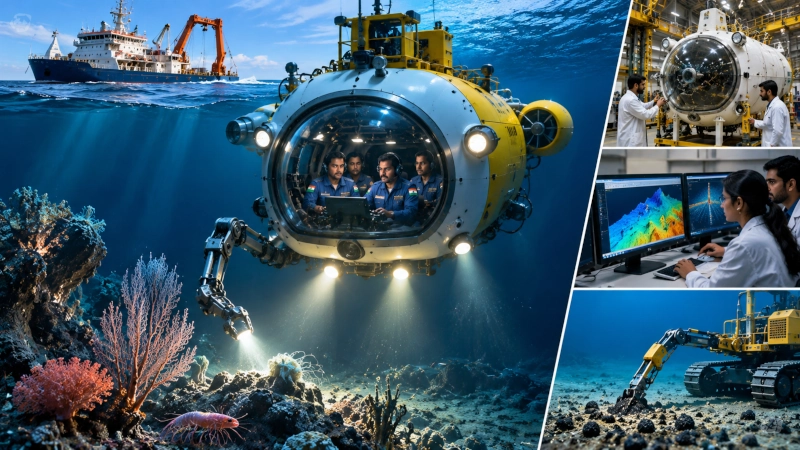
India’s ambitious Deep Ocean Mission is progressing towards the development of indigenous capabilities for human exploration of the deep sea, with the government reviewing advances in the MATSYA-6000 submersible programme, oceanographic technologies and international scientific cooperation. The initiative is intended to strengthen India’s capacity to undertake underwater research, explore deep-sea resources and develop advanced marine engineering technologies.
The progress was reviewed on 10 November 2026 during the Second General Body Meeting of the Earth System Sciences Council (ESSC), chaired by Union Minister of State (Independent Charge) for Earth Sciences and Science and Technology Dr Jitendra Singh. The meeting examined achievements across India’s earth science institutions, with particular emphasis on the Deep Ocean Mission, ocean observation, weather forecasting and polar research.
A major highlight was the continuing development of MATSYA-6000, India’s indigenous human-occupied submersible designed to carry three aquanauts to a depth of 6,000 metres. The Ministry also reviewed the experience gained by Indian scientists during an Indo-French deep-sea expedition in August 2025, when two Indian aquanauts successfully descended to depths of 4,025 metres and 5,002 metres aboard the French submersible Nautile.
The developments represent important steps towards establishing India’s independent deep-ocean exploration capabilities and strengthening the scientific and technological foundations of its Blue Economy.
MATSYA-6000: India’s Indigenous Deep-Sea Exploration Vehicle
MATSYA-6000 is being developed by the National Institute of Ocean Technology (NIOT), Chennai, under the Ministry of Earth Sciences as part of the Samudrayaan programme within the Deep Ocean Mission.
The submersible is designed to transport three personnel to depths of up to 6,000 metres, enabling scientists to undertake direct observations, collect biological and geological samples, and investigate underwater environments that remain difficult to access using conventional research equipment.
The vehicle incorporates a spherical personnel compartment constructed from titanium alloy, designed to withstand the immense hydrostatic pressures encountered in the deep ocean. At depths approaching 6,000 metres, external water pressure reaches approximately 600 times atmospheric pressure, requiring specialised structural materials, safety systems and engineering techniques.
According to information previously provided by the Ministry of Earth Sciences, the submersible is designed for a normal operational endurance of 12 hours, with emergency life-support provisions extending to 96 hours. Its systems include underwater acoustic communication, navigation equipment, battery-powered propulsion, buoyancy management mechanisms and emergency ascent arrangements.
The submersible is also being equipped with scientific instruments and underwater manipulators to enable researchers to examine the seabed and collect samples during future missions.
The successful development of such a platform would allow India to undertake human scientific exploration at depths that have traditionally required highly specialised foreign research vessels and submersibles.
Successful Harbour Trials Establish Engineering Foundations
The MATSYA-6000 programme has already completed important stages of design, system integration and controlled testing.
During January and February 2025, NIOT conducted wet harbour trials at the L&T Shipbuilding facility in Kattupalli, near Chennai. These tests evaluated essential operational systems, including flotation, stability, manoeuvrability, propulsion, communication, power management and human-support arrangements.
The trials represented a significant step towards validating the integration of the vehicle’s subsystems before undertaking progressively more demanding underwater operations.
NIOT has also been working on specialised components required for deep-sea deployment, including buoyancy materials, pressure-resistant structures and safety mechanisms.
A critical feature of the development programme is the need to establish the reliability of all major systems under the conditions expected during deep-water operations. These include extreme external pressure, limited communication capability, low temperatures and the operational challenges associated with launching and recovering a human-occupied vehicle at sea.
The Ministry’s review on 10 November highlighted the continuing development of MATSYA-6000 as a central component of India’s deep-ocean research programme. The vehicle’s full 6,000-metre operational capability remains a development objective, subject to the successful completion of further testing and certification.
Indian Aquanauts Gain Experience at Depths Exceeding 5,000 Metres
An important achievement supporting the Samudrayaan programme came through India’s scientific cooperation with France.
On 5 and 6 August 2025, two Indian aquanauts from NIOT successfully undertook deep-ocean dives aboard Nautile, a research submersible operated by the French marine research institute IFREMER.
Senior scientist Raju Ramesh and retired naval commander Jatinder Pal Singh participated in the expedition, reaching depths of 4,025 metres and 5,002 metres in the Atlantic Ocean.
The dives were conducted under an Indo-French scientific collaboration intended to provide Indian personnel with direct operational experience in deep-sea exploration.
The expedition involved a five-member NIOT team that joined the French oceanographic research vessel L’Atalante near Lisbon, Portugal.
During the operations, Indian scientists gained experience in mission preparation, underwater navigation, descent and ascent procedures, buoyancy management, acoustic communication and the deployment and recovery of deep-sea vehicles.
They also observed procedures involving underwater manipulators, scientific sampling and the management of onboard support systems.
The experience was particularly valuable because successful human deep-sea exploration requires more than a technically capable submersible. It also depends on trained personnel, mission planning, reliable surface support and established operational procedures.
The Ministry’s November 2026 review recognised these earlier dives as an important contribution to India’s preparations for future indigenous deep-ocean missions.
Building Operational Expertise for Samudrayaan
The experience gained during the French expedition is expected to contribute directly to the operational development of MATSYA-6000.
Human-occupied deep-sea missions require close coordination between the submersible crew and the surface support vessel. Pilots must manage descent rates, navigation, underwater positioning, communication and emergency procedures while operating in environments where direct intervention from the surface is extremely difficult.
Deep-sea operations also require specialised launch and recovery systems capable of safely deploying a submersible from a research vessel and retrieving it under varying sea conditions.
Indian researchers participating in the Nautile expedition were exposed to these procedures in an established operational environment.
The collaboration therefore provides an opportunity to combine indigenous engineering development with practical experience acquired through international scientific cooperation.
Such partnerships are particularly valuable during the development of complex technologies because operational knowledge, training and safety procedures must evolve alongside the hardware.
For Samudrayaan, the eventual objective is to establish an integrated Indian capability involving the submersible, trained aquanauts, scientific instruments, surface vessels and mission-control infrastructure.
Deep-Sea Mineral Exploration and Indigenous Underwater Technologies
Beyond MATSYA-6000, NIOT is undertaking research into technologies required for deep-sea mineral exploration.
The ocean floor contains mineral deposits, including polymetallic nodules that may contain manganese, nickel, copper and cobalt. These materials are of scientific and economic interest because several are used in industrial manufacturing, energy technologies and advanced engineering applications.
India has undertaken exploration activities in the Central Indian Ocean Basin under arrangements with the International Seabed Authority.
Developing technologies capable of operating at great depths presents major engineering challenges. Underwater equipment must withstand high pressure, operate over considerable distances and maintain reliable control and communication in environments where conventional radio communication is ineffective.
NIOT’s research includes underwater robotic systems, seabed exploration equipment, specialised instrumentation and technologies for investigating deep-ocean geological conditions.
The development of indigenous equipment can strengthen India’s ability to undertake scientific surveys and evaluate the characteristics of seabed resources.
However, exploration and the development of mining technology are distinct from commercial deep-sea mineral extraction, which remains subject to applicable international regulations and environmental considerations.
The Deep Ocean Mission is therefore intended to establish scientific knowledge and technological capabilities alongside the assessment of potential resource applications.
Ocean Thermal Energy Conversion and Desalination Research
The Ministry’s review also highlighted NIOT’s work on ocean thermal energy conversion and desalination technologies.
Ocean Thermal Energy Conversion, commonly known as OTEC, investigates the possibility of generating energy from the temperature difference between warm surface seawater and colder water found at greater depths.
In suitable tropical regions, this temperature difference can be used to operate specialised energy-conversion systems.
Although the technology presents considerable engineering and economic challenges, research into OTEC could contribute to future marine renewable-energy applications.
NIOT is also developing desalination technologies intended to improve access to freshwater in island and coastal regions.
The Ministry specifically highlighted desalination solutions for Lakshadweep, where freshwater availability is an important concern because of limited land area and dependence on fragile island water resources.
Technologies that utilise ocean resources for freshwater production could help improve water security in suitable locations, particularly where conventional freshwater sources are constrained.
The development of such systems demonstrates how marine engineering research can address practical challenges affecting coastal and island communities.
Marine Fisheries and Oceanographic Instrumentation
NIOT’s scientific activities also extend to offshore fish cage technologies and oceanographic instrumentation.
Offshore fish cage systems are designed to support aquaculture in marine environments, potentially enabling fish production beyond conventional coastal or inland facilities.
Their development requires research into marine currents, wave conditions, structural durability, environmental interactions and suitable fish-production practices.
Oceanographic instruments, meanwhile, are essential for collecting scientific information about temperature, salinity, currents, underwater pressure and other physical characteristics of the marine environment.
Such observations contribute to marine research, ocean forecasting and the understanding of processes influencing weather and climate.
Indigenous instrumentation also reduces dependence on imported scientific equipment and provides opportunities for Indian researchers and engineers to develop technologies suited to regional oceanographic conditions.
The Ministry’s review identified these activities as part of NIOT’s broader contribution to ocean science and the sustainable utilisation of marine resources.
Deep Ocean Mission and India’s Blue Economy
The Deep Ocean Mission represents a comprehensive national programme extending beyond human submersible development.
Its major areas include deep-sea exploration technologies, underwater robotics, ocean climate-change advisory services, marine biodiversity research, seabed surveys, ocean energy and freshwater technologies.
These activities are connected by the objective of developing scientific knowledge and engineering capabilities for the responsible exploration and utilisation of ocean resources.
India’s maritime geography provides considerable opportunities for such research. Its extensive coastline, island territories and Exclusive Economic Zone support fisheries, maritime trade, marine ecosystems and a wide range of ocean-based economic activities.
However, large areas of the deep ocean remain insufficiently explored, and scientific understanding of their ecosystems, geological structures and environmental processes continues to develop.
The ability to undertake deep-sea observations using indigenous instruments and human-occupied research vehicles would strengthen India’s capacity to contribute to this expanding field.
The technologies developed under the mission may also support Indian manufacturing, specialised materials engineering, underwater communication systems and marine instrumentation.
The programme therefore connects scientific exploration with broader technological development and the long-term growth of India’s Blue Economy.
Coordinated Research Across India’s Earth Science Institutions
The Second General Body Meeting of the Earth System Sciences Council also examined the activities of five major institutions under the Ministry of Earth Sciences.
These included NIOT, the Indian National Centre for Ocean Information Services, the National Centre for Earth Science Studies, the Indian Institute of Tropical Meteorology and the National Centre for Polar and Ocean Research.
Together, these institutions support research and public services spanning the oceans, atmosphere, geological environment and polar regions.
During the meeting, Dr Jitendra Singh emphasised the importance of translating scientific achievements into information that can be understood and utilised by the wider public.
The Minister also encouraged stronger coordination among scientific institutions and greater communication of the practical benefits arising from research.
For the Deep Ocean Mission, such coordination is particularly important because marine exploration depends upon expertise from multiple scientific and engineering disciplines.
Ocean technology, geological research, biological investigation, climate science and environmental observation must work together to develop a comprehensive understanding of deep-sea environments.
The Earth System Sciences Council provides an institutional framework for strengthening cooperation across these areas.
Conclusion
India’s Deep Ocean Mission is advancing through a combination of indigenous engineering, scientific research and international cooperation.
The continued development of MATSYA-6000 represents an important effort to establish a national capability for human exploration at depths of up to 6,000 metres. Its design, safety systems and earlier harbour trials provide the foundation for subsequent underwater testing and operational validation.
The successful dives undertaken by Indian aquanauts aboard France’s Nautile in August 2025 have added valuable practical experience to this effort, strengthening the human and operational capabilities required for future Samudrayaan missions.
At the same time, NIOT’s work on mineral exploration, desalination, oceanographic instruments, offshore aquaculture and marine energy technologies demonstrates the broader significance of India’s ocean research programme.
The review conducted on 10 November 2026 highlights the government’s continuing focus on integrating these capabilities into a comprehensive national effort.
As MATSYA-6000 progresses towards deeper-water testing, India’s investments in marine engineering, scientific infrastructure and trained personnel are helping establish the foundations for a more independent and technologically advanced deep-ocean exploration programme.
References
Ministry of Earth Sciences / Press Information Bureau: Second General Body Meeting of the Earth System Sciences Council, 10 November 2026, Release ID 2334718.
Ministry of Earth Sciences / Press Information Bureau: Indian Aquanauts Complete Deep-Ocean Dives Aboard French Submersible Nautile, 14 August 2025, Release ID 2156508.
Ministry of Earth Sciences / Press Information Bureau: MATSYA-6000 Successfully Completes Wet Testing, 17 February 2025, Release ID 2104039.
Ministry of Earth Sciences / Press Information Bureau: Parliamentary Question on MATSYA-6000, 19 March 2025, Release ID 2112793.
Ministry of Earth Sciences / Press Information Bureau: Parliamentary Question on Deep-Sea Mining, 19 March 2026, Release ID 2242364.
You may also like
-
ISRO Successfully Completes Cryogenic Engine Acceptance Test for GSLV-F19 Mission Carrying NVS-04
-
IIT Gandhinagar Develops Two Promising Compounds to Target Drug-Resistant Brain Cancer
-
Geological Survey of India to Establish Advanced Geophysical Research Laboratory in Hyderabad
-
Pune University Scientists Discover How Immune Cells Influence Ovarian Cancer Progression
-
India and EU Conclude Horizon Europe Negotiations, Opening New Opportunities for Scientific Research
