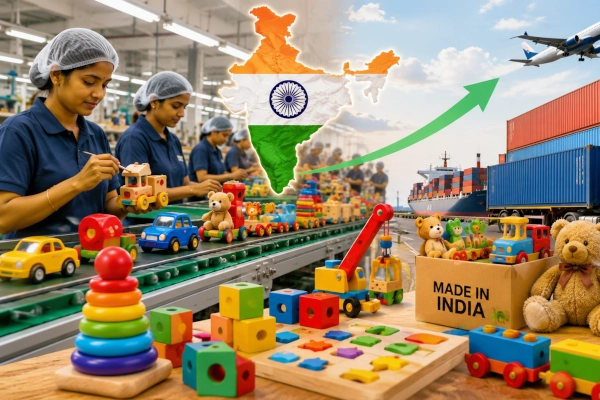
India’s toy industry has undergone a significant transformation, shifting from heavy dependence on imported products towards stronger domestic manufacturing and a growing export presence. Toy exports increased from $203.5 million in FY 2018–19 to $384.7 million in FY 2025–26, registering growth of 89.1 per cent. During the same period, imports declined by 37.5 per cent, from $371.7 million to $232.3 million.
The change has moved India from a toy trade deficit of $168.2 million in FY 2018–19 to a surplus of approximately $152.4 million in FY 2025–26. This represents an overall improvement of about $320.6 million in the country’s toy trade balance.
Indian manufacturers are now exporting toys to markets including the United States, the United Kingdom, the Netherlands and Germany. The sector’s expansion reflects a combination of mandatory safety standards, higher import duties, cluster development, startup participation, export incentives and initiatives encouraging toys rooted in Indian culture and learning traditions.
From Import Dependence to Export Competitiveness
In FY 2018–19, India imported toys worth $371.7 million, substantially more than the value of its exports. A considerable share of products entering the domestic market was reported to be cheap, counterfeit, substandard or unsafe.
A mystery-shopping exercise conducted in 2019 found that only 33 per cent of toys sampled from the Indian market met the applicable Bureau of Indian Standards requirements. This exposed a major consumer-safety problem, especially because toys are frequently handled by young children and may contain small components, sharp edges, hazardous chemicals or unsafe electrical systems.
The government responded through a combination of quality regulation and industrial-development measures. Rather than relying on a single dedicated toy policy, it introduced a coordinated National Action Plan for Toys involving multiple ministries and departments.
The resulting strategy addressed product safety, domestic manufacturing, design capability, traditional toy clusters, educational use, innovation and access to overseas markets.
Mandatory Standards Reshape the Domestic Market
The Quality Control Order for Toys was issued in February 2020 and came into force on January 1, 2021. It made compliance with relevant Indian safety standards compulsory for toys sold in the country.
Manufacturers must obtain a Bureau of Indian Standards licence before applying the BIS Standard Mark to their products. Certification requires an assessment of manufacturing facilities, production controls, testing capability and conformity with the applicable Indian Standard. BIS also conducts factory and market surveillance after licences are issued.
More than 1,800 licences have been granted to domestic toy manufacturers, while over 50 foreign manufacturers have received approval to use the BIS Standard Mark on compliant products intended for the Indian market.
The impact is visible in subsequent quality assessments. According to a BIS survey conducted in 2025, 95 per cent of toy samples met prescribed standards, compared with only 33 per cent in 2019. The improvement indicates that regulation has raised the entry threshold for both domestic and imported products while giving consumers greater assurance about safety and reliability.
Customs Duties Create Space for Indian Producers
Import duties have been used alongside mandatory certification to address the large inflow of low-cost finished toys.
The Basic Customs Duty on toys under HS Code 9503 was increased from 20 per cent to 60 per cent in February 2020 and raised further to 70 per cent in 2023. The duty structure increased the landed cost of imported finished products, giving Indian manufacturers greater room to compete in their domestic market.
At the same time, the customs duty on parts used in electronic toys was revised to 20 per cent in the FY 2025–26 Budget. This distinction supports the import of components required for domestic assembly while retaining a higher protective barrier against finished toy imports.
The long-term competitiveness of the industry, however, will increasingly depend on productivity, design, tooling, material quality and manufacturing scale. Tariff protection can create an initial market opportunity, but producers must ultimately compete on price, safety, originality and durability.
National Action Plan Coordinates 14 Ministries
The National Action Plan for Toys contains 21 action points coordinated by 14 ministries and departments. It provides a common framework for developing the sector across manufacturing, education, culture, design, quality regulation and trade promotion.
A major objective is to encourage toys based on Indian history, traditions, local stories and indigenous knowledge. This creates opportunities for manufacturers to develop products with a distinct identity instead of merely reproducing designs already available in international markets.
The plan also supports toy-design competitions, hackathons, exhibitions and innovation challenges. These initiatives encourage students, designers, engineers, artisans and startups to develop new concepts that can be converted into commercially viable products.
The multi-ministry structure reflects the diverse nature of the toy economy. It includes factory-made plastic and electronic products, wooden toys, textiles, board games, educational kits, puzzles, craft traditions, digital applications and collectibles.
Traditional Clusters Enter Modern Supply Chains
India possesses several long-established toy-making traditions using wood, clay, cloth, leather, natural fibres and locally available materials. Many such enterprises operate on a small scale and require support in tooling, design, packaging, testing and market access.
The Ministry of Micro, Small and Medium Enterprises has approved 18 toy clusters under the Scheme of Fund for Regeneration of Traditional Industries. The Ministry of Textiles is separately providing design and tooling support to 40 clusters.
A cluster-based approach allows groups of producers to share facilities that may be too expensive for individual artisans or small businesses. Common testing laboratories, machinery, design centres, raw-material banks and packaging facilities can improve consistency while preserving regional craftsmanship.
Modernising traditional clusters also creates a route for Indian toys to enter organised retail and export markets. Cultural value alone does not guarantee commercial success; products must also meet safety requirements, maintain uniform dimensions, use durable finishes and arrive in professional packaging.
More Than 700 Startups Join the Toy Economy
More than 700 toy-related startups have been recognised by the Department for Promotion of Industry and Internal Trade under the Startup India initiative. Their presence is broadening the industry beyond conventional manufacturing.
New businesses are developing science kits, robotics products, construction sets, puzzles, board games, assistive toys, learning applications and products combining physical play with digital features. Some companies are also using environmentally conscious materials or redesigning traditional games for contemporary consumers.
Startups can help the sector move into higher-value categories where intellectual property, educational design and brand recognition matter more than low-cost production alone. Their growth can also generate specialised employment in industrial design, animation, electronics, software, child development, packaging and product testing.
The next step will be to help promising companies move from prototypes and limited online sales towards scaled manufacturing and sustained distribution.
Toys Become Part of Classroom Learning
The National Education Policy 2020 promotes play- and activity-based learning, particularly during the foundational and preparatory stages of education.
NCERT’s handbook on toy-based pedagogy explains how toys, games, puppetry and storytelling can be used to teach academic concepts while supporting creativity, communication and problem-solving. Its framework includes indigenous games, toys made from affordable or environmentally sustainable materials and products adapted for different age groups.
This educational approach creates a substantial domestic opportunity for manufacturers. Schools, anganwadis, libraries, learning centres and parents need products designed around specific competencies rather than entertainment alone.
Educational toys must still be age-appropriate, inclusive and linked to clear learning outcomes. Cooperation among educators, child-development experts and manufacturers can help create products that are engaging without sacrificing academic purpose.
Toy Biz International Connects Manufacturers with Buyers
The 17th Toy Biz International business-to-business exhibition was held at Bharat Mandapam in New Delhi from July 4 to 7, 2026.
The event featured 400 Indian toy brands, attracted 100 international buyers from 40 countries and received approximately 30,000 business visitors. Manufacturers interacted with wholesalers, retailers, distributors, institutional purchasers and e-commerce companies.
Trade exhibitions perform an important commercial function in a fragmented industry. Small and medium-sized manufacturers may produce competitive products but lack direct access to national retail chains or overseas importers.
By bringing buyers and producers together, Toy Biz can help manufacturers secure bulk orders, understand international preferences and receive feedback on design, pricing and packaging. Its participation figures also indicate growing commercial interest in sourcing toys from India.
Export Support Extends Beyond Trade Fairs
More than 2,200 toy exporters have received support under the Remission of Duties and Taxes on Exported Products scheme. RoDTEP refunds certain embedded taxes and duties that are not otherwise credited, helping Indian goods compete more effectively in global markets.
The government has also highlighted zero-duty market access for eligible products under trade agreements with several partner economies. Such arrangements can reduce the tariff disadvantage faced by Indian exporters and provide access to larger consumer markets.
Preferential tariffs alone will not secure export orders. Overseas buyers evaluate product safety, delivery reliability, factory capacity, intellectual-property compliance and adherence to the importing country’s chemical and labelling rules.
Indian manufacturers seeking sustained export growth will therefore need to understand the regulatory requirements of each destination and invest in internationally acceptable testing and documentation.
Product Design Will Shape the Next Growth Phase
The initial transformation of the toy sector has been driven largely by import substitution and quality enforcement. Its next phase must be led by original products and recognisable brands.
Successful toy companies often create characters, stories and play systems that can be expanded across multiple products. A strong intellectual-property portfolio can support toys, books, animation, games, merchandise and educational content.
India has a vast source of inspiration in its history, scientific achievements, folklore, wildlife, architecture, festivals and regional traditions. Turning these themes into modern products requires professional research and design rather than superficial cultural decoration.
Designers must also account for age, ergonomics, learning value, accessibility and replay potential. A product that is visually attractive but difficult to use or quickly loses a child’s interest will struggle to build a lasting market.
Electronics and Advanced Manufacturing Offer New Possibilities
Electronic and technology-enabled toys represent a growing opportunity for Indian manufacturers. Robotics kits, programmable devices, remote-controlled products and interactive learning tools can connect the toy industry with India’s electronics and software capabilities.
Domestic production of these categories requires reliable motors, sensors, batteries, circuit boards and safe charging systems. Manufacturers must also manage software updates, data protection and cybersecurity when toys contain cameras, microphones or internet connectivity.
Expanding local component production can reduce import dependence while improving repairability and after-sales service. Collaboration between toy companies, electronics manufacturers and educational-technology firms could produce products tailored to Indian schools and households.
This segment offers higher value, but it also requires stronger engineering and more extensive safety testing than conventional products.
Sustainability Becomes a Competitive Factor
The toy sector uses plastics, textiles, paper, wood, metals, electronic components and packaging materials. As the industry expands, environmental performance will become increasingly important.
Manufacturers can reduce waste through modular design, replaceable components, recyclable packaging and responsible material selection. Wooden and fabric toys can benefit from India’s craft traditions, provided that paints, coatings and small components comply with safety standards.
Durability is itself a form of sustainability. Toys designed for repair, reuse or transfer between children remain in circulation longer and generate less waste than fragile disposable products.
Export markets and large retailers are also placing greater emphasis on material traceability and environmental claims. Companies that establish credible practices early may gain a commercial advantage.
Building a Globally Recognised Indian Toy Industry
India’s 89.1 per cent export growth and 37.5 per cent import decline demonstrate that the structure of the toy market has changed considerably since FY 2018–19.
The improvement in safety compliance is equally significant. Moving from 33 per cent conformity in 2019 to 95 per cent in the 2025 BIS survey indicates that quality regulation has altered the products available to Indian consumers.
The industry must now convert this progress into durable competitiveness. Manufacturers need larger production capacity, original intellectual property, advanced tooling, efficient logistics and deeper international distribution.
India has already established the foundations through standards, clusters, startups, education policy and export support. The next opportunity is to build toy companies that are recognised globally for safety, creativity and distinctly Indian design.
References
Press Information Bureau, Government of India. “India’s Toy Exports Soar 89.1%, Reflecting Strong Growth in Domestic Manufacturing.” Ministry of Commerce and Industry, 28 July 2026. Release ID: 2290441.
Bureau of Indian Standards. “Products Under Compulsory Certification” and “Product Certification Process.” Government of India.
National Council of Educational Research and Training. “Toy-Based Pedagogy: Learning for Fun, Joy and Holistic Development.” Government of India.
You may also like
-
Structural Optimisation Reportedly Cuts HAL LUH Vibration by Up to 50%
-
India and Uruguay Agree Trade and Connectivity Roadmap as Montevideo Ratifies International Solar Alliance
-
The Return of Multipolarity: Why the World Is Moving Beyond a Single Centre of Power
-
The Financial Chokepoint: Why BRICS Can No Longer Depend on SWIFT and the Dollar Alone
-
India Expands Market Access for South African Citrus With New In-Transit Cold Treatment Rules
