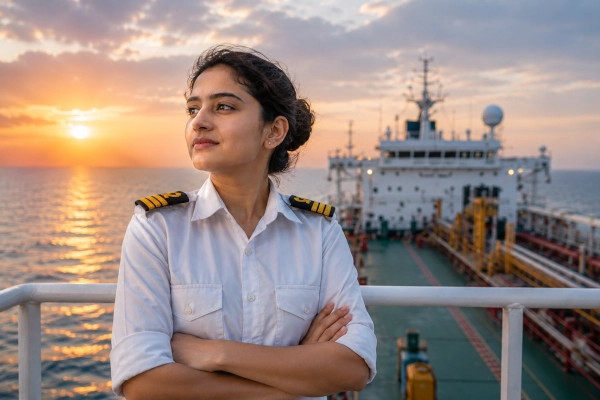
India has emerged as the world’s second-largest supplier of seafarers, marking a major transformation in the country’s maritime workforce and strengthening its role in sustaining international shipping and global trade.
According to the BIMCO–International Chamber of Shipping Seafarer Workforce Report 2026, India supplies 3,11,936 maritime professionals, representing 12.16 per cent of the global seafaring workforce. The country now ranks behind only the Philippines and ahead of other major maritime workforce suppliers, including China, Russia and Indonesia.
The rise is particularly significant because India occupied fifth place in 2015, when its contribution was limited to 5.2 per cent of the world’s seafarers. Its share increased to around 6 per cent by 2021 before more than doubling over the following five years. India’s progression from fifth to second place reflects the rapid expansion of maritime education, certification, training capacity and overseas employment opportunities.
Indian Officers Gain a Strong Global Presence
India’s contribution is especially prominent in the officer category, which includes masters, deck officers, marine engineers and electro-technical officers responsible for navigation, machinery operation, safety and ship management.
The country now supplies 1,40,718 officers, accounting for 13.41 per cent of the global officer workforce. A further 1,71,218 Indian ratings serve in operational and technical roles aboard merchant vessels, representing 11.29 per cent of ratings worldwide.
This distribution demonstrates that India is contributing across different levels of shipboard employment rather than serving primarily as a source of entry-level labour. The large officer share also indicates growing international acceptance of Indian maritime qualifications, training standards and professional competence.
Seafarers perform specialised duties aboard container ships, tankers, bulk carriers, passenger vessels, offshore support ships and other commercial vessels. They maintain navigation systems, propulsion machinery, communications equipment, cargo operations, safety procedures and environmental compliance throughout voyages that sustain international supply chains.
Global Shipping Faces an Officer Shortage
The 2026 workforce report estimates that approximately 2.57 million seafarers currently serve aboard 85,148 merchant ships worldwide. While the overall workforce remains close to industry demand, the balance differs sharply between officers and ratings.
BIMCO and the International Chamber of Shipping estimate a shortage of about 39,100 officers in 2026, alongside a surplus of approximately 56,890 ratings. The industry may require an additional 1,13,735 officers by 2030, depending on fleet expansion and workforce-retention trends.
Around 22,747 additional officers and 8,475 ratings may need to enter the profession annually until 2030. Training, recruitment and retention will therefore be central to the ability of the shipping industry to operate a growing and increasingly technologically advanced global fleet.
This shortage gives India an important opportunity. A large working-age population, English-language capability, established maritime institutes and internationally recognised certification standards place the country in a strong position to supply officers for future global demand.
Maritime Training Capacity Drives Expansion
India’s rise has been supported by the expansion of pre-sea education, competency training, simulator-based instruction, mandatory sea service and certification conducted under the oversight of the Directorate General of Shipping.
Training institutions prepare candidates for careers in nautical science, marine engineering, electro-technical operations, general-purpose ratings and maritime catering. Candidates must also complete prescribed medical examinations, safety courses, competency assessments and shipboard training before qualifying for different seafaring roles.
Indian seafarers are trained and certified in accordance with the International Maritime Organization’s Standards of Training, Certification and Watchkeeping Convention, commonly known as STCW. The convention establishes minimum international requirements for professional competence, watchkeeping, emergency preparedness and safety at sea. India is a party to the convention, and employment aboard Indian or foreign vessels depends on compliance with its training and certification framework.
Digitalisation has also simplified several regulatory processes. Online systems operated by the Directorate General of Shipping support seafarer registration, examination applications, certification, document verification and interaction with recruitment and placement agencies.
These changes have helped reduce paperwork, improve traceability and allow international employers to verify the qualifications of Indian maritime professionals more efficiently.
Structured Shipboard Training Addresses a Critical Bottleneck
Completing classroom education alone does not make a candidate eligible for most seafaring careers. Trainees must obtain prescribed periods of onboard experience before receiving certificates of competency or proficiency.
Availability of shipboard berths has therefore remained one of the most important constraints affecting maritime employment. A trainee may complete a recognised course yet face delays in securing the sea time needed for final qualification.
To address this issue, the Ministry of Ports, Shipping and Waterways launched a six-month Structured Onboard Training Programme in July 2026 for General Purpose Rating and Certificate Course in Maritime Catering trainees awaiting mandatory sea service. The programme is intended to connect trained candidates with supervised onboard opportunities and improve their transition into employment.
Expanding such arrangements will be essential for India’s future growth. Maritime institutes can increase admissions, but the number of qualified seafarers will rise sustainably only when adequate training berths are available aboard working vessels.
Deeper partnerships among shipowners, training institutions, recruitment agencies and maritime authorities could help align enrolment with genuine shipboard demand and prevent students from remaining stranded after completing pre-sea courses.
Mission 20% Sets the Next Workforce Target
The government has announced Mission 20%, which seeks to raise India’s share of the global seafaring workforce from 12.16 per cent to 20 per cent.
The objective is to make one in every five seafarers serving aboard merchant ships worldwide an Indian. Achieving this target will require more than increasing admissions to maritime institutes. It will involve expanding quality training, producing more qualified officers, securing shipboard placements and strengthening the international reputation of Indian certification.
The initiative also seeks closer cooperation between industry and educational institutions so that training responds to changes in ship technology, cargo systems, alternative fuels and maritime regulations.
India had already announced a target of reaching a 20 per cent global workforce share before the publication of the latest BIMCO–ICS figures. In April 2026, the Ministry highlighted plans to align maritime education, policy and research with the country’s long-term growth ambitions.
New Technology Is Changing Seafaring Careers
Modern merchant vessels increasingly rely on automation, satellite communications, integrated bridge systems, electronic navigation charts, digital engine monitoring and shore-based data analysis.
Future seafarers will also need to understand vessels powered by liquefied natural gas, methanol, ammonia, hydrogen and other lower-emission fuels. Each fuel introduces new handling procedures, engineering requirements and safety risks.
Cybersecurity is becoming equally important as navigation, propulsion and cargo systems become more connected. Officers must be capable of identifying digital threats, protecting shipboard networks and maintaining safe operations when electronic systems are disrupted.
India’s maritime curriculum will therefore require continuous revision. Simulator facilities, instructors and certification programmes must keep pace with rapid changes in vessel design and environmental regulation.
Training future officers only for conventional ships would limit their long-term employability. Mission 20% will depend on creating seafarers who are prepared for increasingly digital, automated and environmentally regulated vessels.
Legal Reforms Strengthen Seafarer Protection
The expansion of India’s maritime workforce has been accompanied by an overhaul of the country’s shipping legislation.
The Merchant Shipping Act, 2025, which came into force on March 15, 2026, modernises provisions concerning ship registration, safety, environmental compliance and seafarer welfare. It introduces statutory protection for abandoned seafarers and strengthens oversight of organisations responsible for recruiting and placing Indian professionals aboard ships.
The wider legislative programme includes the Indian Ports Act, Coastal Shipping Act, Bills of Lading Act and Carriage of Goods by Sea Act enacted in 2025. These laws seek to update India’s maritime governance, bring domestic regulations closer to international practice and improve the commercial environment for shipping and ports.
Strong recruitment regulation is especially important because aspiring seafarers may be vulnerable to fraudulent agents, false employment promises and unauthorised fee collection. Licensed Recruitment and Placement Service agencies are expected to follow prescribed standards and remain accountable to the maritime administration.
Growth in workforce numbers must therefore be accompanied by transparent recruitment, enforceable employment contracts, timely payment of wages and effective grievance mechanisms.
Welfare and Security Remain Central Challenges
Seafaring offers international employment and competitive earnings, but it also involves long periods away from home, demanding working conditions and exposure to operational, medical and geopolitical risks.
Recent maritime security incidents in the Persian Gulf and surrounding waters have demonstrated the dangers faced by crews operating through conflict-sensitive regions. The government has strengthened monitoring, issued security advisories and established coordination mechanisms involving the Directorate General of Shipping, Indian missions, shipowners and recruitment agencies.
Mental health, fatigue, isolation, shore-leave restrictions and access to medical support also require sustained attention. Recruitment growth will be difficult to maintain unless the profession offers safe working conditions, career progression and reliable welfare protection.
International employers will increasingly be judged not only by wages but also by crew connectivity, contract fairness, grievance redressal and support during emergencies.
Expanding Opportunities for Women
Women remain underrepresented in seafaring globally, particularly in technical and command positions. Increasing their participation represents one of the largest untapped opportunities for India’s maritime workforce.
The government’s Sagar Mein Samman action plan focuses on gender equality and inclusion in the maritime sector. Measures are intended to improve training access, employment opportunities, safety and workplace conditions for women at sea.
The Ministry reported in May 2026 that women’s participation in India’s maritime sector had increased by 340 per cent since 2020. The base remains relatively small, making further expansion important for achieving Mission 20%.
Separate accommodation, secure grievance systems, maternity-related support, prevention of harassment and stronger recruitment by shipping companies can help make maritime careers more accessible and sustainable for women.
Economic Importance Beyond Shipboard Employment
The growth of India’s seafaring workforce produces benefits extending beyond the individuals employed aboard ships.
Seafarers earn foreign exchange, support household incomes and create demand for training, medical assessment, travel, insurance and financial services. Experienced officers can later move into port operations, maritime education, ship management, surveying, marine insurance, classification societies and logistics.
A larger pool of skilled personnel can also support India’s domestic ambitions in shipbuilding, coastal shipping and fleet expansion. The country needs experienced masters, engineers and technical managers to operate Indian-controlled vessels and build institutional knowledge across the wider maritime economy.
India’s seafaring expansion should therefore be viewed as part of a broader human-capital strategy for the blue economy rather than simply as an overseas-employment programme.
Quality Will Determine the Success of Mission 20%
India’s rise to second place is a significant milestone, but the next phase will be more demanding. Expanding numbers without maintaining training quality could damage the reputation that created the opportunity.
Maritime institutes will need qualified instructors, functioning simulators, updated equipment and transparent placement records. Regulators must continue monitoring institutions and recruitment agencies, while shipping companies should provide adequate onboard training and clearly defined career pathways.
Employment outcomes must also be measured carefully. Registration or course-completion figures alone cannot establish whether candidates obtained sea time, secured contracts or remained employed in the profession.
Mission 20% will ultimately depend on whether Indian seafarers continue to be recognised for competence, discipline, adaptability and professional conduct. By combining international-standard training with welfare protection, digital regulation and stronger industry partnerships, India has the potential to become the world’s leading maritime talent hub.
References
Press Information Bureau, Government of India. “India Emerges as World’s Second-Largest Supplier of Seafarers.” Ministry of Ports, Shipping and Waterways, 28 July 2026.
BIMCO and International Chamber of Shipping. “Seafarer Workforce Report 2026.” Published June 2026.
International Chamber of Shipping. “BIMCO and ICS Report Warns of Potential Future Shortage of Officers.” 25 June 2026.
Press Information Bureau, Government of India. “Promotion of Skill Development in the Maritime Sector.” Ministry of Skill Development and Entrepreneurship, 27 July 2026. Release ID: 2289884.
Press Information Bureau, Government of India. “Seafarer Safety Framework for Emerging Maritime Risks.” Ministry of Ports, Shipping and Waterways, 21 July 2026. Release ID: 2286976.
You may also like
-
SatLeo Labs’ TAPAS-1 Reaches Orbit, Advancing India’s Private Thermal-Imaging Capability
-
TakeMe2Space’s MOI-1A Reaches Space on Falcon 9 Transporter-18 Mission
-
Bank of Baroda Enters Pension Fund Management After PFRDA Appointment
-
SCI and India’s Push for a Larger Indigenous Maritime Fleet
-
Hindustan Shipyard to Serially Produce Indigenous JAYA Autonomous Underwater Vehicle After CSIR-NIO Technology Transfer
