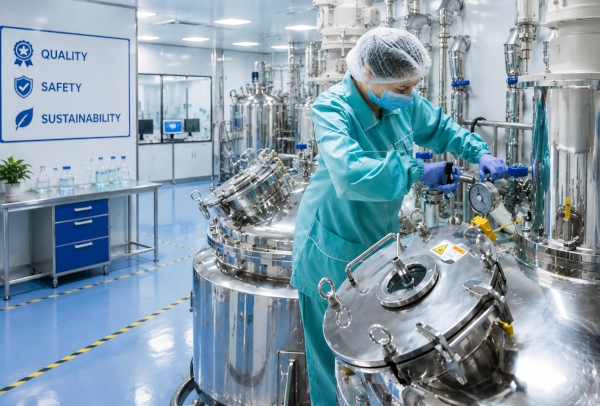
The Union Cabinet has approved the Bharat Audyogik Vikas Yojana–Rasayan, or BHAVYA-Rasayan, for developing three dedicated chemical parks across India. With a total financial outlay of ₹3,030 crore, the initiative seeks to create integrated manufacturing clusters equipped with common infrastructure, environmental management systems and essential industrial utilities.
Of the total allocation, ₹3,000 crore will be used to establish shared infrastructure and basic facilities within the proposed parks. The remaining ₹30 crore has been set aside for administrative and implementation-related expenditure. The scheme, which was initially announced in the Union Budget 2026–27, will be implemented over five years.
Under the funding framework, the Central Government will provide financial assistance of up to ₹1,000 crore for each chemical park. The state selected to host a park will be required to contribute at least ₹500 crore and facilitate land, connectivity, regulatory clearances and supporting infrastructure.
The parks are expected to follow a cluster-based, plug-and-play model, allowing chemical manufacturers to begin operations more quickly by accessing pre-developed industrial land and shared services. The model is intended to reduce the cost and time involved in separately creating utilities, waste-management systems, storage facilities and other essential infrastructure.
Common facilities proposed within the parks include effluent treatment plants, hazardous-waste management systems, treatment and disposal facilities, uninterrupted water and power supplies, testing infrastructure, internal roads and other services specifically required by chemical industries.
Centralised environmental infrastructure will be a major component of the scheme. Chemical manufacturing involves complex effluents and hazardous materials that require specialised handling. Shared treatment and disposal systems can help improve regulatory compliance while reducing the burden on individual manufacturers, particularly small and medium-sized enterprises.
The parks are also expected to support a broad industrial value chain covering basic chemicals, petrochemicals, specialty chemicals, agrochemicals, dyes, intermediates and ancillary industries. Concentrating related companies within integrated clusters can encourage the sharing of raw materials, logistics, storage facilities, technical services and industrial by-products.
India is currently among the world’s leading chemical-producing countries, with established manufacturing centres in states such as Gujarat, Maharashtra, Odisha, Andhra Pradesh and Tamil Nadu. The government expects the new parks to strengthen domestic production, support import substitution and improve the sector’s integration with international supply chains.
Improved infrastructure could also enhance the global competitiveness of Indian chemical manufacturers by lowering logistical and compliance costs. The development of downstream and ancillary units around the major manufacturing facilities is expected to attract private investment and generate direct and indirect employment.
States are likely to compete for the three parks through a challenge-based selection process. Proposals may be assessed on factors such as land availability, access to ports and transport networks, availability of water and power, industrial demand, environmental safeguards and the state government’s financial commitment.
BHAVYA-Rasayan complements the broader Bharat Audyogik Vikas Yojana, under which the Centre plans to establish investment-ready industrial parks across the country. The larger BHAVYA programme focuses on plug-and-play industrial ecosystems with integrated utilities, multimodal connectivity, digital governance and worker-support infrastructure.
The chemical park initiative represents a major infrastructure-led effort to strengthen one of India’s most important manufacturing sectors. Its success will depend on timely land acquisition, efficient Centre-state coordination, strong environmental safeguards and the ability of the selected parks to attract large anchor investors alongside smaller downstream industries.
Reference
The Times of India
“Three Chemical Parks to Be Set Up Under BHAVYA-Rasayan Scheme”
Published: July 24, 2026
Press Information Bureau, Government of India
“Union Budget FY 2026–2027: Chemical Parks — Strengthening India’s Chemical Manufacturing”
Published: February 4, 2026
Press Information Bureau, Government of India
“Union Minister of Commerce & Industry Launches BHAVYA Portal”
Published: June 8, 2026
You may also like
-
When Trade Routes Become Weapons: Why BRICS Needs a Resilient Supply-Chain Architecture
-
India’s Trade With BRICS More Than Doubles to $417 Billion as Export Opportunity Expands
-
India and Uruguay Agree Trade and Connectivity Roadmap as Montevideo Ratifies International Solar Alliance
-
The Return of Multipolarity: Why the World Is Moving Beyond a Single Centre of Power
-
The Financial Chokepoint: Why BRICS Can No Longer Depend on SWIFT and the Dollar Alone
