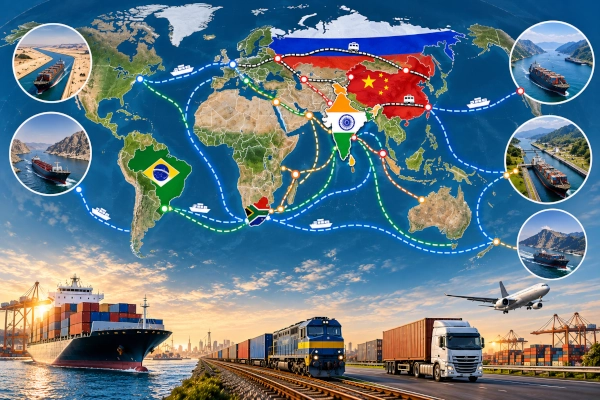
For much of the globalisation era, trade routes were treated primarily as economic infrastructure. Ships followed the cheapest available routes, companies placed production where costs were lowest, energy crossed borders through pipelines and sea lanes, and financial transactions moved through a relatively small number of international payment and messaging systems. That model assumed that commercial efficiency would remain largely insulated from geopolitical rivalry.
That assumption is becoming increasingly difficult to sustain. Trade routes, supply chains, financial networks, technology access and strategic commodities can all become instruments of geopolitical leverage. A shipping route can be disrupted by conflict, a critical technology can be placed behind export controls, access to an essential commodity can be restricted, and financial transactions can become vulnerable to sanctions or political pressure. Even when a physical trade route remains open, higher insurance costs, compliance restrictions or financing difficulties can make commerce more expensive or commercially unattractive.
For BRICS, this changing environment creates both a challenge and an opportunity. Its members span Asia, Africa, the Middle East and Latin America and include some of the world’s largest producers and consumers of energy, minerals, food and manufactured goods. The appropriate response is not withdrawal from globalisation or the creation of a closed economic bloc. BRICS instead needs enough alternative trade routes, financial mechanisms, production capacity and institutional redundancy to ensure that no single chokepoint can determine whether legitimate commerce between its members continues.
Global Trade Remains Vulnerable to Geographic Chokepoints
Modern international commerce remains heavily dependent on a relatively small number of maritime corridors and logistical nodes. The Suez Canal, Bab el-Mandeb, Strait of Hormuz, Strait of Malacca and Panama Canal are not merely geographic features. They are strategic arteries through which vast quantities of energy, manufactured goods, food, minerals and industrial inputs move every year.
Recent disruptions in the Red Sea demonstrated how quickly problems at one maritime corridor can spread through the global economy. Security threats forced many ships travelling between Asia and Europe to avoid the Red Sea and Suez Canal and instead sail around the Cape of Good Hope. The longer route increased voyage times, fuel consumption, freight rates and pressure on shipping capacity.
The disruption also occurred while drought-related constraints were affecting the Panama Canal, illustrating another important vulnerability. Trade routes can be disrupted not only by war or political confrontation but also by climate events, accidents, piracy, infrastructure failure and natural disasters. When global commerce becomes excessively dependent on a limited number of corridors, disruption at any one of them can generate consequences far beyond the immediate region.
BRICS therefore needs to think about trade resilience geographically. Major trading relationships between member countries should ideally have more than one commercially viable transport route so that disruption at one corridor does not automatically interrupt the entire flow of goods.
Supply Chains Are Becoming Instruments of Strategic Competition
The vulnerabilities of international commerce extend far beyond shipping routes. Modern industrial production depends on complex supply chains in which raw materials, components, specialised machinery, software and technology may originate in several different countries before reaching the final manufacturer.
A modern automobile, for example, may depend on semiconductors manufactured in one country, critical minerals extracted in another, battery materials processed elsewhere and specialised software developed in yet another economy. Such international division of production created enormous efficiency, but it also produced concentrated dependencies that can become strategically significant during periods of geopolitical rivalry.
Governments increasingly treat semiconductors, artificial intelligence hardware, telecommunications equipment, advanced machine tools, energy technologies and critical minerals as national-security assets. Export controls, investment restrictions and technology-access limitations are therefore becoming increasingly important elements of international economic competition.
Not every restriction should automatically be regarded as illegitimate because governments have genuine security interests. The larger concern arises when production of a crucial technology or material is concentrated in very few locations. Under those conditions, access can potentially be restricted during political confrontation, leaving dependent economies with few immediate alternatives.
For emerging economies, supply-chain decisions must therefore consider more than price. Governments and industries increasingly need to ask whether an essential component will remain available during diplomatic tensions, whether another supplier can be developed and whether domestic or regional alternatives exist.
Financial Networks Can Become Trade Chokepoints
International commerce depends not only on the physical movement of goods but also on payments, trade finance, settlement systems, correspondent banking and insurance. A shipment may physically travel directly from one BRICS country to another while the financial transaction still depends on institutions or systems located outside both countries.
This creates another form of concentration risk. If businesses can move goods but cannot reliably settle payments, obtain trade finance or secure insurance, physical connectivity alone does not provide genuine economic resilience.
BRICS therefore needs a wider range of interoperable financial mechanisms rather than dependence on any single payment or settlement system. This does not require abandoning existing international systems, nor does it require creating a single BRICS currency. The more practical objective is to give businesses multiple channels through which legitimate transactions can be completed.
Local-currency settlement can form part of this architecture where trade volumes and financial conditions make it commercially viable. Linking domestic payment systems, improving messaging interoperability and strengthening trade-finance mechanisms can provide additional options without forcing every transaction into one model.
The principle should be diversification rather than replacement. A resilient financial architecture is one in which disruption or restriction affecting one channel does not automatically prevent businesses from using another lawful and commercially viable route.
Shipping Insurance Is Another Strategic Vulnerability
Insurance and reinsurance are often overlooked when discussions focus on trade resilience, yet they are essential to the functioning of global shipping. Commercial vessels carrying valuable cargo require insurance, and when conflict erupts near an important sea lane, war-risk premiums can rise sharply.
A shipping corridor does not have to be physically closed to become economically difficult. If insurance costs rise sufficiently, shipping companies may reroute vessels even when passage technically remains possible. The result is higher freight costs, longer delivery times and greater pressure on supply chains.
The same issue affects infrastructure projects and cross-border investment. Large projects require guarantees, insurance and reinsurance before financing can be arranged at acceptable cost. If these services are concentrated among a limited number of institutions or jurisdictions, access can become another potential vulnerability.
BRICS should therefore expand its own insurance and reinsurance capacity while continuing to work with established global providers. The objective should not be to exclude international insurers but to ensure that member countries have additional sources of risk coverage when global conditions become difficult.
A stronger BRICS insurance ecosystem could support shipping, infrastructure financing, energy projects and cross-border trade, providing an additional layer of resilience to the wider economic architecture.
BRICS Needs Multiple Corridors Rather Than One Alternative Corridor
One of the biggest mistakes BRICS could make would be to respond to existing trade-route concentration by creating a new single corridor that simply becomes another chokepoint. Genuine resilience comes from networks of alternatives rather than from replacing one dependency with another.
BRICS members should therefore invest in multiple maritime, rail, road and multimodal corridors connecting production centres with consumer markets. Ports need stronger railway and road connections, landlocked members require access to several ports, and customs systems need to become increasingly interoperable.
A useful long-term objective would be for every major trade relationship between BRICS economies to have at least two commercially viable routes wherever geography allows. If disruption affects one route, cargo could then be redirected through another without bringing trade to a halt.
This requires more than constructing new infrastructure. Customs procedures, documentation standards, cargo-tracking systems and logistics regulations must also become compatible enough to allow goods to shift efficiently between routes.
BRICS could therefore develop a comprehensive mapping of strategic commodities and transport corridors. Such an exercise would identify where major dependencies exist and where infrastructure investment could create alternative pathways.
Critical Minerals Require Complete Value Chains
Critical minerals demonstrate why control over natural resources alone does not guarantee economic security. A country may possess large reserves of lithium, nickel, cobalt or rare earths while still depending on another country for refining, processing, specialised chemicals or advanced manufacturing.
True supply-chain resilience therefore requires the development of complete value chains rather than a narrow focus on extraction.
BRICS includes countries with major mineral resources as well as some of the world’s largest manufacturing economies. This creates an opportunity to distribute different stages of production across several member countries. Mining could be linked with refining, metallurgical processing, battery-material production, recycling and advanced manufacturing.
Such cooperation would also help resource-producing countries capture more economic value. BRICS should avoid reproducing an old economic structure in which one country exports raw materials while another performs nearly all of the higher-value processing and manufacturing.
Strategic partnerships should therefore include technology transfer, processing facilities, skills development and industrial investment. This would make mineral cooperation economically beneficial to producers while simultaneously improving supply security for manufacturing economies.
Food and Fertiliser Need Similar Resilience
Food security is another area where supply-chain disruption can quickly become a national-security issue. Several BRICS countries are major producers or consumers of grains, fertilisers, edible oils and other agricultural commodities, which creates considerable scope for cooperation.
Disruptions involving fertiliser supplies, shipping routes, export restrictions or financial payments can quickly affect agricultural production and food prices. A resilient BRICS agricultural architecture should therefore focus on diversification of suppliers, better logistics and improved information sharing.
Members could cooperate more closely on production forecasts, grain stocks, fertiliser availability and export capacity. Better information would allow governments and businesses to respond more rapidly when shortages emerge in one region.
BRICS could also encourage investment in storage facilities, port infrastructure, cold chains and rail connectivity so that food and agricultural inputs can be moved more easily between member economies.
The aim should not be to create a closed agricultural market. BRICS countries benefit from access to the wider global economy and should continue trading with external partners. The objective should instead be to ensure that temporary disruptions in one market or transport corridor do not produce avoidable shortages elsewhere.
Manufacturing Must Be Distributed Across Several Economies
Supply-chain resilience ultimately depends on production capacity. BRICS cannot insulate itself from international disruption merely by increasing trade among members if production of strategically important goods remains concentrated in one or two locations.
Sectors such as semiconductors, pharmaceuticals, active pharmaceutical ingredients, telecommunications equipment, industrial electronics, energy technologies, machine tools and specialised chemicals all require wider manufacturing bases.
BRICS members should therefore encourage joint ventures, technology partnerships, supplier-development programmes and specialised industrial clusters across several economies. Rather than attempting to duplicate every industry in every country, production could be distributed according to comparative strengths while maintaining enough redundancy to prevent excessive dependence on a single supplier.
Such redundancy may cost more than a purely efficiency-driven supply chain, but the additional cost can function like economic insurance. A supply chain supported by several qualified suppliers in different regions is more resilient than one dependent entirely on the cheapest producer.
The COVID-19 pandemic demonstrated the danger of discovering supply concentration only after an emergency begins. Resilience must therefore be built during normal periods rather than improvised during crises.
Digital Trade Systems Can Reduce Administrative Chokepoints
Not every trade vulnerability requires new ports, railways or industrial plants. Administrative procedures themselves can become significant barriers when customs documentation, certification systems and regulatory requirements are incompatible.
Paper-based processes can make rerouting cargo particularly difficult. If goods suddenly need to enter through a different country or port, businesses may face delays because certificates, customs declarations or cargo records cannot easily be recognised across jurisdictions.
BRICS could therefore make digital trade documentation an important element of its resilience strategy. Secure electronic certificates of origin, interoperable customs records and mutually recognised cargo documentation would reduce transaction costs during normal trade and make emergency rerouting considerably easier.
Greater digital integration could also improve cargo tracking and provide governments with better information about emerging supply disruptions. This would allow authorities to identify shortages earlier and redirect logistics more efficiently.
Administrative interoperability is less visible than major infrastructure projects, but it can have equally important effects on trade efficiency and resilience.
BRICS Must Avoid Becoming a Closed Rival Bloc
BRICS should also recognise that excessive economic fragmentation carries serious risks. A strategy intended to protect members from external vulnerabilities could become counterproductive if it evolves into an attempt to create a completely separate economic bloc.
BRICS economies remain deeply connected to markets in Europe, North America, East Asia, Southeast Asia and other regions. These economic relationships provide investment, technology, export demand and access to specialised products that cannot easily be replaced.
The objective should therefore be diversification rather than separation. BRICS countries can expand trade among themselves while continuing to engage economically with the United States, Europe, Japan, ASEAN and other major partners.
A multipolar economic system should offer more choices rather than create new barriers. Economic resilience is strongest when countries can trade through several markets, several transport corridors and several financial systems without being forced into exclusive blocs.
BRICS therefore has more to gain from supporting an open but diversified global trading system than from building a self-contained alternative to the existing one.
Strategic Redundancy Is More Practical Than Autarky
No major BRICS economy can realistically manufacture every product, extract every mineral or achieve complete energy and technological self-sufficiency. Attempting to do so would raise costs, weaken competition and slow innovation.
The more practical objective is strategic redundancy. Countries need enough domestic capability, diversified foreign suppliers and alternative trade routes so that disruption in one location does not become a national emergency.
A country does not need complete self-sufficiency in semiconductors, energy, food, pharmaceuticals or critical minerals. It does, however, need confidence that essential supplies can still be obtained if one supplier or transport route suddenly becomes unavailable.
BRICS can support this approach through infrastructure investment, harmonised standards, customs cooperation, local-currency settlement where practical, stronger trade finance, expanded insurance capacity and manufacturing partnerships spread across several countries.
Such policies would allow members to remain integrated with the wider global economy while reducing their vulnerability to concentrated dependencies.
The Next Phase of Globalisation Will Be Built Around Resilience
The global trading system of the past three decades was designed largely around efficiency. The next phase will increasingly require a balance between efficiency, security and resilience.
The cheapest route will not always be the most reliable route, the lowest-cost supplier will not always be the safest supplier, and the most convenient payment system should not necessarily be the only payment system available.
This does not mean globalisation is ending. It means that globalisation is being redesigned under the pressure of geopolitical competition, technological rivalry, conflict and climate disruption.
BRICS has an opportunity to influence that redesign because its members collectively possess energy resources, agricultural capacity, mineral reserves, manufacturing capability, large consumer markets, financial centres and important maritime and continental transport corridors.
If these strengths are connected through diversified logistics networks, interoperable payment mechanisms, stronger insurance capacity, distributed manufacturing and resilient critical-mineral and food supply chains, BRICS could reduce its exposure to external chokepoints without isolating itself from the wider world.
The ultimate objective should not be to construct a parallel world economy. BRICS should instead help build an international system in which no single country, corridor, technology supplier, financial network or logistics node possesses enough concentrated leverage to disrupt legitimate trade between others.
That would represent a practical form of economic multipolarity. It would replace excessive dependence not with isolation, but with alternatives, redundancy and choice.
You may also like
-
Indian Semiconductor Companies Propose New Manufacturing and Chip Design Investments in Madhya Pradesh
-
CSIR-CRRI Partners with Industry to Develop Advanced Indigenous Airport Runway and Pavement Materials
-
Paras Semiconductors Secures 43 Acres in Madhya Pradesh for Proposed ₹6,200 Crore Advanced Chip Packaging Facility
-
Petronet LNG Plans ₹1,200 Crore Joint Venture for Ten Compressed Biogas Plants Across India
-
India Seeks South Korean Shipbuilding Partnerships as Sarbananda Sonowal Begins Four-Day Visit to Busan
