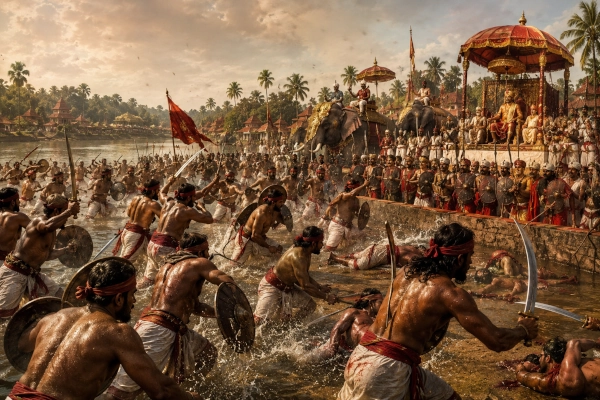
The Valluvanad Rajas, commonly known by the royal titles Valluvakonathiri or Vellattiri, ruled one of medieval Kerala’s most influential inland principalities. The name refers to a hereditary royal line rather than a single monarch. Their kingdom, known in historical records as Valluvanad or the Arangottu Swaroopam, occupied a strategically important region of central Malabar and became renowned for its association with the Mamankam festival, its resistance to the Zamorins of Calicut and the extraordinary martial tradition of the Chaver warriors.
The Names Valluvakonathiri and Vellattiri
The ruler of Valluvanad appears under several titles and spelling variations in historical records. These include Valluvakonathiri, Valluvakkonathiri, Vellattiri, Vellatiri, Velatra, Velnatera, Arangottu Udayavar and Vallabha Raja. British-era treaties and administrative documents frequently referred to the territory as the kingdom of Vellattiri and used Vallabha Raja as a formal designation for its ruler.
The term Arangottu Swaroopam represented the dynastic house governing Valluvanad. A swaroopam in medieval Kerala was a matrilineal royal corporation whose authority passed through branches of an extended ruling family. The senior eligible male usually exercised political and ritual authority as the reigning ruler. This system created continuity even when individual kings died without direct male heirs.
The early hereditary title Rajasekhara also appears in inscriptions connected with Valluvanad. Medieval forms such as Rayaran, Irayira Chekaran and Irayiravar have been associated with rulers or chiefs of the region. The variety of titles reflects the changing political languages of early medieval inscriptions, later royal traditions and colonial documentation.
Valluvanad During the Chera Perumal Period
Valluvanad existed as a territorial division, or nadu, during the rule of the Chera Perumals of Mahodayapuram between approximately the ninth and early twelfth centuries. Its chief belonged to the group of regional nadu-udayavar who exercised authority under the wider Chera political order. Historical studies of early medieval Kerala identify such nadus as important territorial formations supported by local military organisations, temples, landholding groups and assemblies.
Epigraphic evidence places Valluvanad firmly within the political world of tenth-century Kerala. A Chola-period inscription from Tiruvottiyur refers to Rajasekhara, described as the ruler of Vallabha Rashtra, and his son Vellan Kumaran. Vellan Kumaran is recorded as serving the Chola prince Rajaditya during conflicts involving the Rashtrakutas, indicating that Valluvanad possessed an established warrior elite and maintained political connections beyond Kerala.
Another early figure, Rayiran Chathan, appears as the ruler or overlord of Valluvanad and as a witness in the Jewish copper-plate tradition associated with the Chera court. These references show that Valluvanad’s chiefs held recognised status within the political hierarchy of the Chera kingdom.
The military organisation associated with Valluvanad was known as the Aru Nurruvar, or “Six Hundred.” Inscriptions connect this body with the protection of temples and market centres, suggesting that the Valluvanad ruler commanded an organised regional militia capable of operating beyond the immediate royal headquarters.
Emergence as an Independent Principality
The Chera Perumal political order fragmented during the early twelfth century. Its constituent regions gradually emerged as independent principalities ruled by hereditary houses. Valluvanad consequently developed into a sovereign kingdom under the Arangottu Swaroopam, while neighbouring Eranad rose under the Eradis, the family that later produced the Zamorins of Calicut.
At its greatest extent, Valluvanad covered a substantial portion of central Malabar. Traditional descriptions place the Bharathapuzha and the sacred centre of Tirunavaya toward its southern and western zone, the Ponnani coast toward the Arabian Sea, the Panthalur hills toward the north and the Attappadi highlands toward the east. Its boundaries changed repeatedly as neighbouring powers expanded, making every fixed map an approximation tied to a particular period.
The kingdom included territories now divided among parts of Malappuram and Palakkad districts. Important centres associated with its history include Angadipuram, Perinthalmanna, Mankada, Manjeri, Mannarkkad, Tirunavaya, Ponnani and portions of the Bharathapuzha valley.
Angadipuram and the Royal Centre
Angadipuram, near present-day Perinthalmanna, functioned as the principal royal centre of Valluvanad. Kerala’s Revenue Department describes the village as the capital of the powerful medieval kingdom. Its position near routes connecting the coast, the Palakkad region, the eastern highlands and the interior gave the Valluvanad rulers access to agricultural production, inland commerce and military communications.
The political and sacred centre of the dynasty was the Thirumandhamkunnu Bhagavathi Temple. The presiding goddess was revered as the paradevata, or guardian deity, of the Valluvanad royal house. The close relationship between the temple and the dynasty reflects the wider medieval Kerala pattern in which royal power, temple ritual, landholding and military authority formed an interconnected system.
Traditions linking the royal family with Thirumandhamkunnu remain visible in temple customs. The title Valluvakonathiri continues to carry ritual significance in connection with the temple, preserving the memory of the dynasty beyond the end of its territorial sovereignty.
Mamankam and the Authority of the Rakshapurusha
Valluvanad’s most enduring historical association is with Mamankam, the great festival and commercial assembly held once every twelve years at Tirunavaya on the banks of the Bharathapuzha. The event combined worship at the Navamukunda Temple with trade, pilgrimage, martial exhibitions, public ceremony and the display of political authority.
The ruler presiding over Mamankam held the prestigious position of Rakshapurusha, commonly interpreted as the great protector or guardian of the assembly. Presidency of the festival represented far more than ceremonial honour. It projected sovereignty before the assembled chiefs, merchants, warriors, religious authorities and communities of Kerala.
Later historical and literary traditions associate the Valluvakonathiri with the presidency of Mamankam following the disintegration of the Chera Perumal state. The Keralolpathi tradition states that the ruler of the Arangottu Swaroopam received Tirunavaya and the responsibility for conducting the twelve-year festival. The festival’s early history remains partly reconstructed from later chronicles because surviving contemporary inscriptions from the temple precinct provide limited information about its political organisation.
This distinction between inscriptional evidence and later tradition is important. Valluvanad’s early existence and political status have epigraphic support, while several details regarding the original transfer of Mamankam’s presidency come from chronicles composed in later centuries.
Rise of the Zamorin of Calicut
The political balance of northern and central Kerala changed with the rise of the Zamorin of Calicut, or Samoothiri, from the ruling house of Eranad. Calicut’s rulers built their power through military expansion, control of maritime commerce and alliances with merchants and local chiefs.
Access to the coast was essential for a rising commercial state. The Zamorins expanded toward Ponnani and Tirunavaya, territories associated with Valluvanad’s western zone. Control of Ponnani strengthened their position in Indian Ocean trade, while possession of Tirunavaya allowed them to claim the prestigious presidency of Mamankam.
Historical traditions differ on the exact chronology of Tirunavaya’s conquest. Some place decisive campaigns in the fourteenth or fifteenth centuries, while other accounts connect the final transfer of authority with a longer series of wars extending into a later period. The broader sequence remains clear: the Zamorins gradually seized Valluvanad’s western territories, acquired control over Tirunavaya and assumed the title and ceremonial functions of Rakshapurusha.
The loss of Tirunavaya carried immense political and emotional significance for the Vellattiri. It represented the transfer of sacred prestige, commercial influence and regional leadership to Calicut.
The Chaver Warriors
The Valluvanad response produced one of Kerala’s most celebrated martial traditions: the Chavers. The term referred to warriors who undertook a mission with the expectation of death. At successive Mamankam festivals, groups loyal to the Valluvakonathiri attempted to break through the Zamorin’s heavily defended position and kill him.
Their objective combined dynastic loyalty, ritual obligation, revenge and the recovery of the Vellattiri’s lost ceremonial right. The Chaver tradition therefore belonged to the political culture of a prolonged blood feud rather than an isolated act of battlefield desperation. Historical research describes the repeated attacks as a conflict sustained across generations in the name of loyalty to Valluvanad’s ruling house.
The warriors were traditionally drawn from leading martial houses of Valluvanad. Before entering combat, they received blessings, shared a final meal and performed rites appropriate to men preparing for death. Armed primarily with swords and shields, they advanced against the Zamorin’s guards near the Nilapaduthara, the ceremonial platform from which he presided over Mamankam.
William Logan’s Malabar Manual preserves a dramatic account of the Mamankam of 1683 based on regional chronicles. It describes the Chaver warriors receiving farewell blessings, wearing garlands and ashes and advancing through the armed forces surrounding the Zamorin. Logan’s record helped preserve the memory of the Chavers as disciplined martial retainers bound by honour to the Vellattiri.
Their attacks rarely offered a realistic military path to victory. Their deeper meaning lay in the refusal to recognise the Zamorin’s claim as legitimate. Every Chaver assault publicly renewed Valluvanad’s challenge to Calicut’s possession of the Mamankam presidency.
A Prolonged Struggle with Calicut
The conflict extended far beyond the Mamankam grounds. The Zamorins gradually annexed territories associated with Valluvanad, including strategic routes and centres such as Manjeri, Malappuram and areas toward Nilambur. Resistance proved especially intense along important border regions and in territories commanded by local chiefs loyal to the Vellattiri.
Valluvanad’s political structure included subordinate chiefs, landholding families, ministers, commanders and temple authorities. This decentralised order allowed resistance to continue even as the central kingdom lost territory. It also made the principality vulnerable when individual local powers shifted allegiance or accepted the expanding authority of Calicut.
The Vellattiri retained a reduced domain around the eastern and central portions of the former kingdom. By the late eighteenth century, colonial records distinguished Vellattiri, or Valluvanad Proper, from the wider historical territory that had once acknowledged the Valluvanad ruler.
Royal Government and Matrilineal Succession
Like several Kerala royal houses, the Arangottu Swaroopam followed a matrilineal system of succession. Membership and dynastic continuity passed through women of the royal lineage, while senior male members held ruling and military offices.
The family developed several branches or thavazhis. Local genealogical traditions identify branches associated with Kadannamanna, Mankada and other royal residences. Political functions could be distributed among senior members, allowing princes to administer territories, lead forces or perform temple duties under the authority of the ruling Valluvakonathiri.
The kingdom governed through relationships with desavazhis, military households, Brahmin institutions, temple establishments and local landholders. Authority depended on the ruler’s ability to maintain allegiance across this network. Such arrangements characterised many Kerala principalities, where royal sovereignty operated through negotiated layers of hereditary rights.
Mysorean Expansion and the End of Political Sovereignty
During the late eighteenth century, the expansion of Mysore under Hyder Ali and Tipu Sultan transformed the political order of Malabar. Valluvanad, already reduced by centuries of Calicut expansion, came under Mysorean pressure along with the other principalities of the region.
Members of the Valluvanad royal family sought refuge in Travancore during the upheavals associated with Mysorean rule. After the East India Company gained control of Malabar at the end of the Anglo-Mysore conflicts, the old ruling houses recovered limited recognition while effective administration passed to the colonial government. The Valluvanad ruler entered a pension arrangement, bringing the dynasty’s territorial sovereignty to an end during the closing years of the eighteenth century.
The British subsequently created a Walluvanad Taluk within the Malabar District. Its boundaries included areas with different earlier political histories, so the colonial taluk and the medieval kingdom represented related yet distinct geographical units.
Historical Memory of the Vellattiri
The Valluvanad Rajas occupy a distinctive place in Kerala history because their legacy combines early medieval state formation, temple-centred authority, inland trade, matrilineal kingship and military resistance.
Their association with Mamankam gave the dynasty a significance extending beyond the size of its later territory. The Zamorin’s supremacy was publicly celebrated at Tirunavaya, while the Chaver assaults ensured that the Vellattiri’s competing claim remained visible before the assembled political world of Kerala.
Angadipuram, Thirumandhamkunnu, Tirunavaya and the Mamankam monuments continue to preserve this history. The Pazhukka Mandapam and related remains at Tirunavaya are protected as part of Kerala’s archaeological heritage, while ritual associations at Thirumandhamkunnu maintain the memory of Valluvanad’s royal house.
Legacy of the Valluvanad Rajas
The Vellattiri dynasty represents the endurance of a regional kingdom whose political power gradually contracted while its cultural influence survived. Valluvanad produced an identity rooted in the Bharathapuzha valley, its temples, martial houses, literary traditions and agrarian settlements.
The dynasty’s most powerful legacy lies in its defence of political legitimacy. Through generations of conflict, the Valluvakonathiri refused to surrender the historical memory of his right to preside over Mamankam. The Chavers transformed that claim into a ritualised declaration of loyalty and sacrifice.
The history of the Valluvanad Rajas therefore reaches beyond a rivalry between two royal houses. It reveals how sovereignty in medieval Kerala was expressed through sacred geography, temple rights, military allegiance, commercial routes and public ceremony. The Vellattiri lost much of his kingdom to the expanding Zamorin, yet the story of Valluvanad survived through institutions, landscapes and traditions that continue to shape the historical identity of central Malabar.
Reference
M. G. S. Narayanan
Perumals of Kerala: Political and Social Conditions of Kerala
under the Chera Perumals of Makotai
William Logan
Malabar Manual
K. V. Krishna Ayyar
The Zamorins of Calicut
K. N. Ganesh
“Historical Geography of Natu in South India
with Special Reference to Kerala”
Indian Historical Review, Vol. 36, No. 1, 2009
M. P. Greeshmalatha
Historical Geography of Valluvanad
Doctoral Thesis, Department of History,
University of Calicut, 2008
J. Pallath
“Caver—The Suicide Squad of Valluvanad”
Proceedings of the Indian History Congress, 1976
V. V. Haridas
“Dying for a Cause: Caver of Medieval Kerala”
Proceedings of the Indian History Congress, 2000
A. Sreedhara Menon
A Survey of Kerala History
Government of Kerala
Malappuram District Gazetteer
Heritage: Journal of Multidisciplinary Studies in Archaeology
“Cultural Schema in the Architectural Identity of the
Vaishnava Sacred Space of Tirunavaya Navamukunda Temple”
You may also like
-
Setu — The Sacred Southern Crossing Between Rameswaram and Lanka
-
One Voice – One Resolve – One India: Namami Bharatam Marks 150 Years of Vande Mataram Across the Nation
-
Dravida — The Ancient Tamil Country of Rivers, Temples and the Southern Ocean
-
Pandya — The Southern Kingdom of the Vaigai, Tamiraparani and the Pearl-Rich Sea
-
Chola — The Kaveri Kingdom of Fertile Fields, Ancient Cities and the Eastern Sea
