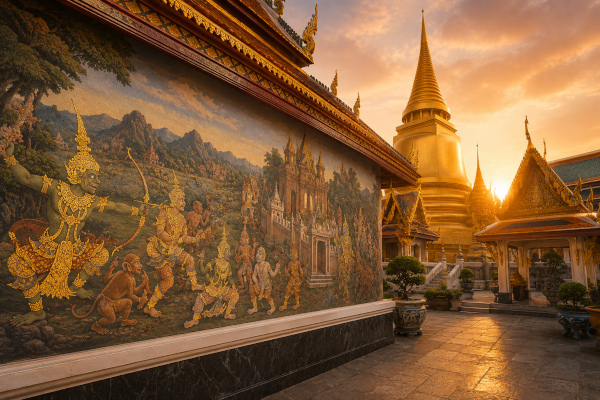
Thailand holds one of the most beautiful living examples of the Ramayana’s journey beyond India. In Thailand, the Ramayana appears as the Ramakien, meaning the “Glory of Rama.” It is not a distant literary borrowing preserved only in old manuscripts. It is a living cultural force visible in royal tradition, temple murals, masked dance, classical literature, sculpture, state symbolism and the moral imagination of Thai society.
The Ramakien is Thailand’s national epic and a Thai adaptation of the ancient Indian Ramayana. The story was reshaped through Thai language, Buddhist ethics, local geography, court culture and Southeast Asian artistic imagination, yet its central soul remains connected to the story of Rama, Sita, Lakshmana, Hanuman and Ravana. The version most studied today was completed at the court of King Rama I in the late 18th century, after earlier versions were lost during the fall of Ayutthaya in 1767.
Ramakien: Thailand’s Ramayana
The Ramakien carries the same moral architecture as the Indian Ramayana: the struggle between dharma and adharma, the duty of the ruler, the loyalty of brothers, the devotion of the wife, the courage of the warrior and the final victory of righteousness. In the Thai version, Rama is known as Phra Ram, Sita as Nang Sida, Lakshmana as Phra Lak, Hanuman retains his heroic place, and Ravana appears as Tosakanth.
The Thai Ramakien is not a mechanical translation of Valmiki’s Ramayana. It is a creative civilisational adaptation. Thailand absorbed the sacred story, gave it local dress, courtly elegance, Thai landscapes, Thai artistic language and Buddhist ethical expression. This is the power of Indian civilisation at its best: it travelled through culture, not conquest; through stories, not swords; through temples, theatre, trade, monks and memory.
The Royal Connection
The Ramakien became deeply connected with Thai kingship. The Chakri kings of Thailand use the royal title Rama, a direct sign of the prestige carried by the Rama ideal in Thai political culture. King Rama I, founder of the Chakri dynasty, supervised the major recension of the Ramakien after the destruction of earlier Ayutthaya texts. His son, King Rama II, later adapted parts of the epic for khon, the classical Thai masked dance-drama.
This royal connection shows how deeply the Ramayana entered Thailand’s idea of righteous rule. Rama is not merely a hero. He represents the ruler who protects order, honours duty and stands for moral authority. This is one of the strongest Vedic and Dharmic links between India and Thailand: kingship is seen as a sacred responsibility, not only as political power.
Wat Phra Kaew: Ramayana On Temple Walls
One of the greatest visual expressions of the Ramakien is found at Wat Phra Kaew, the Temple of the Emerald Buddha, inside the Grand Palace complex in Bangkok. The outer walls of the temple contain 178 mural panels painted during the reign of King Rama I, depicting scenes from the Ramakien. These murals stretch for about two kilometres and unfold the story as a grand sacred and artistic journey.
This is one of the most powerful examples of India-Thailand cultural continuity. A story born in Bharat became part of the sacred and royal architecture of Thailand. In Bangkok, the Ramayana is not hidden in archives. It is painted on temple walls, performed on stage, taught through culture and honoured through royal memory.
Khon: The Living Theatre Of Ramakien
The Ramakien also lives through khon, Thailand’s classical masked dance-drama. Khon is one of the most refined performance traditions of Southeast Asia. Dancers wear elaborate masks and costumes, while the story is narrated through music, movement, gesture and symbolic expression. The Ramakien provided the main narrative foundation for this art form, especially through the versions shaped under the Chakri court.
Through khon, the Ramayana became an embodied tradition. Rama, Hanuman, Sita and Tosakanth are not only literary characters. They move through dance, music, costume, mask and ritualised performance. The body itself becomes a vehicle of dharma.
Sanskrit And Thai Culture
The Sanskrit connection between India and Thailand is deep and visible. The very name Ramakien comes from Rama and kirti, meaning glory or fame. Many Thai royal, religious and administrative words have roots in Sanskrit and Pali. Thai culture absorbed Indic vocabulary through centuries of contact with Indian civilisation, Khmer civilisation, Buddhism, Brahmanical ritual and courtly tradition.
Thai is not descended from Sanskrit, but Sanskrit and Pali profoundly shaped its religious, royal and intellectual vocabulary. This influence can be seen in names, court titles, temple terminology, cosmology, astrology, rituals and classical literature. The Thai writing system also belongs to the wider Brahmic script family through historical Southeast Asian script evolution, placing it within the larger civilisational zone shaped by India’s ancient knowledge systems.
This is why Thai culture often feels familiar to Indians. Names like Rama, Narai, Indra, Brahma, Garuda, Yaksha and Deva appear in Thai religious and artistic life. These words preserve the sound-memory of Sanskrit and the sacred vocabulary of Bharat.
Vedic And Dharmic Connections
Thailand’s Ramakien reflects many Vedic and Dharmic ideas. The idea of the righteous king, the sacred duty of rule, the cosmic struggle between order and chaos, the presence of divine beings, the role of vows, the importance of loyalty and the final triumph of virtue are all part of the Ramayana tradition.
In Thai culture, these ideas blended with Theravada Buddhist values. This blending did not erase the older Indic foundation. Instead, it created a unique Thai expression of Dharma. Rama became a symbol of moral kingship. Hanuman became a heroic figure of courage and intelligence. Ravana or Tosakanth became the image of power without restraint. Sita became a figure of grace and dignity.
This cultural blending is one of the greatest strengths of the Ramayana. It can enter different lands and still preserve its moral centre.
Garuda, Narayana And Royal Symbolism
One of the strongest Indic symbols in Thailand is Garuda. In Hindu tradition, Garuda is the vehicle of Lord Vishnu. In Thailand, Garuda has royal and state significance and is associated with kingship. The Thai understanding of divine kingship carries older Indic elements connected with Vishnu-Narayana, Devaraja ideas and sacred royal authority.
In the Ramakien, Rama is connected with the Vishnu-Narayana tradition. The Thai term Phra Narai reflects Narayana, showing the Sanskritic and Vaishnava layer within Thai religious imagination. These links reveal that the Ramayana’s presence in Thailand is not limited to literature. It extends into state symbols, royal ritual and sacred kingship.
Akhand Bharat In A Cultural Light
The Ramakien gives a beautiful way to understand Akhand Bharat in a positive and civilisational sense. Akhand Bharat here does not mean political control over other nations. It means the wider cultural radiance of Bharat — the ancient civilisational sphere through which Sanskrit, Dharma, Ramayana, temple architecture, sacred kingship, trade, art, astronomy, ritual and philosophy travelled across Asia.
Thailand’s Ramakien is a shining example of this cultural Akhand Bharat. It shows that Bharat’s influence was not limited by modern borders. The civilisational light of India moved across oceans and forests through peaceful exchange. Traders carried goods, monks carried wisdom, artists carried forms, poets carried stories and temples carried sacred symbols.
This shared heritage does not reduce Thailand’s identity. It honours it. Thailand made the Ramayana its own. That is the beauty of civilisational exchange: India gave the seed, Thailand gave it new flowers.
India And Thailand: A Shared Sacred Memory
The India-Thailand relationship is not only diplomatic or economic. It is civilisational. Long before modern embassies and trade agreements, the two regions were connected through stories, scripts, rituals, maritime routes, temples and sacred imagination.
The Ramakien proves that the Ramayana belongs not only to one geography but to a larger cultural family. Thailand preserved Rama in its royal memory. It painted his story on sacred walls. It gave Hanuman a dazzling theatrical life. It carried Sanskritic names into Thai language. It honoured the ideal of dharmic kingship through art and ceremony.
This is why Thailand occupies a special place in the Ramayana world. It is one of the finest examples of how Indian civilisation travelled, adapted and became beloved in another land.
Conclusion
Thailand’s Ramakien is a living bridge between Bharat and Southeast Asia. It carries the Sanskrit memory of Rama, the Vedic idea of righteous order, the Dharmic model of kingship and the artistic brilliance of Thai civilisation. From the murals of Wat Phra Kaew to the masked dance of khon, from royal names to sacred symbols, the Ramayana continues to breathe in Thailand.
In the positive light of Thailand’s Ramakien reminds us that Indian civilisation was never confined to political borders. It lived through culture, language, faith, trade and art. The Ramayana travelled from India to Thailand and returned to us as a reminder that Dharma has many forms, but one eternal light.
References:
World History Encyclopedia. “The Temple of the Emerald Buddha.” Published May 21, 2020. The article notes that the outer walls of Wat Phra Kaew contain 178 mural panels depicting the Ramakien, Thailand’s version of the Ramayana.
World History Encyclopedia. “Painted Mural at the Temple of the Emerald Buddha.” Published May 21, 2020. The source records that the Ramakien mural panels at Wat Phra Kaew were painted during the reign of King Rama I.
Poets.org / Academy of American Poets. “Introduction to extracts from Ramakien.” Published May 20, 2024. The source describes Ramakien as the Thai-language rendition of the Indic tale of Rama and notes the King Rama I court version completed in 1798.
University of Michigan Library Online Exhibits. “The Career of Rama: Thailand.” The exhibit describes the Ramakien as Thailand’s national epic and explains the importance of King Rama I’s retelling.
Encyclopaedia-style summary sources on Ramakien tradition record that the Ramakien is Thailand’s adaptation of the Indian Ramayana, that King Rama I supervised the major recension, and that King Rama II adapted parts of it for khon masked dance-drama.
General cultural note: Thai language and court culture preserve many Sanskrit and Pali-derived terms through centuries of Indic, Buddhist and Southeast Asian exchange. Thai is not descended from Sanskrit, but Sanskrit and Pali have strongly influenced Thai religious, royal and literary vocabulary.
You may also like
-
Kishkindha — The Boulder Kingdom of Pampa, Rishyamukha and the Tungabhadra
-
Setu — The Sacred Southern Crossing Between Rameswaram and Lanka
-
One Voice – One Resolve – One India: Namami Bharatam Marks 150 Years of Vande Mataram Across the Nation
-
Dravida — The Ancient Tamil Country of Rivers, Temples and the Southern Ocean
-
Pandya — The Southern Kingdom of the Vaigai, Tamiraparani and the Pearl-Rich Sea
