GI Produce of India — 11
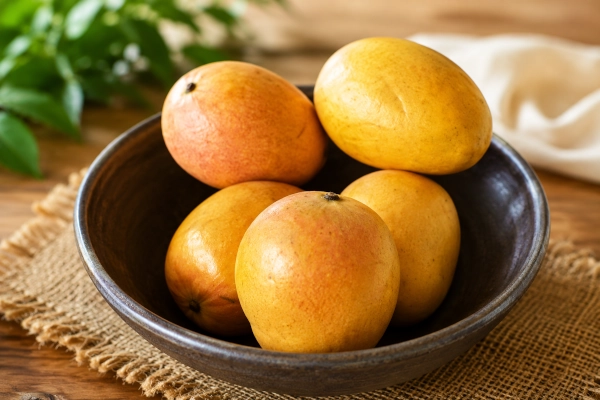
Among Goa’s traditional mangoes, Mussarat—or Mussarad as it is frequently called locally—stands apart through colour, season and culinary versatility. Long before the fruit becomes fully ripe, its skin can develop an extraordinary reddish or crimson blush, giving a tree laden with Mussarat mangoes a striking appearance against the deep green canopy. Beneath that colourful exterior lies firm, juicy and aromatic flesh that has earned the variety a place both on the table and in Goa’s long tradition of mango preserves, jams and sweet preparations.
Unlike the celebrated Mankurad, whose strongest reputation is built around premium fresh eating, Mussarat occupies a broader culinary space. It is a late-season mango, generally maturing during May and June, when several earlier varieties are already disappearing from Goan markets, and its substantial pulp has traditionally made it particularly useful for processing as well as fresh consumption. ICAR-Central Coastal Agricultural Research Institute records two established forms in Goa: Bardez Mussarat, associated principally with North Goa, and Salcete Mussarat, associated with South Goa.
This old Goan cultivar entered a new chapter when it secured geographical-indication protection at the end of 2025. The Geographical Indications Registry officially records it as “Goa Mussarat Mango (Monserrate, Musharad)”, Application No. 1080, recognising Goa as its geographical area and the Department of Science & Technology & Waste Management, Government of Goa, together with the All Goa Mango Growers Association, as the applicants.
Mussarat, Mussarad, Mussorad and Monserrate — One Mango With Many Names
The variety’s many names preserve traces of Goa’s linguistic history. The official GI Registry uses Mussarat, accompanied by the alternative forms Monserrate and Musharad, while Goan speakers and writers frequently use Mussarad or Mussorad. These different forms should not automatically be interpreted as separate mango cultivars, because they largely represent historical and phonetic variations around the same recognised Goan mango tradition.
The older name Monserrate reflects the Portuguese linguistic layer embedded in Goan horticulture. Horticultural accounts from Goa describe how names of many traditional mangoes were derived from individuals, families, localities or Portuguese usage, while pronunciation gradually changed as these names entered Konkani speech. Monserrate consequently evolved locally into forms such as Mussorat, Mussorad and Mussarat, demonstrating how the history of a cultivar can survive not only through grafted trees but also through changing language.
This diversity of names is especially important now that the fruit has GI protection. A trader may advertise Mussarad, another may write Mussorat, and an official document may use Mussarat, but the protected GI gives the product a standard legal identity under which these historical variants can be understood.
A Mango With a Red Blush
The most visually memorable characteristic of Mussarat is its skin colour. ICAR’s horticultural description notes that the fruit is slightly red in colour, while scientific work on Goan mango diversity records the Mussarat types among cultivars capable of developing attractive crimson-to-dark-red blushes on their shoulders.
This pigmentation can appear well before complete ripening, meaning a Mussarat tree carrying developing fruit may display shades of green, red and yellow simultaneously. The colour gives the cultivar considerable ornamental and commercial appeal, particularly in a mango market where many traditional Indian varieties remain mostly green or yellow.
Scientific observations of Goa’s mango germplasm have also identified both Bardez and Salcete Mussarat as useful sources of attractive fruit-colour traits. Their pigmentation therefore has importance not merely for consumers but potentially for mango breeding programmes seeking to combine desirable skin colour with flavour, productivity and other commercial characteristics.
The Two Mussarats of Goa
One of the most interesting features of the cultivar is that Goan horticulture recognises two principal geographical forms. ICAR-Central Coastal Agricultural Research Institute identifies Bardez Mussarat as commonly cultivated in North Goa and Salcete Mussarat as commonly cultivated in South Goa.
This distinction reflects Goa’s remarkably localised mango culture. Traditional cultivars were often propagated within particular villages, talukas and family orchard networks, allowing related forms to develop or become associated with different parts of the state over generations. Bardez and Salcete Mussarat therefore represent not merely two market labels but a reminder that Goan mango diversity evolved through numerous small-scale horticultural landscapes.
Research comparing Goan mango varieties has confirmed that both Bardez and Salcete Mussarat possess attractive skin colour, while the Bardez form is particularly noted for prominently orange pulp. Such variation within a named cultivar is valuable because it gives horticulturists material from which superior selections can potentially be identified and conserved.
Bardez Mussarat — The North Goan Monserrate
Bardez, one of Goa’s historic northern talukas, has long been associated with some of the state’s most distinctive mangoes. Villages and orchards in this region preserved Mankurad, Hilario and numerous lesser-known cultivars alongside Mussarat, creating an exceptionally rich horticultural landscape.
Bardez Mussarat is especially recognised for its intense fruit colour and aromatic pulp. Accounts from experienced Goan horticulturists describe it as a medium-sized fruit, generally larger and heavier than a typical Mankurad, with firm but melting flesh and a characteristic combination of sweetness, aroma and juiciness. Scientific work has also identified the Bardez Mussarat pulp as prominently orange, reinforcing its value as both an eating mango and a source of desirable colour characteristics.
The traditional association between Mussarat and Bardez is so strong that the cultivar has also been referred to as Monserrate de Bardez. That name anchors the fruit directly within the northern Goan landscape, even though related Mussarat cultivation subsequently became established elsewhere in the state.
Salcete Mussarat — The Southern Goan Form
South Goa possesses its own long-established form known as Salcete Mussarat, reflecting the mango traditions of Salcete and surrounding areas. ICAR records this as a recognised type distinct from the more commonly discussed Bardez form, demonstrating that Mussarat’s history encompasses both major halves of Goa.
Like Bardez Mussarat, the Salcete form can develop a conspicuous red blush, and research into Goan mango germplasm has treated the two forms together when examining skin colour and other horticultural characteristics. This makes Mussarat a particularly interesting GI because its identity is statewide while still preserving meaningful local variation within Goa.
Rather than treating such variation as a weakness, it can be understood as part of the cultivar’s heritage. Traditional agricultural varieties frequently contain locally selected lines that have been maintained independently for generations, and conserving these forms may prove valuable for future selection and breeding.
Goa — A Narrow Land Between the Arabian Sea and the Western Ghats
Mussarat developed within one of India’s most distinctive agricultural geographies. Goa lies between the Arabian Sea and the Western Ghats, where coastal plains, lateritic plateaus, river valleys, foothills and forested uplands are compressed into a relatively small state.
This geography creates enormous environmental variation over short distances. Mango trees may grow on lateritic uplands, around traditional homes, along village roads, on mixed farms or in deeper loamy soils closer to river valleys, meaning the orchard landscape is far more varied than that of a single continuous commercial plantation.
Goa’s Directorate of Agriculture identifies mango among the state’s principal fruit crops alongside cashew, coconut, banana, pineapple and jackfruit. This diversity of perennial crops reflects a tropical farming environment in which orchards and home gardens have historically formed an important part of village life.
Laterite and the Goan Mango Tree
Much of Goa is dominated by lateritic soils, recognisable through their reddish colour and high concentrations of iron and aluminium compounds. These soils can be acidic and relatively low in some plant nutrients, but their drainage characteristics make them suitable for several perennial crops when properly managed.
Mango trees are particularly capable of developing extensive root systems once established. In traditional Goan settings, accumulated organic matter, household manure and careful management around homestead trees helped compensate for some of the limitations of lateritic soils, while deeper loamy pockets offered especially favourable conditions.
The strongly seasonal monsoon also shapes soil moisture. Heavy rain replenishes groundwater and soil reserves between June and September, while the subsequent dry months create a long period in which established trees depend upon stored moisture and deep roots. This annual cycle became fundamental to Goa’s mango ecology.
A Climate Built Around the Monsoon
Goa experiences a tropical climate in which the southwest monsoon dominates the annual agricultural calendar. The wet season supplies most of the year’s rainfall within a few months, after which conditions gradually become drier through winter before heat intensifies towards March, April and May.
This sequence is particularly important for mango flowering. Mango trees generally require a relatively dry period to support floral induction, while untimely rain and prolonged humidity during flowering can interfere with pollination and increase disease pressure.
Once fruit has set, rising temperatures support fruit growth and sugar accumulation. Mussarat’s late-season character means that its mangoes remain on the tree as Goa approaches the return of the southwest monsoon, making the cultivar particularly exposed to pre-monsoon thunderstorms, humidity and fruit-fly pressure during the final stages of ripening.
A Late-Season Goan Mango
ICAR specifically classifies Mussarat as a late-season variety, with the principal maturity period extending through May and June. The tree is described as an alternate bearer but also as a high-yielding cultivar, characteristics that give the fruit an interesting combination of strong productivity and year-to-year variation.
Its season places Mussarat after the earliest waves of premium Goan mangoes. Mankurad usually receives tremendous attention during the opening portion of the mango calendar, while varieties such as Hilario and Mussarat help extend quality fruit availability later into the summer.
This later window has considerable market value. Consumers are still eager for good mangoes even as early-season varieties disappear, and a productive late cultivar can therefore occupy a less crowded market while prolonging seasonal income for orchard owners and fruit sellers.
The Advantage and Risk of Late Ripening
Remaining on the tree until May or June gives Mussarat time to develop its characteristic colour and pulp, but it also places the crop closer to the arrival of seasonal rain. Pre-monsoon showers and increasing humidity create biological risks that early mangoes may partly avoid.
One of the most serious threats is the mango fruit fly, whose females lay eggs in maturing fruit. The larvae subsequently develop inside the mango, ruining fruit that may appear healthy from the exterior when harvested.
Late-season mangoes can become particularly vulnerable as temperatures and humidity rise. Goan horticultural advice consequently stresses timely fruit-fly management through sanitation and pheromone-based trapping before infestation becomes visible inside ripe fruit.
Firm, Juicy and Aromatic Flesh
Mussarat’s appeal goes beyond its dramatic peel colour. Descriptions of Bardez Mussarat emphasise firm but melting pulp that is juicy and aromatic, providing enough structure for handling while retaining the softness expected from a ripe table mango.
Studies of Goan mango varieties found prominently orange pulp in Bardez Mussarat, while the fruit’s sugar concentration is generally somewhat below that of the exceptionally sweet Mankurad. This produces a flavour that remains sweet and rich without depending upon extreme sugar intensity.
That balance makes the cultivar useful in several ways. A well-ripened Mussarat can be enjoyed fresh, but its pulp also retains enough body and flavour to perform particularly well when cooked or preserved.
Not Every Great Mango Has to Be the Sweetest
Mango appreciation can become overly focused on sweetness, as though the highest sugar reading automatically identifies the finest fruit. Mussarat demonstrates why this is too simple because its character depends on a broader combination of aroma, colour, texture, juiciness and sugar-acid balance.
Traditional accounts place Bardez Mussarat around the upper-teens in soluble-solid readings, below Mankurad but still firmly within the range of sweet dessert fruit. The slightly less intense sweetness can actually make the mango particularly pleasant in larger portions and gives processors greater control when preparing preserved products.
This makes Mussarat a mango of balance rather than excess. Its reputation was built not by surpassing every Goan variety in sweetness but through the combination of attractive colour, abundant pulp, good flavour and unusually useful processing characteristics.
The Traditional Mango for Goan Preserves
One of Mussarat’s strongest culinary associations is with processed mango products. Goan accounts repeatedly identify the variety as suitable for jams, sweet pickles and other preserves, while households have traditionally used its fleshy pulp for preparations intended to extend mango flavour beyond the fresh-fruit season.
A large quantity of pulp is advantageous when making preserves because less labour is spent peeling and removing stones relative to the amount of usable fruit obtained. The texture and flavour of Mussarat also hold up well during cooking, allowing the mango’s character to remain evident after sugar and other ingredients are added.
This culinary role distinguishes Mussarat from varieties valued almost exclusively as luxury table fruit. Its identity belongs equally to the orchard and the kitchen, connecting fresh mango culture with Goa’s longstanding tradition of preserving seasonal abundance.
Mangada and the Goan Tradition of Mango Preservation
Goa possesses a rich tradition of turning ripe mangoes into preparations capable of lasting beyond summer. One such preparation is mangada, a dense mango preserve or halwa-like sweet made by slowly cooking pulp until moisture is reduced and the flavour becomes concentrated.
Traditional household accounts specifically identify Mussarat or Mussarad as a preferred mango for such preserves because of its fleshy character and distinctive flavour. The fruit’s processing reputation therefore developed not through modern factories alone but inside Goan kitchens where families converted seasonal mango abundance into foods that could be stored and eaten later in the year.
This domestic tradition gives the GI mango an additional layer of cultural significance. Protecting Mussarat means conserving not only a fresh fruit but also the culinary practices that developed around its particular characteristics.
Grafting Preserved Goa’s Named Mangoes
The existence of a named cultivar such as Mussarat depends upon vegetative propagation. A mango stone planted from an excellent fruit does not reliably reproduce an identical tree because seedling mangoes contain new genetic combinations.
Goa became historically significant in Indian mango horticulture because grafting allowed growers to preserve exceptional trees. Scion wood taken from a selected tree could be joined to a compatible rootstock, creating a new plant whose canopy retained the fruit-producing genetics of the original selection.
This technique transformed mango culture because exceptional trees no longer disappeared when the individual plant died. Their characteristics could be reproduced repeatedly, allowing names such as Mankurad, Hilario, Mussarat, Malgesh and Fernandin to survive across generations.
Portuguese-Era Goa and the Rise of Named Cultivars
Goa’s mango history cannot be separated from the horticultural changes of the Portuguese period. Grafting practices became strongly established in Goa centuries ago, contributing to the multiplication of distinct named mango varieties rather than orchards consisting entirely of genetically variable seedling trees.
Many traditional Goan cultivars subsequently acquired Portuguese or Indo-Portuguese names. Some were named after families or individuals, while others reflected localities or particular fruit characteristics, creating a mango vocabulary unlike that of most other Indian regions.
Monserrate belongs to this world. Its transformation into Mussarat or Mussarad shows how a name introduced within an older cultural setting could become naturalised into Goan speech while the tree itself continued moving from orchard to orchard.
Alternate Bearing and the Variable Mango Year
ICAR describes Mussarat as an alternate bearer, meaning trees may produce strongly in one season and less heavily in another. This pattern is common among many traditional mango cultivars and can complicate both farmer income and market supply.
Alternate bearing arises from interactions between crop load, vegetative growth, stored carbohydrates, nutrition and seasonal weather. A tree supporting an exceptionally large crop may have less energy available for the vegetative shoots required for equally strong flowering in the following year.
The challenge for growers is therefore to maintain tree health and nutrition while accepting that traditional cultivars may not behave with the consistency expected from modern plantation crops. Scientific orchard management can reduce some fluctuations, but the biological character of the variety remains an important part of production planning.
A High-Yielding Traditional Variety
Although Mussarat may bear irregularly between years, ICAR nevertheless classifies it as a high-yielding mango. This distinguishes it from certain premium traditional cultivars whose exceptional fruit quality may be accompanied by relatively modest productivity.
High production can create significant value during a good season because the fruit is suitable for both fresh consumption and processing. Growers are therefore not dependent entirely upon the narrow premium table-fruit market and can potentially direct different grades towards different buyers.
This versatility also reduces waste. Mangoes with superficial blemishes may still produce excellent pulp for jam, preserves or other preparations, allowing a larger proportion of the harvest to retain economic value.
The Mango Tree in Goa’s Village Landscape
Traditional Goan mango cultivation is frequently dispersed rather than concentrated into enormous specialised orchards. Trees grow around old houses, within family properties, on village slopes, beside mixed farms and in small orchards containing several varieties.
This dispersed system helped preserve extraordinary genetic diversity because individual households often maintained mangoes chosen for different purposes. One tree might be prized for early fruit, another for table quality, another for pickling, while a late-season cultivar such as Mussarat could extend the household harvest towards the monsoon.
The same system, however, complicates organised marketing. When production is spread across thousands of independent trees and small growers, collecting uniform commercial quantities requires cooperation, grading and coordinated logistics.
Two Regions, One Statewide GI
The existence of Bardez and Salcete forms makes Mussarat especially suited to a statewide geographical indication. The mango is not merely a North Goan speciality or a South Goan speciality, because recognised forms of the cultivar are historically associated with both landscapes.
This statewide identity does not erase local differences. On the contrary, GI protection can provide a framework in which Bardez and Salcete traditions remain documented while the collective commercial reputation of Goa Mussarat becomes stronger.
The geographical indication therefore represents both unity and diversity. It protects one recognised Goan mango identity while acknowledging that the fruit’s living horticultural history contains multiple regional expressions.
The Road to GI Recognition
The application for Goa Mussarat Mango (Monserrate, Musharad) was filed with the Geographical Indications Registry on 27 April 2023. It received Application No. 1080 under Class 31 for agricultural goods, with Goa formally identified as the geographical area.
The applicants were the Department of Science & Technology & Waste Management, Government of Goa, and the All Goa Mango Growers Association. This joint institutional and producer involvement reflects the collective nature of agricultural geographical indications, where government agencies may support documentation and registration while growers remain central to preserving the crop itself.
The application was advertised in Geographical Indications Journal No. 208, made available on 29 August 2025. The Registry now records the product as registered, with the official certificate-of-registration document dated 30 December 2025.
GI Details at a Glance
- Geographical Indication: Goa Mussarat Mango (Monserrate, Musharad)
- State: Goa
- Product: Agricultural
- Class: 31
- Application Number: 1080
- Date of Filing: 27 April 2023
- GI Journal: No. 208
- Journal Availability Date: 29 August 2025
- Certificate Number: Not yet populated in the current public GI Registry application record
- GI Certificate Date: 30 December 2025
- Registered Proprietor / Applicants: Department of Science & Technology & Waste Management, Government of Goa, and All Goa Mango Growers Association
- Geographical Area: Goa
- Registration Valid Until: 26 April 2033 under the ten-year registration term calculated from the filing date; the current public Registry validity field has not yet been populated
A Newly Protected Part of Goa’s Agricultural Heritage
The GI registration came as part of a wider effort to protect Goa’s agricultural diversity. The 2026 Governor’s Address to the Goa Legislative Assembly specifically recorded Mussarad Mango among five newly registered geographical indications, together with Goa Hilario Mango, Taleigao Vayingim, Goa Korgut Rice and Goa Kaju Apple. The state government described these registrations as measures intended to conserve distinctive local varieties while improving market recognition for Goan agricultural products.
The official recognition is particularly significant for traditional mangoes because modern commercial horticulture can gradually narrow genetic diversity. High-demand varieties tend to dominate nurseries and new orchards, while old local cultivars disappear when ageing trees are removed and not replanted.
A GI cannot by itself prevent such loss, but it changes the economic calculation. If the name Mussarat gains market value and genuine growers can benefit from its identity, preserving the trees becomes commercially relevant as well as culturally important.
What the GI Tag Protects
The GI does not mean that the biological material of Mussarat becomes incapable of growing outside Goa. Graftwood can travel, and mango trees can be propagated anywhere environmental conditions permit successful cultivation.
What the registration protects is the geographical identity of Goa Mussarat Mango. The name links fruit with Goa’s recognised production landscape, its traditional horticultural practices and the collective reputation created by local growers.
This distinction between cultivar and geographical identity becomes especially important once a regional product gains premium recognition. A mango may resemble Mussarat or even share related genetics without automatically qualifying for the protected Goa Mussarat identity.
Authorised Users Bring the GI to the Grower
The Intellectual Property India database already lists authorised users for Goa Mussarat Mango, including growers in Calangute and Parra in Bardez. Their appearance in the official record demonstrates that the registration is beginning to move from institutional paperwork towards actual producer participation.
This step is essential because a GI creates economic value only when genuine growers can use it. Authorised-user systems, traceable packaging and identifiable orchard sources can eventually allow consumers to distinguish certified geographical produce from mangoes merely using a familiar varietal name.
The development of more authorised users across both North and South Goa would further strengthen the system. A cultivar with recognised Bardez and Salcete forms requires producer representation broad enough to reflect the living geography underlying the GI.
The Challenge of Authentic Planting Material
Protecting the name Mussarat is only half the conservation task because genuine planting material must also survive. Mango orchards are long-term investments, and a farmer may wait several years before a newly planted graft produces enough fruit to confirm its identity.
Incorrectly labelled nursery plants can therefore create serious problems. If growers unknowingly establish unrelated trees under the Mussarat name, both commercial consistency and the credibility of the GI can gradually weaken.
Mother-tree documentation and reliable scion sources are particularly important because two traditional regional forms already exist. Conserving high-quality Bardez and Salcete material would allow future growers to reproduce the cultivar with greater confidence while preserving valuable variation within the broader Mussarat population.
ICAR and the Conservation of Goan Mango Diversity
Goa’s mango heritage extends far beyond the varieties currently enjoying strong market demand. Horticultural documentation once recorded dozens of indigenous mango cultivars, many of which have declined considerably as old trees disappeared and commercially popular varieties replaced them.
ICAR-Central Coastal Agricultural Research Institute at Old Goa has played an important role in conserving this diversity. Its work on local mango germplasm has documented the physical and chemical characteristics of varieties including Mankurad, Mussarat, Hilario and other traditional selections, providing scientific evidence for traits that orchardists had recognised empirically for generations.
For Mussarat, these collections matter enormously. A cultivar preserved in a field gene bank remains available for future study, propagation and breeding even if individual village trees are lost.
A Valuable Source of Colour Genes
Scientific evaluation of Goan mango varieties has identified Mussarat as particularly interesting because of its skin pigmentation. Bardez and Salcete Mussarat can develop crimson to dark-red coloration on the shoulders, making them potential sources of attractive fruit-colour genes for classical mango breeding.
This illustrates why conserving old regional cultivars has value beyond nostalgia. Modern consumers often respond strongly to visual appearance, and breeders may seek to combine bright skin colour with desirable pulp quality, disease tolerance, regular bearing or improved shelf life.
A traditional cultivar that never dominates supermarket sales can therefore still contribute genetically to future commercial mangoes. Mussarat’s distinctive blush is part of a biological resource whose usefulness may extend far beyond Goa.
Fruit Fly — The Enemy of the Late Mango
Among the most important threats to late-ripening Goan mangoes is the oriental fruit fly. The pest becomes increasingly active as temperatures rise and mangoes approach maturity, with females capable of laying eggs beneath the fruit skin.
Because larvae develop internally, infestation may not become obvious until the fruit has already been damaged. This can be particularly frustrating for growers because an attractive red-blushed Mussarat may appear perfectly healthy from the outside.
Integrated fruit-fly management therefore needs to begin before visible injury appears. Orchard sanitation, removal of fallen fruit and pheromone traps can suppress populations while reducing dependence on poorly timed insecticide applications.
Climate Variability and the Late Goan Mango
Mussarat’s late season also makes it useful for observing how climate variability affects traditional mango production. Changes in winter temperature can influence flowering, while unseasonal showers during bloom can increase fungal disease and reduce fruit set.
Later, prolonged extreme heat can increase water stress, while an early arrival of pre-monsoon rain can expose mature fruit to cracking, disease and increased fruit-fly activity. Because Mussarat remains on the tree into May and June, it experiences a longer transition towards monsoon conditions than many early varieties.
Future cultivation will therefore benefit from better weather forecasting, efficient irrigation, canopy management and integrated pest-control systems. Traditional orchard knowledge will remain central, but scientific advisory tools can provide growers with earlier warnings when seasonal conditions depart from established patterns.
Processing Can Give Mussarat a Larger Economic Future
Mussarat may never need to compete directly with Mankurad for the title of Goa’s most prestigious table mango because its commercial strength lies partly elsewhere. Its abundant pulp, attractive flavour and historical association with preserves give it the potential to support a distinctive range of value-added Goan products.
GI-labelled mango preserves, jams or traditional mangada prepared from authenticated Mussarat could extend the geographical identity beyond the brief fresh-fruit season. Such products would also allow cosmetically imperfect mangoes to retain value rather than being discarded when they fail premium table-fruit grading.
Processing can therefore strengthen orchard economics while preserving culinary heritage. The fruit would continue generating income after the fresh harvest ends, and traditional recipes could become part of the commercial story attached to the GI.
Goa’s Tourism Economy Creates Another Opportunity
Goa receives visitors from across India and abroad, giving regional agricultural products an unusually large potential audience. Yet many visitors encounter the state mainly through beaches, restaurants and nightlife without learning about the extraordinary horticultural diversity that survives within Goan villages.
GI mangoes can help broaden this picture. Orchard visits, mango festivals, seasonal tastings and direct farm sales can connect visitors with Mankurad, Mussarat, Hilario and other regional varieties while ensuring a greater share of premium value reaches growers.
For Mussarat, culinary tourism may be particularly promising because the fruit has both a fresh-eating identity and a processing tradition. Visitors could encounter the mango itself as well as jams, preserves and other preparations whose flavour carries the variety beyond its short seasonal window.
Protecting More Than One Famous Mango
The success of Mankurad should not reduce Goa’s mango heritage to a single variety. The state possesses a remarkable range of cultivars, including Hilario, Mussarat, Malgesh, Fernandin, Xavier and numerous less commercially familiar selections that represent centuries of local horticultural history.
The recent registration of both Goa Hilario Mango and Goa Mussarad Mango is therefore particularly important. It demonstrates a movement away from protecting only the most famous cultivar towards recognising the wider diversity of Goan agriculture.
A healthy mango landscape should contain varieties that ripen at different times and serve different purposes. Such diversity spreads market risk, extends the harvest season and preserves genetic traits that may become valuable under future climatic or commercial conditions.
Preserving Bardez and Salcete Together
Mussarat’s future conservation should recognise the significance of both Bardez and Salcete forms. Treating one as the only authentic expression would risk losing part of the geographical and genetic history already documented by ICAR.
Maintaining representative mother trees from both areas would allow researchers to compare fruit colour, pulp quality, productivity, season and resilience. Growers could subsequently select material suited to different local environments while continuing to operate within the broader Goa Mussarat GI identity.
This approach would allow geographical indication protection to support biodiversity rather than unintentionally promoting uniformity. The goal should be to protect the mango tradition as it actually exists, including the regional variation that generations of Goans maintained.
The Red-Blushed Mango at the Edge of the Monsoon
Mussarat reaches its most characteristic stage when Goa’s dry summer is approaching its dramatic seasonal end. By May and June, the landscape has endured months of heat, the humidity is rising, clouds begin appearing more frequently over the Western Ghats and the monsoon is no longer far away.
Against this changing background, Mussarat trees carry fruit painted in shades of green, yellow and crimson. The flesh inside becomes juicy and aromatic, while the harvest offers one of the final traditional mango experiences before heavy rain changes the agricultural rhythm of the state.
The 30 December 2025 GI registration has now placed formal recognition around this old relationship between fruit and place. The legal identity is new, but the cultivar, its local names, the Bardez and Salcete forms and the recipes built around its pulp belong to a considerably older Goan mango culture.
Goa Mussarat Mango therefore represents much more than another addition to India’s expanding register of geographical indications. It is the red-blushed Monserrate of the Konkan coast—a late-season mango preserved through grafting, shaped by Goa’s monsoon landscape and carried from village orchards into jams, preserves, kitchens and now a protected geographical identity of its own.
You may also like
-
Indian Semiconductor Companies Propose New Manufacturing and Chip Design Investments in Madhya Pradesh
-
CSIR-CRRI Partners with Industry to Develop Advanced Indigenous Airport Runway and Pavement Materials
-
Paras Semiconductors Secures 43 Acres in Madhya Pradesh for Proposed ₹6,200 Crore Advanced Chip Packaging Facility
-
Petronet LNG Plans ₹1,200 Crore Joint Venture for Ten Compressed Biogas Plants Across India
-
India Seeks South Korean Shipbuilding Partnerships as Sarbananda Sonowal Begins Four-Day Visit to Busan
