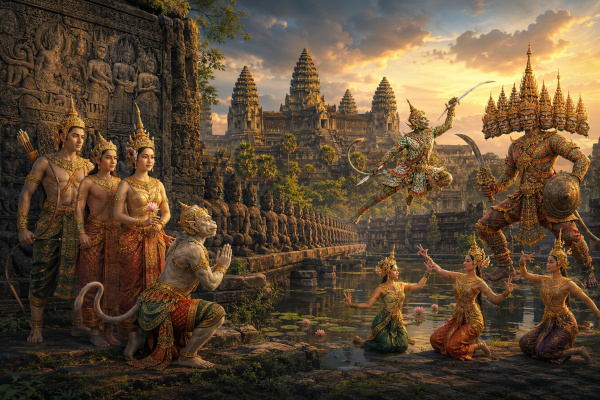
Across the green plains, river valleys and temple-filled landscapes of Cambodia, the memory of ancient India lives in stone, language, dance and sacred imagination. Cambodia is today a deeply Buddhist country, yet its civilizational foundations carry a powerful Hindu and Sanskritic imprint. From Angkor Wat’s Vishnu-centred architecture to the Cambodian Ramayana known as the Reamker, the country preserves one of the finest examples of how Indian thought travelled across the seas and became part of Southeast Asia’s cultural identity.
The story of Rama, Sita, Lakshmana, Hanuman and Ravana did not remain confined to the Indian subcontinent. Through merchants, scholars, priests, artists and maritime networks, the Ramayana crossed the Bay of Bengal and reached the Khmer world. There it was lovingly adapted into Cambodian language, dance, sculpture and courtly tradition. The result was not a simple copy of the Indian epic, but a living Khmer expression of dharma, kingship, loyalty, moral duty and cosmic order.
Kambuja: Cambodia’s Sanskritic Name
The Indian connection begins with the very name of the country. Cambodia’s Khmer name, Kampuchea, is commonly traced to the Sanskrit Kambuja or Kambujadesa, meaning the land of Kambuja. This ancient Sanskritic naming tradition reflects the deep presence of Indian cultural vocabulary in early Cambodian civilisation.
In ancient inscriptions and royal traditions, Cambodia was linked with the idea of Kambuja, a sacred and royal land shaped by Hindu and Buddhist concepts. The Sanskritic element in the name shows that Indian influence was not superficial; it entered the political imagination, religious vocabulary and cultural memory of the Khmer people.
This is why Cambodia occupies a special place in the wider civilizational world sometimes described as Greater India or Akhand Bharat in a cultural sense. This idea does not refer to modern political boundaries. It refers to the historical spread of Indian knowledge systems, Sanskrit, temple architecture, epics, astronomy, statecraft and spiritual traditions across Asia.
Reamker: Cambodia’s Ramayana
The Cambodian version of the Ramayana is known as Reamker or Ramakerti, meaning “The Glory of Rama.” It is one of Cambodia’s most important literary and artistic traditions. The Reamker draws from the Indian Ramayana but gives the epic a distinctly Khmer form through local language, costumes, dance movements, court culture and Buddhist moral interpretation.
In the Reamker, Rama is known as Preah Ream. Sita becomes Neang Seda. Lakshmana is Preah Leak. Ravana appears as Krong Reap. Hanuman remains Hanuman, one of the most beloved heroic figures in Cambodian storytelling.
The main values remain close to the Indian epic. Preah Ream represents righteous kingship, discipline and duty. Neang Seda represents purity, patience and inner strength. Preah Leak represents brotherly loyalty. Hanuman represents courage, intelligence and devotion. Krong Reap represents arrogance, desire and the fall that comes when power separates itself from dharma.
Yet Cambodia gives the epic its own artistic soul. The Reamker often places strong emphasis on loyalty, trust, honour, justice and the responsibilities of rulers. It is not only a story of war between Rama and Ravana; it is also a moral guide for society and kingship. Cambodian audiences experience the epic through dance-drama, masked performance, mural painting, sculpture and temple art.
A famous Cambodian addition is the episode of Hanuman and Sovann Maccha, the golden mermaid. This story is especially popular in Cambodian dance tradition. It shows how the Khmer imagination expanded the Ramayana world while keeping Hanuman at the centre of heroism, charm and divine mission.
Royal Ballet and the Living Ramayana
The Reamker lives most beautifully through Cambodia’s classical dance tradition. The Royal Ballet of Cambodia, also called Khmer Classical Dance, has long been associated with the Khmer court, royal ceremonies and national heritage. UNESCO notes that this art form was traditionally connected with ceremonies such as coronations, marriages, funerals and Khmer holidays.
In these performances, dancers do not merely act; they speak through the body. Hand gestures, eye movements, slow steps, masks and crowns become a sacred language. Rama’s dignity, Sita’s grace, Hanuman’s energy and Ravana’s pride are expressed through carefully trained movements.
This shows that the Ramayana in Cambodia is not only a text to be read. It is a visual, musical and spiritual experience. The Reamker became part of Cambodia’s national memory because it entered the palace, the temple, the stage and the heart of the people.
Angkor Wat: Vishnu’s Cosmic Temple in Cambodia
The greatest symbol of Cambodia’s Hindu roots is Angkor Wat. Built in the 12th century under King Suryavarman II, Angkor Wat was originally dedicated to Lord Vishnu. It later became a Buddhist sacred space, but its foundation, layout and sculptural programme remain deeply connected with Hindu cosmology.
UNESCO describes Angkor as one of Southeast Asia’s most important archaeological sites, covering about 400 square kilometres and containing the remains of Khmer capitals from the 9th to the 15th centuries. Angkor Wat stands at the centre of this grand civilizational landscape.
The temple is designed as a cosmic mountain. Its central towers represent Mount Meru, the sacred mountain of Hindu and Buddhist cosmology. The surrounding moat and galleries evoke cosmic oceans and sacred realms. Walking into Angkor Wat is like moving through a stone diagram of the universe.
The walls of Angkor Wat contain grand bas-reliefs from Hindu mythology. The Churning of the Ocean of Milk, or Samudra Manthan, is among its most celebrated scenes. Devas and asuras pull the serpent Vasuki around Mount Mandara to obtain amrita, the nectar of immortality. This single carving captures a central Hindu idea: the universe is sustained through balance, effort, sacrifice and divine order.
Angkor Wat also contains martial and epic imagery connected with divine battles, royal power and cosmic protection. Its Vaishnava foundation reflects the Khmer king’s desire to associate rulership with preservation, order and dharma.
Vishnu, Shiva and Brahma in Khmer Sacred Culture
Ancient Cambodia honoured many Hindu deities. Vishnu, Shiva and Brahma were not foreign names in the Khmer world; they were part of the sacred grammar of kingship and temple life.
Lord Vishnu was associated with preservation, protection and royal order. The dedication of Angkor Wat to Vishnu shows the importance of Vaishnava thought in the Khmer Empire. Images of Vishnu reclining on the serpent Ananta, Vishnu holding his divine weapons and Vishnu in various forms have been found in Cambodian art.
Lord Shiva was equally important. Shaivism strongly influenced Khmer kingship, temple building and sacred geography. The Shiva Linga became a major symbol of divine energy, sovereignty and cosmic creation. UNESCO identifies the Temple of Preah Vihear as a Shiva-dedicated temple, with a sacred complex dating mainly to the 11th century and roots going back to the 9th century.
Brahma, the creator, appears in Khmer sculpture and temple iconography. The Trimurti concept of Brahma, Vishnu and Shiva helped shape the Khmer understanding of creation, preservation and transformation. Cambodia also absorbed forms such as Harihara, the combined form of Vishnu and Shiva, showing how Khmer religion often united multiple Hindu streams into one royal-sacred vision.
Ganesha, Indra, Skanda, Lakshmi and other Hindu figures also appear in Cambodian art. Their presence proves that Hinduism in Cambodia was not limited to a single deity or sect. It was a wide spiritual landscape combining Vaishnava, Shaiva, Shakta and later Buddhist elements.
Sanskrit in Cambodia: The Language of Kings, Temples and Knowledge
Sanskrit was one of the strongest bridges between India and Cambodia. It was the language of royal inscriptions, temple dedications, religious praise, genealogy, philosophy and high culture. Through Sanskrit, Indian ideas entered the Khmer court and became part of Cambodia’s political and spiritual vocabulary.
Early Cambodian inscriptions often used Sanskrit for sacred and royal purposes, while Old Khmer was used for local administrative and social details. This bilingual world shows a sophisticated civilisation where Sanskrit carried prestige, ritual authority and philosophical meaning, while Khmer remained the living language of the people.
Linguistic studies note that Khmer absorbed a large body of loanwords from Sanskrit and Pali, especially in religion, administration, scholarship and royal vocabulary. The influence was so deep that many formal Khmer words still carry Sanskritic echoes today.
Sanskrit and Khmer: Similar Words and Shared Roots
Modern Khmer is not an Indo-Aryan language like Sanskrit. It belongs to the Austroasiatic language family. Yet its higher vocabulary contains many Sanskrit and Pali words, especially in religious, royal and scholarly usage. Over centuries, these words changed pronunciation and spelling according to Khmer sound patterns, but their roots remain visible.
Some examples include:
Raja became Reach or Reachea in Khmer, connected with king, royal authority and kingdom. This appears in formal words related to royalty and state.
Dharma became Thom or Thorm in Khmer usage, connected with religion, moral law, teaching and righteous duty.
Nagara became Nokor or Angkor, meaning city or capital. The word Angkor itself is linked with the Sanskrit nagara, showing how Indian urban vocabulary entered Khmer geography.
Deva became Tev or Tevada, used for divine beings, celestial figures and sacred beings in Cambodian tradition.
Vihara became Vihear, meaning temple or sanctuary. The name Preah Vihear itself carries this sacred Indic connection.
Chakra became Chak, associated with wheel, power and royal order in formal vocabulary.
Sala, from Sanskrit shala, is used in Khmer for hall, school or public building.
Guru became Kru in Khmer usage, meaning teacher or master.
Rama became Ream, Sita became Seda, Lakshmana became Leak, and Ravana became Reap in the Cambodian Ramayana tradition.
These examples show how Sanskrit did not remain locked inside old inscriptions. It entered speech, titles, place names, temple names, literature and everyday cultural memory. The Khmer language transformed Sanskrit words into Cambodian forms, making them part of its own identity.
Khmer Script and Indian Brahmi-Pallava Roots
The script connection is equally important. Khmer writing developed from South Indian forms of the Brahmi script family, especially the Pallava script tradition that spread through maritime and cultural contact. Sources on Khmer script note its adaptation from Pallava forms used in South India and Southeast Asia during the early centuries of Cambodian epigraphy.
This means the Indian influence was not only oral or religious. It shaped the written form through which Cambodia recorded kings, temples, donations, sacred geography and law. The same script world allowed Sanskrit and Old Khmer to stand side by side on stone inscriptions.
The survival of inscriptions across Cambodia, Laos, Thailand and Vietnam shows how wide the Khmer cultural sphere once was. These inscriptions remain crucial sources for understanding ancient Cambodian history, because they record royal lineages, temple foundations, donations, rituals and social organisation.
Indian Statecraft and Khmer Kingship
The Khmer Empire also absorbed Indian ideas of kingship. The king was seen not merely as a political ruler but as a guardian of cosmic order. This idea closely resembles the Indian concept of Rajadharma, where the ruler protects society by upholding justice, order, prosperity and sacred law.
The Devaraja idea, often translated as “god-king,” became associated with Khmer royal ideology. It connected kingship with divine authority, especially through Shiva and Vishnu traditions. Temples were not only places of worship; they were statements of sovereignty, sacred geography and cosmic legitimacy.
A Khmer capital was often designed around a central temple, water reservoirs, processional routes and sacred alignments. This reflected an Indian-style vision of the kingdom as a mirror of the cosmos. The king ruled from the centre of a sacred order, while the temple symbolised Mount Meru, the axis of the universe.
Hinduism and Buddhism: A Khmer Synthesis
One of Cambodia’s most remarkable achievements is the blending of Hindu and Buddhist traditions. Hinduism shaped early Khmer kingship, temple building, Sanskrit learning and mythology. Mahayana Buddhism later entered royal and artistic life. Theravada Buddhism eventually became dominant among the Cambodian people.
Yet the rise of Buddhism did not erase the Hindu foundation. Instead, Cambodia created a layered civilisation. A Buddhist monk could walk through a Vishnu temple. A Buddhist society could preserve the Reamker. A Hindu temple could become a Buddhist shrine while still keeping its Sanskritic memory.
This synthesis explains why Cambodia feels both deeply Buddhist and deeply connected to India’s Hindu heritage. Angkor Wat itself embodies this continuity. It began as a Vishnu temple and became a Buddhist sacred site, making it one of the finest examples of religious transformation without cultural erasure.
Ramayana as Moral and Royal Philosophy
The Reamker gave Cambodia more than a heroic story. It offered a moral code. Rama became the model of disciplined leadership. Sita became the model of dignity and strength. Lakshmana became the model of service. Hanuman became the model of brave devotion. Ravana became the warning against arrogance and uncontrolled desire.
For rulers, the epic taught that power must be guided by restraint. For warriors, it taught courage with loyalty. For families, it taught honour and sacrifice. For society, it taught that dharma sustains order while adharma brings ruin.
This is why the Ramayana could travel so successfully from India to Cambodia. Its values were universal, but its expression became local. Cambodia took the Indian epic and dressed it in Khmer silk, crowns, gestures, music and temple stone.
Maritime India and Cambodia: A Peaceful Civilizational Journey
The spread of Hinduism, Sanskrit and the Ramayana into Cambodia was mainly the result of maritime contact, scholarship, trade and cultural prestige. Indian merchants crossed the Bay of Bengal. Brahmins carried rituals and Sanskrit learning. Buddhist monks carried scriptures and philosophical ideas. Artists carried visual forms. Local rulers adopted, adapted and transformed these influences.
This was not a story of conquest. It was a story of cultural attraction. Indian civilisation offered powerful ideas of kingship, sacred architecture, grammar, astronomy, ritual, ethics and literature. The Khmer world received these ideas and reshaped them into one of Asia’s greatest civilisations.
The result was not India outside India, but a Khmer civilisation enriched by Indian roots. Cambodia remained Cambodian, yet its temples, scripts, names and epics reveal the deep civilizational dialogue with Bharat.
Cambodia as a Living Memory of the Ramayana World
Today, Cambodia continues to preserve this heritage. Angkor Wat appears on the Cambodian national flag. The Reamker remains a source of artistic pride. Classical dance keeps alive the gestures of Rama, Sita, Hanuman and Ravana. Sanskritic words survive in royal titles, religious vocabulary, temple names and formal Khmer speech.
For India, Cambodia is a reminder that its ancient civilisation travelled through ideas rather than armies. For Cambodia, India is part of the deep ancestry of its temple culture, script, epic imagination and royal philosophy.
The Ramayana in Cambodia is therefore not only a religious story. It is a bridge across the Bay of Bengal. It connects Ayodhya with Angkor, Sanskrit with Khmer, Vishnu with Angkor Wat, Hanuman with Cambodian dance and dharma with Khmer kingship.
The forests of Angkor still speak in the language of stone. Their towers rise like Mount Meru. Their carvings carry the gods and heroes of Hindu memory. Their inscriptions preserve the dignity of Sanskrit. Their dances keep the Reamker alive.
Cambodia’s Hindu roots and Ramayana tradition stand as one of the most beautiful chapters in the civilizational journey of India and Southeast Asia — a journey of shared stories, sacred language, royal ideals and timeless cultural friendship.
You may also like
-
Kishkindha — The Boulder Kingdom of Pampa, Rishyamukha and the Tungabhadra
-
Setu — The Sacred Southern Crossing Between Rameswaram and Lanka
-
One Voice – One Resolve – One India: Namami Bharatam Marks 150 Years of Vande Mataram Across the Nation
-
Dravida — The Ancient Tamil Country of Rivers, Temples and the Southern Ocean
-
Pandya — The Southern Kingdom of the Vaigai, Tamiraparani and the Pearl-Rich Sea
