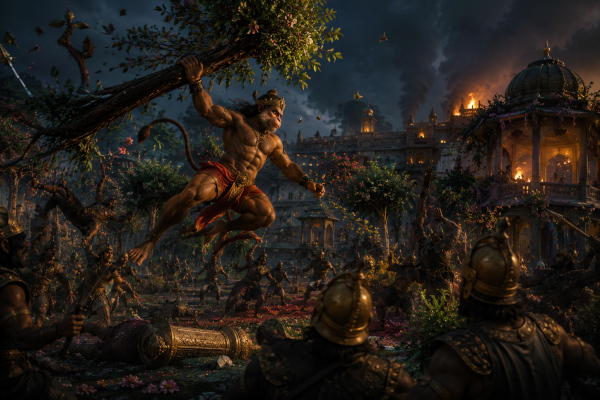
In the Ramayana, Hanuman’s mission to Lanka begins as a deep reconnaissance operation and rises into one of the most intelligent combat probes in ancient war literature. He crosses the ocean, enters the enemy capital, studies its streets, observes its fortifications, locates Sita, speaks to her, delivers Rama’s message and confirms her condition. At this point, the mission has already achieved its primary intelligence objective. A lesser warrior would have returned with the report. Hanuman chooses a larger strategic outcome. He decides to test Lanka’s fighting strength from within the heart of Ravana’s city.
This moment reveals Hanuman as far more than a messenger. He becomes a battlefield analyst, special forces raider, psychological operator and reconnaissance commander in a single frame. After meeting Sita in Ashoka Vatika, he reflects on the available instruments of statecraft. Conciliation, gifts and dissension appear unsuitable against the Rakshasas who are loyal to Ravana’s terror-backed order. Direct action remains the tool that can expose their strength. This reasoning transforms his next move from anger into military method. The destruction of Ashoka Vatika becomes a planned provocation, designed to draw the enemy into the open.
In modern military language, this resembles reconnaissance by combat. A force deliberately initiates contact with the enemy to discover strength, weapons, response time, command structure, reserves, morale and tactical habits. Maps, spies and observation posts reveal many things, yet actual combat reveals the living pulse of an army. The first enemy response shows guard discipline. The second response shows local command readiness. The arrival of elite units shows escalation protocol. The use of special weapons shows doctrinal thresholds. Hanuman’s raid follows this logic with remarkable clarity.
Ashoka Vatika is the perfect target for such a probe. It lies inside Lanka, close to the emotional and political centre of Ravana’s regime. It is guarded, symbolic and connected to the captivity of Sita. By striking it, Hanuman touches Ravana’s pride, palace security and internal authority at the same time. The broken trees, shattered pavilions and scattered guards become more than physical damage. They become a loud military signal inside the enemy capital: Rama’s side has reached Lanka, studied it and now possesses the courage to act in its most protected spaces.
The first wave of Rakshasa guards rushes against Hanuman and gives him a measure of Lanka’s basic security layer. Their speed of arrival shows the alert network around the garden. Their fighting style shows the quality of palace troops. Their collapse shows the weakness of routine guards against an exceptional raider. Hanuman watches the enemy through combat, learning as he fights. Every blow he delivers becomes a question thrown at Lanka’s defence system. Every unit sent against him becomes an answer.
Ravana’s next responses reveal the ladder of command. Stronger warriors arrive, then named commanders, then royal fighters. Jambumali comes armed and confident. The sons of ministers enter the field. Aksha, Ravana’s young prince, joins the battle with royal pride and trained aggression. Each escalation tells Hanuman how Lanka values the threat. A small disturbance becomes a palace crisis. A palace crisis becomes a royal military engagement. The enemy’s order of reaction stands exposed in the open air of Ashoka Vatika.
This is exactly what a modern probing action seeks to achieve. A commando team striking a forward post, an armoured patrol pushing toward a suspected defensive line, a drone swarm drawing radar activation, or a naval task group testing surveillance coverage all serve the same larger purpose. The aim is to make the enemy reveal what it has kept hidden. Once the enemy reacts, its sensors light up, its artillery speaks, its reserves move, its commanders transmit, and its doctrine becomes visible. Hanuman achieves this with his own body as the probe, his strength as the weapon and his intellect as the command centre.
The battle also measures morale. Lanka’s warriors do arrive with fury, yet their confidence cracks when they face a single Vanara who fights with speed, imagination and overwhelming physical force. Hanuman leaps across the garden, tears through formations, uses trees and pillars as weapons and turns the enemy’s own terrain into a battlefield tool. For Ravana’s men, the scene becomes psychologically disturbing. The invader is alone, inside their capital, and still controls the tempo of battle. This kind of psychological shock is one of the richest products of reconnaissance by combat.
Modern warfare treats tempo as a weapon. A smaller force can dominate a larger force by controlling speed, surprise and escalation. Hanuman does this instinctively. He chooses when to reveal himself, where to strike, how much force to use and how long to continue. The Rakshasas keep reacting to his rhythm. He sets the pace. They follow it. This gives him command over the encounter even while surrounded inside hostile territory.
The arrival of Indrajit adds another layer to the reconnaissance. Ravana finally sends a warrior of high strategic value, a prince skilled in celestial weapons and battlefield deception. Hanuman’s encounter with Indrajit reveals the existence of Lanka’s elite capability. The mission has now reached its highest intelligence gain. Hanuman has moved from testing guards to measuring royal champions. He has forced the enemy to bring out a prized weapon system in human form. In modern terms, the probe has drawn out the elite reserve and confirmed the adversary’s escalation ceiling.
Hanuman’s acceptance of capture after the Brahmastra episode is also a calculated intelligence move. He gains entry into Ravana’s court, sees the king directly, studies the atmosphere of power, assesses the ministers and delivers Rama’s warning inside the enemy’s command chamber. A captured raider becomes a messenger inside the citadel. This is battlefield intelligence turning into psychological warfare. The enemy believes it has seized the intruder, while the intruder uses that moment to inspect the political core of the enemy state.
The burning of Lanka that follows becomes the final phase of the operation. Hanuman’s flaming tail moves through streets, mansions, towers and military zones, turning punishment into mapping through movement. As fire spreads through the layout of the city, spreads fear across neighbourhoods and proves that Lanka’s inner security can be penetrated repeatedly in a single night. The raid becomes a preview of the war to come. Lanka learns that the army across the sea has reach, courage and divine backing. Rama receives proof that Lanka can be entered, shaken and studied.
There is a clear parallel with modern special operations. Before a large campaign, commanders value raids that clarify the battlefield. Such actions identify enemy reaction patterns, expose air-defence behaviour, test communication speed, reveal leadership confidence and create fear inside defended zones. A strike across the Line of Control, a patrol clash on high-altitude ridges, a naval surveillance sweep in contested waters, or a drone-led probe against a defended sector can all produce the same kind of intelligence. The battlefield speaks most clearly when pressure is applied.
Hanuman’s Ashoka Vatika action also shows the difference between bravery and controlled aggression. His violence has direction. His target has meaning. His escalation has purpose. He destroys enough to provoke, fights enough to assess, allows capture enough to gain access, speaks enough to warn and escapes enough to report. Every phase serves Rama’s campaign. This makes the raid a complete military operation rather than a burst of heroic anger.
For Rama’s army, the intelligence value is immense. Hanuman returns with Sita’s location, Ravana’s arrogance, Lanka’s internal layout, the quality of its warriors, the presence of elite commanders, the psychological condition of the enemy and the possibility of deep penetration. The information helps convert devotion into strategy. The coming war against Lanka gains clearer shape because one warrior forced the enemy to reveal itself before the main army arrived.
Reconnaissance by combat is dangerous because it walks into uncertainty by design. Hanuman succeeds because his strength is joined with discipline. He enters Lanka as a silent observer, becomes a controlled attacker, turns into a captive envoy, rises as a fire-borne psychological weapon and returns as an intelligence carrier. The Ashoka Vatika raid therefore stands as one of the clearest examples of ancient battlefield probing. It shows that a well-planned act of combat can become a map, a message, a warning and a strategic report.
In the larger Ramayana war narrative, this episode prepares the ground for the siege of Lanka. Rama’s army receives more than news of Sita. It receives a tested understanding of the enemy’s fighting system. Hanuman has made Lanka respond under pressure. He has measured its muscle, exposed its pride and shaken its confidence. The raid proves a timeless truth of warfare: sometimes the clearest way to understand a fortress is to strike its gate and watch how the defenders move.
You may also like
-
Former DRDO Chief Samir Kamat Confirms Akash Missile Exports to Tajikistan and Turkmenistan
-
MoD Signs ₹586 Crore Contract for Indigenous Auxiliary Power Units for T-72 and T-90 Tanks
-
India–Mongolia Joint Military Exercise Nomadic Elephant 2026 Begins in Pithoragarh
-
Agni-5 Heavy Penetrator Concept Emerges as India Studies Long-Range Bunker-Busting Capability
-
DRDO Gives Private Industry Greater Freedom to Refine Secondary Designs and Subsystems
