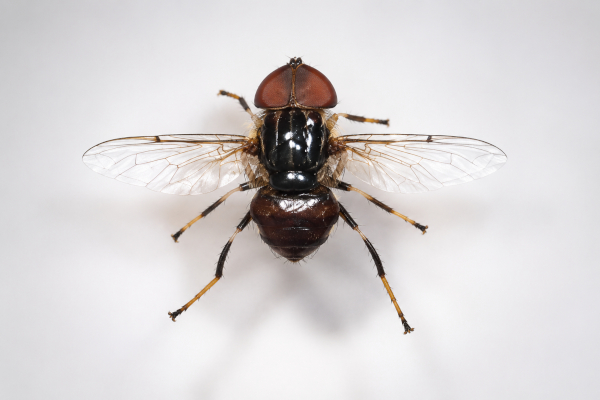
The Gangetic Plains of West Bengal have revealed a fresh chapter in India’s insect biodiversity, with scientists from the Zoological Survey of India discovering two new species of hoverflies from the region. The newly identified species, named Eristalinus sapphirinus and Eristalinus brunettii, mark the first major addition to India’s known Eristalinus hoverfly fauna in more than a century. The last major contribution to this group was recorded in 1923, making this discovery a significant moment for Indian entomology.
Hoverflies belong to the family Syrphidae and are often mistaken for bees or wasps because of their appearance and movement around flowers. Their role in nature is far deeper than their small size suggests. Adult hoverflies visit flowers and support pollination in wild plants, cultivated crops and natural ecosystems. Their larvae also contribute to ecological balance, with some species living in aquatic habitats where they help break down organic matter and recycle nutrients. This makes hoverflies important both above flowers and within the hidden layers of wetland-like microhabitats.
The discovery was made by researchers associated with the Zoological Survey of India in Kolkata. The study was carried out by Bristi Roy, Oishik Kar and Jayita Sengupta, with scientific guidance from senior ZSI experts including Dhriti Banerjee and Atanu Naskar. The findings were published in the European Journal of Taxonomy, giving the discovery international scientific recognition.
The research team examined specimens collected from different districts of West Bengal between 2022 and 2025. Since many hoverfly species look very similar to one another, the scientists used an integrative taxonomic method. This combined close study of body structure with mitochondrial COI DNA barcoding, allowing the team to confirm that the specimens were distinct species previously unknown to science. Modern DNA-based methods helped bring clarity to a group where visual identification alone can be difficult.
The first new species, Eristalinus sapphirinus, gets its name from its striking sapphire-blue metallic appearance. The second, Eristalinus brunettii, has been named in honour of Enrico Adelelmo Brunetti, whose work made a major contribution to the study of Indian Diptera, the insect order that includes flies. By naming the species this way, the researchers have linked modern Indian taxonomy with the historic foundations of insect research in the subcontinent.
The importance of this discovery goes beyond the naming of two new insects. It proves that even familiar landscapes can still hold unknown life forms. The Gangetic Plains are among India’s most densely inhabited and heavily modified regions, yet they continue to shelter undocumented biodiversity. This finding shows that important scientific discoveries are not limited to remote forests, high mountains or protected reserves. They can also emerge from agricultural belts, riverine plains, wetlands, village edges and everyday landscapes shaped by human activity.
The discovery also highlights the importance of studying lesser-known pollinators. Public attention often goes to bees and butterflies, while hoverflies remain less recognised despite their ecological value. In a time when pollinator decline is becoming a global concern, documenting such species becomes essential for understanding how ecosystems function and how biodiversity supports agriculture, soil health and plant reproduction.
For India, this discovery strengthens the role of institutions like the Zoological Survey of India in documenting the country’s living wealth. Taxonomy may appear quiet and slow from the outside, but it forms the foundation of conservation science. A species must first be identified, described and named before it can be protected, studied or included in ecological planning. Every new species added to science expands the map of India’s biodiversity.
The discovery of Eristalinus sapphirinus and Eristalinus brunettii is therefore more than a scientific record. It is a reminder that nature still holds secrets in plain sight. In the flowers of Bengal’s plains, in the shimmer of a small fly’s body, and in the patient work of field scientists, India’s biodiversity continues to reveal itself one species at a time.
You may also like
-
IISc Scientists Show How Strong Magnetic Fields Could Allow White Dwarfs to Exceed Chandrasekhar Limit
-
IIT Madras to Launch Global Mission to Map 100 Human Brains in 3D
-
3,898 Indian Scientists Feature in 2026 Global Top 2% Research Database; IISc Leads Indian Institutions
-
New Metal-free Porous Material can Help Produce Affordable Clean Energy
-
A Decade of Cosmic Flickering Reveals New Clues About A Rare Giant Binary Black Hole System
