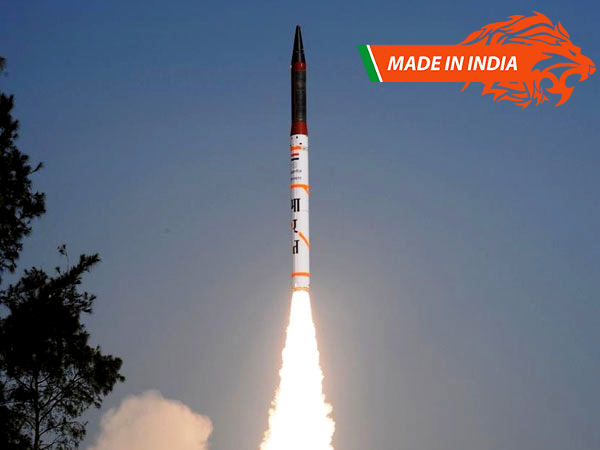
India has successfully test-fired the Agni-4 ballistic missile from the Integrated Test Range at Chandipur in Odisha, demonstrating the continued operational reliability of one of the country’s most important land-based strategic weapon systems.
The Ministry of Defence said the missile was launched on August 6, 2026, under the aegis of the Strategic Forces Command. The flight validated all designated operational and technical parameters, indicating that the missile, its mobile launching system, command procedures and supporting tracking infrastructure performed according to mission requirements.
Although described in the latest government announcement as a medium-range ballistic missile, Agni-4 has previously been officially classified as an intermediate-range or long-range surface-to-surface ballistic missile. Its publicly stated range is approximately 4,000 kilometres.
The latest launch was therefore more than another missile-development experiment. Since it was conducted by the Strategic Forces Command, the organisation responsible for managing India’s strategic delivery systems, it represented an operational validation of an established missile capability.
A Strategic Forces Command Test
The involvement of the Strategic Forces Command is one of the most significant aspects of the August 2026 launch.
Developmental trials are generally conducted to prove new technologies, test redesigned components or expand the performance envelope of a missile. Strategic Forces Command launches, by contrast, are intended to validate the readiness of the weapon system in conditions that resemble actual operational deployment.
Such launches test the complete chain required to employ the missile: movement of the launcher, preparation of the weapon, command authentication, launch procedures, navigation, propulsion, stage separation, re-entry and terminal accuracy.
They also provide missile crews with practical experience while allowing defence authorities to evaluate the condition and reliability of deployed systems.
India previously conducted an operationally configured Agni-4 launch from Chandipur in September 2024. That test was also carried out under the Strategic Forces Command and validated the missile’s operational and technical parameters.
The August 2026 launch demonstrates that Agni-4 remains an active and relevant component of India’s strategic missile inventory even as the country develops newer systems such as Agni-Prime, Agni-5 and advanced multiple-warhead technologies.
India’s 4,000-Kilometre Strategic Missile
Agni-4 is a two-stage, solid-propellant, surface-to-surface ballistic missile developed indigenously by the Defence Research and Development Organisation.
The missile was created to provide India with a reliable strategic strike capability at ranges significantly greater than those offered by Agni-1 and Agni-2, while remaining lighter and more mobile than some earlier long-range missile designs.
Officially released information places its range at approximately 4,000 kilometres. During its January 2014 developmental test, Agni-4 travelled its intended distance in around 20 minutes and reached an altitude exceeding 850 kilometres before re-entering the atmosphere and striking its designated target area.
Its range enables the missile to cover an extensive geographical area from deployment locations deep within Indian territory. This gives national planners greater flexibility when selecting launch positions and reduces the requirement to move missile units close to potentially vulnerable frontier areas.
The ability to deploy farther inside the country also makes the missile force more difficult to detect, track and neutralise during a crisis.
Agni-4 occupies an important position within India’s layered family of land-based ballistic missiles. It offers substantially greater reach than shorter-range Agni systems while complementing the longer-range Agni-5.
Rather than being made redundant by the arrival of more advanced missiles, Agni-4 provides an additional combination of range, mobility, reliability and dispersal that strengthens the overall survivability of India’s deterrent.
Designed for Road Mobility
One of Agni-4’s principal operational advantages is its road-mobile configuration.
The missile can be transported and launched from a specially designed mobile launcher instead of being permanently restricted to a fixed launch facility. The system was tested from an indigenously developed road-mobile launcher during its developmental programme.
Mobility is vital for a strategic missile because fixed installations can be identified and continuously monitored by satellites, aircraft and other intelligence platforms.
Mobile launchers can be dispersed across a wider operating area, relocated periodically and concealed until required. This complicates an adversary’s surveillance and targeting calculations and improves the probability that a retaliatory force will survive an attempted first strike.
Road mobility also allows the missile to operate without dependence on a small number of exposed launch sites.
Combined with solid-fuel propulsion, the mobile configuration reduces preparation time and supports a higher degree of operational responsiveness.
Two-Stage Solid Propulsion
Agni-4 uses two solid-propellant rocket stages.
Solid-fuel missiles offer several advantages over older liquid-fuelled ballistic missiles. Their propellant can remain stored inside the missile for extended periods, avoiding the lengthy and potentially hazardous fuelling procedures required immediately before launch by many liquid-propellant systems.
This allows the missile to remain in a higher state of readiness and reduces the observable activity that could reveal an impending launch.
Agni-4’s developmental programme also introduced composite rocket-motor technology. Composite materials help reduce structural weight while maintaining the strength required to withstand the intense stresses of launch and atmospheric flight.
During the missile’s 2011 test, the composite rocket motor, two-stage propulsion system and associated technologies performed successfully throughout the flight.
A lighter missile with efficient propulsion can carry its payload over greater distances while retaining the mobility required for deployment on a road-mobile platform.
Indigenous High-Accuracy Navigation
Agni-4 represented an important advance in India’s indigenous missile-guidance capabilities.
The missile incorporates a Ring Laser Gyro-based Inertial Navigation System, or RINS, supported by a redundant Micro Navigation System known as MINGS.
An inertial-navigation system uses internal sensors to calculate the missile’s position, speed and orientation after launch. Because it does not depend entirely on external signals, it can continue guiding the missile even in an environment where satellite-navigation services are unavailable, denied or disrupted.
The redundant navigation arrangement allows the missile to compare and cross-check data from different systems, improving reliability and reducing the risk that the failure of a single component could compromise the mission.
Official accounts of earlier trials said the missile achieved high accuracy and that its navigation systems successfully corrected the flight path after encountering disturbances.
Agni-4 also employs a fifth-generation onboard computer, distributed avionics architecture, a high-speed communication bus and a fully digital control system.
Together, these components process flight information, execute guidance commands and control the missile’s trajectory from launch through atmospheric re-entry.
These technologies were significant not only for Agni-4 itself. They contributed to the knowledge base required for India’s subsequent generation of longer-range and more sophisticated ballistic missiles.
Surviving Atmospheric Re-entry
A long-range ballistic missile leaves the dense lower atmosphere during the middle portion of its flight and later returns at extremely high velocity.
The re-entry vehicle must survive enormous aerodynamic pressure and intense heat while protecting the payload and guidance electronics.
During previous Agni-4 tests, the re-entry heat shield was exposed to external temperatures of around 4,000 degrees Celsius. Despite these conditions, the internal temperature surrounding the missile’s avionics reportedly remained below 50 degrees Celsius.
This thermal protection is essential because even a missile that completes its boost and mid-course phases successfully would be ineffective if its payload or guidance equipment were damaged during re-entry.
The successful validation of Agni-4’s re-entry vehicle demonstrated India’s ability to manufacture specialised heat-resistant materials and design structures capable of surviving the severe environment associated with long-range ballistic flight.
Strengthening Credible Minimum Deterrence
Agni-4 forms part of India’s land-based strategic deterrent.
India’s declared nuclear posture is centred on maintaining credible minimum deterrence. Under this principle, the country seeks a force sufficiently survivable and reliable to ensure that any nuclear attack would invite unacceptable retaliation.
A credible deterrent requires more than the possession of warheads. It depends on dependable delivery systems, trained personnel, secure command arrangements, survivable launch platforms and regularly validated operational procedures.
The Agni-4 contributes to these requirements through its range, mobility, solid propulsion and ability to carry a strategic payload.
Its 4,000-kilometre reach allows launch units to operate from dispersed locations, while the road-mobile launcher improves survivability. Solid fuel provides greater readiness, and indigenous navigation technology reduces dependence on external infrastructure.
Repeated Strategic Forces Command launches provide evidence that the system is being maintained, exercised and evaluated rather than merely retained as a symbolic capability.
India has previously stated that successful Agni training launches reaffirm the country’s policy of credible minimum deterrence.
Why Older Missile Systems Are Still Tested
The continued testing of Agni-4 should not be interpreted as a sign that India lacks newer ballistic missiles.
Strategic weapon systems remain in service for many years and require periodic launches throughout their operational lives. Missiles, mobile launchers, electronic systems, propulsion units and stored components must be examined to ensure that age, storage conditions and environmental exposure have not affected performance.
A representative missile may be selected from the production inventory and launched to evaluate the health of the wider fleet.
Operational tests can also assess updated software, replacement components, improved manufacturing processes and refinements to command-and-control procedures.
The presence of multiple missile types gives India greater operational flexibility and complicates an adversary’s defensive planning. An opponent must account for launchers with different ranges, trajectories, deployment patterns and readiness characteristics rather than preparing to counter a single standardised weapon.
Agni-4 therefore continues to possess strategic value alongside Agni-5 and newer Agni-Prime systems.
Chandipur’s Role in India’s Missile Programme
The Integrated Test Range at Chandipur has played a central role in the development and validation of India’s missile capabilities.
Its coastal location allows missiles to be launched over the Bay of Bengal, where designated impact areas can be established away from densely populated regions and commercial activity.
A network of radars, telemetry stations, electro-optical instruments and other sensors monitors the missile during flight.
Earlier Agni-4 trials were followed by tracking systems positioned along the Odisha coast, while ships deployed near the target area observed the terminal phase and impact.
The data collected during such launches allows scientists and military authorities to reconstruct the complete flight, measuring propulsion performance, structural behaviour, navigation accuracy, stage separation, re-entry conditions and terminal impact.
The August 2026 statement that all operational and technical parameters were validated indicates that the missile’s performance remained within the prescribed mission envelope throughout the test.
A Mature Indigenous Strategic System
Agni-4 was developed through the combined work of several DRDO laboratories and Indian industrial partners.
Its propulsion, composite structures, navigation instruments, flight-control systems, onboard computing and re-entry protection represent capabilities that India developed progressively through its indigenous missile programme.
The missile’s successful developmental trials eventually led to testing in its deliverable configuration with the participation of Strategic Forces Command personnel. Following the January 2014 trial, DRDO stated that the system was ready for induction and serial production.
The transition from scientist-led developmental testing to military-controlled operational launches is a critical milestone in the life of any strategic weapon.
The latest test indicates that Agni-4 has moved well beyond the stage of experimental technology and has become a mature system whose readiness is maintained by India’s strategic forces.
A Clear Signal of Operational Preparedness
The August 6 launch reinforces three important messages.
First, India continues to maintain and validate every important layer of its strategic missile force rather than concentrating exclusively on its newest weapons.
Second, the Strategic Forces Command is regularly exercising the personnel, equipment and procedures required to operate the country’s land-based deterrent.
Third, India’s indigenous missile technologies—including solid propulsion, composite motors, inertial navigation, digital flight control and re-entry protection—have matured into dependable operational capabilities.
Agni-4 may no longer be the newest missile in India’s arsenal, but its combination of approximately 4,000-kilometre reach, road mobility, rapid-readiness solid propulsion and proven guidance technology gives it continuing strategic importance.
The successful launch from Chandipur demonstrates that the missile remains operationally credible and technically reliable.
For India, the value of Agni-4 lies not simply in the distance it can travel. Its real importance lies in its ability to survive, remain ready, operate from dispersed locations and provide a dependable retaliatory capability within the country’s broader strategic deterrence architecture.
References
Press Information Bureau, Ministry of Defence, “‘Agni-4’ Ballistic Missile Successfully Test-Fired,” August 6, 2026.
Press Information Bureau, Ministry of Defence, “Successful Launch of Agni-4 Ballistic Missile,” September 6, 2024.
Press Information Bureau, Ministry of Defence, “India Successfully Test Fires Agni-IV,” January 20, 2014.
Press Information Bureau, Ministry of Defence, “India Launches New Generation Strategic Missile Agni-4,” November 15, 2011.
Press Information Bureau, Ministry of Defence, “Successful Flight Test of Agni-IV,” January 2, 2017.
You may also like
-
Indian Navy Vice Chief Inspects Japan’s Mogami-Class Stealth Frigate as India-Japan Shipbuilding Cooperation Expands
-
India and Russia Explore Joint Icebreaker Construction as Maritime Industrial Cooperation Expands
-
Philippine Marine Wargames Reportedly Show BrahMos Can Penetrate Chinese Destroyer Air Defences
-
Safran Signs 18 Agreements with Indian Aerospace Suppliers, Expanding Make in India Manufacturing Partnerships
-
Indian Army’s Vajra Corps Certifies First Batch of Drone Operators, Strengthens Battlefield Surveillance
