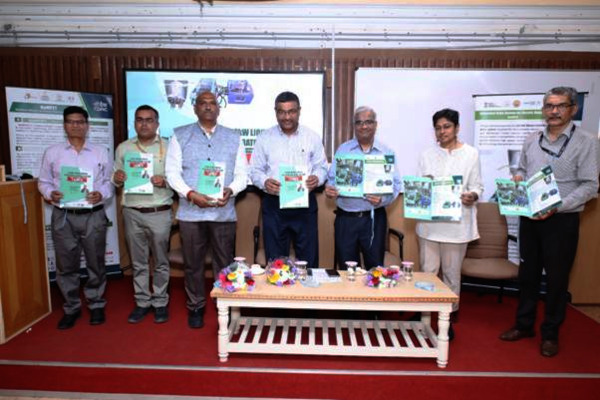
In a major boost to India’s electric mobility landscape, the Ministry of Electronics and Information Technology (MeitY) today launched a 30 kW Wide Band Gap (WBG)-based Integrated Drive System (IDS) designed to accelerate electric vehicle (EV) adoption across the country. The indigenously developed technology was unveiled at the Indian Institute of Technology Madras campus in Chennai by MeitY Secretary Shri S. Krishnan, underlining the government’s push toward self-reliant, cutting-edge power electronics for EV applications.
Developed through a collaborative effort led by the Centre for Development of Advanced Computing (C-DAC), Thiruvananthapuram with technical partnerships from IIT Madras and Lucas TVS, the new system marks a significant stride in strengthening India’s capabilities in advanced power electronics, a crucial component of modern electric powertrains.
Driving Indigenous Innovation in EV Powertrains
The 30 kW power class targeted by the IDS is particularly relevant for India’s fast-growing electric passenger vehicle segment, including compact cars and fleet mobility solutions. Until now, a large portion of high-performance EV powertrain systems and critical semiconductor-based components had been sourced from imports, keeping costs high and limiting domestic control over these technologies.
By integrating the electric motor and power inverter into a single compact, high power-density unit — replacing the traditional separated motor-drive configuration — the new system enhances efficiency and supports lower production costs through localisation. According to MeitY, this integration not only strengthens India’s EV supply chain but also positions the country for scalable manufacturing aligned with national initiatives such as Production-Linked Incentive (PLI) schemes.
The indigenous IDS technology has been successfully designed, fabricated, and validated, and is now ready for commercialisation and large-scale deployment — a milestone that could provide a meaningful reduction in import dependency while spawning opportunities for micro, small, and medium enterprises (MSMEs) in power electronics, thermal systems, and EV control hardware manufacturing.
Catalysing a Self-Reliant EV Ecosystem
Speaking at the event, Shri S. Krishnan emphasised the government’s commitment to turning India into a technology developer and exporter, aligning with Prime Minister Narendra Modi’s vision of “Make in India, Make for the World.” He noted that the development of the 30 kW IDS represents a significant milestone in India’s journey toward Aatmanirbhar Bharat in electric mobility and strategic electronics. Shri Krishnan highlighted that design-led innovation within India will help foster strong domestic intellectual property, boost the start-up ecosystem, and scale high-value manufacturing in the EV sector.
The initiative was carried out under the National Mission on Power Electronics Technology (NaMPET), which serves as a government-driven platform to promote innovation and collaborative R&D between public research organisations and industry partners, aimed at building globally competitive solutions in power electronics and next-generation mobility systems.
Dignitaries present at the launch included Shri E. Magesh, Director General of C-DAC; Shri Manoj Kumar Jain, Group Coordinator (R&D in IT, CC & BT), MeitY; Shri Ramanathan N. S., CTO of Lucas TVS Chennai; Shri Renji V. Chako, Senior Director of C-DAC Thiruvananthapuram; Dr. Om Krishan Singh, Scientist ‘E’ at MeitY; Prof. Kamlesh Hatua of IIT Madras; and other industry representatives.
You may also like
-
IIT Gandhinagar Researchers Find New Molecular Weakness in Drug-Resistant Staphylococcus
-
IIT Madras and CMC Vellore Build AI Toolkit to Detect Kidney Disease Before Major Damage
-
India’s New Eye in the Sky: Why EOS-05 Is a Major Leap for ISRO and Earth Observation
-
Tiny Molecular Switch Enables Nature-inspired Biomaterials for Self-powered Healthcare
-
Manipal Researchers Combine Lasers and AI for Real-Time Industrial Fuel Quality Monitoring
