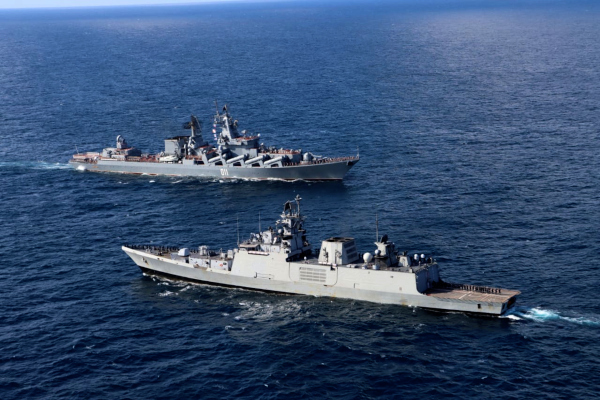
The Indian Navy (IN) is undertaking a Passage Exercise (PASSEX) with Russian Federation Navy (RuFN) in the Eastern Indian Ocean Region (IOR) from 4 to 5 December 2020. The exercise involves participation of RuFN guided missile cruiser Varyag, large anti-submarine ship AdmiralPanteleyev and medium ocean tanker Pechenga. INis being represented by indigenously constructed guided missile frigate Shivalik and anti-submarine corvetteKadmattalongwith integral helicopters.
The exercise is aimed at enhancing interoperability, improving understanding and imbibing best practices between both the friendly navies, and would involve advanced surface and anti-submarine warfare exercises, weapon firings, seamanship exercises and helicopter operations.
PASSEXs are conducted regularly by IN with units of friendly foreign navies, whilst visiting each other’s ports or during a rendezvous at sea. This exercise, being conducted in the Eastern Indian Ocean Region, reflects the strong long-term strategic relationship between the two countries and particularly, defence cooperation in the maritime domain.
This exercise is being conducted on the occasion of ‘Navy Day’ of the IN on 4th December, which emphasizes the strong bonds of friendship shared between the two friendly militaries. This PASSEX would be another step towards strengthening Indo-Russian defence relations. The two navies have built a robust relationship through regular exercises such as INDRA Navy conducted biennially, with the last edition held in the Northern Indian Ocean Region from 4 to 5 September 2020.
Source: PIB
You may also like
-
JCBL Receives DRDO Technology for Indigenous 20-Tonne Heavy Drop System for C-130J and C-17
-
DRDO Moves 30 kW Laser Weapon Towards Production, Industry Partner Selection Planned Within Six Months
-
IG Defence Validates KAL Long-Range Strike Drone’s Integrated Systems in Pokhran Trial
-
Vajra Air Defence Warriors Validate AKASHTEER Sensor-to-Shooter Network in Day-Night Firing Drills
-
INS Sahyadri and INS Kulish Reach Philippines for ADMM-Plus Maritime Cooperation
%20between%20Russian%20Federation%20Navy%20and%20Indian%20Navy%20in%20Eastern%20Indian%20Ocean%20Region)