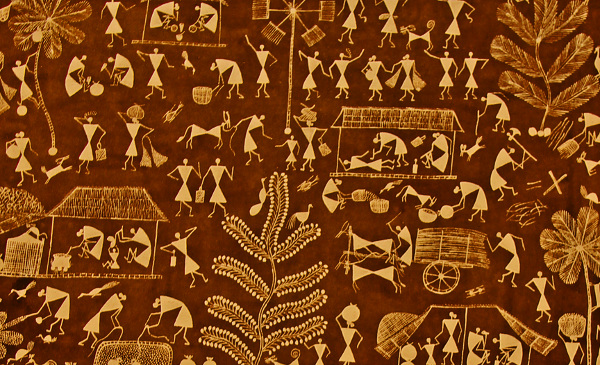
Technological advancements over the past few decades have changed how we live our lives. The number of applications of technology in real-life scenarios is numerous. Here is an episode where technology is being used to restore art that is at risk. Based out of Odisha, the Centurion University is preserving tribal art and culture from the state in 3D format.
Art restoration in 2D format has already been underway. However, it was often found to miss out on the finer details of the traditional art forms. The answer is 3D technology, say the researchers of the Centurion University’s Gram Tarang vocational institute. The institute is also working with farmers to bring out smart agricultural practices in Odisha.
Under the new 3D technology for preserving art, more than 4,000 artifacts belonging to five of the 62 tribes across Odisha have already been preserved in 3D digital format. This method also included audio and visuals. The restored documents are accessible online for scholars and researchers working on tribal art.
3D Technology
The 3D art restoration program team has worked on textile, weaponry, household artifacts, agricultural tools and practices, musical instruments, and also religious idols. The team felt that given another decade or two, the tribal art would be lost forever. Preserving them now was essential.
What’s more, the team has also integrated 3D technology with VR. The documents can also be accessed via Oculus VR headsets. Abhi Mitra, a game programmer at Gram Tarang Technologies and his research colleagues has worked closely with the tribal communities to preserve their art and culture in its original form using 3D and VR.
The team is also working on AR, VR, UAVs like drones, and artificial intelligence to capture tribal art and culture. By using these technologies, the team is protecting crumbling monuments as well, especially those that are at risk of destruction from natural and man-made calamities.
In another case in Mumbai, an ancient site was first surveyed using terrestrial laser scanning, popularly called LIDAR, to construct a 3D model. Next, the model was used as a baseline to monitor the surface of the building for structural changes. Some of the monuments, art, and culture preserved are available to the public as a VR experience in selected ASI (Archaeological Survey of India) – restored sites.
Source: GizBot
Image Courtesy: Life in Silicon Valley
You may also like
-
ISRO Successfully Launches GSLV-F18, Places NVS-03 Navigation Satellite into Geosynchronous Transfer Orbit
-
India Establishes ₹325 Crore Bharat Bovine Breeding and Research Centre in Gujarat to Advance Indigenous Cattle Genetics
-
ISRO Set to Launch NVS-03 Navigation Satellite with Indigenous Atomic Clock to Strengthen India’s NavIC System
-
IIT Guwahati Scientists Reveal How Plants Adapt Their Water Transport Systems During Drought
-
Indian Scientists Discover New Electric Ray Species in Arabian Sea, Revealing Hidden Deep-Ocean Biodiversity
