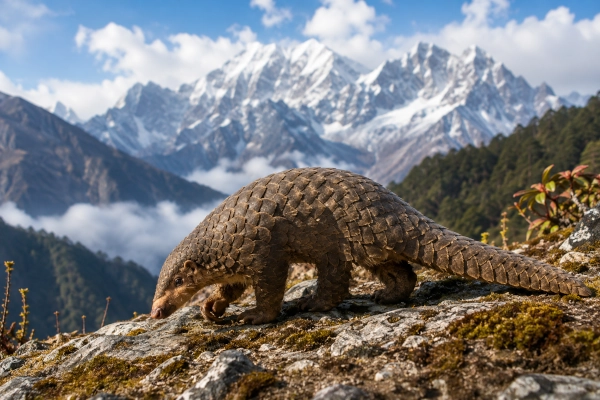
A pangolin first scientifically described in the Himalayas nearly two centuries ago has been restored to full species status after researchers extracted genetic information from its 190-year-old museum specimen and combined it with modern genomic and anatomical evidence.
The study, published in Communications Biology on 1 July 2026, concludes that the Himalayan pangolin should be recognised as Manis aurita Hodgson, 1836, a distinct living species rather than being treated as a population or subspecies of the Chinese pangolin, Manis pentadactyla.
The finding has particular importance for India because the newly revalidated species occurs across the southern Himalayan region, including northeastern India, with confirmed genetic records from Assam, as well as Nepal, South Tibet and adjoining Himalayan areas.
Rather than representing the discovery of an animal previously unknown to science, the research resolves a complicated taxonomic puzzle stretching back to the nineteenth century. An old scientific name that had largely fallen out of use has now been shown, through DNA and morphology, to represent a genuine evolutionary lineage.
A Pangolin Described in 1836
The story of the Himalayan pangolin begins with British naturalist Brian Houghton Hodgson, who collected a specimen in central Nepal in 1836 and described the animal under the name Manis auritus.
The surviving adult skin, catalogued today as BMNH 43.1.12.85, eventually became the lectotype — the reference specimen used to define the taxon scientifically.
Over subsequent decades, however, zoologists disagreed over the animal’s status.
The Himalayan form was eventually absorbed into the Chinese pangolin and treated as Manis pentadactyla aurita, effectively reducing it to a subspecies rather than recognising it as an independent species.
That interpretation persisted for much of the twentieth century.
The 2026 study returned directly to Hodgson’s historic specimen and used modern genomic techniques to answer a question that nineteenth-century zoologists could never have resolved with morphology alone.
DNA Extracted From the Historic Type Specimen
Researchers generated new next-generation sequencing datasets that included DNA obtained from the M. aurita lectotype.
They combined these data with previously published pangolin genomes and mitochondrial DNA sequences.
The final genomic dataset incorporated 55 whole-genome sequencing datasets representing 53 pangolin individuals and comparative outgroups, together with approximately 70 mitochondrial genomes.
This allowed the researchers to compare the old Himalayan specimen directly with modern pangolin populations from across Asia.
The result was striking.
The 1836 specimen consistently fell within a deeply divergent genetic lineage previously identified by scientists as MPB, while typical Chinese pangolins belonged to another lineage known as MPA.
The two were not simply regional populations of the same recently separated animal.
Their evolutionary histories extended far deeper into the past.
Himalayan and Chinese Pangolins Split About 1.8 Million Years Ago
Genome-wide analysis indicated that the ancestors of the Himalayan pangolin and the Chinese pangolin diverged approximately 1.8 million years ago, during the early Pleistocene.
Since that separation, the two lineages appear to have remained largely isolated.
Researchers found only very limited evidence of later genetic exchange with related pangolin species.
The magnitude and persistence of the genetic separation provided strong evidence that the Himalayan animals represent an independent evolutionary lineage rather than merely a geographic variation of Manis pentadactyla.
The researchers also proposed that major climatic oscillations during the Pleistocene may have contributed to the split.
As climate repeatedly changed across Asia, ancestral pangolin populations may have become separated into western Himalayan and eastern Asian refuges. Over immense periods of isolation, those populations followed different evolutionary pathways.
Anatomy Supports the Genetic Evidence
DNA was only part of the evidence.
The research team also compared skulls and external body characteristics and found consistent anatomical differences between the Himalayan pangolin and the Chinese pangolin.
Manis aurita possesses a larger overall skull, with a proportionally shorter and broader nasal region.
Externally, it tends to have a larger body, longer tail and smaller external ears, or pinnae, than Manis pentadactyla.
The scales are generally described as dark brown to deep chestnut.
Researchers also identified differences around the snout. In M. aurita, scales do not extend completely to the end of the snout, leaving a distinct area of exposed skin.
Taken together, these characteristics mean that the genetic split is accompanied by measurable physical differentiation.
That combination of genomic and morphological evidence was central to the researchers’ decision to restore the species.
The Himalayan Pangolin Returns as Manis aurita
Under zoological nomenclature, an older valid scientific name generally takes precedence over a newer name when both are shown to describe the same species.
Because Hodgson’s Manis aurita dates to 1836, the researchers concluded that it is the correct name for the Himalayan lineage.
This has another important consequence.
In 2025, researchers had described a genetically distinctive pangolin from northeastern India and the broader Indo-Burmese region as a new species called Manis indoburmanica, the Indo-Burmese pangolin.
That study recognised that the animals were genetically different from conventional Chinese pangolins, but uncertainty remained over whether the older Himalayan name aurita applied to the same lineage.
By sequencing the historic lectotype, the 2026 researchers were able to answer that question.
The type specimen of M. aurita falls within the same genetic lineage as the animals described as M. indoburmanica.
The study therefore concludes that Manis indoburmanica is a junior synonym of Manis aurita — in other words, the animals represent the same species, but the older 1836 name has priority.
The historic name Pholidotus assamensis, introduced in 1872, is similarly regarded as a junior synonym.
Assam Provides Important Indian Evidence
For India, one of the most significant findings concerns the geographic identity of pangolins in the Northeast.
Genetically verified members of the M. aurita lineage occur in Assam, placing northeastern India firmly within the species’ confirmed distribution.
The study’s genetic mapping showed the lineage concentrated across the southern Himalayan region, including Nepal, South Tibet and Assam.
The broader taxonomic assessment places the species along the southern Himalayan foothills and adjoining Indo-Burmese region, including parts of northeastern India and southern Bhutan.
Its eastern distribution remains less certain, and researchers say further surveys will be necessary to determine its precise limits and possible occurrence farther into Myanmar.
This uncertainty makes new field sampling particularly important.
Animals previously recorded simply as Chinese pangolins in parts of the eastern Himalayas may require taxonomic reassessment.
India Now Has an Important Pangolin Taxonomy Question
India has traditionally been considered home to two pangolin species: the Indian pangolin (Manis crassicaudata) and the Chinese pangolin (Manis pentadactyla).
The Indian pangolin occupies a broad range across much of the subcontinent, while the Chinese pangolin has historically been associated with northeastern India and Himalayan regions.
The revalidation of M. aurita changes that picture.
At least some populations previously classified as Chinese pangolins in northeastern India actually belong to the Himalayan pangolin lineage.
The Zoological Survey of India’s recent mammalian checklist had already acknowledged the taxonomic upheaval, noting the redesignation of northeastern Indian Chinese pangolin populations following the description of Manis indoburmanica in 2025.
The 2026 genomic work now pushes that revision one stage further by showing that the valid historical name for this lineage is Manis aurita.
Detailed surveys will be required before the precise boundaries between M. aurita, M. pentadactyla and M. crassicaudata can be fully mapped across the Himalayan and northeastern landscape.
Two Genetic Populations May Exist Within the Species
The study also revealed an intriguing pattern within the Himalayan pangolin itself.
Population-genetic analyses separated M. aurita into two major genetic clusters.
One comprised animals from Nepal, while the second included animals from South Tibet and northeastern India.
This internal genetic structure suggests that Himalayan pangolin populations have themselves experienced considerable geographic isolation.
It could eventually have important implications for conservation.
If geographically separated populations contain distinctive genetic diversity, protecting animals in only one portion of the species’ range would not necessarily preserve the full evolutionary diversity of Manis aurita.
More sampling from India, Bhutan, Nepal and adjoining regions will be needed to understand this population structure.
Himalayan Pangolin May Reach Around 3,000 Metres
The species occupies an unusual ecological zone extending from comparatively low elevations into Himalayan landscapes.
The study describes M. aurita as occurring from lowlands to approximately 3,000 metres above sea level, although pangolins generally appear more frequently in forest environments below about 2,500 metres.
Its habitats include mixed deciduous and evergreen forests.
Vegetation associated with its habitat can include sal (Shorea robusta), Schima wallichii, Castanopsis indica and Himalayan alder (Alnus nepalensis).
The species has also been recorded near human-modified landscapes where suitable forest survives, indicating some capacity to persist in disturbed environments.
That adaptability, however, should not be mistaken for security.
Pangolins Remain Among the World’s Most Trafficked Mammals
Pangolins are subjected to intense illegal hunting and trafficking because of demand for their scales and meat.
Their keratin scales have been used in illegal traditional-medicine markets, while pangolin meat is consumed in some regions as a luxury product.
All recognised pangolin species have consequently suffered severe pressure from international wildlife trafficking.
The Himalayan region is particularly important because several international borders intersect across difficult mountainous terrain.
Nepal, northeastern India, Bhutan, Tibet and Myanmar collectively form a complex landscape through which wildlife can be illegally transported.
The researchers specifically highlight trafficking pressure affecting Himalayan pangolin populations and stress that clearer identification of the species could strengthen conservation and enforcement.
A Restricted Range Makes the Species More Vulnerable
Recognising M. aurita as a separate species also changes how its conservation status must be understood.
When Himalayan animals were grouped within the much more widely distributed Chinese pangolin, conservation assessments could effectively treat them as one component of a larger species.
The new taxonomy reveals that the Himalayan lineage occupies a considerably more restricted geographic range.
Population-genomic reconstruction also indicates that M. aurita has undergone a prolonged population decline extending deep into the Pleistocene.
A species with a restricted distribution, fragmented populations and continuing trafficking pressure can require conservation measures very different from those designed around a supposedly widespread taxon.
The researchers therefore argue that formal conservation assessments need to catch up with the new taxonomy.
CITES and IUCN Lists Will Need Taxonomic Updating
The revalidation creates an unusual regulatory issue.
The pangolin species historically recognised by conservation authorities are individually incorporated into international conservation frameworks, including CITES Appendix I, which prohibits international commercial trade in pangolins and their parts.
However, Manis aurita has only now been restored as a distinct species.
The researchers therefore recommend that the updated taxonomic name be incorporated rapidly into the nomenclatural references used by CITES and considered separately in future conservation assessments.
This does not mean pangolins in India suddenly become legally available for hunting or trade simply because their scientific name has changed.
Rather, authorities, wildlife forensic laboratories and international conservation bodies will need to ensure that legal and regulatory databases accurately reflect the revised taxonomy.
The researchers have also called for a dedicated assessment of M. aurita for the IUCN Red List.
DNA Could Strengthen Wildlife Crime Investigations
One of the most practical consequences of the research could emerge in wildlife forensics.
Illegal pangolin shipments frequently consist not of whole animals but of scales, meat or other body parts.
Physical identification of such material can be extremely difficult, particularly when closely related species overlap in appearance.
Genetic reference data provide enforcement agencies with another tool.
DNA recovered from confiscated scales or tissue can potentially be compared with known genetic lineages to determine not only whether material came from a pangolin but which species and potentially which geographic population was involved.
Recognising M. aurita therefore improves the biological reference framework available to investigators studying illegal wildlife trade.
It could also help researchers reconstruct trafficking routes by identifying whether confiscated animals originated in the Himalayan region, China, Southeast Asia or elsewhere.
Museum Specimens Become Genetic Time Capsules
The discovery also demonstrates the extraordinary scientific importance of natural-history collections.
When Hodgson’s pangolin specimen entered a museum collection in the nineteenth century, genetics did not exist as a scientific discipline.
Its collectors could not have imagined that almost two centuries later scientists would extract molecular information from the preserved skin to settle the animal’s evolutionary identity.
Modern ancient-DNA and museum-genomics techniques increasingly allow researchers to recover information from specimens collected long before contemporary conservation surveys began.
These collections function as biological archives, preserving records of populations that may since have declined, shifted their ranges or disappeared entirely.
In the case of Manis aurita, the historic specimen provided something modern animals alone could not: a direct genetic connection to the name published in 1836.
Without sequencing the type specimen, uncertainty over whether the old Himalayan name and the newly identified genetic lineage referred to the same animal might have continued.
Not a Newly Discovered Pangolin, but a Species Restored by Science
The most accurate description of the 2026 finding is therefore not that scientists have discovered a completely new pangolin species.
The animal was known.
It had been described 190 years ago.
What was lost was recognition of its biological independence.
For decades, the Himalayan pangolin was submerged within the Chinese pangolin complex. Modern genomics has now shown that the distinction observed by nineteenth-century naturalists reflected a much deeper evolutionary separation.
The combination of genome-wide DNA, mitochondrial evidence and anatomical differences establishes Manis aurita as a distinct lineage that separated from the Chinese pangolin approximately 1.8 million years ago.
For India, that reclassification gives new importance to pangolin populations in Assam and the wider Northeast.
For conservationists, it reveals another geographically restricted and heavily threatened branch of the pangolin family tree that requires focused protection.
And for taxonomy, the story offers a remarkable example of how a specimen collected in the Himalayas in 1836 can still transform modern science nearly two centuries later.
You may also like
-
Karnataka’s Tiger Population Could Cross 700 as New Census Builds on Official Count of 563
-
Project Cheetah Expands as Veerangana Durgavati Tiger Reserve Becomes Madhya Pradesh’s Third Cheetah Habitat
-
Kashmir Markhor Population Rises to 227 as Kazinag Conservation Efforts Show Results
-
ICAR-CIFRI Pushes Conservation of Indigenous Himalayan Fish for Biodiversity and Livelihood Security
-
Indian-Born Cheetah KJP21 Gives Birth to Five Cubs at Kuno, India’s Cheetah Population Reaches 60
