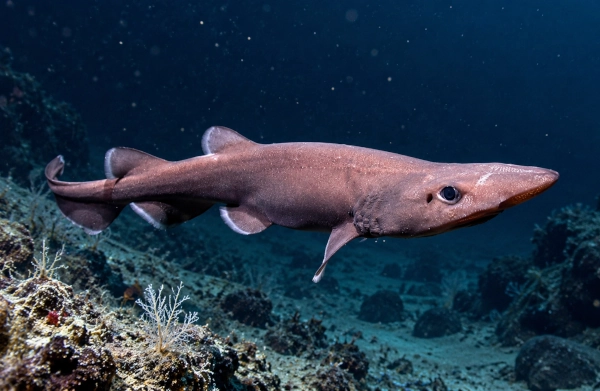
Scientists from the Zoological Survey of India have described a new species of deep-sea catshark from the Arabian Sea off Kerala, adding another little-known predator to India’s expanding inventory of marine biodiversity.
Named Apristurus drona, the new shark was described by Sweta Beura, K. K. Bineesh and Dhriti Banerjee of the Zoological Survey of India. Their study was published on June 9, 2026, in the taxonomic journal Zootaxa. The researchers propose the common name Arabian slender catshark.
The description is based on four specimens — two males and two females — measuring between 439 and 473 mm in total length. They were collected from the continental slope off Kollam on Kerala’s southwest coast at depths of around 400–650 metres. The specimens had entered fishing catches as bycatch from deep-sea shrimp trawling operations landing at Sakthikulangara Fisheries Harbour.
The holotype, an adult male measuring 473 mm, was collected on April 28, 2022. Additional specimens were collected during 2024, allowing researchers to make detailed comparisons before formally establishing the shark as a separate species.
Apristurus drona has a slender body tapering towards the tail and a dark black to brownish-black colouration. Its first dorsal fin is smaller than the second, while the shark possesses numerous tiny multicuspid teeth arranged in rows. Researchers also identified differences in fin proportions, vertebral counts, intestinal spiral-valve structure and other anatomical features that separate it from related catsharks.
Morphology alone was not used to establish the new species. The scientists also carried out DNA barcoding using the mitochondrial COI gene. Genetic analysis placed the specimens in a distinct evolutionary lineage and showed clear divergence from their closest known relatives. The nearest genetic match, Apristurus nakayai of the southwestern Pacific, differed by roughly 5.5–5.7%, while divergence from A. exsanguis and A. macrorhynchus was even greater.
The new species belongs to the Apristurus brunneus group, a wider assemblage of deep-water catsharks. Its closest relatives occur thousands of kilometres away in areas including the southwestern and northwestern Pacific and waters around New Zealand, making the presence of a distinct lineage off India’s west coast particularly significant.
Researchers currently know A. drona from the Kollam continental slope and the broader Wadge Bank region of the Arabian Sea. They describe it as very rare in fisheries bycatch and note that it has no known commercial importance. Its actual distribution, abundance and ecological role remain poorly understood.
The name “drona” honours the son of the study’s second author, K. K. Bineesh.
The discovery highlights how poorly explored India’s deeper marine habitats remain. Continental slopes hundreds of metres beneath the Arabian Sea support biological communities that are rarely observed directly, and specimens recovered incidentally through deep-sea fisheries can sometimes reveal species previously unknown to science.
With DNA analysis increasingly complementing traditional taxonomy, Apristurus drona provides another example of how systematic exploration of India’s marine fauna is uncovering previously undocumented biodiversity in the deep waters surrounding the subcontinent.
You may also like
-
Wild Water Buffaloes Return to Madhya Pradesh’s Kanha Landscape After Nearly 100 Years
-
Indian Scientists Discover New Seahorse Species in Indian Ocean, Resolve 150-Year-Old Scientific Mystery
-
Chhattisgarh Plans Innovative Tree Surgery to Save Over 500 Damaged Trees in Udanti Sitanadi Tiger Reserve
-
Kerala’s Peechi Wildlife Survey Records 395 Species, Adds 36 New Entries to Biodiversity Checklists
-
Tiger Returns to Maharashtra’s Beed Forests After Nearly 100 Years, Highlights Importance of Wildlife Corridors
