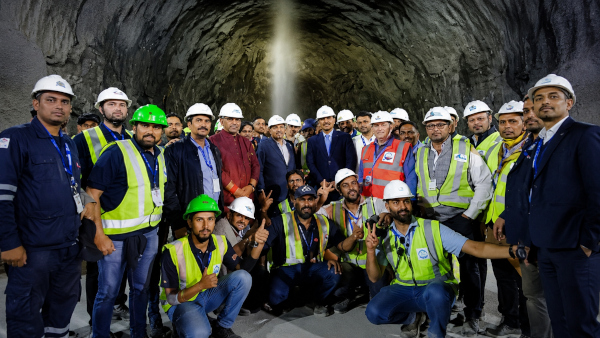
India’s strategically important Zojila Tunnel, designed to establish all-weather road connectivity between Kashmir and Ladakh, is expected to be completed within the next six to eight months, according to Union Minister for Road Transport and Highways Nitin Gadkari. Speaking at the seventh World Landslide Forum in New Delhi on 24 November 2026, the minister stated that approximately 70 per cent of the project had been completed. The infrastructure project is expected to significantly improve regional connectivity, strengthen military logistics and reduce the seasonal isolation experienced by communities in Ladakh.
Zojila Tunnel Moves Towards Completion
The latest completion estimate indicates that the project could be ready between May and July 2027, subject to construction progress and prevailing conditions. The development follows the successful excavation breakthrough of the main tunnel at its eastern portal in Minamarg, Kargil district, on 9 June 2026. Although the breakthrough represented a major engineering achievement, the project remains under construction and has not yet been commissioned for regular traffic.
Being developed at an estimated cost of ₹6,800 crore, the Zojila Tunnel will connect Baltal and Minamarg along National Highway 1. The approximately 13.15-kilometre bidirectional tunnel forms a critical component of India’s efforts to establish dependable road connectivity across the Himalayan region. Its completion will substantially reduce dependence on the existing mountain pass, which remains vulnerable to severe winter weather.
Strengthening India’s Strategic Military Logistics
The Zojila Pass constitutes an important geographical link between the Kashmir Valley and Ladakh, facilitating civilian transportation as well as military logistics. Heavy snowfall, avalanches and adverse weather conditions have historically disrupted movement across the pass during winter. These seasonal restrictions have imposed considerable logistical challenges on the transportation of personnel, equipment and essential supplies.
The Ministry of Road Transport and Highways has officially highlighted the tunnel’s significance for national security and military preparedness. Once operational, the infrastructure is expected to improve the reliability of Indian Army transportation and facilitate sustained logistical support throughout the year. The availability of a dependable road connection will strengthen strategic mobility while reducing the challenges associated with seasonal transportation disruptions.
Overcoming Himalayan Engineering Challenges
The Zojila Tunnel is being constructed at elevations ranging from approximately 2,900 to 3,310 metres above sea level. Engineers and construction personnel have had to contend with difficult geological formations, heavy snowfall, extreme weather and avalanche-prone terrain. The successful excavation breakthrough achieved in June 2026 demonstrated substantial progress in addressing these engineering challenges.
The broader project incorporates protective infrastructure designed to mitigate the risks associated with mountainous terrain. These include avalanche barriers, snow galleries, protective drainage infrastructure, bridges and reinforced approach roads. Such measures are intended to improve the resilience of the transportation corridor and support safer movement across the region.
Advanced Tunnel Safety Infrastructure
The Zojila Tunnel is being equipped with modern safety and traffic-management systems intended to support reliable operations under challenging environmental conditions. Planned facilities include mechanical ventilation, automatic fire detection, electronic surveillance and pedestrian emergency passages. These systems will play an important role in maintaining operational safety within the long underground transportation corridor.
The integration of tunnel engineering with protective infrastructure along the approach roads is particularly significant in the Himalayan environment. Reliable connectivity requires not only the completion of the underground passage but also the resilience of the surrounding road network. The remaining construction and commissioning activities will therefore be essential to delivering the project’s intended benefits.
Transforming Connectivity Between Kashmir and Ladakh
The completion of the Zojila Tunnel is expected to considerably reduce travel time across the mountainous corridor. According to the Ministry of Road Transport and Highways, the journey between Sonamarg and Minamarg could be reduced from nearly two hours to approximately 30 minutes. The improved connection is also expected to lower transportation costs, reduce fuel consumption and minimise weather-related travel disruptions.
The Zojila Tunnel will complement the Sonamarg Tunnel, also known as the Z-Morh Tunnel, which was inaugurated in January 2025. Together, these infrastructure projects will strengthen the road corridor connecting Srinagar, Sonamarg, Kargil and Leh. Their combined contribution will represent an important advancement towards more dependable connectivity between the Kashmir Valley and Ladakh.
Economic Development and Regional Integration
Beyond its strategic importance, the Zojila Tunnel is expected to generate substantial socioeconomic benefits for communities across Jammu and Kashmir and Ladakh. Improved transportation reliability will facilitate the movement of agricultural produce, commercial goods and essential commodities while strengthening access to healthcare, education and other public services. Local enterprises could also benefit from reduced seasonal disruptions and improved access to larger markets.
The tourism sector is expected to benefit from improved accessibility to Ladakh and the surrounding Himalayan destinations. More dependable road connectivity could support hospitality enterprises, transportation services and local employment opportunities. The infrastructure will also help integrate remote communities more closely with regional economic networks.
Strengthening India’s Himalayan Infrastructure
The Zojila Tunnel represents a major component of India’s continuing investment in resilient mountain infrastructure. By addressing geographical and climatic barriers that have historically restricted movement across the Himalayan region, the project combines civilian development objectives with broader national security requirements. Its successful completion will demonstrate the importance of sustained engineering capabilities in overcoming some of the country’s most demanding terrain.
With approximately 70 per cent of construction completed and a revised completion estimate extending into mid-2027, the project is progressing towards a significant infrastructure milestone. Once commissioned, the Zojila Tunnel is expected to strengthen Ladakh’s economic integration, improve the quality of life of regional communities and enhance India’s strategic preparedness. Its enduring contribution will lie in transforming a traditionally seasonal mountain crossing into a more dependable corridor of connectivity, development and national integration.
Sources
- Ministry of Road Transport and Highways, Press Information Bureau — Historic Breakthrough Achieved at Zojila Tunnel Project, 9 June 2026. Release ID: 2270874.
- Press Trust of India — Nitin Gadkari’s statement at the seventh World Landslide Forum, 24 November 2026, reported by The Week and Business Standard.
You may also like
-
Vindhyagiri Delivery Marks Completion of India’s Project 17A Stealth Frigate Programme
-
Walchandnagar Industries Secures ₹18.46 Crore Universal Vertical Launcher Order
-
India Optel Commences Production of Indigenous CM-3 MR Sight at Dehradun
-
Solar Defence Successfully Completes Trials of Indigenous Bhargavastra Counter-Drone System
-
Indian Air Force Invites Bids for Specialised Protective Flying Equipment for Rafale Aircrew
