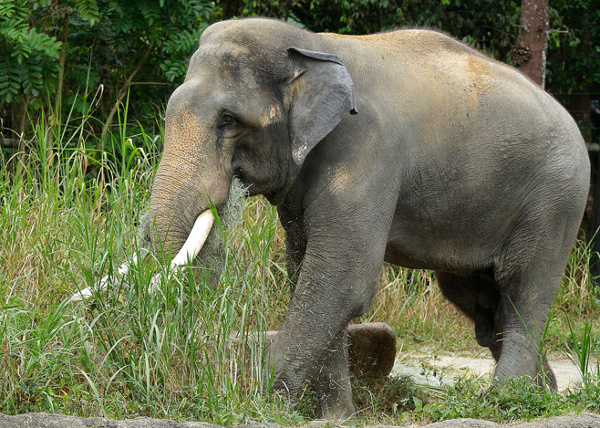
India marked World Elephant Day 2026 by highlighting its growing conservation network for the Asian elephant. The country now supports an estimated 22,446 wild elephants across major forest landscapes.
India is home to around 60% of the world’s wild Asian elephant population. Prime Minister Narendra Modi highlighted this global responsibility while marking World Elephant Day on August 12.
The Prime Minister also praised forest personnel, scientists, veterinarians, mahouts and local communities. He said their work remains central to India’s elephant conservation efforts.
India’s Wild Elephant Population Stands at 22,446
The Synchronous All India Population Estimation of Elephants 2021–25 estimates India’s wild elephant population at 22,446.
India currently protects elephant habitats through 33 Elephant Reserves and 150 identified elephant corridors. These landscapes help elephants move between forests while maintaining genetic diversity.
Elephants often travel long distances in search of food, water and breeding grounds. Their home ranges can extend from about 100 to 3,000 square kilometres.
These movements also benefit forest ecosystems. Elephants disperse seeds, create pathways and help nutrients move through the landscape. Their presence therefore supports many other plant and animal species.
Project Elephant Anchors Conservation Efforts
The Union government runs Project Elephant as its flagship programme for elephant conservation.
The Ministry of Environment, Forest and Climate Change supports states through financial and technical assistance. The programme focuses on habitats, captive elephants and human-elephant conflict.
India has also increased the use of modern technology. Conservation teams now use radio collars, genetic databases, artificial intelligence and early-warning systems.
Scientists have also strengthened the way India counts wild elephants.
The SAIEE 2021–25 exercise used India’s first DNA-based synchronised elephant population assessment. Researchers studied dung samples and identified individual elephants through genetic fingerprints.
This approach helped scientists detect repeated samples and improve population estimates. Researchers combined the genetic data with block counts and line-transect surveys.
150 Corridors Keep Elephant Landscapes Connected
Elephant corridors have become another important part of India’s conservation strategy.
The government has identified and validated 150 corridors across 14 elephant-range states. These corridors connect forests that roads, settlements and other development have fragmented.
The East-Central region has 52 corridors, while the Northeast has 48. Southern India has 32 and the Northern region has 18.
West Bengal has the highest number, with 26 elephant corridors. India also has 19 inter-state corridors and six transboundary corridors connecting India and Nepal.
Monitoring has shown increased elephant use in 59 corridors. Use remained stable in another 29 corridors.
Protecting these pathways can reduce conflict and allow elephant herds to move safely between feeding and breeding areas.
Elephant Reserves Expand Across India
India’s network of Elephant Reserves has also expanded since 2014.
The 33 reserves now cover about 80,777 square kilometres across 14 major elephant-range states. The expansion has added around 8,610 square kilometres to the reserve network.
The government has also introduced a Management Effectiveness Evaluation framework for Elephant Reserves.
Authorities tested the framework in Shivalik, Kaziranga-Karbi Anglong, Mayurbhanj and Nilgiri. They now plan to extend the system across the country’s Elephant Reserves.
Regional Action Plans will further coordinate conservation between states. This is important because elephant populations often move across administrative boundaries.
Technology Helps Make Railways Safer for Elephants
Railway tracks that pass through elephant landscapes remain a major conservation challenge.
Government agencies have jointly surveyed 127 sensitive railway stretches covering 3,452.4 kilometres.
Authorities identified 77 stretches across 14 states for additional safety measures. These sections cover 1,965.2 kilometres and involve 705 proposed mitigation structures.
Measures include underpasses, overpasses, ramps and modifications to bridges and level crossings.
Technology has also become an important part of railway safety.
Railways and wildlife authorities use optical-fibre intrusion detection, seismic sensors and thermal cameras. AI-enabled Distributed Acoustic Sensing systems can also alert loco pilots, station masters and control rooms.
According to the government, elephant deaths caused by train collisions fell from 26 in 2013 to 12 in 2024.
Genetic Database Tracks Captive Elephants
India has also strengthened oversight of captive elephants.
The Gajah Suchana mobile application maintains genetic and identification records for registered captive elephants. The database includes DNA profiles, physical characteristics and ownership information.
Authorities can use these records to verify an elephant before its transfer. The information can also support investigations into illegal movement or trade.
The Captive Elephant (Transfer or Transport) Rules, 2024 provide another layer of regulation. A High-Powered Committee examines interstate transfers.
Communities Remain Central to Conservation
Human-elephant conflict remains one of India’s most difficult wildlife challenges.
The government provides compensation and financial assistance to people affected by elephant encounters. Support covers deaths, serious injuries, minor injuries and damage to crops or property.
Authorities have also introduced hotspot mapping, rapid-response teams and district-level monitoring. Elephant-specific conflict mitigation guidelines issued in 2023 aim to improve coordination between agencies.
These measures recognise a simple reality. India cannot protect elephants without protecting the interests of people who share their landscapes.
From Cultural Reverence to Modern Conservation
Elephants have occupied a special place in Indian civilisation for centuries. They appear in religious traditions, royal history, art and community practices.
Modern conservation adds science and technology to that cultural relationship.
India now combines protected habitats, corridors, genetic research, artificial intelligence and community participation. This approach seeks to protect elephants while reducing conflict in increasingly shared landscapes.
On World Elephant Day, Prime Minister Modi underlined that India’s 33 Elephant Reserves provide vital habitats for the species. He also recognised the people working on the ground to secure their future.
With 22,446 wild elephants, 33 Elephant Reserves and 150 identified corridors, India carries a significant share of the global responsibility for the Asian elephant. Its long-term success will depend on keeping these landscapes connected while allowing communities and elephants to coexist safely.
Official Sources
You may also like
-
India Expands Global Big Cat Conservation as International Big Cat Alliance Opens New Headquarters
-
Satpura Tiger Reserve’s Barasingha Population Crosses 300 as Madhya Pradesh Plans New Wildlife Corridors
-
Karnataka’s Tiger Population Could Cross 700 as New Census Builds on Official Count of 563
-
Project Cheetah Expands as Veerangana Durgavati Tiger Reserve Becomes Madhya Pradesh’s Third Cheetah Habitat
-
Kashmir Markhor Population Rises to 227 as Kazinag Conservation Efforts Show Results
