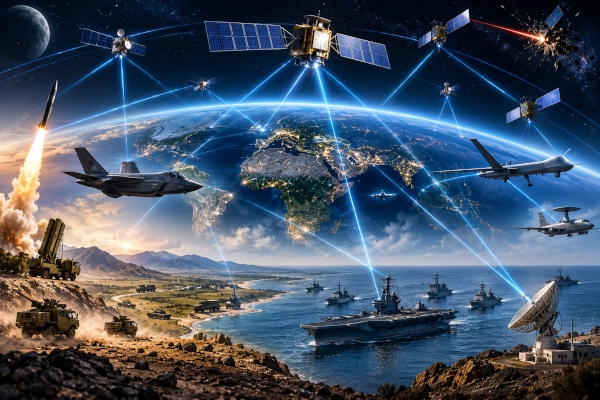
For most of the space age, satellites were viewed primarily as instruments that supported military operations conducted on Earth. They provided communications, weather data, navigation and reconnaissance, but warfare itself was still understood mainly in terms of land, sea and air. Cyberspace later emerged as another operational domain as militaries became dependent on computer networks. Space is now undergoing a similar transition.
Modern armed forces have become so dependent on satellites that losing access to them could dramatically reduce their ability to fight. Precision-guided weapons need accurate positioning. Commanders require secure communications over thousands of kilometres. Aircraft, warships and ground formations depend on satellite navigation. Intelligence agencies use orbital sensors to monitor military movements, missile launches and strategic installations. Satellites increasingly provide the information that connects weapons, commanders and sensors into a single battlefield network.
This dependence has changed the strategic value of orbit. Space is no longer merely a place from which wars on Earth are observed. It has become part of the military infrastructure through which wars are conducted.
NATO formally recognised this change in 2019 when it declared space its fifth operational domain, alongside land, sea, air and cyberspace. NATO now describes space-based communications, navigation, intelligence and missile warning as essential components of modern military operations.
Satellites Have Become the Eyes of Modern Armies
One of the most important military functions performed from orbit is intelligence, surveillance and reconnaissance. Optical and radar-imaging satellites can monitor airfields, ports, missile bases, troop concentrations and naval movements over enormous areas.
Unlike conventional reconnaissance aircraft, satellites can observe areas deep inside hostile territory without entering another country’s airspace. Synthetic-aperture radar satellites can also collect imagery through clouds and during darkness, making orbital surveillance increasingly persistent.
The significance of this capability becomes particularly obvious during military crises. Satellite imagery can reveal whether forces are mobilising, whether aircraft have moved to forward bases or whether naval vessels have left port. Commercial satellite companies have made some of these capabilities available outside governments, meaning journalists, analysts and private organisations can now observe developments that were once visible only to intelligence agencies.
This has reduced the ability of large military movements to remain completely concealed. An army preparing for war may attempt camouflage and deception, but it increasingly operates beneath a constellation of government and commercial sensors.
Precision Warfare Depends on Space
Modern precision weapons are also closely connected to space-based navigation.
Satellite navigation systems such as GPS, Russia’s GLONASS, China’s BeiDou and India’s NavIC provide position, navigation and timing information. Military aircraft, ships, ground vehicles, drones and missiles can use these signals to determine their position and coordinate operations.
The United States Space Force describes positioning, navigation and timing as one of the core military missions provided from space, alongside satellite communications and missile warning.
The effect on warfare has been profound. A weapon that once required a pilot or artillery observer to identify a target may now receive coordinates through a digital network and navigate towards them with high precision. Units separated by hundreds or thousands of kilometres can coordinate using common timing and positioning information.
This also explains why satellite-navigation signals have become targets themselves. Jamming or deceiving navigation signals can reduce the accuracy of weapons and disrupt military operations without physically destroying a satellite.
Space Is Central to Military Communications
Military forces increasingly depend on satellites for secure communications beyond the range of terrestrial radio networks.
A warship operating thousands of kilometres from its home base, a reconnaissance aircraft over an ocean, a remotely operated drone and a headquarters on another continent may all depend on satellite links. These networks allow commanders to transmit intelligence, targeting information, orders and battlefield data across enormous distances.
This is particularly important for countries that operate globally. Without satellite communications, maintaining command links with forces deployed across oceans would become far more difficult.
The same dependence creates vulnerability. A communications satellite does not necessarily need to be destroyed to become ineffective. Its signal can potentially be jammed, its ground station attacked or its computer systems compromised.
Space warfare therefore extends far beyond missiles attacking objects in orbit.
Satellites Can Provide the First Warning of Missile Attack
Another critical military role performed from space is missile warning.
Infrared satellites can detect the intense heat produced by ballistic missile engines shortly after launch. This gives governments precious additional time to assess an attack, alert forces and activate missile-defence systems.
The US Space Force operates space-based and ground-based systems specifically designed to detect missile launches around the world. Its Defense Support Program satellites have historically used infrared sensors in geosynchronous orbit to identify missile and rocket launches, while newer architectures are being developed for more resilient missile warning and tracking.
As hypersonic weapons and manoeuvring missiles become more important, countries are increasingly considering constellations of satellites in lower orbits that can provide continuous tracking rather than simply detecting the initial launch.
The battle for missile defence is therefore moving upward. Sensors in space may detect the weapon, satellites may track it, terrestrial radars may refine its trajectory and interceptors may ultimately attempt to destroy it.
Space Assets Are Becoming Targets
Once satellites became indispensable to military operations, adversaries naturally began developing ways to disable them.
Counter-space weapons can take several forms. The most dramatic are direct-ascent anti-satellite missiles, which are launched from Earth and physically collide with satellites in orbit. Other concepts include satellites capable of approaching or interfering with another spacecraft, electronic systems designed to jam satellite signals, directed-energy systems that could temporarily blind optical sensors and cyber operations aimed at satellite networks or their ground infrastructure.
NATO says that potential adversaries have developed capabilities capable of disrupting, degrading, deceiving, denying or destroying space systems. It also notes that Russia and China have developed and tested a broad range of counter-space technologies.
The variety of these methods means that a future confrontation in space may not resemble traditional warfare. There may be no explosion and no visible attack. A satellite could simply stop communicating, receive false data or become unable to use its sensors effectively.
Anti-Satellite Missiles Demonstrate the Physical Threat
Direct-ascent anti-satellite weapons remain the most visible example of counter-space capability.
India demonstrated such a capability during Mission Shakti on March 27, 2019, when a DRDO-developed ballistic missile defence interceptor destroyed an Indian satellite in low Earth orbit using a hit-to-kill interception. The Ministry of Defence said the test demonstrated India’s ability to defend its assets in outer space and made India the fourth country to demonstrate such a capability.
The United States, Russia and China have also demonstrated anti-satellite capabilities.
These weapons present a serious strategic problem because destroying a satellite can create orbital debris travelling at enormous speed. A debris cloud can threaten not only military satellites belonging to the participants in a conflict but civilian and neutral spacecraft for years afterwards.
For this reason, physically destroying satellites may sometimes be less attractive than temporarily disabling or interfering with them.
Electronic Warfare May Be More Useful Than Destruction
Jamming is likely to be one of the most important forms of space warfare because it can disrupt satellite services without producing debris.
Satellite communications and navigation depend on radio-frequency links between spacecraft and users on Earth. Powerful electronic-warfare systems can attempt to interfere with those signals. Navigation receivers can also be subjected to spoofing, where false signals attempt to convince the receiver that it is somewhere other than its true location.
A military force operating in a heavily contested electromagnetic environment may therefore discover that satellite navigation becomes unreliable precisely when it needs it most.
This is driving militaries towards alternative navigation methods, hardened receivers, encrypted signals and the ability to operate when satellite services are degraded or unavailable.
Space warfare and electronic warfare are consequently becoming increasingly intertwined.
Cyber Attacks Could Reach Satellites Without Going Into Orbit
Cyber operations provide another path for attacking space capabilities.
Every satellite depends on a larger system that includes ground-control stations, computer networks, software, communication links and data-processing facilities. An adversary that compromises those terrestrial systems may be able to interfere with a satellite without attacking the spacecraft itself.
Cyber operations might attempt to disrupt commands, manipulate data, disable ground infrastructure or interrupt communications between a satellite and its operators.
This creates an important strategic reality: protecting military space systems does not end at the edge of the atmosphere. Ground stations, fibre-optic links, power supplies, cloud infrastructure and software all form part of the same space architecture.
A country’s satellite constellation may therefore be only as secure as the computers controlling it.
Commercial Satellites Are Changing Warfare
The rapid growth of commercial space companies has added another layer of complexity.
Private companies now operate large constellations capable of providing broadband communications, high-resolution imagery, weather data and other services previously associated mainly with national governments.
NATO’s 2025 Commercial Space Strategy explicitly recognises that commercial providers can supply important capabilities during peace, crisis and conflict. The Alliance is working to integrate commercial satellite services into defence planning while avoiding excessive dependence on any single company.
This creates difficult questions during wartime. If a privately operated satellite provides communications or intelligence directly supporting military operations, an adversary may regard that system as contributing to the conflict even though it remains commercially owned.
The boundary separating civilian and military infrastructure in space is therefore becoming increasingly difficult to define.
Large Constellations Are Making Space Systems Harder to Disable
Traditional military satellite architectures often depended on a relatively small number of expensive spacecraft. That created obvious vulnerabilities because losing even one specialised satellite could significantly reduce capability.
Countries are increasingly moving towards distributed constellations containing larger numbers of smaller satellites.
The logic is similar to redundancy in computer networks. Destroying or disabling one satellite has less effect if dozens or hundreds of others can continue providing coverage.
The United States is developing proliferated satellite architectures for functions including missile warning, tracking and communications. NATO’s HALO initiative, launched by eight allies in 2026, similarly aims to connect national military satellites into a networked architecture intended to improve resilience and military advantage in space.
Future space power may therefore depend less on a handful of extraordinarily capable satellites and more on networks that can continue functioning after individual spacecraft are lost.
Space Domain Awareness Is Becoming Essential
Before a country can defend its satellites, it must know what is happening around them.
Space domain awareness involves detecting and tracking objects in orbit, identifying potentially threatening behaviour and understanding whether another spacecraft is manoeuvring close to a sensitive satellite.
Thousands of operational satellites and far larger numbers of debris objects now move through Earth’s orbital environment. Distinguishing an ordinary manoeuvre from a potentially hostile one can therefore be extremely difficult.
India has been expanding its indigenous capabilities in this area through the Network for Space Objects Tracking and Analysis, or NETRA. ISRO’s 2025 Space Situational Awareness Report says work is underway on an optical telescope at Hanle in Ladakh, while an indigenous phased-array space-object tracking radar is being developed for deployment in northeastern India. ISRO’s Multi-Object Tracking Radar at Sriharikota already contributes to tracking satellites and other objects.
These systems have obvious civilian value because they protect satellites against collisions and debris. The same tracking capabilities are also strategically important because they improve knowledge of activity around national space assets.
India’s Military Dependence on Space Will Continue to Grow
India’s dependence on space-based infrastructure is increasing alongside the technological sophistication of its armed forces.
Satellites support communications, navigation, weather forecasting, mapping and surveillance over the Indian Ocean and surrounding regions. As India expands long-range missiles, unmanned systems, network-centric warfare and maritime surveillance, the importance of secure space services will continue to increase.
Mission Shakti demonstrated that India possesses the technological capability to intercept a satellite in low Earth orbit. However, the larger challenge is protecting India’s own rapidly expanding space infrastructure.
That means resilient constellations, independent navigation, secure communications, space-object tracking, protected ground stations and the ability to continue military operations even when some satellite services are disrupted.
Space defence is therefore not simply about possessing an anti-satellite missile. It is about ensuring that the armed forces can continue functioning when the space environment itself becomes contested.
Navigation Sovereignty Is Becoming a Security Requirement
India’s development of NavIC illustrates another dimension of this problem.
Reliance entirely on a foreign satellite-navigation system creates a potential vulnerability because the country operating that system ultimately controls its most sensitive services. Developing an independent regional navigation capability gives India greater control over positioning and timing information during crises.
Similar thinking explains China’s BeiDou and Europe’s Galileo.
Navigation systems have enormous civilian importance, supporting transportation, telecommunications, financial timing and emergency services. Their military importance means they also form part of national strategic infrastructure.
The closer civilian society and military operations become tied to satellite timing and navigation, the greater the consequences of disruption.
Warfare on Earth Will Increasingly Begin in Orbit
Future wars are unlikely to begin with spacecraft firing at each other in scenes resembling science fiction. Space conflict is more likely to begin quietly.
Navigation signals may suddenly become unreliable. Satellite communications could experience interference. Reconnaissance satellites might be dazzled or electronically disrupted. Cyber attacks could target ground-control infrastructure. Satellites may manoeuvre close to one another in ways intended to intimidate or collect intelligence.
These activities could occur before conventional weapons are fired.
The objective would be to degrade an opponent’s ability to see, communicate, navigate and coordinate before major combat begins.
This makes space warfare particularly attractive as part of a broader campaign combining cyber attacks, electronic warfare, long-range missiles and conventional military operations.
Destroying Satellites Could Hurt Everyone
Space also differs fundamentally from traditional battlefields because debris does not respect national borders.
A destroyed ship eventually sinks. A destroyed aircraft falls to Earth. Debris from a satellite collision can remain in orbit and potentially threaten spacecraft belonging to many countries.
That creates powerful incentives for restraint.
The world’s dependence on satellites extends far beyond defence. Banking networks, weather forecasting, disaster management, telecommunications, agriculture and transportation all depend on space-based services.
A large-scale conflict that generated substantial orbital debris could therefore damage the global economy long after the military confrontation ended.
This is one reason non-destructive counter-space techniques may become more prominent. States may seek to interrupt an adversary’s satellite services while avoiding permanent physical destruction of the orbital environment.
The Fifth Domain Connects All the Others
The reason space has become strategically important is not because future armies will necessarily fight battles in orbit. Its importance comes from the fact that space increasingly connects every other battlefield.
A fighter aircraft receives satellite navigation and intelligence. A warship communicates through satellites while monitoring distant waters. A missile may receive coordinates generated by orbital reconnaissance. Ground formations use satellite communications to coordinate. Missile-warning satellites alert air-defence networks to an incoming attack.
Space therefore acts as the information layer above land, sea and air.
Whoever can preserve that layer while degrading an opponent’s access to it gains a significant advantage.
The Contest Will Be About Resilience as Much as Weapons
The emerging space arms competition will not be determined simply by which country possesses the most powerful anti-satellite missile.
The more important measure may be which country can continue operating after its space infrastructure comes under attack.
That means deploying larger and more distributed constellations, protecting ground infrastructure, developing alternatives to satellite navigation, strengthening cybersecurity, improving space-domain awareness and ensuring that military units can continue fighting even when orbital support is partially unavailable.
NATO’s current space policy explicitly recognises the need to operate in a disrupted, denied and degraded space environment.
That concept will increasingly influence military planning elsewhere as well.
The Battlefield Has Expanded Above the Atmosphere
Space was once regarded mainly as the realm of scientific exploration and superpower prestige. It later became essential infrastructure for telecommunications, navigation and weather forecasting. It is now becoming something more consequential: part of the architecture through which military power is generated and exercised.
The transformation does not mean that space must inevitably become filled with weapons. Nor does it mean that every military satellite is itself a weapon. It means that modern warfare has become so dependent on orbital systems that protecting one’s own access to space and denying an adversary the unrestricted use of theirs have become legitimate military considerations.
The fifth domain is therefore fundamentally different from the four that preceded it. Armies do not need to occupy territory in space to benefit from it. They need information, communications, positioning, surveillance and warning delivered from orbit.
As warfare becomes more networked, automated and long-range, that dependence will deepen.
The next major conflict may still be fought principally by soldiers, aircraft, ships, missiles and drones on Earth. Yet many of those weapons will see their targets, receive their orders and find their way because of machines moving silently hundreds or thousands of kilometres above them.
That is why space is becoming the fifth domain of modern warfare.
You may also like
-
DRDO Opens Actuators, Infrared Seeker, Lightweight Torpedo and Armour Technologies to Indian Industry
-
Indian Army to Add 225 Indigenous FPV Drones; Aerodrone Says Systems Were Tested Up to 17,500 Feet
-
DRDO Opens Indigenous Electro-Mechanical Actuator Technologies to Indian Industry
-
Hical Technologies Expands Rafale and Aerospace Manufacturing with New Bengaluru Facility
-
IZI Enterprise Wins DRDO Order for VANA Surveillance Drones
