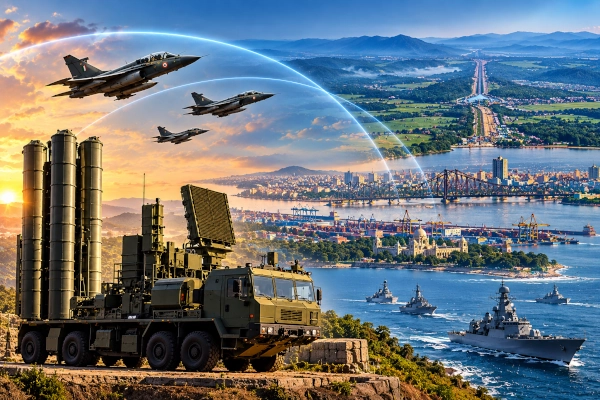
Eastern India is becoming increasingly important in India’s air-defence planning because of its strategic geography, major urban centres, transport corridors, military infrastructure and access to the Bay of Bengal. The region includes the vulnerable Siliguri Corridor, the Kolkata metropolitan area, important ports and industrial zones, and the main land routes connecting the rest of India with the Northeast.
This importance is growing at the same time that India is developing a new generation of indigenous long-range air-defence systems led by DRDO’s Project Kusha. Recent secondary reports have suggested that Kolkata could eventually host elements of the Kusha system around 2030–32, although no such deployment has been officially confirmed by the Ministry of Defence, DRDO or the Indian Air Force.
Eastern India Has a Distinct Strategic Geography
West Bengal occupies a particularly sensitive position in India’s eastern security architecture. It shares a long international border with Bangladesh, lies close to the Bay of Bengal and provides access towards the northeastern states through the Siliguri Corridor.
The Siliguri Corridor is a narrow stretch of territory connecting most of the Northeast with the rest of India. Roads, railways, communications and energy infrastructure passing through this region give it importance far beyond its physical size. Any disruption in this area could affect connectivity and logistics across a much wider part of the country.
The corridor has therefore received sustained attention in official security reviews. The Centre has focused on surveillance, border infrastructure, fencing and mobility in northern West Bengal, reinforcing the importance of the region to national connectivity and defence planning.
Kolkata Forms Part of a Wider Strategic Zone
Kolkata lies much farther south than the Siliguri Corridor, but its importance comes from a different combination of factors. It is one of eastern India’s principal economic and logistics centres and is connected with major ports, industrial zones, transport networks and military infrastructure.
The wider Kolkata–Haldia region is important for maritime trade and industrial activity, while West Bengal itself is becoming more relevant to India’s defence-industrial ecosystem. New shipbuilding and defence manufacturing initiatives in the state add another layer to its strategic importance.
For this reason, Kolkata is better understood as part of a broader eastern defence zone extending from the Bay of Bengal coast towards northern West Bengal and the Northeast, rather than simply as an isolated urban centre requiring protection.
Kusha Could Transform India’s Long-Range Air Defence
Project Kusha is one of India’s most ambitious indigenous air-defence programmes. DRDO conducted the maiden flight test of the Kusha long-range surface-to-air missile on July 23, 2026, successfully intercepting an electronic target representing a high-speed, high-altitude aerial threat.
The system is being developed to engage fighter aircraft, missiles, unmanned aerial vehicles and large airborne platforms. Its missiles, radars and command-and-control components are being developed domestically by DRDO laboratories and Indian industry.
Kusha is therefore expected to become an important part of India’s future layered air-defence network. Its development could reduce dependence on imported long-range systems while giving India greater control over production, maintenance, upgrades and future expansion.
Modern Air Defence Requires Multiple Layers
Modern air defence cannot rely on a single missile system or radar. Potential threats now include fighter aircraft, ballistic missiles, cruise missiles, drones, loitering munitions and precision-guided weapons, all of which operate at different ranges, altitudes and speeds.
India is consequently building a layered architecture that combines long-range interceptors, shorter-range surface-to-air missiles, ballistic-missile defence, airborne early-warning aircraft, ground-based radars, electronic warfare and directed-energy systems.
In eastern India, such a network would have to cover a large and geographically complex area extending from the Bay of Bengal coast through Kolkata and northern West Bengal towards the Northeast. Kusha would be only one component within that wider defensive structure.
The Siliguri Corridor Creates a Broader Defence Requirement
The strategic significance of eastern air defence is particularly clear around the Siliguri Corridor. The challenge is not merely to protect the narrow corridor itself, but also the transport hubs, air bases, communications infrastructure and logistics networks that support movement towards the Northeast.
Long-range air-defence systems integrated with airborne surveillance and ground-based sensors could help protect a much larger area than conventional point-defence systems. This makes the eastern theatre a natural candidate for deeper integration of surveillance and interception capabilities as India’s indigenous systems mature.
The geography of the region means that any future air-defence architecture would need to be designed around both territorial protection and the uninterrupted movement of military and civilian resources.
The Bay of Bengal Adds a Maritime Dimension
Eastern India’s air-defence requirements also extend towards the maritime domain. The Bay of Bengal has become more important because of naval expansion, commercial shipping, offshore infrastructure and India’s growing strategic engagement with Southeast Asia.
Potential aerial threats approaching from the sea would create different detection and warning requirements from those originating across a land frontier. Long-range radars, airborne early-warning aircraft and surface-to-air missile systems could therefore complement naval air-defence assets across the eastern seaboard.
Kolkata, Haldia and coastal Odisha all lie behind this maritime space, increasing the strategic value of stronger air-defence coverage across eastern India.
Bangladesh Adds a New Strategic Variable
Bangladesh’s changing external relationships have added another factor to the regional security environment. Dhaka has indicated that it could consider joining the Mecca Joint Defence Agreement involving Saudi Arabia, Türkiye and Pakistan, although no accession decision has been announced.
Such a development would be strategically relevant to India because Pakistan is a core member of the arrangement and because India–Bangladesh relations have recently experienced periods of political and diplomatic friction.
This does not mean that Bangladesh should automatically be treated as a military threat, nor is there evidence that India has decided to deploy Kusha in Kolkata specifically in response to Dhaka. The significance lies in the broader change in regional alignments that India will have to monitor as it plans future force posture and air-defence coverage.
Reports of a Kolkata Kusha Deployment Remain Unconfirmed
The claim that Kolkata could host Kusha appears to originate from specialised defence reporting rather than an official government announcement. Some reports have suggested a possible deployment around 2030–32 and linked it to the changing strategic environment around Bangladesh.
No corresponding confirmation has been issued by DRDO, the Ministry of Defence or the Indian Air Force. Operational locations for strategic air-defence systems are sensitive military matters, and until officially confirmed, Kolkata should be described only as a possible or reported future location.
The broader argument does not depend on this specific claim. Even without a confirmed Kolkata deployment, the strategic case for strengthening air defence across eastern India remains substantial.
Indigenous Systems Could Reduce Dependence on Imports
India currently relies on the Russian-origin S-400 for part of its very-long-range air-defence capability while developing indigenous systems to expand domestic capacity. Kusha could give India greater control over production, maintenance, upgrades and future force expansion.
This is important because India may eventually require multiple long-range air-defence formations across widely separated regions. Domestic production would make it easier to build and sustain a larger network than relying indefinitely on imported batteries and foreign supply chains.
The development of Kusha therefore has significance beyond one deployment location. It represents part of a broader effort to create a scalable indigenous air-defence architecture for multiple strategic theatres.
Eastern India Could Become a Major Air-Defence Theatre
The strongest case for strengthening air defence in eastern India does not depend on a single country or a single reported deployment. The region combines the Siliguri Corridor, major population centres, ports, military infrastructure, industrial zones, maritime approaches and the critical land connection to the Northeast.
At the same time, drones, cruise missiles and precision-guided weapons are expanding the area that modern air-defence networks must protect. This makes eastern India increasingly relevant to the development of a layered national air-defence structure.
Project Kusha could eventually become one of the major systems supporting that architecture. Its precise deployment locations remain undisclosed, but the broader direction is clear: as India develops indigenous long-range missiles, airborne surveillance, ballistic-missile defence and shorter-range interception systems, eastern India is likely to become an increasingly important part of the country’s defensive network.
References
Press Information Bureau, Ministry of Defence — DRDO Conducts Successful Maiden Flight-Test of Kusha Long-Range Surface-to-Air Missile
https://www.pib.gov.in/PressReleaseIframePage.aspx?PRID=2288526
Akashvani News — Home Minister Reviews Security of Siliguri Corridor and North Bengal
https://newsonair.gov.in/hm-shah-chairs-meeting-on-implementation-of-new-criminal-laws-at-uttar-kanya-in-siliguri/
Reuters — Bangladesh Could Consider Joining Mecca Pact
https://www.reuters.com/world/asia-pacific/bangladesh-could-consider-joining-mecca-pact-test-foreign-ties-2026-08-25/
Reuters — Türkiye, Pakistan and Saudi Arabia Defence Pact
https://www.reuters.com/world/asia-pacific/turkey-pakistan-saudi-arabia-defence-pact-technically-same-natos-article-5-2026-08-08/
ET Defence — Kolkata Emerges as Likely Hub for India’s Next Air Defence Shield
https://defence.economictimes.indiatimes.com/news/manufacturing/kolkata-emerges-as-likely-hub-for-indias-next-air-defence-shield/134464884
You may also like
-
India Expands Smart Anti-Airfield Weapon Family with Satellite and Electro-Optical Guidance
-
K30 Biho Returns to Discussion as Indian Army Looks for Mobile Counter-Drone Air Defence System
-
Astra Microwave Expands Counter-Drone Capabilities with Layered Detection and Neutralisation Systems
-
MDL Begins Development of Indigenous Lithium-Ion Battery System for Project-75(I) Submarines
-
Tarang Shakti Delegates from 28 Countries Visit HAL and BEL to Explore India’s Defence Manufacturing Ecosystem
