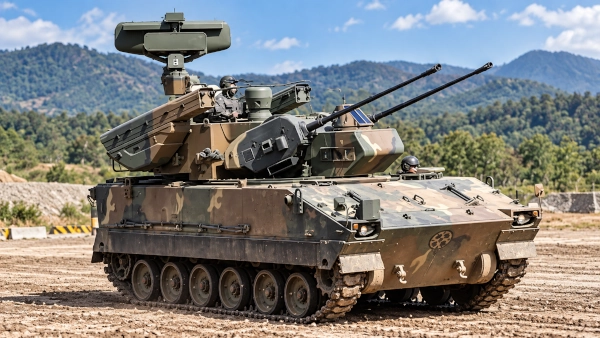
The Indian Army is looking to strengthen its short-range air defence capabilities as modern battlefields increasingly feature drones, loitering munitions and low-altitude aerial threats. Against this backdrop, South Korea’s K30 Biho Hybrid Air Defence System has reportedly returned to discussions as a possible solution for a mobile gun-missile air defence requirement.
The K30 Biho combines rapid-firing automatic cannons with short-range surface-to-air missiles, creating a layered engagement capability against aircraft, helicopters, unmanned aerial vehicles and other low-altitude threats. The system is designed to operate alongside mechanised formations and provide protection to mobile military units.
India’s interest in such systems comes from the growing importance of counter-unmanned aerial system (C-UAS) capabilities. Recent conflicts have demonstrated that relatively inexpensive drones can challenge traditional air defence networks, creating demand for systems that combine detection, tracking and rapid interception.
K30 Biho Was Earlier Evaluated Under Indian Army Air Defence Requirement
The K30 Biho is not a new entrant in India’s defence discussions. The system was earlier evaluated for the Indian Army’s requirement for a Self-Propelled Air Defence Gun Missile System (SPAD-GMS).
The South Korean platform competed against other international systems during the earlier evaluation process. The requirement was aimed at replacing ageing air defence platforms and providing mobile protection to armoured and mechanised formations.
Although the earlier process did not result in a final contract, the K30 Biho has continued to remain relevant because of its combination of mobility, radar-guided engagement capability and integrated gun-missile configuration.
Hybrid Gun-Missile Systems Gain Importance in Counter-Drone Warfare
The battlefield role of short-range air defence has changed significantly with the expansion of drone warfare. Traditional air defence systems designed primarily against aircraft must now detect and engage smaller, slower and more difficult-to-track targets.
A hybrid system such as the K30 Biho offers two layers of engagement. The 30 mm cannons can provide close-range defence against drones and low-flying targets, while missiles extend the engagement range against larger aerial threats.
For the Indian Army, such systems could complement existing air defence assets, including upgraded L-70 guns, indigenous missile systems and electronic warfare-based counter-drone solutions.
India–South Korea Defence Cooperation Continues to Expand
The K30 Biho discussions come within the broader framework of growing India–South Korea defence cooperation. The two countries have previously collaborated in defence manufacturing, including the localisation of South Korean K9 Vajra-T self-propelled howitzers in India through partnerships involving Indian industry.
South Korea has also emerged as an important defence technology partner for India, particularly in areas involving artillery, naval systems and advanced military platforms.
Future cooperation in air defence would align with India’s broader objective of expanding indigenous manufacturing and technology transfer opportunities under the Make in India framework.
Indigenous Air Defence Development Remains a Parallel Priority
While foreign systems continue to be evaluated for capability gaps, India is also developing indigenous air defence solutions through organisations such as the Defence Research and Development Organisation (DRDO) and Indian defence companies.
Projects involving missile systems, radars, electronic warfare and counter-drone technologies are being pursued to create a more integrated air defence network.
The Indian Army’s requirement for mobile short-range air defence reflects the changing nature of warfare, where protection against drones and low-altitude threats has become a critical operational necessity. The renewed attention on systems like the K30 Biho highlights the importance of combining mobility, rapid response and multi-layered interception capability in future battlefield environments.
References
- Defence Acquisition Council and Ministry of Defence procurement documents on Indian Army air defence requirements
- Hanwha Aerospace — K30 Biho Hybrid Air Defence System information
- Indian Army and DRDO publications on air defence and counter-drone capabilities
You may also like
-
India Moves Towards Five-Year Assured Orders for Defence Startups Under New Procurement Reforms
-
Zen Technologies Introduces Indigenous Hyper-Strike Falcon AI-Guided Counter-Drone Interceptor
-
L&T and Germany’s SCHOTTEL Expand Partnership for Controllable Pitch Propeller Systems in Indian Shipbuilding
-
India to Train 60,000 Civil Defence Volunteers Across 12 States and UTs with Indian Army Support
-
Indian Army’s Northern Command Opens 75-Day Defence Technology Internship Programme for Young Innovators
