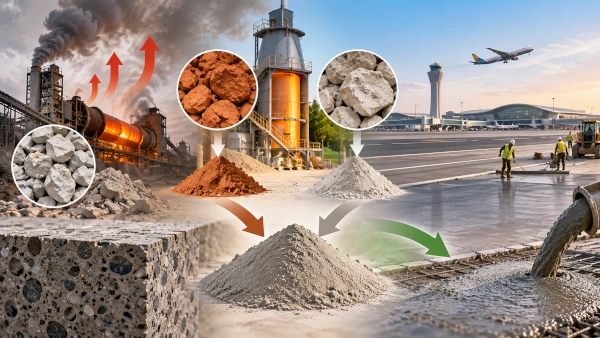
India’s next major change in construction may come from something far less visible than a new bridge, expressway or skyscraper. It could come from changing what goes inside the concrete.
Limestone Calcined Clay Cement, or LC3, is a low-clinker cement developed through international research in which IIT Delhi and IIT Madras played major roles. Instead of relying overwhelmingly on energy-intensive Portland clinker, LC3 combines clinker with calcined clay, limestone and gypsum. The result can deliver comparable structural performance while reducing the carbon footprint of cement by roughly 35–45% compared with Ordinary Portland Cement.
India gave the technology its own national standard in 2023. Commercial production followed, and LC3 has since moved into large infrastructure construction at Noida International Airport. What began as materials research is now entering the stage where it could influence how one of the world’s largest cement-consuming countries builds.
Why Ordinary Cement Produces So Much Carbon Dioxide
The problem LC3 addresses begins with clinker, the hard intermediate material that gives conventional Portland cement much of its binding capability.
To make clinker, cement plants heat limestone and other raw materials to around 1,400–1,500°C. Producing that heat requires considerable energy, traditionally from fossil fuels.
There is also a second source of emissions that cannot be eliminated simply by changing the fuel. Limestone is largely calcium carbonate. When it is heated during clinker manufacture, it decomposes into calcium oxide and releases carbon dioxide. This chemical reaction, known as calcination, is responsible for a substantial share of cement’s process emissions.
Ordinary Portland Cement typically contains around 90–95% clinker. NITI Aayog identifies lowering this clinker content as one of the most important routes for reducing the carbon intensity of Indian cement.
LC3 attacks both problems by requiring much less clinker.
How LC3 Replaces Nearly Half the Clinker
The commonly discussed LC3 formulation contains roughly 50% clinker, 30% calcined clay, 15% limestone and 5% gypsum. India’s BIS standard permits a broader range, with clinker generally accounting for 50–80%, calcined clay 10–35% and limestone 5–20%.
Clay does not require clinker temperatures. Suitable kaolinite-rich clay can be heated to approximately 800°C, transforming the kaolinite into a highly reactive material known as metakaolin.
The limestone portion requires even less processing because it can largely be ground rather than converted into clinker.
Replacing clinker therefore reduces both the fuel needed for high-temperature processing and the carbon dioxide released by limestone decomposition.
That is why the emissions benefit is much larger than simply improving the efficiency of an existing cement kiln.
The Chemistry That Makes Calcined Clay and Limestone Work Together
LC3 is more sophisticated than simply diluting cement with powdered clay and limestone.
When Portland clinker reacts with water, it produces compounds responsible for strength as well as calcium hydroxide. The reactive silica and alumina in calcined clay then react with this calcium hydroxide to form additional cementitious products.
A second reaction gives LC3 its distinctive chemistry. Alumina released from the calcined clay interacts with the carbonate supplied by finely ground limestone, producing additional stable hydration phases.
This combination helps fill pores within the hardened cement paste and creates a denser microstructure. The interaction between clinker, metakaolin and limestone allows a surprisingly large amount of clinker to be removed without losing the performance expected from structural cement.
The limestone is therefore not simply an inert filler, and the calcined clay is not merely a substitute added to reduce cost. Their chemistry works together.
India Created a Dedicated Standard for LC3
A major step towards commercial adoption came when the Bureau of Indian Standards introduced IS 18189:2023 for Portland Calcined Clay Limestone Cement.
The standard defines raw-material requirements, permitted proportions and manufacturing methods. Among its requirements, clay used for producing the calcined-clay component must contain at least 40% kaolinite.
LC3 can be manufactured by intergrinding clinker, calcined clay and limestone or by uniformly blending the required components with Portland cement and gypsum.
The existence of a BIS standard matters because large construction projects, engineers and government agencies generally depend on recognised standards when specifying structural materials. LC3 therefore moved beyond being an experimental cement formulation and entered India’s formal construction-material framework.
BIS subsequently processed its first licensing applications for cement manufactured under IS 18189, signalling the transition towards industrial production.
JK Cement Takes LC3 Into Commercial Production
The transition from laboratories and demonstration plants to commercial manufacturing accelerated in July 2025.
JK Cement informed the stock exchanges that it had begun commercial production and dispatch of LC3 at its Mangrol works in Chittorgarh district, Rajasthan. The company described itself as the first in India and the Indian subcontinent to begin commercial production under the new BIS standard.
Its formulation uses approximately 50% clinker, 30% calcined clay and 15% limestone, with the remainder including gypsum.
JK Cement says the product can reduce carbon dioxide emissions by up to 40% compared with conventional OPC. Its earlier research and development work on LC3 involved collaboration with IIT Delhi, while clay calcination trials were undertaken within its existing manufacturing network.
The significance is not simply that India now produces another variety of cement. Commercial manufacture demonstrates that LC3 can be integrated into an established cement company rather than requiring an entirely new industrial system.
Noida International Airport Becomes a Major Real-World Test
LC3 received an important infrastructure demonstration when Noida International Airport announced in September 2025 that it had become India’s first large-scale infrastructure project to incorporate LC3 into construction.
The airport described the material as capable of reducing carbon intensity by up to 40% compared with conventional Portland cement and highlighted the lower temperature required to calcine clay.
The project is especially relevant because airports require large quantities of concrete and operate under demanding engineering and durability requirements.
It is important, however, to distinguish the confirmed claim from broader descriptions circulating online. The airport’s official announcement confirms large-scale use of LC3 in the airport construction project. It does not establish that the entire runway itself was constructed using LC3.
The airport deployment nevertheless moves the material far beyond laboratory testing and small demonstration buildings.
LC3 Versus Ordinary Portland Cement
Ordinary Portland Cement remains important where rapid strength development or specialised high-strength applications are required.
NITI Aayog notes that LC3 can achieve strength comparable with OPC at conventional later-age measurements, but it can show lower early strength at one and three days. It may also require more water because of the characteristics of metakaolin.
Those differences matter for construction programmes requiring extremely fast formwork removal, rapid precast production or particular concrete specifications.
LC3 has other advantages. Its lower clinker content means lower heat generation, while the refined pore structure produced by its hydration chemistry can improve resistance to the penetration of aggressive substances. Commercial producers are consequently targeting structural applications including slabs, beams, foundations and structures exposed to moisture, chlorides and sulphates.
LC3 should therefore be viewed as another engineered cement system rather than a universally superior replacement for every OPC application.
LC3 Faces an Established Competitor: PPC
India already uses enormous quantities of low-clinker cement.
Portland Pozzolana Cement, or PPC, uses fly ash from coal-fired power plants to replace part of the clinker. Under the relevant BIS standard, fly ash can constitute approximately 15–35% of PPC.
PPC has become deeply established in Indian construction. NITI Aayog reports that PPC alone accounts for around 65% of Indian cement output, while PPC and Portland Slag Cement together represent about 72%. OPC accounts for roughly 27%.
LC3 is therefore not entering an industry dominated exclusively by high-clinker OPC. It must compete with a mature, widely available and familiar blended cement.
Its long-term advantage lies partly in where its raw materials come from.
Fly ash depends on coal-fired electricity generation, while blast-furnace slag depends on particular steelmaking processes. NITI Aayog expects growing constraints on these supplementary materials as India’s power and steel industries change. Demand for fly ash from cement could begin exceeding available supply in some scenarios during the 2030–2035 period, while availability is expected to decline further as coal power is phased down over the longer term.
Calcined clay does not depend on another carbon-intensive industry continuing to produce waste.
Not Every Clay Can Be Used
LC3 nevertheless has its own raw-material constraint.
The clay must contain enough kaolinite to become sufficiently reactive after calcination. India’s BIS standard specifies a minimum kaolinite content of 40% for the raw clay used in this cement.
That means cement manufacturers must identify suitable deposits, determine their mineral composition and consider transport distances before establishing production.
The situation is more favourable than it might initially appear. LC3 research has found that lower-grade kaolinitic clays unsuitable for high-value ceramic or paper applications can still be useful for cement production. In some Indian locations, suitable clay can occur as overburden or material already associated with quarrying.
The economic question therefore becomes highly regional. Plants close to suitable clay deposits have a considerable advantage.
Existing Cement Plants Can Be Adapted
LC3 does not require India to replace its cement industry with an entirely new manufacturing system.
The basic grinding, blending, storage and dispatch infrastructure already exists. The major additional requirement is the ability to calcine clay at the appropriate temperature and then incorporate it consistently with clinker and limestone.
NITI Aayog notes that some existing equipment, including older kiln systems, may be adaptable for clay calcination. The lower processing temperature also reduces thermal energy requirements compared with clinker production.
This compatibility with existing industrial infrastructure is one reason LC3 has attracted considerable interest. Cement producers can lower clinker intensity without abandoning decades of investment in existing plants.
Could LC3 Become Mainstream in India?
LC3 does not need to replace every bag of OPC or PPC to have a major impact.
India produced more than 400 million tonnes of cement annually by 2023–24, and infrastructure, housing and industrial construction continue to drive demand. Even a substantial partial shift towards lower-clinker formulations would affect national limestone consumption, kiln energy demand and cement-sector emissions.
NITI Aayog already includes LC3 among the technologies capable of lowering India’s clinker-to-cement ratio over the coming decades. Its assessment places LC3 alongside other blended cements as part of the pathway towards a less carbon-intensive cement industry.
The immediate challenge is scale. Producers need reliable clay resources, calcination capacity, quality control and regional distribution. Engineers, contractors and project specifications also need to become as familiar with IS 18189 cement as they already are with OPC and PPC.
Commercial production, BIS standardisation and use at Noida International Airport show that this transition has already begun.
A New Material for India’s Next Construction Cycle
LC3 is not cement without clinker, nor does it eliminate the environmental impact of construction. Its importance lies in achieving a large reduction in clinker without requiring the industry to abandon Portland-cement chemistry, existing manufacturing infrastructure or familiar concrete practices.
That makes the technology particularly relevant to India.
The country already has a sophisticated blended-cement industry, substantial limestone resources, suitable clay deposits and enormous future demand for infrastructure. It also has domestic scientific expertise that helped move LC3 from research into practical construction.
From laboratories at IIT Delhi and IIT Madras to a BIS standard, commercial production at Mangrol and large-scale deployment at Noida International Airport, LC3 has crossed the critical boundary between promising material and industrial product.
India will continue using several types of cement because different structures require different properties. LC3 adds an important new option: a cement capable of substantially reducing clinker consumption while preserving the strength and durability required for modern construction. As production expands, it gives India a practical route to build more infrastructure with considerably less carbon embedded in every tonne of cement.
References
- Bureau of Indian Standards — IS 18189:2023, Portland Calcined Clay Limestone Cement Specification
https://www.bis.gov.in/wp-content/uploads/2025/05/COMPENDIUM-OF-CEMENT-STANDARDS.pdf - NITI Aayog — Roadmap for Cement Sector Decarbonisation, 2026
https://www.niti.gov.in/sites/default/files/2026-01/Roadmap_for_Cement_Sector_Decarbonaisation.pdf - NITI Aayog — Scenarios Towards Viksit Bharat and Net Zero: Sectoral Insights — Industry, 2026
https://niti.gov.in/sites/default/files/2026-02/Scenarios-Towards-Viksit-Bharat-and-Net-Zero-Sectoral-Insights-Industry.pdf - Noida International Airport — 26 September 2025: Noida International Airport Becomes First Large-Scale Project to Build with Limestone Calcined Clay Cement
https://www.niairport.in/en/company/news/2025/2025-09-26 - JK Cement — 30 July 2025: Intimation About Launch of LC-3 Cement and Commencement of Commercial Production at Mangrol
https://www.jkcement.com/wp-content/uploads/2025/07/LC_3cement30725_final.pdf - JK Cement — JK Super LC-3 Cement
https://www.jkcement.com/grey-cement/jk-super-lc3-cement/ - JK Cement — Integrated Annual Report 2024–25
https://www.jkcement.com/wp-content/uploads/2025/06/JK-Cement-AR-2024-2025.pdf - LC3 Project — The Material: Limestone Calcined Clay Cement
https://lc3.ch/the-material/ - LC3 Project — Why LC3?
https://lc3.ch/why-lc3/
You may also like
-
ICAR Scientists Develop Indigenous Protective Gloves for Cotton Farmers, Sign Commercial Manufacturing Agreement
-
BHEL–Coal India Joint Venture Begins Construction of ₹25,016 Crore Indigenous Coal Gasification Project in Odisha
-
PM Modi to Inaugurate RBI’s Tier IV Data Centre and Cybersecurity Training Institute in Bhubaneswar
-
India Creates 11 Crore Digital Farmer IDs Five Months Ahead of Target, Strengthening AgriStack Infrastructure
-
Chak-Hao Black Rice of Manipur and Nagaland: The Aromatic Purple Heritage Grain with GI Recognition
