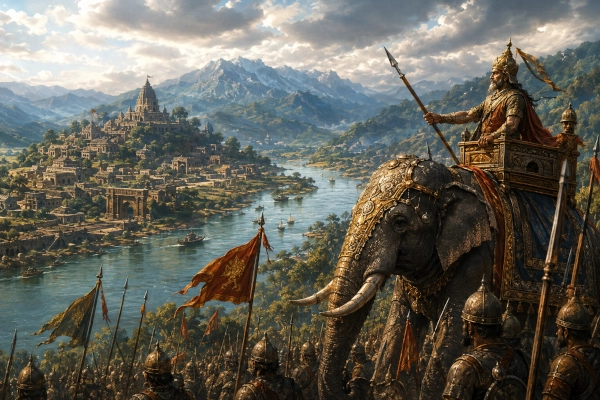
Mahabharatha Georgaphy:Pragjyotisha
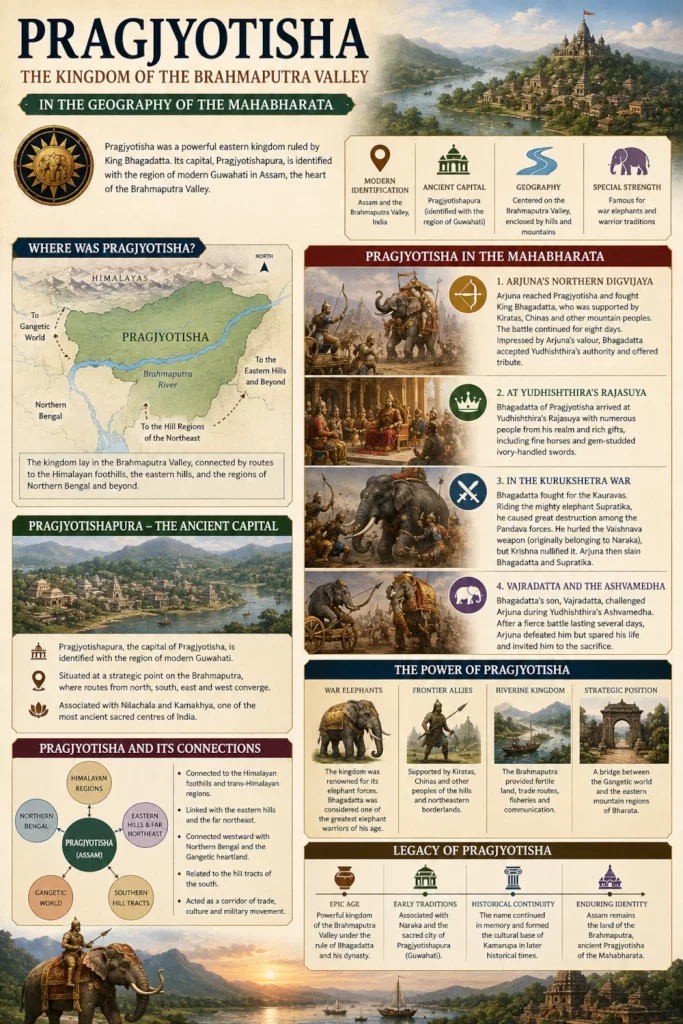
Modern Identification: Assam and the Brahmaputra Valley, India
Pragjyotisha in the Geography of the Mahabharata
Pragjyotisha was one of the great eastern and northeastern kingdoms of the geographical world described in the Mahabharata. Its strongest association is with the Brahmaputra Valley of present-day Assam, while its principal city, Pragjyotishapura, has traditionally been located in or around the region of modern Guwahati. The Government of Assam itself preserves this identification, describing ancient Guwahati as Pragjyotishpur, while the Indira Gandhi National Centre for the Arts identifies ancient Assam with Pragjyotisha and Kamarupa and places Pragjyotishapura in or near Guwahati.
In the epic, Pragjyotisha is not presented as an insignificant frontier territory. It is a powerful kingdom ruled by Bhagadatta, an elderly but formidable warrior whose reputation extended across Bharata. He commanded strong elephant forces, was associated with peoples of the mountains and northeastern borderlands, fought Arjuna during the preparations for Yudhishthira’s Rajasuya, attended the imperial sacrifice with valuable tribute, and later became one of the most dangerous commanders fighting for the Kauravas at Kurukshetra.
The prominence given to Bhagadatta makes Pragjyotisha one of the clearest northeastern geographical anchors in the Mahabharata.
The Land of the Brahmaputra
The geographical heart of Pragjyotisha can be sought in the Brahmaputra Valley, the enormous alluvial corridor running across Assam between the Himalayan foothills in the north and the hill systems to the south. The Government of Assam describes the Brahmaputra Valley as the eastern continuation of the Indo-Gangetic plain and notes that it forms the dominant physiographic region of the state.
This landscape is fundamentally shaped by the Brahmaputra and its many tributaries. Broad floodplains, river islands, wetlands, forests and surrounding hills created an environment very different from the drier plains of the upper Ganga-Yamuna region. Communication naturally followed the great river and the corridors formed between the valley and the surrounding mountains.
Pragjyotisha therefore occupied an exceptional position. To its west lay the routes leading towards northern Bengal and the Gangetic world. To the north rose the Himalayan and trans-Himalayan regions. To the east stretched the upper Brahmaputra Valley and the approaches towards the mountains of the far northeast, while to the south lay the hill systems connecting the valley with other parts of northeastern India.
The kingdom was consequently both a riverine power and a frontier kingdom.
Pragjyotishapura and Modern Guwahati
The name Pragjyotishapura, meaning the city or capital of Pragjyotisha, has long been associated with modern Guwahati.
The Kamrup Metropolitan district administration states that Guwahati was once known as Pragjyotishpur and notes the city’s repeated appearance in the Sanskrit epic and mythological traditions. IGNCA similarly describes the capital of ancient Pragjyotisha as Pragjyotishpura situated in or near Guwahati.
The identification is geographically convincing. Guwahati occupies one of the most strategically important stretches of the Brahmaputra, where hills approach the river closely and where routes from the north, south, east and west converge.
Control of this region provided access to movement along the Brahmaputra while also allowing command of passages towards the Khasi-Jaintia uplands, the lower Assam plains and the eastern valley.
Ancient traditions surrounding Nilachala and Kamakhya, together with the wider sacred landscape of Guwahati, further demonstrate the extraordinary antiquity with which the region was remembered. These later religious traditions should not automatically be projected unchanged into the historical setting of the Mahabharata, but they reinforce the longstanding importance of the Guwahati area within the cultural geography of ancient Assam.
Bhagadatta — The Great King of Pragjyotisha
The personality who dominates the epic’s description of Pragjyotisha is King Bhagadatta.
Bhagadatta is consistently portrayed as an elderly ruler of enormous military reputation. He was especially renowned for elephant warfare and is repeatedly compared with Indra because of his skill while fighting from the back of a war elephant.
His importance becomes clear during the preparations for Yudhishthira’s Rajasuya. Arjuna was assigned the northern direction during the Pandava digvijaya and eventually reached the kingdom of Pragjyotisha.
The Sabha Parva describes Bhagadatta as supported by Kiratas, Chinas and other warriors when Arjuna attacked his kingdom. Rather than immediately submitting, Bhagadatta met the Pandava in an extraordinarily prolonged engagement.
The battle lasted for eight days.
This detail alone distinguishes Pragjyotisha from many of the kingdoms encountered during the Pandava campaigns. Arjuna conquered numerous rulers, but the epic devotes special attention to the resistance offered by Bhagadatta.
Arjuna’s Eight-Day Battle at Pragjyotisha
Arjuna’s approach to Pragjyotisha produced one of the most memorable episodes of his northern conquest.
Bhagadatta came out to confront him with forces drawn from his own kingdom and allied peoples of the northeastern frontier. The resulting battle continued for eight days, with neither side willing to abandon the contest.
Eventually Bhagadatta recognised Arjuna’s extraordinary prowess. The confrontation then assumed an unusually respectful character.
Bhagadatta acknowledged the Pandava’s strength and asked what Arjuna required of him. Arjuna explained that he was campaigning to secure recognition of Yudhishthira’s imperial authority before the Rajasuya and requested tribute rather than the destruction of Pragjyotisha.
Bhagadatta agreed.
The episode therefore ends not with the annihilation of the kingdom but with its ruler accepting Yudhishthira’s supremacy for the purposes of the Rajasuya.
The narrative also reflects Bhagadatta’s status. Arjuna does not treat him as an ordinary defeated ruler. Their conversation is marked by mutual respect, and the king is portrayed as belonging to an older generation of renowned warriors.
Pragjyotisha at Yudhishthira’s Rajasuya
Bhagadatta subsequently appears at Yudhishthira’s Rajasuya sacrifice, demonstrating that his agreement with Arjuna was honoured.
The Sabha Parva specifically names Bhagadatta of Pragjyotisha among the great kings who arrived at Yudhishthira’s court. He is described as accompanied by numerous peoples associated with his realm and the surrounding regions.
Another Rajasuya passage records Bhagadatta arriving with valuable tribute that included exceptionally fine horses and richly decorated swords with ivory handles ornamented with gems.
The episode demonstrates the economic and political connections of Pragjyotisha with the larger subcontinent. Although situated far to the northeast of Indraprastha, its ruler participated fully in the diplomatic system represented by the Rajasuya.
Pragjyotisha was geographically distant, but it was not politically isolated.
A Kingdom Connected with the Mountain Peoples
The forces associated with Bhagadatta provide important clues to the geographical character of Pragjyotisha.
During Arjuna’s campaign, the king is described as supported by Kiratas and Chinas, together with other warriors. The terminology of the epic cannot simply be equated with modern ethnic or national boundaries, but the grouping clearly places Bhagadatta within a northeastern world connected with Himalayan, trans-Himalayan and forested hill populations.
The Brahmaputra Valley naturally formed the centre of such a network.
From the valley, routes led towards the Himalayan foothills and Bhutan in the north, Arunachal and the upper Brahmaputra regions in the east, the Patkai and Naga hills farther southeast, and the Meghalaya plateau to the south.
Pragjyotisha could therefore draw strength not merely from an agricultural river valley but from relationships with populations occupying the surrounding mountain belts.
The Mahabharata repeatedly describes Bhagadatta as the ruler of mountainous regions or as being accompanied by hill kings. During the Kurukshetra war, he appears surrounded by warriors of the mountain countries.
This portrayal fits remarkably well with the geography of Assam, where the great Brahmaputra plain is enclosed by mountain and hill systems on almost every side.
Elephants and the Military Power of Pragjyotisha
More than any other characteristic, the military identity of Pragjyotisha in the Mahabharata is associated with war elephants.
Bhagadatta was regarded as one of the greatest elephant warriors of his age. His famous elephant Supratika became almost as celebrated as the king himself.
This association is geographically appropriate. Northeastern India has historically been one of the major habitats of the Asian elephant, and the forests surrounding the Brahmaputra Valley provided an environment in which elephants could become important both economically and militarily.
The Mahabharata makes Bhagadatta’s mastery of elephant warfare central to his battlefield identity.
Arjuna himself describes Bhagadatta as exceptionally skilled in fighting from an elephant and considers him perhaps the foremost elephant warrior in the world. Supratika is similarly described as an extraordinary animal capable of breaking battle formations and resisting enormous punishment.
Pragjyotisha therefore appears not simply as a distant kingdom possessing elephants, but as a realm in which elephant warfare had developed into a specialised military tradition.
Bhagadatta Chooses the Kaurava Side
Despite his earlier submission to Yudhishthira during the Rajasuya campaign, Bhagadatta later fought for Duryodhana and the Kauravas during the Kurukshetra war.
Such shifts were not unusual within the political world of the epic. Participation in the Rajasuya acknowledged Yudhishthira’s imperial position at one moment, but it did not permanently bind every ruler to the Pandavas in the later dynastic struggle.
Bhagadatta arrived at Kurukshetra as one of the Kaurava coalition’s most formidable commanders.
His presence gave Duryodhana a weapon particularly suited for breaking infantry and chariot formations: a veteran elephant warrior commanding the enormous Supratika.
The scale of the danger becomes apparent when Bhagadatta enters full combat against the Pandava army.
Supratika’s Assault on the Pandava Army
Mounted on Supratika, Bhagadatta created devastation among the Pandava forces.
At one stage the great elephant charged directly against Bhima, crushing his chariot. Rather than flee, Bhima moved underneath the enormous animal and used his knowledge of elephant fighting to avoid being killed. Supratika attempted to seize and crush him, while Bhima repeatedly manoeuvred beneath the animal before escaping.
For a time, the Pandava army believed that Bhima had been killed.
Yudhishthira and other warriors surrounded Bhagadatta, but Supratika continued breaking through their formations. The elephant threw aside chariots and terrified horses, while Bhagadatta struck at the surrounding warriors from its back.
The epic’s description conveys the psychological impact that a highly trained war elephant could have on an army. Chariots that dominated open warfare could become vulnerable when horses panicked before an elephant, while infantry could be scattered or trampled.
Bhagadatta and Supratika together effectively functioned as a mobile shock force.
Arjuna Turns Against Bhagadatta
The situation became serious enough that Arjuna recognised that Bhagadatta had to be stopped personally.
Hearing the noise of the Pandava formation breaking under Supratika’s attack, Arjuna told Krishna that the ruler of Pragjyotisha was clearly responsible. He praised Bhagadatta’s mastery of elephant warfare and declared that few warriors could hope to stop him.
The encounter brought the two warriors together again under very different circumstances.
During the earlier digvijaya, their eight-day battle had ended with respect and tribute. At Kurukshetra there could be no comparable settlement.
Bhagadatta attacked Krishna and Arjuna from Supratika while Arjuna gradually stripped away the elephant’s armour and neutralised the king’s weapons.
Then the battle reached its most famous moment.
The Vaishnava Weapon
Bhagadatta possessed a formidable divine weapon connected in the epic narrative with Naraka, another figure closely associated with Pragjyotisha in later traditions.
During the battle, Bhagadatta transformed his elephant goad through mantra into the Vaishnava weapon and hurled it towards Arjuna.
Krishna intervened.
Instead of allowing the weapon to strike Arjuna, Krishna received it upon himself, where the terrible missile became harmless. Krishna then explained the older history of the weapon and told Arjuna that Bhagadatta had now been deprived of his most dangerous defence.
The episode is one of several moments during the Kurukshetra war in which Krishna’s role as Arjuna’s charioteer becomes inseparable from his divine identity.
For Pragjyotisha, it also connects Bhagadatta with an older legendary tradition involving Naraka and the sacred mythology of the eastern kingdom.
The Death of Bhagadatta and Supratika
Once the Vaishnava weapon had been neutralised, Arjuna resumed his attack.
He struck Supratika with a powerful arrow that penetrated deeply into the elephant. Despite Bhagadatta’s attempts to urge it forward, the wounded animal eventually collapsed.
Arjuna then fired a crescent-headed arrow that pierced Bhagadatta’s chest.
The old king fell from his elephant and died on the battlefield.
The epic gives Bhagadatta a death appropriate to his reputation. He does not disappear anonymously within the enormous casualty lists of Kurukshetra. His final battle receives extended treatment precisely because he was regarded as one of the strongest warriors in the Kaurava host.
His death also closes the personal relationship between Arjuna and the elderly ruler who had once fought him for eight days before accepting Yudhishthira’s supremacy.
Yet it does not end the story of Pragjyotisha.
Vajradatta — The Kingdom After Bhagadatta
Pragjyotisha reappears after the Kurukshetra war through Vajradatta, the son of Bhagadatta.
When Yudhishthira later performed the Ashvamedha, the sacrificial horse entered the realm of Pragjyotisha. Vajradatta came out to challenge Arjuna, who was accompanying the horse.
The confrontation had an unmistakably personal dimension.
Vajradatta remembered that Arjuna had killed his father at Kurukshetra and sought battle with him. Like Bhagadatta, he fought from the back of a powerful elephant.
The battle between Arjuna and Vajradatta continued for several days. Eventually Arjuna defeated him and brought down his elephant, but he deliberately spared the young king because Yudhishthira had ordered him not to kill rulers encountered during the Ashvamedha campaign.
Arjuna instead invited Vajradatta to attend Yudhishthira’s sacrifice.
Vajradatta accepted.
This episode is especially valuable for understanding Pragjyotisha as a political entity. The kingdom does not vanish with Bhagadatta. His son succeeds him, possesses a capital and army, continues the family’s elephant-warrior tradition and remains powerful enough to confront Arjuna.
The Mahabharata therefore presents Pragjyotisha as an enduring royal house rather than merely the personal domain of a single famous warrior.
Pragjyotisha and the Tradition of Naraka
Later traditions strongly associate Pragjyotisha with Narakasura or Naraka, whose capital is often placed at Pragjyotishapura.
The connection is not entirely absent from the Mahabharata. During Bhagadatta’s final battle, Krishna explains that the Vaishnava weapon had previously belonged to Naraka before coming into the possession of the ruler of Pragjyotisha.
Later Purāṇic and regional traditions developed the Naraka-Pragjyotisha association much more extensively, making Naraka one of the foundational rulers connected with the ancient kingdom.
It is important, however, to distinguish between layers of tradition. Bhagadatta is the overwhelmingly dominant ruler of Pragjyotisha in the central political narrative of the Mahabharata, while the elaborate legends surrounding Naraka and Pragjyotishapura belong to a wider body of epic and Purāṇic literature.
Together, these traditions contributed to the enduring identification of the Guwahati-Assam region with ancient Pragjyotisha.
Pragjyotisha and Kamarupa
The names Pragjyotisha and Kamarupa became closely associated in the historical and literary traditions of Assam.
Government and cultural sources describe ancient Assam as known through these two names, with Pragjyotisha particularly prominent in epic tradition and Kamarupa becoming the better documented political name in subsequent historical periods.
The relationship should not be interpreted too mechanically. Ancient territories did not possess immutable boundaries, and a name occurring in an epic cannot automatically be assumed to describe precisely the same political borders as a kingdom documented many centuries later.
Nevertheless, there is a clear continuity of geographical memory.
Both names became associated with the Brahmaputra Valley and with the Guwahati-Kamakhya region. The later kingdom of Kamarupa would become one of the great historical powers of northeastern India, extending at various times well beyond the boundaries of modern Assam.
Pragjyotisha can therefore be understood as the important epic predecessor within the geographical tradition from which historical Kamarupa later emerged.
The Strategic Importance of the Brahmaputra Corridor
The power of Pragjyotisha becomes easier to understand when viewed through the geography of the Brahmaputra.
The river is not simply a body of water crossing Assam. It creates an enormous east-west corridor through terrain otherwise dominated by hills and mountains.
Settlements controlling major points along this corridor could influence movement of people, animals, agricultural goods and armies.
At the same time, the valley connected the Gangetic world with regions farther east and north. Routes through northern Bengal provided access towards the middle Ganga basin, while mountain passages linked Assam with Himalayan and trans-Himalayan regions.
This helps explain the diverse peoples associated with Bhagadatta in the epic.
Pragjyotisha lay at a meeting point between the plains civilisation of northern India and the complex cultural world of the northeastern hills.
A Landscape of Rivers, Forests and Elephants
The natural environment also helps explain the character given to Pragjyotisha by the Mahabharata.
The Brahmaputra floodplain supported fertile agricultural land, while the hills and forest belts surrounding it contained immense natural resources. Rivers provided movement and fisheries, forests supplied timber and elephants, and the mountains connected the valley with communities occupying very different ecological zones.
Bhagadatta’s elephant forces fit naturally into this setting.
Unlike kingdoms remembered primarily for cavalry or chariot warfare, Pragjyotisha’s most famous military figure fights from an elephant of extraordinary size and power. Even Bhagadatta’s son Vajradatta repeats the pattern during the Ashvamedha.
The repeated association across generations suggests that elephant warfare formed a distinctive part of how the epic remembered the kingdom.
An Eastern Kingdom Fully Connected with Bharata
Pragjyotisha was geographically distant from Hastinapura and Indraprastha, yet the Mahabharata repeatedly demonstrates that distance did not mean isolation.
Arjuna travels to Pragjyotisha during his digvijaya. Bhagadatta attends the Rajasuya. The king joins the Kaurava alliance at Kurukshetra. After his death, Vajradatta confronts Arjuna during Yudhishthira’s Ashvamedha and is eventually incorporated into the new post-war political order.
These episodes connect the Brahmaputra Valley directly with the principal political events of the epic.
The kingdom’s rulers possessed relationships with other monarchs, participated in imperial sacrifices, travelled across the subcontinent and fought in the central war of the Kuru dynasty.
The northeastern frontier was therefore an integral component of the geographical imagination of the Mahabharata.
Pragjyotisha in the Mahabharata Landscape
Pragjyotisha can be identified most convincingly with Assam and the Brahmaputra Valley, with Pragjyotishapura situated in or around present-day Guwahati. The precise boundaries of the epic kingdom cannot be reconstructed as modern political borders, and they may have extended beyond present-day Assam at different stages of the tradition. The geographical core, however, lies firmly in the Brahmaputra region.
Few kingdoms in the epic possess such a distinctive identity.
Pragjyotisha is the kingdom where Arjuna fights Bhagadatta for eight days before the Rajasuya. It sends rich tribute to Yudhishthira. Its elderly king becomes one of the greatest elephant warriors at Kurukshetra, riding the formidable Supratika and nearly breaking the Pandava army before being killed by Arjuna. After the war, Bhagadatta’s son Vajradatta again defends the kingdom against the same Pandava during the Ashvamedha.
Through these episodes, the Mahabharata preserves a vivid memory of a powerful northeastern realm—a kingdom of the Brahmaputra, surrounded by mountains, allied with frontier peoples and renowned across Bharata for its elephants and warriors.
Pragjyotisha thus represents one of the great eastern limits of the epic’s political world: the ancient kingdom of the Brahmaputra Valley where the plains of Assam met the mountains of India’s northeast.
You may also like
-
Yavana in the Mahabharata: Greek Connections, Pandava Campaigns and the Warriors of Kurukshetra
-
India and Sri Lanka Launch SAMHiTA Manuscript Digitisation Project to Preserve Ancient Buddhist Heritage
-
ASI Uses Ground-Penetrating Radar to Investigate Ancient Buddhist Stupa at Ujjain After Nearly 90 Years
-
Pahlava: The Parthian World Beyond India’s Northwestern Frontiers in the Mahabharata
-
Namami Gange in 2026: 368 Projects Completed, 4,339 MLD Sewage Treatment Capacity Created as Ganga Rejuvenation Advances
