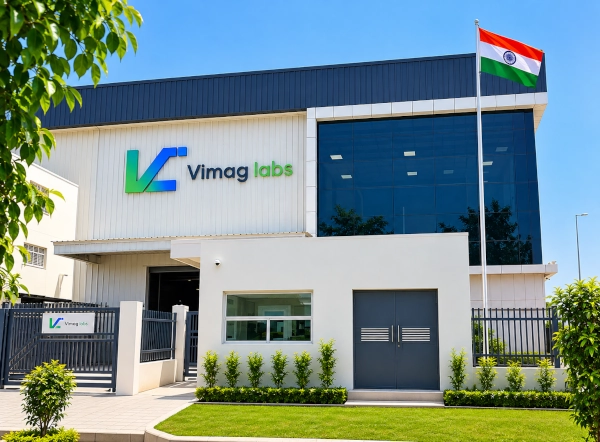
Bengaluru-based deep-technology company Vimag Labs has commenced manufacturing operations at its first production facility in Met City, Jhajjar, Haryana, marking an important step in India’s development of advanced electric motor and propulsion technologies. The company has outlined a phased investment plan of approximately ₹50 crore to expand manufacturing capacity, develop its domestic supply chain and support customers in India and international markets.
Announced on October 13, 2026, the new facility manufactures and assembles electric motors, control systems and related propulsion technologies, including Vimag Labs’ proprietary magnet-free electric motor platform. The company reports that it has already completed and exported its first production batch from Jhajjar, marking its transition from technology development and validation towards commercial manufacturing.
Vimag Labs aims to develop an India-based manufacturing network capable of scaling production to 10,000 motor and control systems per month, depending on customer demand and programme requirements. The expansion is also expected to generate approximately 100–150 direct and indirect employment opportunities across engineering, manufacturing, testing, quality assurance and supply-chain operations.
Jhajjar Manufacturing Facility Marks Transition from Research to Commercial Production
Vimag Labs’ first dedicated manufacturing facility is located at Met City in Jhajjar, Haryana. The operational site currently occupies approximately 10,000 square feet, with provision for expansion to around 20,000 square feet as manufacturing requirements increase.
The facility represents a transition in the company’s development, moving its proprietary electric motor technology from research, engineering validation and prototype development towards industrial production. Its initial operations focus on mid-power electric motors, associated control systems and propulsion technologies intended for commercial applications.
According to the company, the manufacturing infrastructure includes clean-room areas, automated production equipment, digitally connected manufacturing systems and facilities for product testing and process validation. These arrangements are intended to support repeatable production processes and maintain quality as manufacturing volumes increase.
The commencement of operations is particularly significant because developing an advanced electric motor technology requires more than proving its performance in laboratory conditions. Commercial production also demands consistency in component manufacturing, assembly, testing and quality control across successive production batches.
Vimag Labs has confirmed that its first production batch has already been exported. While the company has not disclosed the destination, customer or quantity involved, the development marks an initial step towards supplying internationally manufactured products from its Indian facility.
₹50 Crore Phased Investment Planned for Manufacturing Expansion
Vimag Labs has outlined an investment plan of approximately ₹50 crore to support its manufacturing expansion in India. Rather than committing the entire amount immediately, the company intends to deploy capital progressively according to customer demand, production requirements and the development of commercial programmes.
The proposed investment will support manufacturing capacity, production infrastructure, testing capabilities and the expansion of the company’s industrial network. Vimag Labs is also evaluating additional manufacturing locations and partnerships as part of its longer-term strategy.
The phased approach is designed to align capital expenditure with actual business requirements. As customer programmes move towards higher production volumes, the company plans to expand its manufacturing capabilities and strengthen relationships with component manufacturers, tooling specialists and industrialisation partners.
The ₹50 crore figure represents the company’s current investment plan rather than expenditure already completed. Vimag Labs has indicated that the eventual scale and timing of investment will evolve according to market traction and expansion opportunities.
By linking capacity expansion to commercial demand, the company intends to establish a sustainable manufacturing base capable of supporting domestic and international customers without committing resources ahead of confirmed production requirements.
Magnet-Free Electric Motor Technology Reduces Dependence on Rare-Earth Permanent Magnets
At the centre of Vimag Labs’ manufacturing programme is its proprietary Virtual Magnet Synchronous Motor (VMSM) technology, an electric motor architecture designed to operate without rare-earth permanent magnets.
Conventional permanent magnet synchronous motors commonly use powerful magnets embedded in the rotor to generate the magnetic field required for operation. High-performance versions often rely on rare-earth materials such as neodymium and dysprosium, which are important components of many electric vehicle propulsion systems.
Vimag Labs has developed an alternative approach that replaces the permanent magnetic field with a controlled magnetic field generated through its motor architecture, power electronics and proprietary software.
The company’s technology integrates electronic control with motor design to regulate magnetic fields during operation. Vimag describes this as a software-defined approach to electric motor technology, allowing the magnetic field to be controlled dynamically instead of relying on fixed permanent magnets.
This architecture is intended to provide performance comparable to permanent magnet motor systems across selected applications while removing the requirement for rare-earth permanent magnets.
Eliminating permanent magnets from a motor design can reduce dependence on materials associated with concentrated global supply chains. However, the overall commercial advantages of alternative motor technologies depend on factors such as efficiency, power density, manufacturing cost, reliability and performance under actual operating conditions.
Vimag Labs states that its patented VMSM platform targets applications in electric mobility, industrial equipment, robotics and defence-related systems. Detailed, independently verified performance comparisons across these applications were not included in the October 13 announcement.
Software-Defined Magnetic Fields Introduce a Different Approach to Motor Design
The technological distinction of Vimag Labs’ motor platform lies in its method of creating and controlling magnetic fields.
Electric motors convert electrical energy into mechanical motion through interactions between magnetic fields. In permanent magnet synchronous motors, the rotor contains magnets that produce a fixed magnetic field, while electronically controlled currents in the stator generate a rotating magnetic field.
Vimag’s VMSM architecture replaces the permanent magnets with a system that generates and controls the required magnetic field electronically. The company’s approach combines motor architecture, power electronics and software-based control into an integrated system.
This design allows the motor’s operating characteristics to be managed through electronic controls. The company is developing the platform for applications with different power, torque and operating requirements.
The ability to modify magnetic field behaviour through control systems represents an important engineering approach, particularly as electric propulsion technologies increasingly depend on the integration of software and power electronics.
imag Labs’ transition to manufacturing will provide opportunities to evaluate the commercial suitability of its technology as customer programmes progress from testing into regular production.
Manufacturing Capacity Targeted at 10,000 Systems Per Month
Vimag Labs is developing its manufacturing network with the objective of eventually producing up to 10,000 motor and control systems per month.
This figure represents the intended scalable capacity of its broader manufacturing network rather than the current production output of the Jhajjar facility.
The initial manufacturing phase will concentrate on mid-power applications, including motor and control systems intended for electric mobility and other electrified equipment. These products will form the foundation of the company’s early commercial manufacturing programmes.
As customer demand increases, Vimag plans to add production capacity across facilities and manufacturing partners. The expansion will involve additional investment in equipment, testing infrastructure, supply-chain development and production processes.
The company has indicated that capacity additions will depend on the requirements of individual customer programmes and the mix of products being manufactured.
This approach recognises that different motor systems may require specialised components, testing procedures and assembly arrangements. Establishing the capacity to manufacture large quantities of products therefore involves both physical infrastructure and a reliable network of suppliers capable of meeting technical specifications.
The planned manufacturing expansion reflects Vimag Labs’ ambition to develop an Indian production base serving multiple electric propulsion applications.
High-Power Motors of 570 kW and Above Planned for Future Production
Although Vimag Labs is initially focusing on mid-power motor systems, the company intends to expand into high-power applications as its commercial programmes mature.
The future manufacturing roadmap includes electric motor and control systems rated at 570 kilowatts and above. Such power levels are relevant to demanding industrial and propulsion applications that require substantial electrical and mechanical output.
High-power electric motors present additional engineering challenges involving electrical insulation, thermal management, component durability, power electronics and control-system integration.
Manufacturing these systems at commercial scale also requires suitable testing facilities and production infrastructure capable of handling higher electrical loads and operating stresses.
Vimag Labs has stated that expansion into this segment will depend on customer requirements and the progress of existing programmes. The company expects to develop additional manufacturing and testing capabilities as demand for higher-power systems increases.
The announcement does not establish a commercial production date for the 570 kW systems. They remain part of the company’s planned manufacturing expansion rather than its confirmed current production portfolio.
Industry 4.0 Manufacturing Systems Support Quality and Traceability
The Jhajjar facility incorporates digitally connected production equipment and technologies associated with Industry 4.0 manufacturing.
According to Vimag Labs, the manufacturing setup includes Internet of Things-enabled monitoring, automated production systems and digital traceability arrangements intended to support quality-controlled manufacturing.
Industrial IoT systems allow connected equipment to collect and communicate operational information during production. Depending on their configuration, these systems can support process monitoring, equipment maintenance and the identification of manufacturing deviations.
Digital traceability can help manufacturers maintain records of components, assembly processes and testing results. Such records become particularly important when supplying products to customers requiring consistent quality and compliance with technical specifications.
For electric motors and propulsion systems, manufacturing consistency is essential because variations in assembly, electrical characteristics or mechanical tolerances can influence product performance.
Vimag Labs intends to combine its proprietary motor technology with automated manufacturing methods to establish production processes capable of scaling as demand increases.
Vimag Labs Raises $5 Million in Series A Funding Led by Accel
The commencement of manufacturing follows Vimag Labs’ announcement of a $5 million Series A funding round led by Accel, with participation from Chakra Growth Fund and Thinkuvate.
The investment forms part of the company’s efforts to advance its proprietary motor technology, develop commercial customer programmes and expand manufacturing capabilities.
Funding is particularly important for deep-technology companies because bringing advanced engineering products into commercial production often requires substantial investment in research, prototyping, testing equipment and specialised manufacturing infrastructure.
Vimag Labs’ funding and manufacturing expansion represent complementary elements of its commercial development strategy. The investment provides financial backing for the company’s efforts to move from technology validation towards industrial production and customer delivery.
Manufacturing Partnership with Jendamark to Support Production Scale-Up
Vimag Labs has signed a manufacturing memorandum of understanding with Jendamark Pvt. Ltd. to support the industrialisation and production scale-up of its VMSM technology.
The partnership is intended to contribute to manufacturing process development as the company expands its production capabilities.
Industrialising an advanced motor architecture requires specialised expertise in production engineering, equipment design, manufacturing automation and quality control. Collaboration with manufacturing technology companies can help developers translate engineering designs into repeatable industrial processes.
Vimag Labs is also building a wider ecosystem of manufacturing, component, tooling and industrialisation partners across India.
These relationships are intended to support the company’s production requirements while developing a domestic network capable of serving both Indian and international customers.
High-Voltage Inverter Technology Expands Electric Propulsion Capabilities
In addition to its motor manufacturing programme, Vimag Labs has secured an exclusive United States technology licensing, manufacturing and commercialisation agreement involving a high-voltage inverter platform.
According to the company, the agreement covers a production-ready, bidirectional inverter technology capable of operating at voltages of up to 1,000 volts.
Inverters are essential components of many electric propulsion systems because they convert and control electrical power supplied to motors. They also play a role in regulating motor speed, torque and operating characteristics.
Bidirectional power conversion can support the movement of electrical energy in both directions where the system architecture permits, including applications involving regenerative energy recovery.
High-voltage inverter technology is especially relevant to larger electric propulsion and industrial systems that require substantial electrical power.
The licensing agreement could complement Vimag Labs’ motor technology by expanding its capabilities in associated power electronics.
India’s Magnet-Free Motor Technology Supports Advanced Manufacturing Ambitions
Electric motors are essential components of modern industrial equipment, electric vehicles, robotics and other electrified systems.
As these applications expand, manufacturers are exploring different motor architectures to balance efficiency, performance, material availability and production costs.
Rare-earth permanent magnets remain important in many high-performance motors, but their supply chains are geographically concentrated. This has encouraged research into alternative designs that can reduce dependence on permanent magnetic materials.
Vimag Labs’ VMSM technology represents one such approach, combining electromagnetic engineering with electronic control systems and proprietary software.
For India, developing indigenous capabilities in advanced motor design and manufacturing can contribute to the growth of domestic engineering expertise and specialised industrial supply chains.
The establishment of manufacturing operations in Jhajjar is significant because it connects technology development with commercial production infrastructure.
As Vimag Labs expands its customer programmes, the performance and competitiveness of its technology will increasingly depend on product reliability, manufacturing consistency, customer adoption and the ability to achieve the intended production scale.
Vimag Labs Aims to Build a Global Production Base from India
Vimag Labs’ manufacturing strategy extends beyond serving the domestic market. The company intends to develop an India-based production network capable of supplying motor and control systems to customers across international markets.
Its first export batch from Jhajjar represents an initial commercial milestone in that direction.
The company’s broader plans include developing manufacturing and industrialisation partnerships across India while expanding its business activities in Europe and the United States.
Manish Seth, Co-founder and Chief Executive Officer of Vimag Labs, described the commencement of manufacturing as an important transition from technology development to industrial production.
He emphasised that the company intends to scale mid-power motor systems first, followed by higher-power applications as customer programmes advance.
The company’s phased investment strategy will determine how quickly additional production capacity becomes available. Its future expansion will also depend on customer requirements, manufacturing partnerships and the commercial adoption of its proprietary technology.
Vimag Labs’ Jhajjar Facility Marks a New Step in Indian Deep-Tech Manufacturing
The commencement of manufacturing at Vimag Labs’ Jhajjar facility represents an encouraging development for India’s advanced engineering and electric propulsion sector.
The operational factory, completion of the first export batch and planned ₹50 crore manufacturing expansion demonstrate the company’s intention to move its proprietary magnet-free motor technology into commercial production.
Its long-term manufacturing strategy combines software-defined motor technology, automated production infrastructure, domestic supply-chain partnerships and international customer engagement.
The proposed expansion towards 10,000 motor and control systems per month, together with future high-power applications, provides a roadmap for scaling production as commercial demand develops.
Vimag Labs’ transition from research and development to manufacturing highlights the growing ambitions of India’s deep-technology sector. By developing advanced electric motor technologies and establishing domestic production capabilities, the company is contributing to India’s efforts to build a stronger, innovation-driven manufacturing ecosystem with opportunities in both domestic and global markets.
References
1. Vimag Labs — Company Press Release
Vimag Labs Begins Manufacturing from Jhajjar; Outlines Around Rs 50 Crore Phased India Manufacturing Plan
Issued: October 13, 2026
Source: Press release supplied directly to Dharmakshethra by Vimag Labs’ media representative.
2. Vimag Labs — Official Website
Software-Defined Magnet-Free Electric Motors and VMSM Technology
https://vi-mag.com/
3. Vimag Labs — Official Company Information
Technology Development, Funding and Manufacturing Partnerships
https://vi-mag.com/company.html
4. Vimag Labs — Official Technology Announcement
Vimag Labs Secures Fifth Patent for Magnet-Free VMSM Platform
July 14, 2026
https://www.vi-mag.com/patent-vmsm.html
You may also like
-
JSR Dynamics Advances Indigenous Jet-Powered Weapons and Guided Rockets
-
Pune Startup Hyperonic Engineering Develops Indigenous Hydrogen Refuelling Systems for Clean Transportation
-
IIT Madras Startup Folium Sensing Develops Fibre-Optic Technology to Monitor Railways, Pipelines and Border Security
-
IIT Roorkee Startup Metastable Materials Develops Indigenous Technology to Recover Critical Battery Metals
-
Chennai Startup Evoxia Develops Hydrogen Plasma Technology for Indigenous Silicon Manufacturing
