Ancient Warfare Strategies from the Purāṇas | Śrīmad Bhāgavata Purāṇa | Skandha 8, Chapters 15–23
Introduction: The Conquest That Was Reversed Without a Conventional Battle
The Śrīmad Bhāgavata Purāṇa contains several extraordinary accounts of warfare in which the outcome of a conflict is determined not merely by the strength of armies or the employment of powerful weapons but also by political judgment, strategic intelligence, psychological influence and the authority of established obligations. Among these narratives, the encounter between Lord Viṣṇu in his Vāmana incarnation and the powerful Asura ruler Mahābali presents a particularly significant examination of how an apparently invincible military power can lose its territorial supremacy without being defeated in a conventional battle.
Bali had achieved one of the greatest strategic victories recorded in the Purāṇic accounts of the Deva–Asura conflicts. Having recovered from an earlier defeat by Indra, he rebuilt his military strength under the guidance of Śukrācārya and the descendants of Bhṛgu. His subsequent advance against Svarga compelled Indra and the Devas to abandon their celestial capital, allowing Bali to establish authority over the conquered realm. The Asura ruler consequently possessed formidable military resources, extensive political power and the prestige associated with defeating the established celestial order.
Yet this supremacy was eventually overturned through an encounter that began not with a declaration of war but with the arrival of a young Brahmacārī seeking a seemingly insignificant donation. Lord Viṣṇu, appearing as Vāmana, approached Bali during a sacrificial ceremony and requested only three paces of land. Bali agreed to the request, despite warnings from his preceptor Śukrācārya that the visitor was Viṣṇu himself and that fulfilling the promise would result in the loss of his possessions.
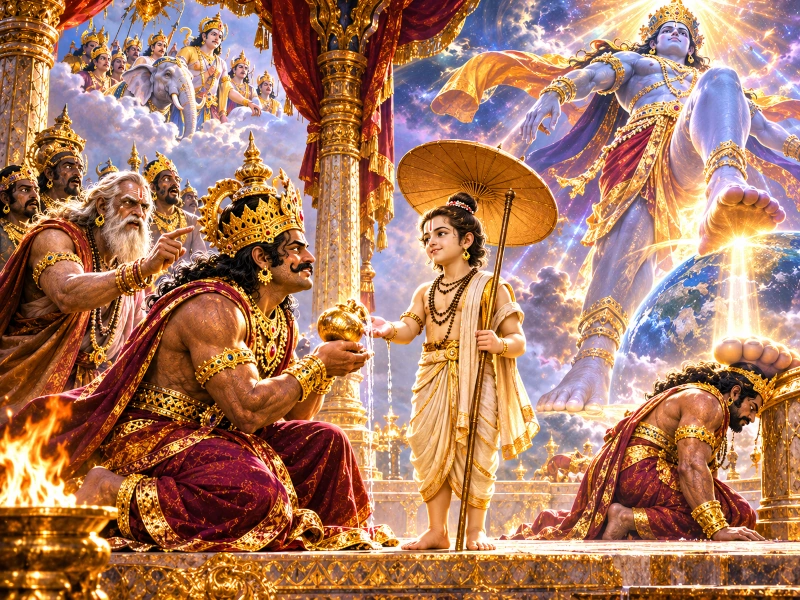
Vāmana subsequently assumed his universal form as Trivikrama and encompassed the worlds with two strides. Unable to provide the third pace of land, Bali offered his own head, surrendering his remaining claim to sovereignty. The political order established through Bali’s earlier military conquest was thereby reversed without Indra having to undertake another conventional campaign against the Asura ruler.
The central strategic significance of this episode is that overwhelming military superiority does not guarantee permanent political control when sovereignty can be challenged through obligations, legitimacy and forms of authority that operate beyond conventional warfare.
The narrative also presents an important distinction between political defeat and moral failure. Although Bali loses his kingdom, his determination to honour his promise earns him divine recognition and the grant of Sutala, where Lord Viṣṇu promises to protect him. The episode therefore examines not only the limitations of military power but also the relationship between political authority, moral commitment and the enduring reputation of a ruler.
The Strategic Background: Bali’s Supremacy Over Svarga
The circumstances preceding Vāmana’s intervention are essential to understanding the military significance of the episode. In the earlier battles between the Devas and Asuras, Bali had confronted Indra and suffered defeat. His subsequent restoration through the intervention of Śukrācārya and the Bhṛgu priests enabled him to rebuild his strength and undertake another campaign against the celestial kingdom.
The Viśvajit sacrifice provided Bali with extraordinary military equipment, including a magnificent chariot, powerful weapons, inexhaustible quivers and celestial armour. Supported by formidable Daitya commanders, he advanced towards Svarga with an army of overwhelming strength. Indra, recognising the extraordinary power of the approaching Asura forces, consulted Bṛhaspati, who advised the Devas to withdraw rather than engage Bali under conditions that offered little prospect of victory.
Indra accepted this recommendation, and Bali occupied the celestial capital. The conquest gave the Asura ruler authority over territories previously governed by the Devas and established him as the dominant political figure within the celestial order. His military strength had been translated into territorial control, while the withdrawal of Indra demonstrated the inability of the Devas to resist him under the prevailing circumstances.
The military importance of Bali’s conquest lay in his ability to transform regenerated military strength into political control over a strategically decisive kingdom without requiring the destruction of Indra’s forces in a final battle.
However, Bali’s success also created a new strategic problem for the Devas. Their former ruler had been displaced, while the Asura army possessed the capabilities necessary to resist conventional attempts to restore the previous political order. The balance of power had shifted so decisively that another direct confrontation offered little prospect of success.
The circumstances therefore required an intervention capable of overcoming Bali’s supremacy through an entirely different means. The subsequent appearance of Vāmana demonstrates how the Purāṇic narrative moves from a contest of armies to a contest involving authority, obligation and the limits of sovereignty.
The Decision to Avoid Conventional Warfare
The Bhāgavata Purāṇa describes Aditi, the mother of the Devas, grieving over the loss of their position and seeking guidance from her husband, Kaśyapa. Recognising her distress, Kaśyapa advises her to undertake the Payovrata, a religious observance dedicated to Lord Viṣṇu. Through her devotion, Viṣṇu appears and agrees to restore the fortunes of the Devas.
The narrative makes an important distinction between this divine intervention and an ordinary military counteroffensive. Viṣṇu does not immediately assemble an army to confront Bali’s forces or initiate another large-scale battle for Svarga. Instead, he takes birth as Vāmana, a young Brahmacārī of small physical stature, and approaches the Asura ruler during an important sacrificial ceremony.
The choice of this form becomes central to the subsequent encounter. Bali’s military establishment is prepared to confront powerful enemies, but Vāmana arrives as a religious student seeking charity rather than as an openly hostile warrior. His appearance does not initially suggest a threat to Bali’s territorial possessions or military supremacy.
The strategic principle illustrated by the narrative is that an objective difficult to achieve through direct military confrontation may become attainable through a different form of engagement that operates outside the adversary’s conventional defensive preparations.
Within the theological framework of the Purāṇa, Vāmana’s actions represent the exercise of divine authority rather than an ordinary human military stratagem. Nevertheless, the episode provides a useful conceptual illustration of how political outcomes may be transformed through instruments other than open warfare.
The distinction is especially important because Bali’s earlier military victories remain intact as battlefield achievements. His loss of sovereignty does not result from a renewed defeat by Indra’s army. Instead, the circumstances governing his authority change through an encounter that his military strength cannot prevent.
Vāmana’s Arrival: Entering Through a Sacred Institution
The Bhāgavata Purāṇa, Chapter 18, describes Vāmana approaching the sacrificial arena where Bali is conducting a series of Aśvamedha sacrifices under the guidance of the Bhṛgu priests. As the patron of the ceremony, Bali occupies a position of religious and political importance, surrounded by experienced priests and members of his royal establishment.
The setting is significant because the sacrificial ceremony carries established expectations concerning hospitality, generosity and the treatment of worthy visitors. A ruler conducting such an undertaking is expected to receive religious guests respectfully and provide appropriate gifts according to his capacity.
Vāmana enters the assembly carrying the traditional articles associated with a Brahmacārī, including an umbrella, staff and water vessel. His extraordinary radiance attracts the attention of the assembled priests, who recognise that the young visitor possesses qualities far beyond those of an ordinary student.
Bali receives him respectfully, offers the customary honours and invites him to request a suitable gift. The interaction consequently develops within the framework of a religious obligation rather than military confrontation. The ruler’s extraordinary armed forces and formidable defensive capabilities have no immediate role in determining how the visitor is received.
The strategic importance of Vāmana’s arrival lies in the distinction between entering an adversary’s territory as an invading warrior and approaching the ruler through an institution whose accepted customs require respectful reception and engagement.
The episode demonstrates how established institutions can shape the behaviour of powerful rulers independently of their military capabilities. Bali’s authority allows him to command armies and occupy kingdoms, but his position as the patron of a religious ceremony also creates obligations that influence his conduct.
Vāmana’s arrival therefore shifts the encounter away from the battlefield and into a setting where the decisive issue becomes the nature of the promise Bali is prepared to make.
The Three Paces of Land: A Limited Request with Extraordinary Consequences
The decisive exchange occurs in Chapter 19, when Bali asks Vāmana what he desires. As a ruler possessing extraordinary wealth and territory, Bali offers to provide a substantial gift, demonstrating both his generosity and his confidence in the resources available to him.
Vāmana, however, requests only enough land to be measured by three of his own footsteps. The apparent modesty of the demand surprises Bali, who considers the request insignificant in comparison with the wealth and territories he is capable of granting.
Bali encourages the young Brahmacārī to ask for something greater, but Vāmana declines. He explains the importance of contentment and maintains that three steps of land will be sufficient. The exchange establishes a striking contrast between the apparent scale of the request and the actual magnitude of its consequences.
Bali initially evaluates the demand according to Vāmana’s visible physical stature. He assumes that three steps taken by such a small visitor cannot impose any meaningful cost upon his kingdom. His assessment therefore depends upon an incomplete understanding of the person making the request and the capabilities concealed behind the appearance of an ordinary Brahmacārī.
The central strategic lesson is that the apparent size of a concession does not necessarily determine its ultimate significance. The consequences of an agreement depend upon its terms, the capabilities of the parties and the circumstances under which it is fulfilled.
The episode demonstrates the danger of evaluating an undertaking solely through its immediate appearance. A commitment that seems limited may produce extraordinary consequences when the assumptions underlying the agreement prove incorrect.
In Bali’s case, the request for three paces of land becomes the mechanism through which the territorial supremacy gained by military conquest is placed at risk.
Śukrācārya’s Warning: The Importance of Strategic Intelligence
The most important warning in the episode comes from Śukrācārya, Bali’s preceptor and principal adviser. Recognising the true identity of the young Brahmacārī, Śukrācārya explains that the visitor is Lord Viṣṇu appearing in the form of Vāmana.
He warns Bali that the request for three paces of land is connected with the restoration of the Devas’ authority and that fulfilling the promise will result in the loss of his possessions. Śukrācārya understands that Vāmana’s apparent physical limitations cannot be used to predict the true extent of his capabilities.
His intervention fundamentally changes the nature of the decision confronting Bali. Before receiving the warning, Bali had agreed to a request he considered insignificant. After Śukrācārya’s explanation, he understands that fulfilling the commitment may cost him his kingdom.
The military and political significance of Śukrācārya’s warning lies in the importance of identifying the true capabilities and intentions of another party before accepting an obligation whose consequences may become irreversible.
The preceptor’s advice represents a form of strategic assessment. He identifies the visitor, explains the likely consequences of the proposed concession and recommends that Bali reconsider his undertaking before completing the donation.
The episode also reveals the importance of timing. The warning comes after Bali has already expressed his willingness to provide the gift, creating a conflict between strategic caution and the obligation to honour his word.
The central decision-making principle is that informed assessment should precede binding commitments, because the freedom to reconsider a decision may become severely constrained once an obligation has been publicly accepted.
Śukrācārya’s counsel also demonstrates that accurate intelligence does not necessarily determine the final decision of a ruler. Bali receives the warning and understands its significance, but chooses to proceed for reasons that extend beyond the preservation of his territorial possessions.
Bali’s Decision: Political Survival Versus Personal Honour
Bali does not dismiss Śukrācārya’s warning because he doubts the identity of Vāmana. Instead, he considers the consequences and deliberately chooses to honour his promise despite understanding the danger.
In Chapter 20, Bali explains that he cannot withdraw from his commitment merely to preserve his wealth or political authority. His reasoning is grounded in the importance he attaches to truthfulness, generosity and the dignity of his lineage.
The decision represents one of the most important moral dimensions of the narrative. Bali has the opportunity to preserve his possessions by refusing to complete the donation, but doing so would violate an obligation he considers essential to his honour.
Śukrācārya, by contrast, evaluates the situation primarily according to the preservation of Bali’s material and political interests. The difference between their positions creates a fundamental conflict between strategic calculation and moral commitment.
The strategic dilemma is that political survival and adherence to an accepted moral obligation may lead towards different decisions, particularly when a ruler has committed himself before fully understanding the consequences.
Bali chooses to honour his promise. From a purely territorial perspective, the decision exposes his kingdom to an extraordinary loss. Within the religious framework of the Purāṇa, however, it becomes the foundation of his spiritual distinction.
This distinction is essential to interpreting the episode accurately. The narrative does not present Bali merely as an ignorant ruler defeated through deception. It portrays him as a powerful king who knowingly places truthfulness above the preservation of his possessions.
The deeper lesson is that political defeat does not necessarily imply moral defeat, and the loss of material sovereignty may coexist with the preservation of personal integrity and honour.
Bali’s decision therefore transforms the encounter from a question of territorial control into a wider examination of the responsibilities and values that define legitimate leadership.
The Transformation into Trivikrama: Cosmic Authority Replaces Military Power
After Bali formally completes the donation, the decisive transformation occurs. Vāmana expands into his universal form as Trivikrama, encompassing the worlds through an extraordinary manifestation of divine power.
The Bhāgavata Purāṇa, Chapters 20 and 21, describes the universe appearing within the Lord’s vast form as he measures the promised territory. The small request that Bali had initially considered insignificant now acquires an entirely different meaning.
With two strides, Trivikrama encompasses the worlds under Bali’s authority, leaving no remaining territory upon which the third step can be placed. The terms of the promise have therefore produced a result that Bali’s original calculations could not have anticipated.
The theological meaning of the episode is central to the narrative. The Supreme Being demonstrates an authority extending beyond the territorial power of any ruler, revealing the limitations of sovereignty acquired through military conquest.
From the perspective of strategic analysis, the episode illustrates the difference between possessing political control over territory and possessing the superior authority capable of determining the limits of that control.
Bali’s military strength had enabled him to conquer Svarga, but his armies cannot prevent the consequences of the obligation he has accepted. The political order created through military victory is overturned by the manifestation of an authority beyond ordinary battlefield power.
This distinction makes the episode particularly significant within the Purāṇic accounts of warfare. The decisive change in sovereignty occurs without Indra defeating Bali in another conventional battle.
The central military lesson is that the outcome of a political conflict need not always be determined through the destruction of an opposing army. A change in the conditions governing sovereignty can produce a strategic result that conventional military operations have failed to achieve.
The Asura Commanders Attempt Resistance
The transformation of Vāmana into Trivikrama creates an immediate reaction among Bali’s followers. Recognising that their ruler has lost his possessions, several Asura commanders become enraged and prepare to resist the divine intervention.
The Bhāgavata Purāṇa describes an armed confrontation between the Asuras and the attendants of Lord Viṣṇu. The Asura forces regard the loss of their master’s possessions as an unacceptable reversal and attempt to respond through military action.
However, the resistance proves ineffective. Viṣṇu’s attendants defeat the attacking forces, demonstrating the overwhelming superiority of the power confronting them.
Bali then intervenes and orders his commanders, including Vipracitti, Rāhu and Nemi, to withdraw. He recognises that the circumstances no longer favour military resistance and that continuing the confrontation will not restore his lost territories.
The strategic significance of Bali’s order lies in the recognition that military resistance becomes counterproductive when it can no longer alter the political outcome and merely exposes the remaining forces to further destruction.
The episode also demonstrates the importance of maintaining command authority during a sudden strategic reversal. Although his followers are prepared to fight, Bali retains sufficient control to order their withdrawal.
His conduct contrasts with that of rulers who continue military operations solely to defend their prestige after the original strategic objective has become unattainable.
The ability to restrain one’s own forces when the conditions for victory no longer exist is an essential element of responsible military leadership.
Bali’s decision demonstrates that military judgment remains important even after political authority has been lost. He cannot reverse the consequences of Vāmana’s intervention, but he can prevent his commanders from continuing an ineffective confrontation.
Bali’s Surrender: The Third Step and the Preservation of Honour
The encounter reaches its moral climax when Vāmana asks Bali where he can place the third step promised in the donation. By this stage, the first two strides have encompassed the worlds, leaving Bali unable to provide additional territory.
The Bhāgavata Purāṇa describes Bali being bound with the ropes of Varuṇa, yet remaining steadfast in his commitment. Rather than attempting to deny the promise, he offers his own head as the place for the final step.
This decision transforms the nature of his defeat. Bali no longer possesses the territorial authority he previously exercised, but he retains the ability to fulfil his word through personal surrender.
The strategic and moral significance of Bali’s response is that the loss of political power does not necessarily destroy a ruler’s dignity when he remains faithful to principles he considers more important than possession of territory.
His decision also demonstrates a distinction between surrendering political authority and abandoning personal responsibility. Bali accepts the consequences of the obligation he has undertaken rather than transferring responsibility to his advisers or military commanders.
Within the devotional framework of the Purāṇa, his conduct becomes evidence of extraordinary sincerity and devotion. Although his conquest is overturned, his moral standing is elevated through the very circumstances that bring about his political defeat.
The episode preserves an important principle of leadership: a ruler’s enduring reputation may depend less upon the extent of his conquests than upon the integrity with which he responds when power and possessions are taken away.
Bali’s surrender therefore becomes more than the conclusion of a territorial dispute. It represents the triumph of an ethical commitment over the desire to preserve political authority at any cost.
The Restoration of Indra: Political Victory Without a Conventional Campaign
The consequences of Vāmana’s intervention extend beyond Bali’s personal surrender. The objective associated with the divine incarnation is the restoration of the celestial order following Bali’s conquest of Svarga.
Chapter 23 describes Lord Viṣṇu returning the territories previously seized by the Asuras to Indra, thereby restoring the Devas’ authority. The political result is achieved without requiring Indra to undertake another successful conventional campaign against Bali.
This distinguishes the episode from the earlier battles in which the Devas and Asuras confronted one another directly. Indra had previously been unable to resist Bali’s restored military strength and had withdrawn on Bṛhaspati’s advice. Through Vāmana’s intervention, the territorial outcome is reversed without Indra having to destroy the Asura army in a decisive battle.
The central strategic principle is that political objectives can sometimes be achieved through changes in authority, accepted obligations or negotiated arrangements rather than through the direct military defeat of an opposing force.
In the Purāṇic narrative, the decisive authority is divine and cosmic rather than institutional or diplomatic in the modern sense. Nevertheless, the distinction between battlefield victory and political outcome remains important.
The Devas recover their former position because the conditions supporting Bali’s sovereignty have been fundamentally transformed. The political objective is therefore achieved through an intervention that changes the basis of authority rather than through a renewed contest of conventional military strength.
The episode demonstrates that military supremacy and political sovereignty are not identical. A ruler may possess overwhelming armed strength yet lose control of territory when the authority supporting his claim is superseded by a greater power.
Bali Receives Sutala: Defeat Without Annihilation
The concluding stages of the narrative provide an important contrast with accounts in which military defeat results in the destruction of the opposing ruler.
Although Bali loses his territorial supremacy, Lord Viṣṇu does not destroy him. Instead, the Lord acknowledges his devotion and grants him the realm of Sutala, described as possessing extraordinary prosperity and protection.
Viṣṇu further promises to remain associated with Bali and protect his new domain. The Bhāgavata Purāṇa also describes Bali’s future elevation to the position of Indra in a later Manvantara.
The settlement consequently creates a new political arrangement in which Indra regains Svarga while Bali receives a separate realm and divine protection.
The strategic significance of this outcome lies in the possibility of resolving a struggle for sovereignty without requiring the complete destruction or permanent humiliation of the displaced ruler.
The narrative demonstrates the distinction between removing an adversary from a particular position of authority and eliminating that adversary altogether.
Bali’s rule over Svarga ends, but his existence, dignity and future are preserved. Within the religious framework of the Purāṇa, the outcome reflects divine grace and recognition of Bali’s devotion rather than a conventional peace treaty.
The broader principle is that the restoration of political order need not always require the annihilation of the defeated side. A settlement can resolve the struggle for authority while preserving the dignity and future of those who have lost power.
The conclusion of Bali’s encounter therefore introduces an important dimension of post-conflict political judgment. The objective of restoring Indra’s authority is achieved without treating the destruction of Bali as a necessary condition for success.
Modern Strategic Parallel: The Suez Crisis of 1956
A useful modern illustration of the distinction between military success and political authority can be found in the Suez Crisis of 1956. Following Egyptian President Gamal Abdel Nasser’s nationalisation of the Suez Canal Company in July 1956, Britain and France became involved in a military intervention alongside Israel.
The military operations launched in October and November initially achieved important battlefield objectives. However, the intervention generated intense diplomatic opposition, including from the United States. President Dwight D. Eisenhower’s administration opposed the operation and applied substantial diplomatic and financial pressure to secure a ceasefire and withdrawal.
The United Nations also played an important role in the crisis, including through the establishment of the first United Nations Emergency Force. Britain and France accepted a ceasefire on 6 November 1956 and subsequently withdrew their forces.
The crisis demonstrated that tactical military success could be rendered politically ineffective when the wider diplomatic and economic circumstances prevented the successful consolidation of the intended political outcome.
The comparison with Vāmana’s intervention is conceptual rather than literal. The Suez Crisis involved sovereign states, military operations, international institutions and financial pressure, while the Bhāgavata Purāṇa describes a divine intervention operating through a religious promise and cosmic authority.
Nevertheless, both narratives illustrate the distinction between possessing military capabilities and maintaining the political conditions necessary to exercise authority.
The common strategic lesson is that military power does not automatically guarantee political success when other forms of authority, obligation or external pressure determine the final settlement.
In the Suez Crisis, international diplomacy and economic pressure contributed to the reversal of an intervention that had achieved initial military successes. In the Purāṇic account, Bali’s territorial supremacy is reversed through his accepted obligation and Vāmana’s divine manifestation.
The broader principle is that the outcome of a political confrontation may be determined outside the battlefield, even when one side possesses formidable military strength.
The comparison demonstrates why military planners and political leaders must consider the wider institutional, economic and diplomatic environment within which military power is exercised. Tactical success cannot be treated as sufficient when the political conditions necessary to preserve the achievement remain unfavourable.
Strategic Lessons for Modern Military and Political Leadership
The encounter between Vāmana and Bali presents several enduring lessons concerning political power, strategic judgment, diplomatic engagement and the relationship between military strength and accepted obligations.
The first concerns the limitations of conventional military superiority. Bali possesses extraordinary resources and has already conquered Svarga, yet those capabilities cannot prevent the loss of his sovereignty through Vāmana’s intervention. Military supremacy does not necessarily provide protection against political, institutional or other forms of authority capable of altering the conditions under which power is exercised.
The second lesson concerns the importance of understanding an interlocutor’s true capabilities. Bali initially evaluates Vāmana according to his small physical stature, while Śukrācārya recognises the divine identity concealed behind that appearance. Effective strategic judgment requires leaders to assess the actual capabilities and intentions of another party rather than relying upon outward appearances or assumptions of weakness.
The third concerns the significance of binding commitments. Vāmana’s request appears modest, but Bali’s decision to honour it ultimately transforms the political situation. An apparently limited obligation can produce consequences extending far beyond its initial scope when its implications have not been fully understood.
The fourth concerns the timing of strategic advice. Śukrācārya identifies the danger after Bali has already expressed his willingness to grant the request. Critical assessments must be undertaken before commitments are made, because public promises can substantially restrict a ruler’s ability to reconsider a decision.
The fifth concerns the distinction between tactical resistance and strategic feasibility. Bali’s followers attempt to fight after the loss of their master’s possessions, but Bali orders them to withdraw. Continuing military resistance is strategically unsound when the underlying political objective can no longer be achieved through the available means.
The sixth concerns the relationship between sovereignty and legitimacy. Bali acquires the celestial kingdom through military superiority, but the narrative ultimately places that authority beneath Viṣṇu’s cosmic sovereignty. The possession of territory and the exercise of political power are distinct from the wider principles through which authority is recognised and sustained.
The seventh concerns the conduct of a defeated ruler. Bali honours his promise despite losing his possessions and accepts the consequences of his decision. Personal integrity can preserve a leader’s moral standing even when his political and military power has been lost.
Finally, the episode illustrates an alternative to the complete destruction of a defeated adversary. Bali receives Sutala and divine protection, while Indra regains Svarga. The restoration of political order need not always require the annihilation of the displaced ruler; a settlement can preserve dignity while resolving the underlying contest for authority.
These principles are particularly relevant to understanding the relationship between military operations and political outcomes. Armies can conquer territory and compel adversaries to withdraw, but the long-term exercise of authority depends upon a wider range of factors, including legitimacy, institutional support, accepted obligations and the ability to establish a sustainable settlement.
Conclusion: The Victory That Required No Conventional Campaign
The encounter between Vāmana and Mahābali stands among the most remarkable episodes of strategic and political transformation in the Śrīmad Bhāgavata Purāṇa.
Bali had achieved extraordinary military success. Having recovered from defeat, he rebuilt his strength, advanced against Indra and occupied Svarga after the Devas withdrew. His position appeared secure because the military power available to his opponents was insufficient to challenge his supremacy directly.
Yet the conquest was eventually overturned through an encounter that began with a seemingly insignificant request for three paces of land. Vāmana approached Bali within the framework of a sacred ceremony, obtained his promise and subsequently manifested the cosmic authority through which the worlds were encompassed.
Bali’s armies could not prevent the result. His followers briefly attempted resistance, but the king ordered them to withdraw and ultimately surrendered by offering his head for the third step.
Indra consequently regained his celestial kingdom, while Bali received Sutala and the recognition associated with his devotion and unwavering commitment to truthfulness.
The central strategic lesson is that the possession of overwhelming military strength does not guarantee the permanence of political authority. A ruler may conquer territories through force yet lose them through circumstances that operate beyond the conventional battlefield.
The episode also demonstrates that strategic success and moral worth are not necessarily identical. Bali loses his imperial supremacy but emerges from the encounter with his integrity recognised and his future protected.
The greater lesson of the narrative is that political power must be understood in relation to obligations, legitimacy, judgment and the wider authority under which it is exercised.
For students of military strategy, Vāmana’s intervention provides a striking illustration of how a seemingly limited engagement can transform the outcome of a much larger struggle. For students of political leadership, Bali’s response demonstrates the importance of honouring commitments and accepting responsibility even when doing so entails extraordinary personal loss.
The enduring principle of warfare preserved in this episode is that the most decisive victory may not require the destruction of an adversary’s army, but the transformation of the political conditions that make his supremacy possible.
Through the encounter between Vāmana and Bali, the Bhāgavata Purāṇa presents a profound lesson concerning the limits of conquest: military power may establish an empire, but its continued existence depends upon forces and obligations that military strength alone cannot always control.
Scriptural References: Śrīmad Bhāgavata Purāṇa, Skandha 8, Chapter 15, concerning Bali’s conquest of Svarga; Chapters 16–17, concerning Aditi’s observance and the appearance of Viṣṇu; Chapter 18, concerning Vāmana’s arrival at Bali’s sacrifice; Chapter 19, concerning the request for three paces of land and Śukrācārya’s warning; Chapter 20, concerning Bali’s decision to honour his promise and Vāmana’s transformation into Trivikrama; Chapter 21, concerning the Asuras’ resistance and Bali’s order to withdraw; Chapter 22, concerning Bali’s surrender and the granting of Sutala; and Chapter 23, concerning the restoration of Indra’s authority.
You may also like
-
The Council of Ministers: How Kauṭilya Evaluated Advice, Secrecy and Decision-Making
-
The Sacred Groves of India: Traditional Protection and Modern Biodiversity Conservation
-
Indra Loses Svarga to Bali: Strategic Withdrawal, Political Defeat and the Preservation of Military Power
-
Rāma’s Approach to Rāvaṇa: The Role of Negotiation Before the Use of Force
-
The Nair Military System: Organisation, Training and Changing Warfare Traditions in Kerala
