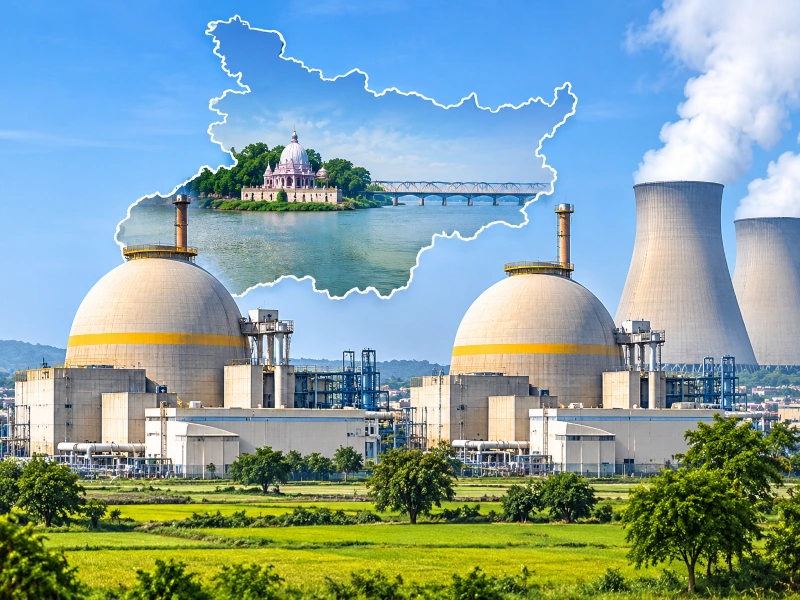
Bihar is preparing for a major expansion of its energy infrastructure, with NTPC Limited and Nuclear Power Corporation of India Limited (NPCIL) signing agreements for two proposed nuclear power projects involving a combined investment of approximately ₹1.4 lakh crore. The projects, each planned with a generation capacity of 2,800 megawatts (MW), could introduce nuclear power generation to the state and strengthen its long-term electricity supply.
The agreements were exchanged on 20 November 2026 in Patna as part of the Bihar Business Connect 2026 initiative. The proposed nuclear facilities form part of a larger package of six energy projects involving investments estimated at ₹1,72,885 crore.
NTPC Proposes 2,800 MW Nuclear Power Plant in Banka
NTPC has proposed establishing a 2,800 MW nuclear power plant at Bhitiya in Bihar’s Banka district, with an estimated investment of ₹70,000 crore.
The proposed facility is expected to comprise four nuclear reactor units, each with a generating capacity of 700 MW. The project would represent a significant expansion of NTPC’s involvement in nuclear energy and contribute to the diversification of India’s electricity generation infrastructure.
NTPC has traditionally been associated with thermal power generation but has increasingly expanded its activities into renewable energy, nuclear power and other emerging energy technologies. The proposed Banka project would support this broader diversification while creating opportunities for industrial development in Bihar.
NPCIL Proposes Second Nuclear Power Plant in Siwan
Nuclear Power Corporation of India Limited has proposed another 2,800 MW nuclear power plant at Talhar in the Raghunathpur area of Siwan district.
The project carries an estimated investment of ₹70,000 crore and is also envisaged as a four-unit nuclear power station, with each unit having a capacity of 700 MW.
NPCIL operates India’s commercial nuclear power reactors and has extensive experience in the construction and operation of Pressurised Heavy Water Reactors (PHWRs). Its participation would bring established nuclear engineering, operational and safety expertise to the proposed development.
Together, the two nuclear projects would provide Bihar with a proposed installed generation capacity of 5,600 MW, representing one of the state’s most substantial planned investments in electricity infrastructure.
Six Energy Projects Involving ₹1.72 Lakh Crore
The two nuclear power proposals are part of a wider energy investment programme comprising six projects with a combined estimated investment of ₹1,72,885 crore.
In addition to the nuclear facilities, the programme includes four proposed pumped-storage hydropower projects across Nawada, Jamui and Aurangabad districts.
The pumped-storage projects are planned to provide a combined generating capacity of approximately 6,000 MW. These facilities would support electricity storage and grid balancing by using surplus electricity to pump water to an elevated reservoir and releasing it through turbines when additional power is required.
The combination of nuclear generation and pumped-storage capacity could provide Bihar with a more diversified electricity infrastructure. Nuclear power offers continuous electricity generation, while pumped-storage systems can help manage fluctuations in electricity demand and support the integration of renewable energy.
If all six projects are implemented at their proposed capacities, they would collectively represent 11,600 MW of additional power generation and storage capacity.
Potential Benefits for Bihar’s Industrial Development
The proposed investments could have significant implications for Bihar’s industrial and economic development.
Large electricity infrastructure projects require extensive engineering, civil construction, specialised equipment, transportation and supporting services. Their implementation could create opportunities for domestic manufacturers, engineering contractors, construction companies and skilled workers.
The development of nuclear power facilities could also encourage improvements in roads, transmission infrastructure, industrial services and technical training in the surrounding districts.
For Bihar, additional electricity generation capacity would be particularly relevant to its efforts to attract manufacturing investment, expand industrial activity and strengthen infrastructure.
The proposed projects could also contribute to India’s wider objective of increasing non-fossil-fuel electricity generation and expanding domestic nuclear power capacity.
Agreements Mark an Initial Stage of Development
The agreements represent an important initial step in the development of the proposed nuclear power plants. However, the signing of agreements does not constitute final project approval or the commencement of construction.
Before implementation, the projects would require detailed site assessments, technical feasibility studies, financial planning, environmental and statutory clearances, and the necessary nuclear regulatory approvals.
The proposed locations, reactor configurations, investment estimates and implementation schedules would be subject to further evaluation during project development.
The Atomic Energy Regulatory Board would have a central role in the regulatory approval process, including the assessment of nuclear safety requirements before construction and subsequent commissioning activities.
Strengthening India’s Nuclear Energy Infrastructure
India has been expanding its indigenous nuclear power programme, including the development of 700 MW Pressurised Heavy Water Reactors. These reactors form an important part of the country’s strategy to increase reliable, low-carbon electricity generation through domestically developed nuclear technology.
The proposed Bihar projects would align with this national effort by expanding the geographical reach of nuclear power development and encouraging investment in large-scale electricity infrastructure.
With NTPC and NPCIL participating in the proposed investments, Bihar has taken an initial step towards establishing a substantial nuclear energy sector. Successful implementation would strengthen the state’s electricity infrastructure, support industrial growth and contribute to India’s expanding nuclear power programme.
You may also like
-
Pinaka Aerospace Emerges L1 for DRDO’s Airborne Radar Testing System Procurement
-
NSE Becomes World’s Fifth-Largest Listed Exchange Operator by Market Capitalisation
-
IAF Issues RFI for 500 Indigenous Surveillance Drones With Over 200 Km Range
-
Hoverit Develops Indigenous RATO System and Successfully Launches Divyastra Mk1 Strike Drone
-
Adani Defence Demonstrates Bagheera AT1 Vehicle-Mounted Anti-Tank Missile System at Pokhran
