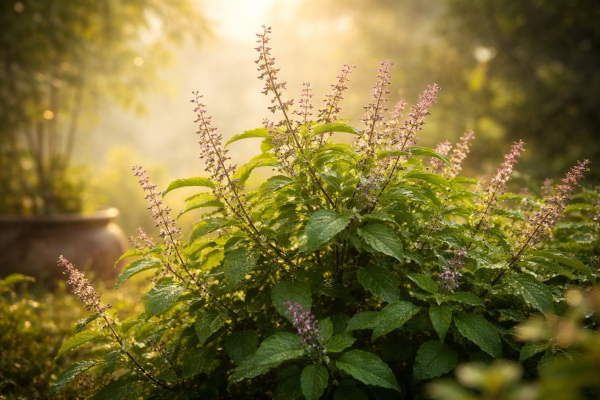
In Ayurveda, Tulsi is far more than a household plant growing in a courtyard pot. It sits at the meeting point of medicine, daily ritual, seasonal care, and preventive living. The National Medicinal Plants Board describes Tulsi, or holy basil, as Ocimum sanctum / Ocimum tenuiflorum of the Lamiaceae family, and notes that the economically important medicinal part is the herb itself, especially the leaves and tender shoots. Traditional use extends across the leaves, flowers, and at times the whole plant, with longstanding use in cough, cold, bronchitis, gastric upset, diarrhoea, dysentery, ringworm, and other skin complaints; the leaf oil is also described as antibacterial, insecticidal, and mosquito-repellent. Ayurvedic reviews describe Tulsi’s classical profile as katu, tikta, and kashaya in rasa, ushna in virya, katu in vipaka, with laghu, tikshna, ushna, and ruksha gunas. In practical Ayurvedic language, that makes Tulsi warming, light, sharp, drying, and channel-opening, which is why it is so often associated with kapha-vata balance, especially where there is mucus, damp heaviness, sluggish digestion, chilliness, or blocked respiration.
One of the most useful things to understand before discussing Tulsi varieties is that Ayurveda gives Tulsi a common foundational dravyaguna identity, while traditional practice and modern botany recognize a few distinct forms under the Tulsi umbrella. The two best-known domestic forms are Rama Tulsi, with green leaves, and Krishna or Shyama Tulsi, with purple or dark-toned leaves and stems. A major review describes these as the two common cultivars of Tulsi. A separate genetic-authentication study adds an important nuance: the popular threefold division into Rama, Krishna, and Vana Tulsi matches science only partially. In that work, Rama and Krishna Tulsi aligned with O. tenuiflorum, while Vana Tulsi belonged to a different haplotype, which helps explain why Vana often feels botanically and aromatically distinct in real-life use. That means Ayurveda users are correct to sense a difference between these plants, yet it also means the boundaries between traditional naming and botanical classification are not perfectly rigid.
Rama Tulsi is the green-leaved domestic form most commonly seen in Indian homes, temple courtyards, and kitchen gardens. Because it belongs to the core O. tenuiflorum group and carries the standard Ayurvedic Tulsi profile, Rama Tulsi is the variety most naturally associated with daily household use. It lends itself well to fresh-leaf chewing, light herbal infusions, simple kashayam-style decoctions, and combinations with ginger, black pepper, or honey in traditional cold-season routines. In Ayurvedic terms, Rama Tulsi is especially well suited to everyday kapha-clearing and agni-supporting use—morning heaviness, a tendency toward recurrent colds, mild throat irritation, slow digestion after heavy food, and the damp lethargy that often builds during monsoon weather. Since official Indian medicinal-plant literature already records Tulsi’s use in cough, cold, bronchitis, gastric disorders in children, and minor skin conditions, Rama Tulsi can be thought of as the most practical household form of classical Tulsi action.
Krishna Tulsi, also called Shyama Tulsi, belongs to the same core medicinal group but is visually distinguished by its purple leaves and darker stems. Ayurveda does not assign it an entirely separate pharmacological universe; rather, Krishna Tulsi shares the same broad Tulsi character of pungency, bitterness, warmth, and kapha-vata regulation. Where it often stands apart is in strength of aroma, perceived intensity, and phytochemical emphasis. Comparative research on holy basil has reported that red holy basil showed higher antioxidant capacity and higher phenolic content than white holy basil, and broader reviews of Tulsi recognize Krishna Tulsi as the purple form alongside green Rama Tulsi. In everyday Ayurvedic practice, this has helped Krishna Tulsi earn a reputation as the form many households reach for when the respiratory picture feels thicker, colder, and more congested—deep chest heaviness, stubborn throat irritation, dense morning mucus, or the kind of cold weather imbalance that benefits from a hotter, more penetrating herb. The classical logic remains the same: Tulsi reduces kapha by cutting through dampness and stagnation, and helps regulate vata where cold and obstruction have joined forces.
Vana Tulsi is where the discussion becomes especially interesting. Traditional users often describe it as the wild or forest Tulsi, and modern work suggests that this intuition has genuine botanical substance behind it. The Tulsi-authenticity literature indicates that Vana Tulsi is distinct from the Rama-Krishna group, and later summaries identify it with Ocimum gratissimum. Studies on basil aroma chemistry also report a strong clove-like smell in O. gratissimum, which matches the lived experience of Vana Tulsi drinkers who often find it more expansive, fragrant, and sharply aromatic than domestic Rama or Krishna plants. In Ayurvedic use, Vana Tulsi is especially valued where prana, freshness, and aromatic clearing matter as much as outright heating power. It is excellent for infusions, steam inhalation blends, and tea-drinking meant to clear dullness from the head and chest while lifting the senses. If Rama Tulsi feels like the daily household guardian and Krishna Tulsi feels like the more forceful respiratory worker, Vana Tulsi often feels like the most aromatic and space-opening member of the family, with a wild, clove-rich fragrance that gives it a slightly different personality even while it still functions inside the broader Tulsi tradition.
From an Ayurvedic standpoint, the most honest way to compare the three is this: all Tulsi types broadly share the classical Tulsi profile, but they differ in how that profile is expressed through leaf color, aroma, chemistry, and practical use. Rama Tulsi suits regular household infusions and day-to-day kapha management. Krishna Tulsi carries the same core dravyaguna but is often favored where users want a more intense-feeling respiratory herb. Vana Tulsi stands out for aroma, openness, and fragrant tea use, especially when one wants Tulsi’s clearing quality with a more expansive sensory character. Across all three, the common traditional uses remain recognizable: respiratory support, digestive lightening, external use for minor skin issues, and seasonal resilience. Modern human research remains promising rather than final: a systematic review found 24 human studies reporting therapeutic effects in areas such as metabolic disorders, cardiovascular disease, immunity, and neurocognition, while the Merck Manual says there are still few high-quality human studies confirming effectiveness for specific conditions. Merck also advises caution because holy basil may cause nausea or diarrhoea, may be unsuitable during pregnancy or while trying to conceive, may worsen hypothyroidism by lowering thyroxine, and may increase bleeding risk, especially around surgery or with anticoagulant medicines. So Tulsi deserves both reverence and discernment: it is a profound Ayurvedic herb, yet one best used with the same intelligence and proportion that Ayurveda itself demands.
References:
- National Medicinal Plants Board (NMPB), Ministry of AYUSH. “Organic cultivation of Bacopa monnieri and Ocimum sanctum.”
https://nmpb.nic.in/sites/default/files/publications/Information_about_Organic_Cultivation_of_Tulsi_and_Brahmi.pdf - A. Sharma et al. “A systemic review on tulasi (Ocimum sanctum Linn.).”
https://www.botanyjournals.com/assets/archives/2021/vol6issue5/6-5-23-394.pdf - D. Singh et al. “A review on phytochemical and pharmacological aspects of Ocimum sanctum Linn.”
https://www.sciencedirect.com/science/article/abs/pii/S0926669018302711 - G. Jürges et al. “Product authenticity versus globalisation—The Tulsi case.”
https://pmc.ncbi.nlm.nih.gov/articles/PMC6261265/ - W. Wangcharoen, S. Morasuk. “Antioxidant capacity and phenolic content of holy basil.”
https://www.thaiscience.info/journals/Article/SONG/10987137.pdf - N. Jamshidi, M.M. Cohen. “The Clinical Efficacy and Safety of Tulsi in Humans.”
https://pubmed.ncbi.nlm.nih.gov/28400848/ - Merck Manual Professional Edition. “Holy Basil.”
https://www.merckmanuals.com/professional/special-subjects/dietary-supplements/holy-basil - P. Du et al. “Identification of Key Aromatic Compounds in Basil (Ocimum L.) Species.”
https://pmc.ncbi.nlm.nih.gov/articles/PMC9865694/
You may also like
-
Ayurveda on Fresh Food Versus Reheated Food: Why Freshly Prepared Meals Are Preferred for Healthy Digestion
-
Ayurveda on Cold Foods and Iced Drinks: Why Food Temperature Matters for Digestion
-
Serum Institute of India-Manufactured Ebola Vaccine Enters Clinical Trial in Uganda
-
Ayurveda and Hydration: How Much Water Should We Really Drink?
-
Warm Water in Ayurveda: When and Why It Is Recommended
