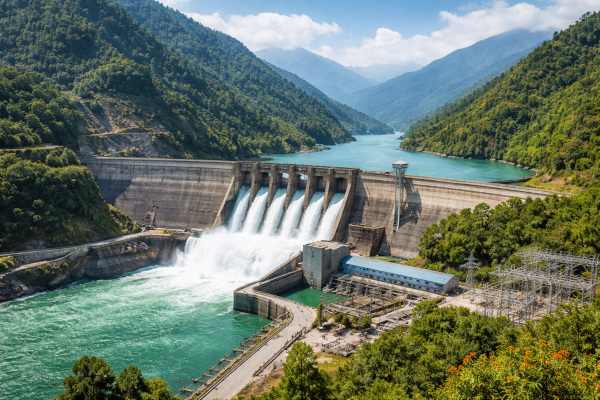
India is set to cross a major clean energy milestone, with installed non-fossil fuel power capacity expected to touch 300 GW by the end of the current quarter. The announcement places India’s energy transition at a decisive point, where renewable power, nuclear capacity, hydroelectric generation and emerging green hydrogen infrastructure are beginning to form the backbone of a new national energy system.
Union Minister for New and Renewable Energy Pralhad Joshi said India has carried out one of the world’s fastest and largest green energy transformations over the past 12 years. The statement was made in New Delhi during a workshop focused on strengthening the National Green Hydrogen Mission through state policies, industrial hubs and infrastructure planning.
The 300 GW mark is important because it shows the scale of India’s shift from conventional fossil-heavy power generation to a diversified cleaner energy base. Non-fossil capacity includes solar, wind, hydro, nuclear and other clean power sources. Solar power has been the strongest growth engine, supported by large parks, rooftop installations, domestic manufacturing, falling technology costs and strong demand from states and industries. Wind, hydro and nuclear add stability to this mix, giving India a broader clean power foundation.
This milestone also fits into India’s wider climate and energy targets. The country has committed to reaching 500 GW of non-fossil fuel capacity by 2030. Reaching 300 GW in 2026 would place India on a stronger path toward that goal. The remaining journey will require faster project execution, transmission expansion, storage deployment, domestic manufacturing and state-level reforms.
The next stage of India’s clean energy growth will depend heavily on grid readiness. Renewable power generation is spread across resource-rich regions such as Rajasthan, Gujarat, Tamil Nadu, Karnataka, Andhra Pradesh and Maharashtra. Large-scale transmission corridors, battery storage systems, pumped hydro projects and smart grid technologies will be essential to carry this power to industrial centres, cities and emerging green hydrogen hubs.
Green hydrogen is now becoming a central pillar of this transition. The National Green Hydrogen Mission aims to attract investments worth around ₹8 lakh crore and create nearly 6 lakh jobs in the sector. The mission seeks to build a domestic ecosystem covering renewable power supply, electrolysers, hydrogen production, storage, transport, industrial consumption and exports.
Green hydrogen can transform sectors where direct electrification is difficult. Fertilisers, refineries, steel, shipping, heavy transport and chemical industries can use green hydrogen as a cleaner fuel or feedstock. For India, this creates both an industrial opportunity and an energy security advantage. A strong green hydrogen sector can reduce import dependence on fossil fuels and support the creation of future-ready manufacturing clusters.
The government’s focus on state policies and hubs is important. Green hydrogen requires coordinated planning between renewable energy developers, industrial consumers, ports, water infrastructure, storage systems and logistics networks. States with strong renewable energy potential, coastal access and industrial demand can become early leaders. Gujarat, Odisha, Tamil Nadu, Andhra Pradesh, Maharashtra and Rajasthan are among the states well-positioned for hydrogen-linked growth.
The allocation of ₹22 crore to support renewable energy startups adds another layer to the policy push. Startups can play a useful role in electrolyser innovation, battery management, energy analytics, grid software, hydrogen safety systems, fuel cells, recycling and decentralised clean energy applications. India’s clean energy transition will need large companies for scale and startups for specialised innovation.
Private sector participation will decide the speed of execution. Major Indian companies are already investing in solar manufacturing, green hydrogen, battery storage, electrolysers, ammonia, green fuels and clean energy infrastructure. Their role is crucial because green energy expansion requires massive capital, long-term offtake agreements, technology partnerships and export-linked planning.
The 300 GW non-fossil capacity milestone also has a strong economic dimension. Clean energy is now linked to industrial competitiveness. Global supply chains are moving toward lower-carbon production, and countries with abundant clean power will have an advantage in manufacturing, data centres, green steel, green ammonia, electric mobility and export industries. India’s clean power expansion can therefore support both climate goals and industrial growth.
The transition also strengthens rural and regional economies. Solar parks, wind farms, transmission projects, green hydrogen hubs, manufacturing units and storage facilities create employment across construction, operations, maintenance, engineering, transport and services. With the right local training ecosystem, clean energy can become a major job creator in semi-urban and rural industrial belts.
India’s challenge now is to convert capacity growth into reliable clean power availability. This means faster land approvals, stronger transmission planning, better financial health of distribution companies, domestic manufacturing depth, storage affordability and skilled manpower development. The clean energy race will be won through execution as much as ambition.
The expected 300 GW milestone signals that India’s energy transition has entered a scale phase. Renewable power is expanding, green hydrogen is moving from policy to infrastructure planning, startups are being drawn into the ecosystem, and industry is preparing for a lower-carbon future. The next few years will decide how effectively India turns this momentum into energy security, industrial strength and green employment.
You may also like
-
India’s Economic Warfare Challenge: Strategic Autonomy, Energy Security and the Rise of a Global Power
-
India-US Trade Deal Stalemate: Why Washington’s Tariff Pressure Has Failed to Secure an Agreement
-
US Double Standards in Foreign Policy: 16 Recent Cases Involving India, Russia, China and Global Trade
-
India’s Arctic Energy Ambitions: Russian Oil, LNG and a New Sea Route to Indian Ports
-
India and Russia Explore Joint Icebreaker Construction as Maritime Industrial Cooperation Expands
