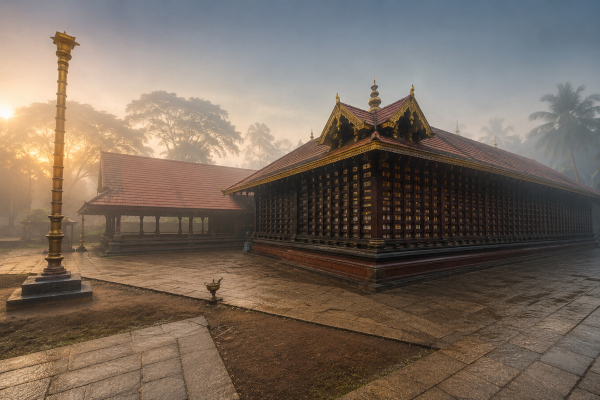
Thirunakkara Mahadeva Temple stands in the heart of Kottayam town as one of the most culturally important Shiva temples of central Kerala. It is a temple where devotion, royal history, Kerala architecture, mural art and festival traditions come together in a compact sacred space. Kerala Tourism describes it as an ancient Lord Shiva temple known for its traditional Kerala-style architecture, vibrant murals and Koothambalam, the classical temple theatre used for cultural performances.
The temple is believed to be around 500 years old and is associated with the Thekkumkoor kings, the old ruling house of the Kottayam region before Travancore’s expansion. Records cited by Kerala Tourism state that the temple was built by the King of Thekkumkoor, a princely state that existed in southern Kerala before 1750 CE. This historical connection gives Thirunakkara a special place in Kottayam’s memory. It is not merely a town temple; it is a reminder of the period when Kottayam had its own regional political identity, royal patronage and temple-centred cultural life.
The name Thirunakkara is connected to Nakkara Kunnu, the sacred hill on which the temple stands. Kerala Tourism notes that the temple is located on Thirunakkara Hill, locally known as Nakkara Kunnu. This elevated position adds to the temple’s atmosphere. Even though modern Kottayam has grown around it with roads, shops, traffic and civic activity, the temple still preserves the old feeling of a hill shrine placed above the daily movement of the town.
The Legend of the Thekkumkoor King
The temple’s origin story is deeply tied to the devotion of a Thekkumkoor ruler. According to the legend recorded by Kerala Tourism, one of the Thekkumkoor kings was an ardent devotee of Lord Vadakkumnathan, the form of Shiva worshipped at the famous Vadakkumnathan Temple in Thrissur. As the king grew old, the long journey to Thrissur became difficult, and he prayed that Lord Shiva should remain close to him in Kottayam itself.
The legend says that after a dream-like divine instruction, a learned Brahmin priest discovered a Shiva Linga buried in the earth at the present temple site. The king then built a temple to enshrine the Linga, and that shrine became the Thirunakkara Mahadeva Temple. Like many Kerala temple legends, this story combines royal devotion, dream revelation, sacred geography and the discovery of a hidden divine presence. The message is simple and powerful: when the devotee can no longer travel to Shiva, Shiva comes to the devotee.
This legend also explains why Thirunakkara is emotionally important to Kottayam. The temple is not presented as a casual royal construction. It is remembered as the answer to a king’s longing, the manifestation of Shiva for a devotee who wanted the Lord near him. That is why Thirunakkara Mahadeva is often experienced by devotees as a peaceful, accessible and intimate Shiva presence in the middle of the town.
The Deity and Sacred Presence
The presiding deity is Lord Mahadeva, worshipped here in the form of Shiva. The temple tradition centres on the idea of Shiva as a serene and protective presence. Kerala Tourism’s festival account also mentions that the temple enshrines idols of Lord Subramanya, Lord Ganesha, a Panchaloha idol of the Goddess, and Lord Ayyappa. This gives the temple the familiar Kerala Mahakshetra pattern, where the main deity is surrounded by associated deities who complete the ritual and devotional field.
For a devotee, Thirunakkara is especially suited for quiet Shiva worship. The temple’s location in town makes it accessible to office-goers, students, traders, residents and travellers. It functions both as a major heritage shrine and as an everyday temple. This is one of the beautiful features of Kerala’s temple culture: a shrine may be centuries old and architecturally rich, yet still remain part of ordinary daily life.
Kerala Architecture in the Middle of a Town
Thirunakkara Mahadeva Temple is a fine example of traditional Kerala temple architecture. Kerala Tourism specifically highlights its Kerala architectural style, mural paintings, Koothambalam, Anakottil and Kodimaram. These features place it within the classical design language of Kerala’s old temples, where wood, laterite, granite, copper roofs, sloping forms, courtyards and ritual pathways come together.
The Kodimaram, or flag mast, is one of the most visible ritual markers of the temple. It announces the sacred axis of the shrine and becomes especially important during festivals. The Anakottil, associated with elephant processions and festival arrangements, reflects the temple’s role in Kerala’s ceremonial culture. In many Kerala temples, the Anakottil is not just a structure; it is the visual stage where the grandeur of festival worship begins.
The temple’s architecture does not try to overwhelm through height in the manner of massive Dravidian gopurams seen in Tamil Nadu. Instead, it follows Kerala’s more inward-looking sacred style. The emphasis is on proportion, timber craftsmanship, ritual movement, roof forms, lamp-lit ambience and the relationship between courtyard, sanctum and performance space. The beauty of Thirunakkara lies in this balance: it is grand enough to carry royal memory, yet intimate enough to feel like a living town shrine.
Murals: Shiva, Vishnu and the Painted Theology of Kerala
One of the temple’s most admired features is its mural tradition. Kerala Tourism notes that the murals at Thirunakkara depict stories of Lord Shiva and the Dashavathara, the ten avatars of Lord Vishnu. This is very significant. Although the temple is dedicated to Shiva, its walls also preserve Vaishnava themes. Such a combination is common in Kerala’s sacred art, where temple walls often become visual scriptures that hold multiple strands of Hindu tradition together.
Kerala murals are not merely decorative paintings. They are theological storytelling in colour. The figures, postures, ornaments, eyes, gestures and compositions carry layers of meaning. In a temple like Thirunakkara, murals convert the wall into a sacred book. A devotee who walks through the temple is not only moving through stone and wood; he is also passing through painted episodes from the Puranic imagination.
The presence of Shiva themes and Dashavathara imagery also reflects Kerala’s integrated spiritual culture. Shaiva, Vaishnava, Shakta and local ritual traditions often coexist in the same sacred complex. Thirunakkara therefore represents a broader civilisational instinct: the temple is dedicated to one principal deity, yet its artistic memory embraces a larger Hindu universe.
The Koothambalam: Where Temple and Performing Arts Meet
Thirunakkara’s Koothambalam is one of its most important cultural features. Kerala Tourism identifies it as the traditional temple theatre where different cultural art and dance forms are held. In Kerala, the Koothambalam is a sacred performance space, traditionally associated with temple arts such as Koodiyattam, Chakyar Koothu and other classical or ritual performances.
The presence of a Koothambalam shows that Thirunakkara was never only a place of ritual worship. It was also a cultural institution. The temple courtyard and theatre became spaces where music, percussion, dance, storytelling and devotion merged. This is a key feature of Kerala’s temple civilisation. Temples did not merely preserve faith; they preserved art, language, rhythm, costume, oral memory and local community life.
During festivals, this cultural role becomes even more visible. Kerala Tourism notes that the Thirunakkara festival includes Kathakali performances, Velakali, Mayilattom, percussion music and other cultural programmes. The temple therefore becomes a seasonal cultural capital for Kottayam, where devotion is expressed through art as much as through prayer.
Thirunakkara Arattu: Kottayam’s Grand Temple Festival
The most famous celebration associated with the temple is Thirunakkara Arattu. Kerala Tourism describes it as a grand annual festival held at Thirunakkara Mahadeva Temple, celebrated for ten days from the first day of the Malayalam month of Meenam, which usually falls in March-April. The festival concludes with the ceremonial Arattu, the holy bathing of the deity.
The Arattu procession is the emotional and visual climax of the festival. According to Kerala Tourism, the procession features nine caparisoned elephants, decorated with traditional ornaments and parasols, accompanied by drummers and dancers as the procession moves towards the temple tank for the ritual bath of the deity. This is Kerala festival culture in its full visual language: elephants, parasols, percussion, lamps, sacred movement and community gathering.
The festival is also known for its performing arts. Kerala Tourism mentions Mayilattom, Velakali and night-long Kathakali performances on the third and fourth days of the festival. These are not side events. They are part of the temple’s living cultural ecosystem. A festival at Thirunakkara is not only about ritual sequence; it is also about the arts that Kerala’s temples have nurtured for centuries.
For Kottayam, Thirunakkara Arattu is more than a religious event. It is a civic memory. People who may live in different parts of the district associate the festival with childhood, family visits, percussion, elephant processions, temple lamps and the crowded town atmosphere of festival days. The temple becomes the heart of the town’s cultural calendar.
The Temple as Kottayam’s Sacred Centre
Kottayam is known today for education, publishing, rubber trade, literature, churches, newspapers and civic life. Yet Thirunakkara reminds us that the town’s identity is older than its modern institutions. Before Kottayam became famous as a centre of letters and print culture, it had temple hills, royal lineages, agrarian settlements, trade routes and sacred landscapes.
The temple’s location in the middle of town makes this continuity visible. A devotee can move from the busy streets of Kottayam into the temple space and immediately sense a change in rhythm. Outside, the town runs on time, commerce and traffic. Inside, the temple runs on lamps, bells, rituals, murals and memory. This contrast is one of the reasons Thirunakkara remains so powerful. It holds an older Kottayam within the modern one.
What Devotees and Visitors Should Notice
A visitor to Thirunakkara should take time to observe the temple slowly. The first thing to notice is the setting: the shrine is not hidden in a remote village, but placed in the active centre of Kottayam. Then comes the architectural rhythm — the entry, the courtyard, the flag mast, the temple structures and the atmosphere created by traditional Kerala design.
The murals deserve special attention. They are part of the temple’s heritage, and they connect the devotee to Kerala’s old visual culture. The Koothambalam should also be seen as a sacred cultural space, not merely as a hall. It represents the old relationship between worship and performance, where art was offered to the deity and shared with the community.
During festival season, the temple transforms completely. The calm shrine becomes a vibrant centre of sound, colour and movement. The Arattu procession, elephants, percussion and classical performances turn Thirunakkara into one of Kottayam’s most memorable public religious events.
How to Reach Thirunakkara Mahadeva Temple
Thirunakkara Mahadeva Temple is easily accessible because it stands in Kottayam town itself. Kerala Tourism notes that the Thirunakkara Bus Stop is about 250 metres away, Kottayam Railway Station is about 1.9 km away, and the nearest airport is Cochin International Airport, around 81.6 km from the temple. This makes the temple convenient for pilgrims, tourists and heritage travellers visiting Kottayam, Kumarakom, Ettumanoor, Vaikom or other nearby sacred and cultural destinations.
The best time to experience the temple’s festival atmosphere is during the Meenam festival season in March-April, while those seeking quiet darshan may prefer ordinary weekdays or early morning visits. Festival dates in Kerala are based on the Malayalam calendar and local temple customs, so Kerala Tourism advises confirming exact dates with local authorities because they may vary.
Conclusion: A Living Temple of Shiva, Art and Kottayam’s Memory
Thirunakkara Mahadeva Temple is one of those Kerala shrines where the sacred and the historical stand very close to each other. Its legend speaks of a Thekkumkoor king whose devotion brought Shiva closer to Kottayam. Its architecture preserves the graceful discipline of Kerala temple design. Its murals keep alive the painted language of Hindu storytelling. Its Koothambalam reminds us that temples were once theatres of art, music and cultural transmission. Its Arattu festival continues to gather the town into a shared celebration of devotion and identity.
In a fast-growing urban centre, Thirunakkara remains a sacred anchor. It is a Shiva temple, a royal memory, a mural gallery, a festival ground, a cultural stage and a living symbol of Kottayam’s older soul. For devotees, it is the abode of Mahadeva. For heritage lovers, it is a window into Kerala’s temple civilisation. For Kottayam, it is one of the town’s deepest roots.
You may also like
-
Suhma — The River-and-Forest Country of Southwestern Bengal
-
Gauda — The Western Bengal Country of the Bhagirathi and the Rise of Karnasuvarna
-
Pundra — The Northern Bengal Kingdom of the Karatoya and the Ancient City of Pundranagara
-
Vanga — The River Kingdom of the Bengal Delta and the Eastern Sea
-
Kishkindha — The Boulder Kingdom of Pampa, Rishyamukha and the Tungabhadra
